


Basement Insulation

Basement Insulation – Walls
Basement insulation is far more complicated than insulating regular wood framed walls. In fact, improperly insulated basement walls are one of the biggest reasons for mold in homes. If you don’t do this correctly you’ll be exposing your family to dangerous mold exposure. In this article I’ll show you How To Insulate Basement Walls properly.

It’s All About Water Vapor
 Basement Insulation is difficult to understand because of water vapor issues. While this is a topic best left to another article entirely, it’s important to realize that there are two sources of significant water vapor in a basement. Just like in the rooms above the basement, water vapor from inside the room wants to escape to the outside.
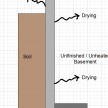
In addition, and likely more serious, is water vapor escaping from the concrete wall and trying to escape to inside the finished room. Concrete looks just like a sponge under a microscope and it holds water just like a sponge. In fact, over the entire life of concrete it holds water. So concrete is ALWAYS letting off water vapor and that water vapor is trying to either dry to the outside or into your finished space. To fully understand this please read our basement insulation vapor barrier article.
What NOT To Do When Insulating A Basement
Under no circumstances should you try either of these methods for insulating basement walls. Both of these are similar, both of these are methods I see all the time, and they ALL end up with mold problems:
- Layer of plastic poly installed over the concrete wall. Next a wall is framed and fiberglass insulation is installed in the stud bays. In some cases this is either kraft faced or another layer of poly is installed. This situation is bad because any water vapor that gets into the stud bays will end up condensing on the surface of the poly (the poly will be as cold as the concrete wall, around 50 degrees F.), the water then causes mold to start growing in the nicely tented space between studs.
- A stud wall is built such that it’s an inch or two away from the concrete. In this case only fiberglass insulation is installed between studs (no plastic on concrete). A vapor barrier is installed, then drywall. This situation is really bad, water vapor from the concrete escapes into the stud cavity and condenses on the back of the vapor barrier behind the drywall. Again, water creates a nasty mold situation in the stud bay.
These are horrible details, no amount of water proofing, concrete sealer, etc is going to make them better. My advice is simple: DO NOT EVER USE those details.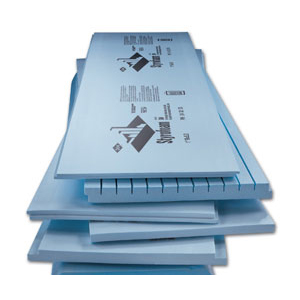
Closed Cell Foam Is The Answer
Whether you spray it in place or install sheets, closed cell foam is the answer for basement insulation. When properly installed, closed cell foam (spray or board) provides two benefits: first and foremost it’s a great insulator with MUCH better R values per inch than fiberglass, and secondly when you use closed cell foam that’s at least 1-1/2 inches thick, it actually acts as a vapor barrier. So essentially you get a vapor barrier and insulation all wrapped into one easy to use product.
DIY Basement Insulation Using Foam Board
The following is a great example of proper DIY basement insulation. If you’d like to see a more detailed article on how to do use this approach you can see that HERE.
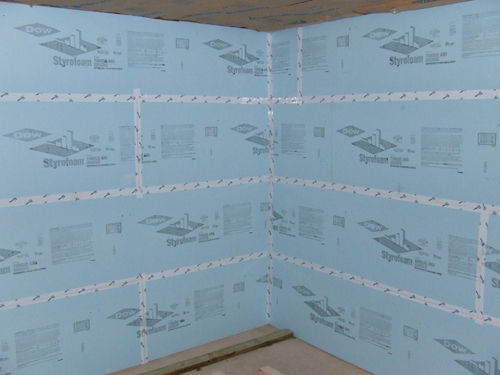
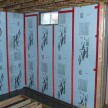
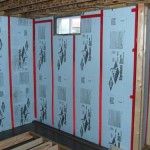
Several years ago I insulated the basement walls in our basement storage room. I installed 1-1/2″ extruded polystyrene foam insulation board by DOW. I used a special Styrofoam adhesive to adhere the foam board to the concrete (you can also use “Great Stuff Pro” foam in a can). The foam board I am used comes with a tongue and grove so installation is pretty easy. Just cut the boards to length, apply some adhesive and press it against the wall. Note, you may need to apply pressure to the foam with boards until the adhesive dries.
If you’d like to see a video of this type of approach check out our DIY Basement Insulation Video.
You’ll notice that I installed the boards horizontally. Since doing this project we’ve been installing them vertically at work and it’s much easier to do! Placing them vertically makes it much easier to keep them from falling down while the adhesive cures.
Seal Insulation Joints
Updated (Oct 2014)
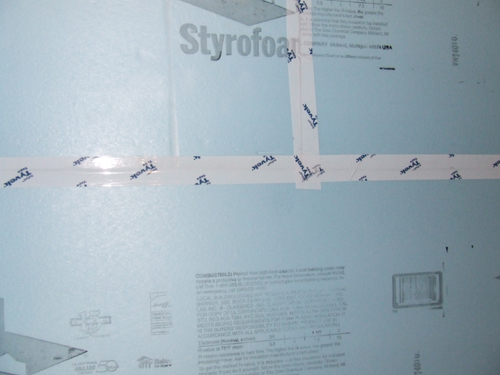
Years ago when I first started using this method there were very few options available for tape products to seal foam board insulation panels. Back then I used Tyvek tape but that product is no longer recommended for use on foam board. Most of the foam board manufacturers now manufacture tapes made specifically for sealing these products. DOW offers the WEATHERMATE™ Construction Tape, and Owens Corning has JointSealR™ Foam Joint Tape. These products are more expensive, but they are specifically designed for this application and very important to the long term performance of the insulation barrier.
Frame Basement Walls
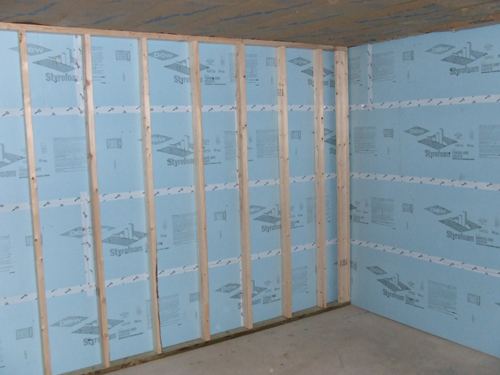
Once all the insulation was in place I started framing up 2×4 walls. I placed the walls directly in front of the foam insulation and then insulated the wall cavities with fiberglass insulation. You’ll need to nail the pressure treated plate of the wall to the concrete with a Trigger Tool Kit, 22 Caliber.
You may be wondering why I used fiberglass insulation after giving it a black eye above. We can use it in this situation because we have an insulated vapor barrier between it and the concrete. By doing the combination of insulation materials I achieved approximately an R values of 16. This was much cheaper than doing it all in foam.
There is also some really great information at the Building Science Corporation.
Insulated Concrete Floors
For this project we didn’t insulate the concrete floors because we have radiant heated slabs. However, if your home doesn’t have radiant heat and you’re looking for information on that topic then we recommend you read How To Insulate A Concrete Floor.









My question is : do you still need foam insulation to grade on the exterior of the basement walls if you insulate as directed on the inside? Thanks so much for your helpful information.
Not necessarily. Many people do. One reason to consider it, because it helps keep water away from the foundation wall. It’s a good first line of defense.
Great advice. I was wondering what to put directly on the concrete walls if drain tile was installed in the interior and dimpleboard was was run about one foot up the basement wall. This would would obviously cause the foam board to be away from the wall or do I just rest it on the dimpleboard? Also, what stops the vapor from traveling up the wall and entering the ceiling joists. Thank you
Ron – You can place the foam directly over the dimple board. The idea is to seal the top with tape and/or spray foam.
When doing the framing for the walls, do I want to insulate the floor first. That way I can get foam board down before I put the 2×4 baseboard down, or do I want that 2×4 to be on the concrete floor.
David
Dave – Either approach will work. Good luck.
If the basement has already been framed, how can we seal the foam boards behind the 2×4 to create the barrier needed.
My recommendation is to move those walls (not as hard as you think) away from the wall so you can insulate correctly.
How do you keep a continuous foam insulation/vapor barrier when you have drains and stacks right against or maybe an inch from the concrete walls? Is it okay to use 2″ foam everywhere and just slip a 1″ piece the width of the pipe tightly behind the pipe and tape it to the 2″ on either side? Or should I just insulate around it and frame around it?
James – You do the best you can! :) Obviously in a remodeling situation it’s nearly impossible to get it perfect. Your solution is spot on. Good luck.
Todd,
The bottom half of my foundation wall is 12″ poured cocrete and continues with an 8″ CMU the rest of the way up, creating a 4″- 5″ ledge on the interior face. I would think using the foam board method would not work as well in this condition. Any ideas.
It will work fine, you just need to step the insulation and seal the joint well. Good luck.
Todd- Great blog! Can I install my 2″ of XPS foam over a painted concrete wall? I am having great difficulty removing the paint (have gotten it down to 1 to 2 layers and bare in some spots) and contractors I’ve called are not interested in helping complete the paint removal task. I am concerned the paint could become a food source for mold behind the XPS foam. Is that a concern or does it not matter if its behind the vapor barrier? Should I add a skim coat of concrete to the existing wall to cover up the paint so it isn’t directly touching the foam? Thanks!!
I wouldn’t worry about the paint, just be sure to remove any loose paint and clean the the surface real well. Good luck.
Hello Todd – I’m finishing my basement and the baseement was comleted with the big silver padding insulation that is nailed to the concrete. What is your recommendation on how to finish the basement walls with this type of insulation already there?
I’m assuming you mean that your basement has some sort of “bagged” fiberglass insulation? If it were my home I’d remove that insulation and use closed cell foam board. In my professional opinion fiberglass insulation has NO place in insulating basement walls.
Good luck.
Hi Todd,
Thank you very much for your write up. In the mechanical room of my basement I currently have a foil backed fiberglass nailed to poured concrete wall (it is not ‘bagged’ so fiberglass is directly against concrete I guess it is something similar to http://www.specjm.com/products/faced/fsk25.asp). I was planning on installing the foam boards as you suggest. My question is, can the foam boards just be left exposed? I have no need/desire to frame in walls in this part of the basement (rest of the basement is finished). I basically just want to get rid of the exposed fiberglass insulation.
Jeff – Technically you should not as it poses a fire hazard. Most building codes specify a minimum flame spread rating for occupied spaces. Check with your local building code official on the requirement, then check the product information on the foam you’re considering. Most do not meet the standard and therefore need some protection.
Hi Todd, Love the articles here. I have a 50’s house with a “finished” basement. The foundation walls have plastered applied directly onto the concrete. I want to frame some of the exterior walls so that I can extend the electrical and drywall nicely around my new windows. Can I apply the closed cell foam directly to the plaster? Many thanks!
Peggy – In some situations plaster can promote mold growth. So there is a slight risk that mold could develop behind the foam if the conditions will support mold growth. Having said that, I think it’s certainly a possible solution. You might want to consider some type of paint that helps prevent mold to at least seal the plaster first. Good luck.
That is terrific advice, I’ll do that. Living in Colorado I don’t worry about mold too much but it is possible. Thanks again!
Hi Todd
I am trying to insulate my basement wall. There is a 4 foot block wall below grade then a 4 foot 2×6 framed wall on top above grade wich creates a 3 1/2″ bench. Can I put blue board on block wall , insulate 2×6 with roxul . Then if I frame a2x4wall 8 foot high and insulate it with roxul for additional r value can or do I have to use poly vapour barrier? I know it sounds confusing. My basic question is can you go block wall, blue board roxul, poly, then drywall, or no poly?
Andy – You can install the foam board over the lower block wall. You can insulate the exterior wall with Roxul, no vapor barrier. Then insulate your new 2×4 wall in front of all that with Roxul and vapor barrier. Good luck.
Hi Todd
Thank you . I was worried about putting poly over the area that has blue board and having two vapour barriers. Again thank you. Great info.
Typically you would have that issue…but that area isn’t completely sealed off because the foam doesn’t go all the way up.
Hi Todd,
My basement is already 2×4 framed about 1.5″ from concrete wall. The previous owners used fiberglass insulation which I have removed. I was able to slip 1″ XPS behind the framing, but can not get them to adhere due to the concrete wall being uneven. Any advice on how to get them to stay in place? As an alternative, can I just attach the XPS to the inside framing and then drywall directly over that?
Thanks
Ed – This is what I would try.Keep the 1″, then install a piece of 1-1/2″ or 2-1/2″ between the studs, foam it in place. This should hold the 1″ in place. You REALLY need to the 1″ to create a vapor barrier. This all needs to be sealed well. Good luck.
Hi Todd
Due to low ceilings, I was going to use 3/4″ XPS foam on the floor. I used 1 1/2″ on the walls – I know it’s not ideal, but is 3/4 ” better than nothing? My ceilings are about 6’9″ so I’m trying to minimize the sub-floor impact on height. Basement gets humid in summer but I have 2 dehumidifiers and a Slim Jim AC/Dehumidifier going most of the time.
Thanks,
Tom
3/4″ on the floor will make a pretty big difference, so yes, better than nothing.
Thanks Todd. Your site is great. I’ve learned a ton reading through these topics. I have one more question, if there are some uneven spots on the floor, what type of shims should I use? I imagine that you would shim under the foam board?
Thanks
Best approach is to use a floor leveling compound so that the transitions are as smooth as possible. Good luck.
Thanks for all the great info. I’m going to be refinishing about 2/3 of my basement and plan on using 1 1/2″ closed cell insulation like you recommend. Do I need to insulate the exterior walls that won’t be part of the finished area? I’m thinking this could lead to a moisture problem in the unfinished part of the basement or at lease an increased humidity level in the basement if these walls are left uninsulated.
Thanks for all your help.
Dave – Not necessarily, but you’ll need to pay close attention to any walls that separate the spaces. The issue will be creating a proper vapor barrier to keep moisture from the unfinished space from getting trapped in the separation wall.
Todd,
Have you checked the compatibility between the Tyvek tape and the XPS foam board? I taped the joints on my XPS boards just like you did with the common transparent red tape. About 9 months later, the joints under the tape were bubbling up, and the tape was lifted up off the XPS board. You may want to go back to a house that was completed 1yr+ ago to see if you have the same issue as I do.
After some research, I found that XPS reacts to the plasticizers in the tape adhesive. I’m guessing the Tyvek brand tape has the same plasticizers in it as well. I’m planning on calling Dow this week to see if they can recommend a tape that will not react with XPS.
The quest for a perfect basement finishing solution is a difficult one!
Mike – I’ve never had any issues. Many times we use the tape that DOW sells (it’s blue).
Todd, what type and/or brands do you recommend for the Styrofoam adhesive for gluing the XPS to the walls? Thanks!
If you go to the hardware store you’ll typically find one or two choices of adhesives that list foam board. The glue is only to help hold up the sheets while you frame the walls, in some situations we don’t even use it.
Mike,your point is a good one. Tyvek themselves now recommends against using their tape on rigid foam board. From what I have read, they recommend against it’s use because the tape is made specifically for Tyvek wrap and does not expand and contract at the same rate as the foam board and over time, it will crinkle and peel off the foam board’s surface.
Most of us that do a rigid install won’t even know if the tape job eventually fails, because as you know, once the rock goes up, it becomes an out-of-sight, out-of-mind situation.
Owens Corning makes an XPS specific seam tape called JointsealR for use with their Foamular product line. It’s a 3.5 inch wide tape that has a waxed paper backing that has to be peeled off before applying. The tape itself is very rubbery in nature and pulls and stretches in all directions fairly easily. The adhesive on the JointsealR tape seems to be a good bit stronger than the glue on the Tyvek tape.
I had originally used the Tyvek tape on a recent 700 square foot basement install because it had been mentioned in a few forum posts online, as well as a few blogs such as this one. After the install, not being 100% happy with the strength of the bond of the Tyvek tape in some areas, I decided to look into the matter. It was at that time I found out that Tyvek didn’t support the use of their tape as a seam tape in rigid foam install situations.
So I personally decided to make a change…
Two days later after I received a few rolls of the JointsealR tape, I easily removed the Tyvek tape from the entire job in about 20 minutes time. It peeled right off with no effort whatsoever. I mean it peeled right off; entire eight foot long strips -top to bottom- with one very easy, few-second pull.
I then installed the Foamular JointsealR tape. Once on the wall, I could not peel the JointsealR off more than an inch at a time. The difference was night and day!
The JointsealR tape costs about 3 to 4 times more than the other tapes commonly used and is hard to kind of hard find. I could only find it at one online insulation product retailer. Those might be a few reasons it is not mentioned or used more often.
Thanks for the update guys. I plan on updating the article accordingly. Lots of things have changed over the last few years with more manufacturers addressing issues like tapes. If you go back about 5 years ago, the only other tape available was one from DOW. Now there are several options.
Todd, when insulating rim joists, do you recommend XPS, Polyiso, any other type? Any advantage of one over the other? Thanks!
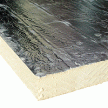
I recommend Polyiso, more Rvalue, and also some radiant benefit. We don’t use it against concrete as the foil face reacts with concrete. Check this out. http://www.homeconstructionimprovement.com/rim-joist-insulation-insulating-options/
And as a follow-up question, does it have to be foil (or something else) faced? Thanks!
Todd, thanks again for your help and guidance!
Before installing the XPS insulation, do you recommend applying hydraulic cement to the base of the wall where it meets the slab? In my case I haven’t seen any water issues but it seems it’s another way moisture or water vapor can get inside. Thanks!
Hector – No need to do that, if there’s a big gap you can seal with foam.
Todd,
Thanks so much for sharing this information. If I have relatively frequent (4 x a year) seepage issues in my basement during heavy rain, is there a step I should follow before installing the foam?
Thanks!
Dave
Dave – With that much “seepage” I’d question whether you should be finishing the basement. I’d first try to solve that problem, better drainage, possible interior drain. Otherwise the foam will likely be hiding trapped moisture that can cause other issues.
Can you please address when you would use 1 1/2 inch XPS versus 2 inch XPS. Both thicknesses are recommended in various articles on the site. Thanks for all of the great information.
Matt both are mentioned for a couple reasons. 1-1/2″ is the minimum thickness recommended to provide a vapor barrier to prevent moisture from the foundation from getting through the foam. Having said that, some publications are now recommending a minimum of 2″. 2″ is also typically more available. Like many things in life, for most people it comes down to money. I hope that helps.
We are insulating a basement wall as you have shown with the blue foam and then a stud wall. Just wondering- if this is airtight that means the maoisture has to escape to the outside? Would this cause the parging to crack on our foundation? Live in northern ontario. Thanks
Terry – Not at all, remember the foundation material (concrete) and most parging materials are cementitious materials. They need water to activate chemically and are not damaged by water.
Should I leave space between the foam board and the frame wall? If so, how much space? I’m trying to maximize space, but if it means taking more space to do it right, than that’s what I will do.
Thanks
Most times we frame tight to the foam.
I have a garden level bathroom with shower. On top of the concrete foundation is the stud framing of the house. Only 2 1/2 inches of foil backed fiberglass was in the walls between the studs with 4+ inches of open air then the drywall. Also, the one inch between the concrete and drywall was not insulated. Can I add 4 inches of foam board behind the batt insulation(between fiberglass and interior drywall) and spray foam the gaps, then also add 1″ foamboard to the concrete foundation, butted up against the drywall?
Dave – I would not recommend that. I’d recommend you remove all the fiberglass, install the foam board first, then you add the fiberglass after. Good luck.
Hi Todd,
I’m dealing with trying to finish 2/3 of my basement. The 1/3 I wasn’t planning on putting anything up on the concrete walls. For the other 2/3 I have framing up already and it is away from the concrete wall but foam insulation wasn’t put in first. On some of the walls i can slip the foam in behind the framing but not on all.
I’m not sure what i should do as it seems impossible to seal up the insulation to be airtight. There’s going to be airflow between studs and from a closet that opens into the unfinished space and due to an open ceiling in another part and various other reasons. I could go crazy with spray foam but still pretty sure i couldn’t have a real vapor barrier. Should I just get the foam board up where I can, seal up what i can, and otherwise be ok with air movement? I run dehumidifiers during the summer to keep moisture levels low.
Thanks for any help.
Jon – Your situation is very common. Unfortunately the best advice I can give you is to take a step back, move the walls in order to properly install foam, then slide them back in place. This may seem really difficult, but with some help it’s not all that hard. Other than that I’d not feel comfortable recommending anything else as I see too many mold/mildew problems. Good luck.
Hi Todd,
Thank you for this extremely helpful thread! I am about to finish my basement using 2″ XPS polystyrene foam on the foundation walls. I have existing “bagged” pink fibreglass insulation directly on the concrete now that I will be removing. I will be building a 2×4 wall in front of the foam. I live in southern Ontario and our building code now asks for an R-20 on basement walls so I was planning to insulate the stud wall make up the extra R-value. My question is, can I use the pink fibreglass insulation that I removed (R-12 value) between the studs? This will give me the R-value I need. It is 4′ wide so I can cut it into 3 16″ strips. This will save me a bunch of money for new fibreglass insulation. I also plan on drywalling the wall without an additional vapour barrier as I have read earlier. Am I on the right track? Thanks for any advice!
Adam – Sounds like a good plan as long as the old fiberglass is dry and clear of any mold/mildew. Best of luck.
Todd
Can I install 1-1/2″ of xps on my poured concrete wall, frame the wall with 3-1/2 metal studs, then add additional insulation in between the studs to get an “R” value of at least R10 per code. This room is a bath with a shower.
The problem I ran into If I use 2″ xps, is my toilet drain
is to close to the wall by 1/2″. I end up with 11-1/2″ to C/L instead of the 12″ required.
I was thinking of adding 1/2″ if xps between the studs on this wall, or would faced or nonfaced fiberglass insulation be better?
WOULD this be acceptable? The insulation would end up laying in the lower track.
I also need to run an 1-1/2 ” pvc drain line running through these wall studs for my sink drain.
What Are your thoughts.
Fred – That will work fine. Also, many times you can get a close rough-in toilet that would buy you another inch or so. Either approach will work fine.
I have a rental property that was built in 1935 with a dirt floor basement (that’s how they did it back in the day). I would like to insulate it and will be using the blue boards you mentioned. The foundation is not a concrete wall (typical old foundation type) so it is not exactly smooth and I am wondering if applying the glue to the board would be effective or if I should be taking a different approach?
Mark – Foam board is really hard to use on an old stone foundation. Typically spray foam is the best approach when dealing with an old foundation like that. Glue simply won’t hold it in place. Good luck.
Aye, that’s the challenge with an old basement like that. Two questions, does foam boards have to be snug against the wall to be effective (glued or otherwise) or if there’s a gap here and there behind the foam board, does that make it ineffective?
They do not need to be tight to the foundation.
Todd
Great site. I’m going to put the foam boards up but will get to the point where my breaker box is mounted to a sheet of OSB which is mounted to the concrete wall. How should I insulate that? Spray behind and around it?
Thanks
Nick – Two options really, either just butt up to the board with your insulation or have the panel detached from the board and insulate behind it. Good luck.
Todd
Is there any issues screwing 1/2″ gypson drywall directly to 12″ engineered beams. Will the screw holes affect the integrity of the 12″ beams? Do I need to use adhesive?
Fred
Not at all. Those beams are designed to have fasteners attached to them. Good luck.
I’m finally getting around to finishing an office in the basement. I have the XPS up. Two hopefully quick questions. Can I use foil tape on the joints? When I insulate between the framing, do I use fiberglass without the paper on one side?
I really appreciate your site. It’s been a great source of information.
Nick – Foam tape most likely won’t stick long term. It’s best to use tape specifically made for that foam, if you’re using DOW then they make a tape. Similarly if you’re using OC, they likely have a recommended tape. Fiberglass without the paper, or if you use paper faced, cut holes in the paper. Good luck.
Hello-do I need to apply any kind of concrete sealer to the walls before putting up the insulation board? Thanks!
Not in my opinion.
Hi, I am finishing a basement room and have to insulate and drywall a concrete foundation wall. I only have 1 1/4″ space due to the door placement which cannot be moved. How should I do this?
Without knowing the specifics I’ll throw out a few things to consider: Smaller door? Transition framing so you’ve only got a small area with foam less than the minimum suggested thickness.
Hi Todd,
I have a situation similar to Andy above where its a poured concrete wall below grade and a 2×6 framed wall above grade, creating an interior ‘concrete shelf’ since the 2×6 wall is flush to exterior. The 2×6 walls are very air-leaky, having just the framing and then the external sheathing, with unfaced fiberglass batt in stud cavities. There is no house wrap. I had looked into caulking and sealing the stud cavities then doing a ‘cut and cobble’ in between the studs to take care of the air infiltration. But I am left with two questions: 1- Is this the best approach for handling the air leakage of the above grade framed wall? Would I be ahead to look into spray foam in these cavities? 2-I did not follow the transition/layering between the framed upper wall, roxul, and then vapor barrier. Can you explain that further? I also have not found Roxul locally [Kansas City]; would unfaced fiberglass work? Thanks in advance.
Daric – Check this out first, this is probably your best bet.
http://www.homeconstructionimprovement.com/walk-basement-wall-insulation/
Hi, Todd,
First and foremost, your articles have been a huge help, so thank you! I am looking to finish my basement and have precast concrete walls with a brick type mold. I was planning on using the closed cell rigid foam board you recommend above. I had a contractor come over just to give a bid and hear what they planned to do. He said, no to the rigid foam board. He said, he would hang .004 mil clear visqueen, then stud, then insulate with unfaced denim insulation? This seems like a lot more money and am concerned the visqueen will lock moisture. What are your thoughts. I live in Illinois where summers are hot and humid and winters are damn cold. Thanks for the help!
josh – your contractor doesn’t understand basements! Any moisture that gets past the wallboard, into the stud cavity will hit the visqueen (which is 50 degrees, same as concrete surface) and condensate resulting in water soaked insulation. Find another contractor that understands the unique issues of a basement.
Good luck.
I have a basement with solid concrete walls. In front of the basement is a crawl space that slopes from about 4 feet to 10 feet in depth.
The crawl space is now vented with plastic covering the dirt.
It produces an odor that permeates the entire basement.
I am wondering if I should covering the floor again and the walls with the 6 mil mylar, seal off the vents, and insulate the ceiling above the crawl space with fiberglass insulation with paper barrier facing down into the crawl space ? I would like to do this myself, but the space is large. A French drain was installed in the front of the crawl space. It didn’t help much.
What is proper way to fix the odor problem ?
Thanks
Craig – Without seeing the site it’s hard for me to completely understand the issues. I assume that crawl space has a dirt floor? Is it now “not sealed”? Was it sealed before with no odor? What is the odor?
Todd,
Thanks for your reply. The floor of the crawlspace is dirt. There is a plastic sheet on the dirt but it does not go up the side of the walls. It has always had and odor-even after installing the plastic. The odor is a moldy smell. I thought the odor would be solved when I had a French drain put in the front of the house. The French drain solve the problem of water puddling at the foot of some of the walls. But it still smells. I am thinking of putting a new sheet of plastic on the dirt that extends up the walls, closing the vents, and installing insulation in between the joists in the ceiling. I hope this insulation does not get moldy. None of the joists have mold on them. Would fiberglass insulation with the paper barrier out toward the crawl space work ?
Thanks.
Craig – My best advice is reading the following article. It really covers your situation and gives you a ton of information. http://buildingscience.com/documents/information-sheets/crawlspace-insulation
Best of luck.
Todd –
We just had a cabin built in northern Wisconsin and we were wondering how to finish the walls. Your article was spot on. Thank you. Just one quick question: we will be putting a wood burning stove in the basement for help with heating. The basement is poured walls and there was a niche behind where the stove will go. Do you recommend putting the insulation and framing the walls as in the article, but putting a different non-flammable finish up or do you have other recommendations? Looking forward to hearing from you.
Great question! You still want to insulate the wall, the question is with what? If this were my home, I’d install foam board insulation, then fill the stud cavity with Roxul insulation. Roxul is used around heat sources and it will protect the framing and foam board. Then you’ll still need to cover all that with an appropriate wall covering suitable for a fireplace surround.
You should also know that I live in Arkansas. We have high humidity particularly in the summer.
Todd,
Thanks for the link to the article. It is going to be very difficult to condition the air in the crawl space as part of the house. I will probably have to seal up the vents and forget the insulation in the sealing.
Thanks for all of your help and information. I am really surprised at how little home building contractors and local inspectors know about how to deal with a crawl space. As my builder did a poor job of dealing with the situation when he built the house.
Thanks again,
Craig
Hi Todd,
We had our house completely remodeled 3 years ago and dug out an additional 20 of basement space. We now want to finish the basement. I planned on leaving the fiberglass insulation up from the builder and having our contractor frame against it.
That seems incorrect. Can you please confirm I need to remove the insulation and put up foam board?
My next question is regarding the old basement walls. Do I need to put foam board against these walls as well?
Thanks for your help, this is a great site!
Len,
I would never leave fiberglass in my own home or one of my clients. I’d remove it and use some type of closed cell foam (XPS foam board or closed cell spray foam). I would do the same exact thing in the old side as well.
Best of luck. Todd
Thanks Todd. I’m learning as I go in terms of prep with this basement project. How do I know what R value xps board is appropriate? Is there a formula?
Also, do you recommend using something like great stuff at the top of the foam board where it meets the ceiling?
Thank you.
At a minimum you need 1-1/2″, I prefer 2″, then fill the stud cavity with additional insulation to get the R value required for your area. You need to seal the top edge with some sort of can foam.
Sorry Todd, a few more questions:
Do I need to put any type of vapor barrier against the wall before applying the foam board? It doesn’t appear so but want to confirm.
Do you recommend adding insulation to the basement ceiling in addition to the foam board?
Any tips for a newbie prepping a bare basement to be finished?!
Thank you very much!
No additional vapor barrier, that’s why it’s so important to use at least 1-1/2″ of xps foam, 2″ is preferred. I always insulate the basement ceiling for both sound and insulation value.
Thanks Todd. I forgot to ask about the bathroom. We will be redoing the bath as part of the basement project. The demo is complete. Should the walls be insulated with the same xps as the rest of the basement? What about behind the shower?
Thank you.
Todd,
Do you use anything different from the xps board to insulate walls in a basement bathroom ?
Thank you.
No sir. Same product throughout. Good luck.
Hi Todd,
I just realized that the old bathroom walls are painted cinder block. I noticed above another poster has what I think is a similar issue where the glue won’t stick to that because it’s not smooth. Is that correct? You had said to use a spray foam. The only spray foam I’m familiar with is the great stuff style. Is there another spray foam for this purpose?
Thanks!!
Lennie
Great stuff will work, but gluing is not really necessary if you’ve got framing in front of it to hold it in place.
Hi Todd,
We had a leak in our basement last year due to a crack in the wall. It was patched inside and out but they left a white plastic sheet glued to the interior wall. Should I take that off prior to xps installation or put the board over it?
Also, I saw on another site that they put waterproof paint on the wall prior to xps. is that necessary or just another step for peace of mind?
Thanks!
Len – No such thing as water proof paint :) More of a damp proofing. It’s a belt and suspenders approach, can’t hurt, but certainly won’t stop water through a crack. I’d leave the plastic.
Thanks for your replies Todd, they’re much appreciated! I shouldn’t have said waterproof, I’m an amateur! I’m questioning if the time and cost are worth it for this paint.
I’d like to get your thoughts on the bathroom. There are a bunch of pipes etc on the walls so getting xps behind them will be a challenge. Can I use the “waterproof ” paint for this area with any benefit?
Thank you again.
Len – The paint can’t hurt. But ultimately it won’t stop the biggest issue. The concrete surface needs to be insulated in combination with a vapor barrier. If you apply paint only (assuming it will completely stop water vapor, which I have my doubts), then any warm, moist air on the inside that contacts that cool (50 degree) concrete surface will likely condense, and get trapped in the wall. It’s really complicated thermodynamics, but the solution really relies on insulating the foundation wall with a closed cell foam. Good luck.
Hi Todd,
Since the old bath is cinderblock, it’s not a smooth surface. I ended up buying the 2×2 2″ foam panels but they can’t go on the wall flush due to the uneven surface of the cinderblock. Do you recommend I do the best I can with the boards and tape the joints or is there another option?
Thank you for all your help!
My basement is already framed. Had water mostly from a sump that didn’t work; apparently inspectors don’t bother to check if it works, just if it’s there. I sprayed the concrete with a deep penetrating sealer and plan to put in an epoxy floor. How can I install the foam insulation without removing all the wood studs? I don’t have a lot of money or help so I need to try to keep it simple. The basement was completely finished. I’ve had to rip out the carpeting, which was completely glued to the floor and removed all the drywall and fiberglass insulation that was used against the exterior walls – wet and blackened with mold. Can I use the canned foam spray behind the studs, between the foam board?
The best approach is moving those walls out so foam can be installed behind them. Will your approach work? Many people try it..and it’s far better than what you had.
I was reading about radiant barrier for attics. what about putting a radiant barrier against the concrete? That would easily slip behind the studs then I could put the insulation boards between the studs.
That just creates a surface that will promote condensation. You really need insulation against the foundation.
Hi Todd,
I ended up buying the 2×2 foam squares for the bath. The problem is since its cinder block, the surface is uneven so the panels don’t match evenly. What do you suggest?
Thanks for all your advice!
It doesn’t matter so long as you seal them well. What type of foam is it? I wasn’t aware that XPS foam was sold in 2×2 panels.
Hi Todd,
The brand is Owens Corning. They’re 2×2 and 2″ thick. They aren’t tongue and groove but much easier to fit in the car! I’ll do my best to seal them well.
Thanks for your reply.
Studs were installed very close to the cement walls in my basement. It is going to be difficult to get insulation board behind the 2x4s. Will mold be a problem if I don’t put any insulation at all behind the drywall ? If so what do you suggest to insulate the walls ?
Craig – The lack of insulation reduces the likelihood of mold, but it doesn’t eliminate the problem. I would avoid drywall. Spray foam is a better option.
Hi,
For the Fiberglass, how did you do it, the article doesn’t state?
I am thinking of doing the above and then using unfaced fiberglass. Should I then put a plastic vapor barrier over that before drywalling?
My basement is a little different in that it is fully exposed. It also has its own zone/thermostat. The exposed wall was already insulated/drywalled by builder, likely just unfaced with vapor barrier. The sides are concrete, but if you split wall into two big triangles the top trianagle is fully above grade while the bottom triangle would be below grade. The concrete wall facing the front of the house would be completely below grade. I’m positive the exterior already has foam board on it. Not sure if doing the above is overkill or what…
Thank you!
Justin
No vapor barrier.
Todd,
I read your article on insulating the basement. I understand the foam board goes right against the cement blocks (wall) and is taped to keep the moisture where it belongs. How do you know this method absolutely does not create any mold behind the foam? Have you looked behind the walls years later to see if any mold developed? I want to remodel my basement, have 2 X 2’s installed with plastic on the interior of the walls. In other words, if I install drywall, it will be against the plastic. Can I proceed with installing the drywall? Will I mold issues? Thanks! Doris
Doris – This method works great, no mold issues as theres no food for the mold.
Your method will not work, plastic will be cold (around 50 deg F, same as concrete), any moisture in the stud bay will hit that, condensate, and start the mold process).
I have a above-floor water channel (baseboard style) running along the wall base to sump (about 4″) and my stud wall will have a 1″ air gap between XPS and interior studs. Do I just run the XPS from the top the channel to ceiling..do I need to seal off the bottom with the interior studs with insulation somehow (sort of like the rim joists?) Also, do you need the seal the air gap between XPS and framing somehow around windows and egress door or is drywall sufficient?
I would not seal the bottom in your situation. The air space doesn’t need to be sealed, you want to maintain air movement.
Hello, I am converting a school bus into an RV and am planning to use closed cell foam board much like you do for basements. The problem with trying to make a house out of a large metal box is in condensation caused by heating and cooling. (Picture the condensation that builds up on the windows of your car. I am taking extra steps to ensure there are no leaks where water can get in but I am still worried about moisture from condensation. I can do the floor and then build a wood frame on top of the foam for the floor but my question is related to the walls and the ceiling. In a bus there are ribs every 2 feet with fiberglass insulation between them and a thin sheet of sheet metal over the top. I don’t want to bring the insulation beyond the edge of the ribs so will cut the board to fit between them but that leaves the ribs to form condensation .. can I tape over the ribs and call it a day or what do you recommend for them? I plan to either reattach the sheet metal or use pallet boards to cover the walls and ceiling after I insulate… I would attach the boards to the ribs with screws the same way the current lining is attached. Also do you recommend some other moisture barrier between either the metal shell and the board or between the board and the inner skin?
If you don’t insulate the ribs they will certainly be a cold spot that could promote condensation. Ideally you’d insulate over everything with a continuous layer.
Thanks for that …even though it wasn’t the answer I was looking for .. because it means losing head room in the bus. If I did say lay 1/2 inch foam board over the ribs .. is it OK to leave the open gaps between the foam board and the roof? Then attach the ceiling material on top of the foam board?
Honestly, 1/2″ foam isn’t much R value and may not help much. If it were mine, I guess I’d install foam between the ribs, then a continuous layer as thick as you can live with over all the other foam and ribs.
Hi Todd
I have a 1912 double brick home (12″ thick)and wish to install a bathroom with a shower in the basement.
How do I insulate with ridged foam board when I read that double brick walls need special care because the brick stay cold and the humidity behind the ridged board can freeze and thawing and can damage the brick.
Without knowing what the masonry detail is like it’s hard to say. You say 12″, but do you know for sure how thick each course is and what the air space is like? drainage? weeping holes? etc?
Todd
I currently have a “finished” basement with painted block walls. The floor is carpet, no pad. The interior walls are studded and drywall. And it already has a drop ceiling.
I want spruce it up a bit by adding bar n bathroom, pad under the carpet etc.(man cave)
I do construction for a living and want another opinion.
The block walls seem to continuously draw moisture slowly over time causing bubbles behind the paint. Every 5 years or so we grind it off and paint it again with a “better” paint product.
It don’t work.
So is it wrong to put foam right against the walls then stud against them
Seems to me that will just hide the problem not fix them. (Where is the moisture going to go?) There is a perimeter drain tile around the outside as well.
I have thought about tapcon treated 2×2 to the blockwall and green drywall ?
I want to fix it right and not have a mold problem behind my walls!
What do you think?
Brad – Great question! What most people don’t understand is that when you look at concrete under a microscope it looks like a sponge. Millions of tiny pores that contain water…forever! It never really dries out. Those pores lose water and absorb water constantly. Having said that, I don’t believe you need to remove the paint, I would put foam over it, make sure it’s sealed well and then stud the wall. The paint won’t promote mold growth, without food for the mold it won’t grow.
Best of luck!
Hi Todd, I’m currently remodeling a basement bedroom. I live in N.E. Ohio.
The previous walls were done in this order:
1.Plastic sheeting against block.
2. 1 1/2″ Firring strips every 16″
3. 1 1/2″ xps fitted between Firring.(nothing sealed)
It has been that way for 8 years with no sign of mold/mdew or moisture behind plastic.
My question is can I leave that wall and frame a new wall in front of it and use batt insulation to increase r value.
Or do I need to tear down and glue xps directly to blick wall than frame.
Thanks, josh
Josh – Your situation is certainly better than most I see/hear about that put fiberglass against the poly. It’s hard to say if your situation will stay that way or change over time. If it were my house….I’d either tear it out and start over, or, at the very least, install continuous foam over what’s there, then frame a wall in front of that.
Best of luck!
Hello Todd:
I am currently remodeling and stripping my basement down to bare block walls. I was wondering if PolyShield EPS foam board would be appropriate to use directly against the block. I am concerned that the outer layer of foil/plastic on this type of foam board may trap excessive moisture in comparison to the “blue board” (higher density) foam. What are your thoughts on this? Any insight would be appreciated. Thank you!
–Will
No worries on my end. I would however make sure it’s suitable for direct contact with concrete (some foils corrode). Good luck.
Be cautious about putting nails into the concrete slab. In older homes the slabs maybe only 2-3 inches thick (maybe even less). When a nail is shot into the tread plate it can create a path for pressurized ground water (located under the slab) to escape into the room (the room is at a lower pressure). Water will flow from high pressure to low pressure flooding the basement. In older homes and areas prone to basement flooding use an adhesive such at liquid nails to secure the pressure treated tread plate to the concrete slab.
hi
After I use the foam board against the basement walls should I use faced or Un-faced insulation between the studs?
thanks
Unfaced….if you use faced be sure to cut holes in the paper.
Todd, I’ve relied heavily on your articles for a job in my walkout basement. I just applied 2″ XPS to the concrete walls in a single basement room that we are finishing. This room also has a half-framed exterior wall. I’ve now got framed 2×4 walls up against the concrete/XPS walls, and I’m ready for the next step, hoping you can offer advice.
My big problem is cold sheathing and resulting mold on the OSB on my framed basement exterior walls. Originally the house had batts covered with clear poly on the framed exterior walls. Since I heat with wood, I initially thought I should humidify the house with the furnace fan and attached humidifier – huge mistake. This made the basement especially moist, and before I realized it, I had mold from cold sheathing. I subsequently removed all batts and bleached the walls, and replaced with new batts before I knew better not to use FG in the basement. This seemed to work at first: no mold smell. However, the mold has returned now some years later (I can smell it), even though I no longer humidify, and instead run a dehumidifier. We’ve never had any leaks at all in the basement, even during a time of flooding, so I’m quite confident this is a cold sheathing issue.
I absolutely hate the fact that I can smell mold down there and want to solve the issue once and for all, especially since I am about to put drywall up in the one finished room. We have 2×6 walls, and I want to reinsulate the entire basement. Based upon your articles, I have three options for insulating my OSB.
1) XPS in stud bays and on the rim joist, probably followed by another 2” of EPS for good measure to get me to about R18 or so,
2) 6” open cell spray foam at about $1650, or
3) 2-3” closed cell spray foam at $2700.
Cost is a major concern, but solving my mold issue is absolutely the primary concern, more than cost. Open cell SPF requires wiring the entire basement first, since stud bays will be full of foam. Closed cell allows me to only wire the one room I’m finishing and wire the rest later. I realize I need to cover up the spray foam for fire safety.
The insulation contractor seems knowledgeable and thinks 6” of open cell will bring the interior side of the wall temp above the dew point, eliminating the cold sheathing issue. I am concerned about that really, and concerned about the additional up front cost to wire everything (getting a quote tomorrow) that using open cell requires.
2” XPS + 2” EPS material cost is a little over $1/sq ft, whereas closed cell I think comes to about $3/sq ft. The former requires me to supply the labor, however. I am also concerned that the XPS/EPS route may not perfectly seal everything up, especially in the rim joist, which has some hard to access sections.
Based upon my high level of paranoia about the mold returning, which option do you recommend? Long term, option 2 will be less money, but requires potentially more up front cost, forcing me to rough in wiring everywhere. If money were not an option I would without a doubt do closed cell SPF. However I’m having a hard time deciding to just spend the money and get the peace of mind I want, though that (closed-cell) is what I am leaning toward.
A side note. Before reinsulating, I will spray Concrobium on the wood to remove and prevent mold. However since I used bleach previously for mold, the use of Concrobium requires that I first wash the wood with warm soapy water to remove the layer of carbon that bleach leaves behind, which prevents Concrobium from working – according to Concrobium’s FAQs.
Thanks for your help!
Rob – It’s amazing how many basements have this issue so don’t feel bad. If it were my home I would NEVER use open cell foam. If you get any leak at all it will be a sponge and you’ll have mold like you can’t even imagine. So I’d stick with the foam board or spray foam. Closed cell spray foam will give you the best results and peace of mind. Good luck.
S it possible to leave blue board up off the floor some and shim it out from wall like 1/4 inch with pressure treated ply strips?..very minimal water and no money at this point in renovation to dig up outside an seal cinder block walls..any condensation, water infiltration would then still be able to drain off wall and into sump?
Hello, I am planning on finishing my basement as you stated. My only question is should I use faced or unfaced fiberglass batts in the studs? Thanks
Unfaced is preferred.
Thanks Todd for all of this info…knowledge is power. Here’s my situation. We currently have an unfinished basement (90% which is below grade…only portion above grade is a foot and a half around entirety of house). The ceiling of the basement is insulated with unfaced fiberglass batts 10-12 inches thick…installed between the joists) and there is no insulation on the walls. We have had a mice problem (building nests in the insulation, etc.) so want to remove that and hopefully provide fewer places for the pests to make their homes. Also the insulation has a funny smell (house was built in 2011 and builder says it was the newest things at the time and that the smell would go away…it hasn’t). Have done some reading that it’s superior to insulate the walls of basement (with foam board anyway vs ceiling. Your thoughts? And what thickness at walls? Also if just insulating rim joists, what thickness board there?
Also if down the road, there is a leak in a basement wall how easy are the foam boards to remove if they are applied with adhesive?
Thanks for your help.
Mala – Insulating the walls is certainly a better option. Here are some things you’ll need to consider.
– If you install foam on the walls, most local building codes require it to be covered to protect against fire. This is usually done with drywall.
– Insulating the rim is good regardless of if you do the floor or walls. I like to use at least 2″ foam, plus fiberglass.
– Removing the foam isn’t that bad, ideally you take steps to prevent leaks; gutters, proper grading, etc.
Good luck.
Thanks for the generous sharing of your expertise, Todd.
I’m gutting our previously finished basement in Montreal because of moisture damage under the plywood subfloor. It turns out the slab is broken and must be removed and repoured. Contractor will put a layer of 3/4″ stone, 2″ Styro insulation and vapor barrier below the slab, install interior perimeter drain below slab (beside footing), and link to sump pump. We are considering hydronic radiant heating in the slab too.
My question is about the foundation walls. Contractor recommends installing Delta MS membrane, which I believe will drain to footing if we have leaks. But I see that you warn against vapor barriers directly against the concrete–what about the Delta membrane in this situation?
Excellent blog–thanks again!
Matthew – The Delta membrane is fine….it’s a problem when you put a vapor barrier over the insulation. I’d do it as well. Good luck.
Hi Todd, do you HAVE to put that second insulation in between the studs
Depends on what R value you need for your local code.
Hi Todd, remodeling older home basement with poured, block , and limestone walls. Putting in drain tile and sump. Installing vapor on wall as part of drain tile. When I put up walls is it ok to use spray foam over vapor barrier? Walls are not smooth so you mentioned in other posts it’s not good to use foam board.
Jason – It’s best to coordinate the spray foam installer with the vapor barrier manufacturer, they should be able to determine if the products are compatible.
So the previous owner of my home had the basement framed with intentions of finishing it. He had a tyvek barrier put on the concrete, then had stud bays filled with open faced insulation, and then a layer of plastic stapled as a moisture barrier to the interior. Fast forward 10 years and the batts have become pretty moldy(it’s been that way for a while).
The problem is the framing is snug against the wall, so I cannot install continuous foam like xps. I want to go ahead and finish the basement, but I really don’t want to tear out all of the framing and start over. Should I cut the hard foam to fit the bays and then try and seal it against the studs? Or am I just stuck using unfaced batts and then installing drywall?
Apperantly he had an issue with water, but that has been corrected, so the basement stays relatively dry now.
Jason – Ouch! That sounds like a real recipe for mold!
– It may sound horrible…but you can “move” the walls away from the foundation. You’d need to free the top and bottom (likely nailed to the concrete and framing above – cut the wall free), then slide the wall away from the foundation. Then you’d be able to slide insulation behind it.
– Insulating just the stud bays doesn’t create a continuous barrier which is really important.
Good luck.
Great site. After reading all of the information on your site, I feel like I may have made a big mistake and spent money I didn’t need to! We have a basement with CMU walls (built in the 50’s) and when we moved into the house the basement was finished and there was a working sump system. Well, it turns out that the previous homeowner applied some sort of colored sealer on the CMU, nailed studs directly to the CMU and installed bat insulation in between the studs. Water seeped through the CMU wall over a period of years and we were faced with a major mold issue. We just completed remediation of the mold, revisions to the exterior grading and downspouts to shed water away from the house, and updating of the sump system. Updating the sump system included the installation of a vapor barrier (poly) adhered directly to the CMU wall that tucks behind the perimeter miradrain – the theory being that any future water seepage through the CMU would be directed down into the miradrain and into the sump system. We plan to re-finish our basement again, and after reading this site, it appears that installing a stud wall with bat insulation in front of the poly vapor barrier is a bad idea. Should I install an XPS foam board over top of the poly vapor barrier with all joints sealed before framing my walls, or should I remove the poly first? Is it okay to adhere the foam board directly to the vapor barrier material, or will the adhesive damage the poly vapor barrier and render it worthless?
Dave – Luckily for you, you still have time to do this correctly. Leaving the poly isn’t an issue, but you’ll want to be be careful not to damage it. In many situations, if you cut the foam to fit tight between the slab and framing above you can install it without any adhesive. Then you tape the seams and frame the wall which will keep the foam from moving. Good luck!
I have 9 foot ceilings in the basement and I do not plan on insulating the ceiling(floor joists). What do you suggest as far as sealing the foam board at the top after I cut pieces and add them to cover the entire wall? It says to seal the top, but what is it I want to seal it to?
You need to seal the top of the concrete wall, between the sill plate and foam on the vertical face.
Great info.
I am framing my basement, from threads foam board sounds as the best deal. My question is, can use foam board on the walls and use fiberglass then drywall on the ceiling? foam on ceiling is out of my budget
Thanks
Sure can. Good luck.
Hi Todd- thanks for posting all this great information. I have a question. We are going to finish our basement. We have radiant floor heat in the slab. I’m terrified of hitting the heat tubing when we attach the PT plate of the walls to the floor. Is the Trigger tool kit ok to use in this application? How do I know I won’t hit the heat tubes?
Julie- When dealing with radiant heat it depends on the situation. For homes that we build and I have a comfort level on the depth of tubing we’ll use glue and short nails to hold it until the glue sets. On houses we have no knowledge, we try to do it with just construction adhesive. Most radiant tubes are down low in the slab, but on occasion they can lift during the concrete pour.
I few years ago I removed all the carpet on my main floor. In doing that, I could clearly hear the furnace, etc because the carpet ‘sound proofing” was removed. I then put rolled fiberglass insulation between the floor joints in the basement. I’m thinking at some point to refinish my basement and am wondering if I could leave this insulation there before I have a dropped ceiling installed, or if I should remove it. (it really helps as a sound barrier). Also, It was nice to see that the insulation (1.5 inch form board that I have been using is correct).
I think you can leave the fiberglass for sure.
thanks for getting back to me.
clarification- the 1.5 form board is what I have been using to insulate my walls
Hi Todd,
We had our crawl dug down to give us a nine foot ceiling room for an extra living space. Unfortunately, I did not know the contractor was going to leave about a half to three quarter inch space between base of foundation wall and now floating floor. Basically, I want to finish off room to hide this unsightly space. We also have a cement ledge about 30 inches high where the original floor was. I was thinking of finishing off the bottom half wall with a corrugated metal roofing sheet. Trying to keep it simple so do you recommend still framing out or can it be attached to the existing cement? Also what are your thoughts on insulation and wood trim at the base? Thinking of leaving the exposed painted cement wall on the top half unless you have other ideas??????
Thanks for the great information you provide. I liked the insulation detail you recommend for insulating basement foundation walls. Question: Do I have to provide the foam boards on the inside of the foundation wall (concrete) if there is a 2″ panel on the outside side already? Thanks in advance.
The outside panels won’t help with moisture, so yes, the inside is critical.
OK – Does the concrete surface need to be painted before installing the foam board? What kind of paint?
It does not. Some people choose to use a water barrier on the concrete, but it’s not necessary.
Todd, Great information for those of us trying to understand all the factors in finishing a basement. I’m wondering what the best way to insulate the space between the top portion of the foam board (the section that rises past the top of the cement wall and reaches the floor joist) and the rim joist. it’s about 9″ of open space from the back of the foam board to the rim joist and is 12″ high from the top of the cement wall to the subfloor in between the floor joists. Thanks for your help.
I’d use foam board for that area as well.
Todd, Thank you for the valuable information you provide.
We have a 1935 home that has no insulation in the walls, and want to insulate from the inside using foam board such as Rmax, then use tongue and groove pine for walls.
Would it be OK to use the same method as you illustrated for the basement walls?
Can we attache the foam boards to the drywall,furring strips then the tongue and groove with a 1/2″ air gap in between?
I’ve never done it, but if there’s no insulation in the walls, then it should work fine.
Thank you Sir.
Todd, thanks in advance for any advice….I’m remodeling my basement that I did 20 years ago…on the garden level side I have 4 ft concrete, then studded up another 3 ft…7 ft total. the studded portion 2×4 with fiberglass insulation and vapor barior furred out to meet 3/4 inch fur strips on the concrete walls then drywall. I would like to just add 2 inch of foam board to the drywall and build another studded wall up to it with out removing the old drywall…any thoughts?
It’s likely that old drywall will be food for mold…i’d tear it out.
Lots of good info: How do I deal with hot water heating pipe on floor against poured concrete outside wall in basement, Is it ok to set 2″ foam on pipe up to floor joist.
Thanks for your help
Alan
The foam is fine against a hot water pipe.
Question about dead air space. I have a 12 course concrete block wall that is drylok’d with varying levels above/below grade (sloping yard). I am planning on using recycled (upcycled?) 1″ polyISO sheets in two layers (2″ overall) and since my wall isn’t perfectly flat (like a poured wall would typically be) I was planning on offsetting it from the wall by about 1/2″ using cut down furring strips or ripped 2×4 strips anchored to the wall and the foam glued/affixed to the strips. I was planning on having the “spacers” (between the foam and wall) be OPEN at the bottom so if the wall was to ever leak (super wet season, or high hydraulic pressure into the wall from the outside) that the condensation had someplace to go. I figured the dead space couldn’t hurt and allowed for any spurious water to escape before it could feed/form mold between the wall and panel. Right now the unheated basement is showing condensation on the parts of the wall above grade when the outside temp gets near 0 degF. Thoughts?
It’s an ok plan…typically we avoid polyiso in basements as it’s not great if it gets wet. The preferred product in a basement is closed cell foam board.
Todd,
Thanks for all the great professional info and suggestions. My foundation walls are poured concrete which have 5″ ibeams braced vertically on the inside to keep the walls from moving in. I would like to frame the walls to cover the ibeams, so my 2×4 wall would be built maybe 6″ away from the foundation. In this case what is the best way to foam the foundation walls? FYI, I will have an unfinished painted ceiling.
I would likely install the foam directly to the foundation, and around the beams, then frame. This means you’ll have to secure the foam to the foundation, furring strips is the easiest. Good luck.
Was wondering how to insulate around water main. comes in at base of wall ( center of wall) and up to basement ceiling only about an 1″ off block. will this cause a vapor or mold problem
I’d spray foam behind it (can foam), then but the foam up to it tight on both sides. Good luck.
Can .5″ or 1″ poly foam be used verses the 1.5″ on the exterior walls and then 1.5″ used in the 2″x 2″stud walls. Trying to maximum interior space in the basement
It won’t provide the necessary vapor barrier unfortunately.
Hi Todd,
I was wondering would it do any good to apply concrete sealer first on the concrete before doing this method?
It can’t hurt….but it’s not 100% necessary
Hi Todd, thanks for the article. But I have a question..
Would it be any good to first apply concrete sealer on the walls before doing this?
Can’t hurt
Hi Todd. I plan to finish both the basement and the garage. Three basement walls are currently bare concrete. Two and 3/4 of these are below grade. Three garage walls are bare concrete as well with 1 wall finished inside and out shared with the basement for the 4th wall of each. The basement gets heated and cooled from the central unit but there is no heat or cool to the garage. I have read the questions, comments and concerns above and wonder what considerations of difference if any I must make in insulating and finishing between them. (Although not decided yet I may choose to add floor mounted heat to the garage at some later date.)
I’d insulate all the concrete walls with foam, it’s a sure bet.
Does it matter if I use dow or Owens foam insulation?
Both are 2″
Only reason I ask is Owens insulation is easier to get in my area..
No difference :)
Hello Todd:
Im about to start finishing my basement. Im going to use the foam boards. You mentioned in your article that you have radiant heated floors. I also have them. But I doent understand the part that you said you nailed the plates to the floor. Werent you afraid of putting holes in the radiant heat? Im planning on just gluing them. Is that ok?
You can just glue them, but many times the glue doesn’t try fast so it’s hard to keep them in place. We typically use a short nail or short Tapcon screw, but then again we know the typical depth of the radiant tubing.
I have a 5 ft crawl space with concrete walls,I would like to insulate all the walls with 2 inch styrofoam.I hadn’t planned on covering the styrofoam,or building any lumber walls as this is not a useable space.My question is what adhesive do I use that will stick the styrofoam to the concrete and wont fall off while it sets up?
Use foam adhesive (spray foam adhesive, it will set up quickly)
Hi Todd,
Thanks for all of the information! 5 Stars!!
I’m using 2″ XPS on all of the exterior walls except for the unfinished part (due to oil tank / boiler / …) it would be too hard to insulate and then cover with walls and sheet rock.
How do you suggest to insulate an interior walls that abuts an unfinished part of the basement.
I was thinking of building the walls with 2×6’s leaving room for 2″ XPS in between the walls and electrical wiring or would 2×4’s be fine? I would be cutting 14.5″ strips of XPS and stuffing and taping between 2×6 or 2×4 studs.
Thanks
I’d likely insulate that wall with unfaced fiberglass.
I was told to remove the plastic off my foamboard before installing it to the wall. I used silicone to ahere it and seal around my joints, then taped the joints. Should i not have removed the plastic? I have not built walls yet but I’m afraid i was given bad advice
What was the product? I’m not aware of plastic on what we use.
Hey Todd,
I recently had a house built with an unfinished basement. I am looking to finish the basement now and unsure of the proper way to insulate the foundation walls. I know the exterior of the poured foundation was waterproofed and R10 foam board attached. R10 meets local building codes however I want to make sure I am not skipping any steps dealing with moisture before I put up studs. I have purchased enough 2″ XPS to do half of the foundation walls but I’m still questioning if it’s necessary or serves a real purpose. Does it make any sense to insulate on both sides of the foundation? I ask because it adds some significant cost plus shrinks the usable interior space. Thanks.
Chris – Unfortunately you really do need to insulate the interior. It’s the only way to ensure that the moisture trapped in the foundation doesn’t migrate inward and condensate on the cool foundation wall, then it’s trapped behind the framing.
Hey Todd,
When my builder framed my home, they framed a 2×4 stud wall that is supporting the floor joist in 1 18′ section of my basement. This stud wall is only 1/4″ to 1/2″ away from the poured wall. I am wanting to insulate the walls prior to finishing the basement, but what should i do with this particular wall? I believe it is load bearing. I live near Atlanta and everyone I talk to take no insulation precautions which I think is a big mistake. But, that’s just me I guess.
Are you sure it’s supporting them? Typically the joists would sit on the foundation, a basement wall may look like its’ supporting, but is just tight to the joists.
Todd,
Any suggestion on how to handle insulating around an existing electrical service panel when using XPS foam board?
Hi Todd – I plan on finishing my basement and using 1.5″ Foamular 150 board (R7.5) on the walls and then 2×4 framing with fiberglass in the cavities.
You mentioned in an article that there is no need for plastic between the fiberglass and the drywall if using 1.5″ foam board of approx R9 value. Given that the Owens Corning product is only R7.5, would I then need to use plastic after the fiberglass, or would I still be ok without plastic?
Thank you.
Tough to say….if you could go to 2″ foam that would be better.
tood i have a 4foot nee wall what is the correct way to insolate it i put batt insolation in the 2by6 wall and i for some reason took out one piece of batting and it was wet what caused this and what can i do to stop this
Read this: https://www.homeconstructionimprovement.com/walk-basement-wall-insulation/
Todd,
I’m getting ready to finish my basement. I came across a product called InsoFast and was curious if you have used this product or have an opinion of it. It would save a lot of space and that’s the appealing part but only if it works !
Thanks,
Dave
I’ve never heard of it so I can’t really comment.
Hello, I have a semi conditioned basement/garage that I would like to insulate to reduce condensation in the summer and warm it up a bit in the winter. I am in NE Indiana and the space stays above freezing in the winter but not by much. It is a 30×40 concrete and block lower with a framed living space above. The back and 1 side wall are concrete 48’ up from the footer and block above that to 10’, other 2 walls are all block. The concrete areas are below grade and none of the walls are currently insulated. Excavating the outside of the concrete walls would be difficult due to decks and utilities. After reading the forum and comments I would like to place 2’ of foil faced polyiso on the interior walls held in place by adhesive and 1×3 furring strips taking care to tape, seal and foam where required. Space is dry with the exception of condensation moisture which forms on the concrete walls and floor when I open my garage doors in the summer. For some reason the polyiso can be had for about half the price of xps in my area. Bad idea or go for it?
I do not recommend polyiso in contact with concrete. Spend the money on XPS and you’ll be happy with the results.
Todd, thanks in advance for your advice. I have 3.5″ steel studs tight to the face of the block wall. Will infilling the stud cavities with closed cell and foaming to the steel stud suffice for an adequate vapor barrier?
Thanks for your input
Really won’t seal it that great. In that application I’d spray foam it.
Please HELP. Are the steps for finishing a basement 1) appropriately attaching the rigid foam directly against cement wall then sealing it with tuck tape &/or spray foam 2) framing the wall with studs, 3) Applying Batt between studs, 4) Sealing all cracks 5) Apply 6 mm vapor barrier over everything 6) Start hanging dry wall
Turned out the contractor that finished the basement at my parents place didn’t insulate between the studs and the concrete walls. There is approx. 6.5″ gap between the walls and the concrete which also has 4″ PVC piping that runs along the length of the concrete and electrical that runs along the studs for outlets. I am able to see the gap from within the unfinished furnace area and I was wondering what options are available for properly insulating without taking down the already finished/painted walls?
Not much you can do now….only way is taking down the wall board finishes.
YOU HAVE MENTIONED BEFORE THAT YOU CANT PUT FOIL FACED FOAM AGAINST CONCRETE BECAUSE IT REACTS WITH IT. SO DOES THAT MEAN YOU CANT PUT IT ON A BLOCK WALL EITHER? IF NOT, IS XPS THE WAY TO GO? WHERE I LIVE, I ONLY HAVE ACCESS TO 1″ AND 2″ XPS. I KNOW 2″ IS PROBABLY BETTER BUT CAN I USE 1″ INSTEAD BECAUSE OF COST? THANKS
I READ SOME COMMENTS BEFORE MINE AND FOUND THE ANSWER TO MY FIRST QUESTION. I WILL HAVE TO USE A COMBINATION OF 1″ AND 2″ IN MY LAUNDRY ROOM BECAUSE MY PLUMBING/DRAIN LINES ARE 1.5″ FROM THE BLOCK WALL. CAN I SLIP A PIECE OF 1″ BEHIND THE PLUMBING LINES OR CAN I JUST SPRAY FOAM (GREAT STUFF CAN) BEHIND THE PLUMBING? ALSO, MY FURNACE/BREAKER BOX ROOM USED TO HAVE A COAL SHUTE IN IT SO THERE IS COAL DUST/ RESIDUE ON THE BLOCK WALL. SOMETIMES, IM GETTING THAT COAL, MUSKY SMELL UPSTAIRS THROUGH MY DUCTS. AFTER I GET IT ALL CLEANED OFF, DO I HAVE TO SEAL THE WALL WITH DRYLOK BEFORE I FOAM IT TO GET RID OF THE SMELL? OR WILL THE FOAM BLOCK THE ODOR? WHAT’S YOUR SUGGESTIONS? THANKS
Hi Todd
Great article.
I have a Porch with a room underneath. The basement walls are poured concrete underground and block above ground the walls are waterproofed with blueskin. The porch deck is poured concrete over corrugated metal. And covered with waterproofing. I would like to waterproof the basement ceiling and then put up sheetrock. Do you have any suggestions for the detail for insulating the ceiling?
Leon,
Water proofing from the inside is likely impossible at best. If it’s not leaking now you’ll probably be ok. I would use a suspended ceiling assembly it this situation.
I am having new home built in zone 4. Basement walls and floor will be r10 from the builder. That is code. Is that good enough or should i add more foam board interior to the walls? I was thing 1″ or 1.5″. Wouldit help or is that overkill and the r10 from builder is food enough?
the real question is vapor barrier….1″ foam won’t stop vapor..and that’s the real problem. You need at least 1-1/2″ of closed cell foam at a VERY minimum.
I’m in Southern Maine. I had a contractor tell me that I need to leave an airspace between the cinder block basement wall and the insulation because having it flush will cause issues with moisture freezing and causing cracking in the basement walls. Have you heard this?
No….not sure how that would happen…shouldn’t be any freezing at that level.
Hi Todd
Great information here. I am installing 2” XPS foam board is my insulation for my basement. However, my corners are recessed and rounded. The recess starts about 7 -8 inches from the corner and is anywhere from 1/2 inch to an inch deeper. Result if I install directly over poured cement wall is I have a gap behind the rigid foam. Can I just use the GreatStuffPro foam to fill gap at top? I’ll still have an air gap. Also at the corner it isn’t sitting flush; it’s rounding in to living space. I was thinking I’d shave off part of the back of the foam to get it flush. Any concerns there? Last question. Should I seal bottom of foam board using the GreatStuffPro form or a caulk before I Put my walls up? Thanks for all the help
I’d shave the back, foam the top, leave the bottom open incase water ever gets back there.
Hi Todd. I apologize if you get this message twice-I’m not sure the first post went through.
First, thanks for all the great information. I’m finishing part of basement. I’m insulation the cement foundation walls using XPS foamboard (2″) glued directly to the walls. I will then frame my walls against the foamboard (using treated wood on the base)
My questions are:
1. For sealing the foamboard, at top and bottom, is it better to use appropriate caulk or the GreatStuffPro foam
2. My corners are curved, and recessed. By that I mean about 7-8 inches from the corner, they recede in by 1/2 inch to an inch, then start to round 2 inches from the true corner and one corner protrudes out. If I try & glue the foamboard to the wall, due to this, I can’t quite get it flush (the board is a full 4 ft long section). It would leave a gap behind it. I don’t this its wise to just use foam to fill the gap at the top, as there will be an air gap behind the foam. What would you suggest?
3. when insulating the rim joists,I know its been indicated its OK to also use the foam board and caulk/sprayform the gaps. Is it also ok to add extra fiberglass insulation there?
Thanks in advance.
Andrew.
1. I prefer can foam.
2. Cut the foam to fit, can foam is necessary
3. adding extra fiberglass is fine
Hello Todd, I will be doing a large basement following your advice. Just one question can the framed wall be finished in any material other than drywall? I was planning an area to be covered with solid wood. Also planning to use steel studs and plates.
your advice is much appretiated.
The codes vary from place to place, but in many places a wood finish is fine. The key is slowing down the spread of fire. I’d check with your local code official.
Todd,
I live in Climate zone 5 and I am insulating my basement. I do not have any water infiltration issues. The basement is a block wall which is sealed on the outside. There is no insulation on the outside of the basement wall. The basement walls are all below grade. My plan was to insulate the basement with foil faced polyiso board. I decided to purchase reclaimed polyiso insulation board and unfortunately, my spouse was given 4 inch polyiso board which is paper faced on both sides.
Unfortunately, I cannot find the answer to my question anywhere.
I am hopeful you will be able to provide me with some insight.
Can I place the polyiso insulation board (paper faced on both sides) against the block wall in my basement?
Thank you,
Doug
Hi, Todd, I have a cement home – slab, walls, and roof. I intend to update the walls at a future date. When originally built, dimensional 2×4 timbers were attached to the poured concrete walls by bolts, bat insulation squeezed between them, and drywall attached. I have several windows, doors, electrical boxes, etc. to work around. I understand that to do the job right, I’d tear it all out and proceed with XPS continuously, build new nominal 2 x 4 walls, add bat insulation, and then add drywall. That’s not in the cards at the moment. Would there be any benefit to just tear out the drywall, correct any defects in the cement, seal the cement (maybe), add the XPS between these oak timbers and put up new drywall? I do understand that I would not get the continuous vapor barrier which is the true target to mitigate water and provide a thermal break. Thanks in advance.
Todd.
I am trying to determine if I need an air gap between the foam board and my framing. You said in the article that you put the framing directly on the foam board and then insulated with the fiberglass batt. Is adding the air gap or having it flush better? I have the space if the air gap is nice to have.
Also is 1-1/2″ required for the vapor barrier or can I use 1″ foam board?
Any help is appreciated!
Definitely want to use at least 1-1/2″, preferably 2″. The air gap is nice but not necessary.