


Finished Basements – Insulation Method

Finished Basement Insulation
I’m preparing to “finish” one of the rooms in the basement. The room is actually going to be a storage room so I use the term “finish” with a grain of salt. I plan on building some shelves to store some of our “junk” that has accumulated in the portion of the basement that will one day become a family room. The storage room will be approximately 12’x14′ and it’s in the front corner of the house that has full 8′ high concrete walls. Before I build any shelves I want to build two walls in front of the concrete walls and insulate them. Before finishing your basement I recommend you get this book, Black & Decker Complete Guide to Attics & Basements.
Recommended Basement Insulation Method
Insulating the concrete walls will drastically improve the overall energy efficiency of the house. In my opinion the best way to insulate a foundation wall is the following:
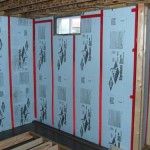
1. Apply an extruded polystyrene foam insulation board (I happen to use “blue board” that DOW makes) to the concrete wall. You can apply the foam insulation board to the wall using a couple of methods; using an adhesive or shooting 1×3 strapping into the concrete wall to hold the insulation in place. I plan on using an adhesive. There are two types of adhesive, one comes in a caulking tube and it generally says foam insulation adhesive or you can use Great Stuff spray foam.
2. Tape all the seams with a tape that is appropriate for adhering to foam board. I like to use Tyvek Tape. The tape helps keep moisture from getting to the wood framing.
3. Build a 2×4 stud wall just in front of the foam board insulation. Fasten the bottom pressure treated plate to the concrete with powder actuated fasteners and nail the top of the wall to the floor framing.
4. Insulate the wall with R11 fiberglass insulation.
For my scenario I plan on using 1″ of blue board (R=5) and R11 fiberglass for a total R = 16. I’ll write a post in the next day or so about my progress.
Check out the followup post, Complete Guide To Insulating Basements.








what brand of foam adhesive did you used ?
@ Ron – We’ve used so many different ones. Check out your local hardware or big box store. Look in the caulking isle and find an adhesive rated for foam. You can also use “Great Stuff” foam to adhere it.
Todd,
I’m still in the researching phase of doing a finishing my basement. I like your foam insulation board then fiber glass as another buffer. Does the fiberglass lay or touch the foamboard? If so, do you have any ideas on how to hang the insulation so that I maintain an air gap b/w the board and the studs?
Reason I ask is that the building code for where I live requires me to offset my studs from the foundation wall by 2″.
…ok so I found some more info in your other threads that probably answers my question. Since my code requires me to have an air gap, I’ll just go with a thicker foam board and just frame with no added insulation. I live near St Louis, MO.
Hi Todd,
Great post(s) on the basements. I am just wondering about one things. I live in the Toronto area in Canada, and really don’t know if that will make a difference to the above post, or my question. I don’t notice any mention of a vapor barrier? With the combination of a foamboard (DOW) and then an insulated wall, does this eliminate the need for the barrier?
Thanks
Jeremy
@ Jeremy – Vapor barriers are a tough issue in this application. By using the foam, and sealing it properly, the theory is you prevent water vapor from moving through the section. Some folks feel that’s not true, others do. I personally think the foam will eliminate the vapor problem. So far the walls I’ve done that way have performed very well.
I like this idea of 1″ polystyrene onthe walls with stud and battsover that,but what about insulating the floor with polystyrene to,or what would you recomend
@ Darren – Lots of people insulate the floors with polystyrene and a plywood sub-floor. There are also lots of basement sub-floor systems on the market and some of them have insulation incorporated into them. Typically we deal with radiant heat so it’s not an issue.
Should there be an air gap between the batt insulation and the foam? Please answer pros and cons. Thanks!
@ Bill – No need for an air space if you’ve installed a sufficient thickness of foam and properly sealed it. If the foam is thick enough the surface of the foam will not be cold enough to cause condensation of any water vapor the penetrates the wall surface and reaches the foam surface.
Todd – Thanks for answering my previous question regarding an air gap between the batt insulation and foam. Is 1″ DOW insulation a sufficient thickness or should I go thicker?
@ Bill – I would suggest 1-1/2″ min.
Hi-
I have read all your posts…I am in in southern N.Y. and have a historically dry basement – my contractor is suggesting to seal my basement cinder block walls with drylock, then stud with wood posts and fill with batt insulation ( not sure if it will have paper or not), then use greenboard instead of sheetrock to finish the wall. Any thoughts on this approach compared to your approach? I really do not want to make an expensive mistake. Thank you in advance for any advice you can offer.
@ Lisa – If it were my house or a house that my crews work on I’d chose not to have that approach done. Drylock is a decent product but it’s not going to keep all the moisture out and you’re just asking for a mold problem once water gets into the fiberglass. Either spray foam it or install a layer of foam board properly sealed before installing any fiberglass or cellulose insulation. I wish you luck.
Hi,
I live in north central Iowa. Have a dry basement made of poured concrete. House is 5 years old. I have started to finish my basement and began by putting a 1/2 inch pink foam board next to the wall and followed with standard stud wall. Thought that would be an easy way to get some extra insulation. I placed batts into the stud wall and left it that way for a while until other aspects of the job could be completed. Had to remove a section of batts and noticed moisture had accumulated on the foam board and had made the insulation a little wet! Things dried out within an hour or so… If I put the batts in and cover with vapor barrier will I be OK, or is the foam board causing the problem? If I do use a vaper barrier, will I be trapping any moisture between the foam board and vaper barrier causing future problems? This “moisture” problem was only an issue on the part of the cement wall that has an outside exposed surface. All other walls constructed using the same method are fine. Not sure if this is also an issue, but the foam has a plastic barrier on each side. Should I have removed this prior to putting up???? Hate to move forward just to have issues down the road. Thanks for your opinion.
@ Joe – There are two issues. First off it sounds like you insulated with fiberglass prior to a vapor barrier and vapor passed though it and hit the cold foam. The foam is cold because it’s only 1/2″ thick. Water vapor can also travel from the concrete through the 1/2″ foam into the stud cavity and cause trouble there. You REALLY need more than a 1/2″ of foam to stop both things from happening.
So… What should I do at this point? I guess I should not have skimped with the 1/2 inch foam board (should have read your info first!!!), but that is what I have. However, at this point all the framing, rooms, closets, etc.. are finished. The foam board does have a plastic film on both sides – will that effectively stop the moisture from coming in from the cement? Do I move the outside walls out from the wall and add thicker foam board? Hate to that if there are other options. Many basement are done in these parts without any foam board at all;Just stud wall, batt insulation, vapor barrier and then drywall. Should I cut out the 1/2 inch foam board and just have that as dead air space in that part of the basement that I noticed the moiture. Not sure what to do???? Thanks in advance for your advice.
@ Joe – It’s hard to say the best approach at this point. It’s possible that your 1/2″ with poly is an effective vapor barrier…….if so you can dry out the fiberglass really well..cover it with a good vapor barrier….and hopefully that will take care of things.
Just wondering…. If I got some 2 inch foam board, cut them to fit snuggly into the stud space and then seal the edges next to the studs, would I effectively be taking care of my potential problem? I would then not need to use batt insulation and could finish as I was planning with drywall. No vaper barrier then would be needed, right…??? Thanks again.
@ Joe – That is a MUCH better solution.
Todd, I am planning on finishing my basement with 1″ R5 foamboard glued to the conrete, then 6″ R22 roxall bats inside of 2×6 framing with a vapour barrier on the inside of the framing. My question is I would rather not leave an air space between the foam board and the bats of insulation, however I do not want to spend the extra for 1 and a half inch foam board like you would’ probably reccomend. Since I am skimping on the insulation would a 1″ apace probably be the best way to prevent water from getting on the insullaion bats, and do you think the vapour barrier is a good idea? Thanks for your help so far, this forum is great!
@ Stu – The air space certainly is an improvement. However, if the water vapor condensates on the surface of the foam board then it’s likely to take longer to dry and may over time be absorbed by the fiberglass. In your case I think it’s very important to use a good vapor barrier.
Todd, just to clarify, the vapour barrier would be on the inside of the framing(the warm side), the side next to the drywall right, not imbetween the foamboard and the bats, sorry if this is a dumb question, my week old child is crying.
@ Stu – You are correct.
Todd, I am redoing my basement and have gutted the walls. When I did I found a white haze on the bottom of the walls. This was probably due to poor grading on the outside walls which I have corrected. I have cleaned off this white haze and plan on sealing walls with Dry Loc. Then using 1 1/2 of the Dow foam insulation and then R13 insulation. I am a little confused as to whether or not to leave a gap between the foam and insulation from the prior posts. Also where the stud meets the floor do you use any different size foam insulation? And at the top of the wall where the sill plate and upstairs floor meet, should I spray “Great Stuff” or do you recommend another product to fill that gap? Thanks for your advice.
@ Mike – That white haze is efflorescence from the concrete. It’s typically a sign of water but it sounds like you have addressed that problem.
The gap is optional, just be sure to seal the foam joints well.
I like to use foam board between the joists as well and foam them into place.
Good luck.
Todd,
Our finished basement has no insulation. None in wall or ceiling. We would like to add some to make our house more energy effecient. The house is 8 years old. What is our best options?
@ Tonya – What are the details of the existing wall systems?
the walls are framed drywall.
@ Tonya – You have a difficult situation. Sounds to me that you will probably need to remove the drywall and then use some type of foam product.
Hi Todd, I am going to finish my basement and am curious if your foam board/faced insulation – faced r-13 against the drywall mehthod still apply. My home is 1 year old with a 10” poured foundation – no water found. I have the “tuff and dry” system on the outside(fiber board plus sealer). I have seen foam in a part of my unfinished walls where the cement wasn’t smooth (extra insulation or barrier?) Based on what I have, is the 1.5 foamboard still necessary? And is the moisture resistant green board drywall a good idea or wasted money?
Also, I have a vapor barrier beneath my cement floor – can I just put some vapor barrier plasic then lay low pile carpet with pad? Or should i still use your foamboard and plywood method?
Thanks!!!
Chris – Some of your comment is hard to understand (cement wasn’t smooth…you see foam?)…..I would definitely recommend at least 1-1/2″ of foam in order to create a good vapor barrier along the existing concrete wall. Moisture resistant drywall certainly can’t hurt, however, if you deal with the moisture problems it’s probably a waste of money. As far as the floor goes, you can get pad and carpet that work well on slabs, it’s really a warmth issue if you already have a good vapor barrier under the slab.
Thanks for the quick response.
The “foam” is in the wall – meaning there are some rough spots on the finished wall and I am seeing foam sticking out. I will talk with the builder to see what this is. I wasn’t sure if this was an added moisture barrier or not with poured foundations. Or someone sprayed foam on the outside for whatever reason.
I was hoping with the poured foundation and the tuff n dry system that I would not need to use the 1.5” foam board. But it is what it is and I don’t want mold.
I was originally going to use drylock and the greenboard. But you mentioned that greenboard is overkill. If i use regular drywall and buy the foam – the costs may almost equal out.
The vapor barrier under the floor is 6mil plastic. I don’t know if that is “good” or not or if there are tears underneath. So the setup of an 8lb top moisture barrier(for spills) carpet pad with commerical low pile and be ok? Or would you still maybe lay down some plastic vapor barrer directly on the slab?
Forgot to add that I do have crushed stone against the foundation and french drains at the footer but this may not matter. The basement walls are all below grade.
Chris – That foam might be a foam block that was used for a block-out for utilities….some times foundation contractors will place a solid piece of foam in the form to create a void.
The 6 mil poly should be sufficient.
Thanks again Todd for your help.
Todd, great info. I live in South West PA – I am trying to make sense out of this basement finishing and moisture control.
1. What adhesive(brand) is proven to hold the 1.5” foamboard against a poured foundation and not fail after years of moisture?
2. The DOW site is saying to push the studs against the foamboard and says to use adhesive as a temporary way to hold the foam there. In another example it mentioned furring strips attached to the cement wall. I was originally hoping to leave a half inch of space between the studs and the foam like you suggest. I am just concerned that after a couple of years the glue will fail and my board will fall leaving an exposted wall. Would it be better to almost paint the adhesive on and put beads every 12”?
3. Also based on your info it seems ok to use faced FG rolled insulation — with the face – facing the warm room?
4. I am not sure I can get unfaced insulation and I am not sure how to secure it to the studs (no paper to staple)
Thanks!!
5. Forgot to ask one more – it is or isn’t ok for the rolled FG Insulation to come in contact with the foamboard?
thanks again!
Chris – Recently we’ve discovered http://building.dow.com/na/en/products/sealants/gspwallfloor.htm DOW Great Stuff foam adhesive. This stuff is amazing and it works VERY well. If you use that stuff plus tape the seams well with Tyvek tape you won’t have any problems. If you go with unfaced FG it will hold itself in place by friction if you’ve framed the walls correctly. The fiberglass can come in contact if need be, I just like having a gap for an added level of separation.
Thank you Todd for your quick answers- it seems that you recommend the unfaced vs. faced in my application?
I will look out for this product and try to get that as my #1 choice- have you had any experience with the probably easier to get Liquid Nails – http://www.liquidnails.com/products/product.jsp?productId=34
thanks again!
Chris – Liquid nails will work as well although not as well.
I have almost completed the job with 2” Pink F150 Owens – including the tedius rim joist area as you suggested. I have the R30 faced insulation pieces that fit up in the rim joist and figured why not reuse them and stuff them behind the foam board. Is this ok and does it matter which way the kraft paper is facing? it is all above grade. Originally(before removal), the unfaced portion was facing the room.
Chris – It shouldn’t hurt anything. Keep the kraft faced towards the finished side.
Sorry – so I am clear – the kraft facing the finished – warm room (so i see it) OR against the foam board (which is against the wood joist).
when they built the house the unfaced side was facing the warm room. (which could have been wrong)
Thanks again for your help in this project. Most appreciated. It was more work and more expensive than FG rolled but it will be worth it.
one more thing- the kraft side isn’t perfectly cut and won’t be an effective vapor barrior. it is a little ragged from pulling out
Chris – Kraft side should be on the warm side, which is AWAY from the foam. No worries if it’s torn, just patch it up with some tape.
Todd,
I am re-doing half my basement, a workshop-storage side. I live in the northeast and my house is a raised ranch that was built in 1965. Recently, I gutted the drywall that was covering the “knee-wall” foundation to find that there was no insulation or vapor barrier. Only some straping that ran horizontally for the drywall to attach to. Based on pervious posts I’ve read on this site, I anticipate doing the following:
1. Install 1 1/2″ Foam Board, adheard with proper adhesive. All joints to be taped with Tyvek tape or equivelant.
2. Build 2×4 framed wall that butts up against foam board. (Do you recommend leaving a space between stud wall and foam board?)
3. Install R-13 Faced insulation in framed wall and regular wall that sits on top of knee wall.
4. Rim joists to be insulated with 1 1/2″ Foam board as well. (Is it ok for this to be exposed?, No covering?)
There doesn’t appear to be any moisture problems, past or present. I am also planning on painting the floor with a 2 part epoxy paint for looks.
Just wanted to see if everything appears correct. Should I also insulate between the floor joists in the above ceiling? It is wide open now with a drop ceiling planned in the distant future.
Appreciate any help and insight!
Thanks,
Dave
Dave – Everything sounds fine. As far as the rim joist it really depends on the local code. Many codes do not allow for foam to be left exposed. Some codes will allow a foil faced foam (PolyIso). Check with your local building official.
My question. My basement had no insulation when purhased. Panal was on the walls. I removed the panals to find straping nailed to the wall. When i insulated i used 1.5 inch foam cap nailed to the straping leaving me a gap between the wall and insulation. Will this be ok? Some say it is better having a gap so your home can breath.
Billy – That is ok, over time the strapping will most likely decay.
Todd,
Thanks for the great info.
I live in Southwestern PA and recently discovered that my finished basement bathroom had started showing signs of moisture (the bottom of the baseboard was wet, as well as signs of mold). My semi-finished garage (no studs on the back wall) connects to the finished bathroom. The block in the garage were extremely wet due to gutters overflowing about 3 or 4 feet high (I corrected that problem). I discovered the bathroom wall on the garage side was wet as well near the floor, and up the side of the block. I cut the drywal to see how bad the damage was. I discovered the previous owner (original builder) put R-13 batt insulation against the cement block with no foam board or anything. This, of course, meant that the water just saturated the bottom of the insulation and then wicked its way onto the studs and drywall. I’m in the process of cutting more drywall out to see how bad it is. From what I can tell it doesn’t appear the water got beyond halfway over into the bathroom.
At this point I’m thinking of tearing down the entire back wall to expose the R-13 insulation. My plan would be to take out the drywall and insulation leaving the studs and cement block visible. The framing is about 1-2″ away from the cement block. My hopes would be that I could somehow get the foam board in-between the studs and cement block and seal it up, then put the insulation back in the studs.
What would your recommendations be for this job?
Thanks!
— Jason
Jason – Don’t feel bad, what was done to your home is done far too many times in this Country because people just don’t understand the situation. First off you need to remove all the old drywall and insulation and most likely dispose of all of it. Secondly I think you have two choices. You could have someone come in and spray foam the wall cavities or you could install some foam board. In your situation I think I would stick to just foam board and no fiberglass. I say this because it’s unlikely you can get sufficient insulation behind the studs and truly seal every thing up. I think you’re better off installing a thinner sheet behind the studs, sealing, then installing another layer between studs, sealing again. Make sense? In PA you probably want at least 2 inches of closed cell foam.
Todd,
Thanks muchly for the information. That makes sense, except for the “thinner sheet behind the studs, sealing, then installing another layer between studs, sealing again…”. What do you mean by that (thin sheet, then sealing, another layer, sealing)?. I was thinking about putting a coat (or 2) of DryLok on the cement block, then the foam board behind the studs, then as you recommended and using foam board instead of the batting insulation.
My next question is, if the foam board is against the cement block and water does happen to make it through the DryLok, wont the water get trapped between the cement and foam board? Or eventually make its way to the floor?
Thanks again!
— Jason
Jason – First off I think Drylok probably an expensive “belt and suspender” approach that may do little to no extra good. First off I would install a layer of foam as thick as you can behind the studs. Be sure you can get it all behind the studs and seal the seams with tape as indicated in the article. If you can’t get at least 2 inches behind the studs I recommend a second layer installed between the stud bays, pushed back to touch the first layer of foam. Again, this layer should be sealed, I would seal it to the studs with canned spray foam like Great Stuff.
Water between the concrete and foam will not be a problem. It may drop down to the floor and you should plan for that in your wall coverings to prevent wicking of water into finished materials like drywall.
Hey Todd,
Thanks! So that I have a better understanding, the foam board serves as what? An insulator and it protects the wood/drywall from direct leaks, or just an insulator, or just a leak protector? If the water can still get to the floor, what good is the foam board?
A few more question:
o) In my situation, you said you’d recommend using the foam board instead of fiberglass insulation, why’s that?
o) You say that the water may drop down between the block and foam board and go to the floor, and I should plan for that. Are you meaning I should use a water-resistant drywall (e.g., green board) instead of regular drywall, and pressure-treated wood for the studs (I believe they already are)?
Thanks!
— Jason
Jason – Some of your questions can be answered in the articles on the site. The quick answers are that closed cell foam acts as an insulator and vapor barrier if you have a minimum of 1-1/2 inches in thickness. If you install a min 1-1/2″ thickness, tape the seams and seal around all penetrations you can stop water vapor from the concrete and/or block from entering the wall cavity and getting trapped in fiberglass thus creating mold/mildew.
In your case, if you can’t get a good layer (1-1/2″ min) behind the wall, sealed properly then there’s a chance that water vapor could get to the stud cavity. So, I recommend you use ONLY foam as this gives you assurance that there will be no fiberglass growing mold.
No matter how well you seal the foam, if you get water behind it, it’s likely to drop down to the floor. What I’m suggesting is keeping things like drywall 1/2″ or so off the floor to prevent wicking. If your basement is prone to more water than that I would recommend not finishing the space.
Todd,
Ahhh…I didn’t even check out the rest of the site yet ;-) Sorry. I’ll check it out after posting this. What you said makes perfect sense now. Thanks so much for the info!
— Jason
Jason – Good luck. If you have more questions don’t hesitate to ask, it’s complicated stuff and unfortunately every situation is a bit different.
I have been reading extensively your info on what to use for a basement to create a vapor barrier and insulation. We have waterproofed the basement which is about 6ft below grade and have gone back in after a substantial rainfall to check for leaks and have found that the walls are “sweating” about 8″ up from the floor. We have only been able to find R5 or 1″ and R10 or 2″ foam board. I see your suggestion of 1.5″ for a vapor barrier. A 1″ thickness would not be sufficient? We are trying to keep the cost low but want to do this one time only. And if the condensation is only on the bottom section of the walls what do we do for any “runoff” however minimal it may be?
Shannon – The 1-1/2″ is the minimum required. I always use 2″ for my clients. It’s important that the foam be installed over the entire wall. It’s expensive, but a very good investment. Good luck.
Todd, I read all the posts and still have a question. I will be insulating my basement in northern Wisconsin. 2″ foam board and tape 2 x 4 walls and fiberglass bats. Should I paint the walls first with DryLok? Will DyLok cause a problem with the foam adhesive? Should the fiberglass bats be faced(paper or foil)?
Thanks you have a great site!
Fred – Thanks for visiting! With 2″ of foam you may or may not need additional insulation, i.e. fiberglass. That really depends on the R value you need/want. If you do go with fiberglass I would use unfaced seeing that you have 2″ of foam.
I’m not sure DryLok will buy you much. The foam is going to take care of moisture. Just my 2 cents.
Hello Todd,
This is a very useful website. I have problem I am hoping you can help me solve I live in Northwestern Ontario. I have one wall in my basement that has condensation behind the vapor barrier, which made the insulation wet. I took the wall down and discovered that there is no mold so probably happens only in the summer months. The previous owner put:
-stud wall 1″ away from the foundation wall
-insulated in between the studs with fiberglass insulation R12
-sealed the stud wall with a 6 mill vapor barrier with acoustic sealant,
-drywall.
I took everything apart except for the stud wall (1″ away from the concrete), now how do I go about fixing the condensation problem.
I was thinking about having some one come in and spray foam that one wall, then insulate (R14 Roxol), do I need a vapor barrier? then drywall. What do you think?
Alex
Alex – Thanks for the compliment. So far everything sounds good, I’d stick with just spray foam, be sure it’s closed cell foam. No need for Roxol if you spray foam it.
Good luck!
Hello Todd,
Thanks for the reply, If i do not use the spray foam what other options do I have to get rid of the condensation problem?
Alex – That’s tough with only 1″ of space. I’d recommend getting a layer of foam behind the framing, taping/sealing all joints, then another layer of foam between studs.
Todd,
I am in the central panhandle of NE and about to pull an entire wall out that was finished with batting and then plain drywalled no moisture barrier that I can see. I found the problem by accident, (we purchased the house 8 weeks ago)after leaning against the wall and leaving a large indention and then pushing off and putting my hand through! I am certain I will find some black mold. The other exterior walls seem to be rather sturdy and rigid leaving me to (*CRINGE*)assume they are finished using styrofoam. I am going to pull an outlet to confirm this. Anyways, I am going to pull the entire wall down and start over. My question is, after reaching bare concrete, and allowing it to dry (to a state of less moisture) should I roll some Zinsser or drylock of sorts over the concrete and then begin this process?
Thanks for the amazing write ups!
Clark – You can do that, we typically do not bother as it’s a “belt and suspenders” type of approach. Focus on a good vapor barrier and the paint really isn’t needed.
Sorry for asking a question again, I am confused. I have a conditioned dry bsmt that I gutted to the studs. I want to insulate as I live in illinois. It will be expensive to remove the studs and reframe the entire bsmt. The floor is vinyl on concrete and the ceiling is stucco. what is the layering of the insulation. Do I put 6mil sheeting behind the studs put in faced batting then greenboard?
lkellyhome – I WOULD NOT recommend you do that. Frankly I don’t recommend any approach that doesn’t include at least 1-1/2 inches of closed cell foam first. If you install poly against the cold concrete wall, water gets behind the wall, hits the cold plastic and condensates. Trust me…I’ve seen is dozens of times and it always ends with mold.
We are going to be insulating the basement (using your directions above) but are wondering whether we should paint the cement block walls first. From some of the comments above, it appears you don’t think this is truly necessary. Our concern is that we do have one corner of the basement where a small amount of water has appeared a few times after very heavy rain. We have tried to address this through landscaping but are not positive the issue has been totally solved…. it only happens when there has been extremely heavy rain. Will using drylock on the bottom half of that wall and perhaps even some of the floor help at all? Thanks for your help!
Julie – Let’s put it this way, it won’t hurt the situation. I’m just VERY skeptical of products that promise to stop water leaks (we’re not talking water vapor) from the inside. Water under pressure is far too powerful to be stopped by some sort of sealer (in my humble opinion).
Todd – Thanks for having such an informative website! I plan on following your steps to insulate my basement, but I have a question. My basement has a french drain around the inside with a sump pump on each end. There’s also a plastic, notched material that extends approx 5-6 inches up the walls to direct any water that may come through the wall (block) into the drain. Would you suggest that I take the foam all the way down to the floor in front of this extender or have it stop above it? Thanks for your help!
Gregg – I would bring it down over the front of it.
Todd,
I am somewhat of an idiot and didn’t plan accordingly for the finishing of my basement….Nonetheless, I have framed, wired, and installed plumbing (all up to code), thinking that I should insulate after doing these things. I put the framed walls as close to the concrete as I could while keeping the square (obviously not the best thing to do). I am guessing you are going to tell me to use the foam board, sealed as best as possible, and not use fiberglass. Can you confirm or give me some insight as to how to best insulate my basement project.
Thanks!
Todd G – You’re not alone, many people do the same thing.
Two options that I would suggest you consider.
1. Spray Foam – Hire someone to spray foam the cavities. This is the best solution for many reasons and one that I’d recommend if you can afford it.
2. Foam Board Between Studs – This is the only other option I’d say to consider and you need to know it’s far from perfect. You’ll want to get the foam board nice and tight and sealed all around. You at least 1-1/2″ but preferably 2″. This solution certainly doesn’t protect you from all the moisture nor possible mold on the framing.
Good luck.
Is it best to frame the walls first and butt the subfloor up to that or best to put the subfloor in and frame the walls on top of that?
Eric – Frankly I’m not sure it matters much. Depending on the sub-floor system some of them recommend framing on top. If you frame on top then you have a better path for water if the floor does get wet.
When I attached the foam to 8″ block I applied the glue using a 3/16″ trowel to both the wall and the Foam Board. Then I pressed it into place and used whatever I had around to maintain contact typically a ladder. I will not be using Fiber glass but Denim which has been treated with boric acid. It’s a bit of over kill but the benefit will be no mice or bugs. I my case the basement does not have heat. So, I am using Electric Radiant Heat (ERH) and setting it 60 Degrees. But to do this a ceramic or porcelain tile is required. Cork is applied to an interior wall then the ERH is glued to the cork using a glue gun. A thin coating of thin set is applied and allowed to cure followed by thin set and the tile and grout.
Kevin – Great tips.
If you are putting the foam insulation on a foundation wall that had fiberglass blankets nailed to it, so that you first have to strip the fiberglass off, what should you do about the nails. Does it impact the integrity of the foam board if you push the board into the nail heads, so that the nail heads are depressed into the foam board? Does it impact the integrity of the foundation wall if you pull the nails out?
Paul – I’d recommend either pulling the nails or just bending them over. Just try to limit how deep they protrude into the foam. Pulling them won’t hurt the wall.
Great advice on this topic! Thanks for sharing your expertise! My situation is a 750 sq. ft. weekend retreat with a poured concrete “pedestal” room, 12 x 12 ft, on the lower level (about half above grade) that supports the main part of the unit above. Upstairs the walls are well insulated. This pedestal room: 1 x 3 in. furring strips with drywall, no insulation at all. Pretty cold in winter, of course. Because of the placement of the heat pump unit, the spiral stairs, and electrical panel, it would be impossible to do the 1.5 in. foam panels with a regular frame wall in front of that. I might be able to squeeze in 1.5 or 2.0 in. foam panels, if I could put drywall right over that, for a total wall thickness of 2 inches. Would it be a reasonable compromise to put pressure treated 2x4s as furring strips every two feet, with the foam panels snug on each side, and sheet plastic pieces maybe a foot wide placed under the furring strips, and taped to the front of the panels on each side of the furring strips to stop moisture?
David – Thanks for the compliment. It would be far better if you use DOW Wallmate. It’s a 2″ foam board that has indentations for the furing.
http://building.dow.com/na/en/products/insulation/wallmate.htm
Thanks! It looks like this product will do the trick!
I see on the instructions for those panels that I’ll need to put screws through the wood strips / foam panels and into the concrete walls. Do you have any tips on the best way to drill and make sure the screws hold in the concrete? Would it be a good idea to drill the holes, pull the panels to vacuum up the grit, and put some sort of plastic anchors in the holes for the screws to grab? Or would one of those power nail guns for concrete perhaps work for this, shooting through the wood, the insulation panels, and into the concrete? Thanks again for your help!
David – I’d use one of two products: Tapcon Screws (no inserts, just a hole drilled first) or Ramset/Hilti powder actuated fasteners.
Thanks! I used those Tapcon screws once before mounting some cabinets in the utility room of my old house, so I’ll probably go with those. — David
First and foremost, congrats on such a great site!
We are renovating a home built in 1975 where the basement was already semi-finished. All the basement exterior walls are drywalled. We want to properly finish the basement but before investing we need to make sure that whatever is there is not going to cause us a problem down the road. Presently, what I see is a 2″ white foam board that is definitely not dense like the Dow or Owen Corning foamular foam board. It’s not branded, it’s almost like a styrofoam. There is then a 1″ air gap followed by steel studs with batt insulation. That white foam board is “NOT” taped or sealed in any way. There is a 6mm vapor barrier between the stud and drywall.
I’m thinking this is not a good solution right? I want to make sure we do it right as it always prooves to be the most cost effective way long term. :-) We live in Ottawa, Canada so it get really cold in the winter. What is the ultimate solution to garantee no problems?
Martin – Thanks for the nice compliment. I hope you’ll visit the site often for other questions.
Do you know how long that system has been in place? If it’s been in place a long time without problems it might be ok. However, from what you describe I’d be skeptical. It sounds like open cell EPS foam board. While it can provide decent insulation value it can act as a sponge for water and it certainly won’t stop water vapor that leaves the foundation from getting into the framing materials and potentially leading to a mold problem.
What should you do? That’s a very good question. I guess I’d want to know how old that system is, are there any signs of mold or water? Depending the answers I might suggest some different considerations.
thanks for the quick response.
I would say that the system has been in place for at least 10-15 years. We’ve had tremendous humidity in the basement since we’ve moved in. We had an open pit sump pump for which we’ve replaced with a closed pit system. At the same time, we’ve purchased an almost commercial grade dehumidifier (SaniDry XP)that has done a very good job controling the humidity level. Since then it’s been very good but what caused me to do all this was that i found signs of mold (fine green moss) accumulating on the bottom of one of the inside wall doors which creeped up to 1/3 of the height of the door. We’ve had a sign of water a few weeks ago that creeped out from behind the wall so that is something else that we’ll need to address.
We now want to build a bedroom, bathroom, recroom etc… to increase our living space and want to do it right, including the floor. If you have a prefered best practice for floor i would love to hear about that as well. Right now we have concrete floors and not sure of the best way to address humidity coming from that.
Once again, many thanks for all your help.
Martin – So it’s safe to say you haven’t owned the home the entire time and therefore don’t really know the history or whether it’s flooded in the past? I ask because the mold could be the result of a past flood. If not then it’s likely caused by moisture problems coming through the EPS foam. If you want to do it right (without concern for money) then I’d tear it all out and start over. You really need either a closed cell spray foam or XPS foam as I’ve shown in several articles. You will likely want to read the following for more information.
http://www.homeconstructionimprovement.com/foam-board-insulation-values/
http://www.homeconstructionimprovement.com/how-to-insulate-basement-walls/
http://www.homeconstructionimprovement.com/vapor-barriers-for-basement-insulation/
Those will help you understand the issues and show you what I recommend if you do it yourself.
Good luck.
Awesome Todd, that’s what we’ll do. The moisture could also be coming from the floor right, what do you recommend doing for that?
Martin – There are lots of issues with basement floors as well. I’d start with reading the following:
http://www.homeconstructionimprovement.com/how-to-insulate-a-concrete-floor/
There are tons of products on the market today if you don’t want to use foam board.
the proposed method has an air gap between the foam and subfloor while the Barricade product is board on foam with an R value of 3.2, would that be enough to keep the moisture out? I like the insulated floor tile product because it maiximises the head room but i’m guessing that it’s probably not as efficient right? Plus you wouldn’t be able to seal the seems with tyvek tape which would also allow for extra moisture to reach the flooring product. In your opinion, is the Barricade truly a viable solution? another one i found was “dricore” http://www.dricore.com but that one has no foam, they claim that you should not trap the moisture but to let it dry as opposed to the foam panels. Thoughts?
You are quickly learning why basements are such a royal pain! There is no perfect answer. DRIcore works pretty well especially with slabs that have a proper vapor barrier under them. Most of this discussion depends on the type of flooring you want to use, how much head room you have, and ultimately budget.
I’m working on that basement project you gave me some advice about back in February. I’m using the 1.5 inch Dow insulation boards with the cut outs for furring strips. Does this have to be covered with drywall for fire safety, or can it be covered with tongue and groove cedar boards or something like that? Would one or the other be better in a basement environment, in terms of any mildew or odor? If I need to use drywall, it it worth using that moisture resistant drywall that is sold for use in bathrooms? Thanks!
David – Glad to hear you’re working on your basement project. Foam board must be covered in order to meet most current building code requirements. The issue at hand is a flame spread issue which really means you’re trying to keep an open flame from starting a quick fire. Many products can be used to meet the criteria. To the best of my knowledge I’m not aware of a tongue & groove product that’s been UL tested to meet that. However, there are plywoods that have been tested.
So I’d check with your local building code official first and see what they think. If they want to see a UL tested assembly then I’d put 7/16″ OSB up (be sure it has the certification) followed by the T&G. The wood would certainly breath well down there and do very well.
Good luck.
Thanks, Todd!
Question,
I am just starting on finishing my basement. The house is relatively new and has 2″ extruded foam with a moisture barrier on the outside of the foundation. Given that level of insulation, would you recommend also applying the extruded foam on the interior? Do you think that would typically be a code requirement? If you suggest yes to the interior foam, would your recommended width be less than 1 1/2″ for the foam?
If the foam is not needed on the interior due to the exterior insulation, would you be ok with batt insulation?
I read the building science report on insulation, and it states that the exterior extruded foam would cover the entire concrete of the foundation and connect to the exterior siding. However, on my house it appears they stopped the insulation at ground level and there is no insulation from ground level to the siding (about 2 feet). Is there anything I should do to rectify this shortfall?
Thanks!
I recommend you just “ignore” the exterior insulation and consider it a “cherry” on top. I would still recommend the 1-1/2″ minimum foam, sealed properly, then supplemental insulation to meet code. The reality is it’s very hard to get a continuous layer on the outside and have it work seamlessly with the exterior siding/insulation.
Good luck.
Todd,
Lots of great information here. I have started my project on by 11 yr old poured concrete basement with walk out in Mass. I’ve used your rim joist method using the 2″Poly ISO and I’m going with the 2″ XPS and 2″x2″ steel studs for the walls. I do have two questions though. Could I just put more of the XPS under the bottom of the wall rather than the trex?
My second question is I have two interior walls for framing out two utility areas. Can I just use unfaced batt insulation for these walls? The boiler room will have louvered doors anyway and I was planning on insulating the majority of the exterior envelope (minus behind the oil tank and boiler and expansion tank because there is no room )
Brian – You certainly can use insulation under the wall framing. I would use something thinner than 2″…probably 3/4 or 1″ max. This may effect the fasteners you use to tie down the bottom plate. You can use fiberglass in those partition walls, the trick is getting a proper vapor barrier in there, on the warm side, and, with no covering on the back side, I’d be nervous about condensation on the metal studs.
Todd,
Thanks so much. The trick on the partisan wall is that I don’t know what would be considered the warm side. The space I’m finishing is not currently designed to be heated and the utility area has the boiler so it has some heat. For the water tank / water filter area (the other portioned off area) I will do what you said regarding the vapor barrier on the warm side.
After the Job is complete I will see if I need heat. The space will be used as a workshop and office.
Thanks again for the info. I just liked the FB page as well.
Brian
In that case…i’d likely use Roxul insulation with not vapor barrier.
Live in iowa zone 5, bought ranch with walk out basement built in 1959. Finished basement, cinder block 2″ air gap and paneling is it. Now knowing just enough to be dangerous and not wanting to restud the whole basement. ( not sure I could ) My options of getting at least an R-11 for energy rebate is limited. Not a lot of time so I need to do room by room at own pace. So I feel spray foaming May not be the right option for me, I would have to do it myself.
Polyisocyanurate (foil-faced) gives me R-14 in a 2″ space. Not knowing anything about this kind of insulation other than it is about $30.00 a sheet. My questions are as follows : 1) is this a viable option for my basement insulation? 2) is this stuff mold resistant ? 3:) If sealed well do I need a moisture barrier ? 4) do I need to seal the blocks at all first ? Or is there an option I am missing ?
Thanks!
David – Your home sounds like many that were built in that time frame. While I understand your desire to do this without removing the studs I must caution you that installing the foam BEHIND the studs is the only way I’ll recommend. The foam not only insulates, but also creates an effective vapor barrier. The article you should most read is: http://www.homeconstructionimprovement.com/how-to-insulate-basement-walls/
Also, products like XPS foam are better suited in direct contact with concrete. Good luck.
Hi Todd,
Thanks for all the useful info here. I have a few questions that I hope you can help me with as I am about to finish my basement.
1) I plan on using rigid foam on the cement walls and batts between the studs but what do I do in the boiler room? With everything I have in there, it will be difficult to insulate the walls (but I may be able to do the rim joists). Should I just leave it alone or should I do something? If left alone, will cold air get into the finished space? Should I insulate the interior wall/door between the boiler room and the finished space?
2) In the corner where my gas meter and circuit break are located I am going to frame my wall about 3 feet off of the cement wall and there will be a door to get into this area along with the laundry room. Should I just insulate between the studs or should I also use XPS on the walls around the circuit breaker and gas meter? If the latter, can I leave the XPS boards “exposed” within this closet/laundry area?
3) For hard to reach areas, or areas where there are many wires (like above the circuit breaker), is it ok to not insulate these spots? Basically, the general question is whether or not a partial insulation job is better than no insulation.
Thanks for your help!
John – Glad you found our site useful. Here are a few thoughts:
1. In many situations the boiler room will get the rim joist done, and the walls left undone (this is the case in my own home actually). The wall between the boiler room and finished space typically would need to be insulated to meet energy code requirements (if you have such requirements in your area).
2. This is tough….in some areas the code official will require the foam to be covered…in some areas they are allowing it to remain exposed because some products have been successfully tested to meet the flame spread criteria. I’d discuss with the local building code official. Obviously anything you can insulate is a good thing.
3. Something is always better than nothing….it comes down to time and money. Use your judgement and go with it.
Thanks, Todd. For the boiler room rim joists, once I adhere and caulk the XPS, can I leave it exposed? Or does it need to be covered with anything?
Also, is it best to caulk the XPS boards or use spray foam? From a pricing perspective, there are $6 cans of spray foam but I am not sure how much you get out of that. In there a rule of thumb as to how long a can lasts, in terms of linear feet? For instance, a single area between a 16″ x 8″ rim joist is 4 linear feet. How many of these “boxes” can be sealed with one can of spray foam?
Last question…
I’ve heard people recommending using an infrared thermometer to test the effectiveness of their insulation job. However, those usually take the temperature of a surface and not the air so technically, one can do a horrible job of insulating a rim joist but if they shoot the back of the XPS board for a reading it will give a misleading reading. Am I missing something, or is there an IR thermometer that gives AIR temp coming through any potential openings.
Thanks
John
Spray foam is the preferred method…caulking typically is much harder to get a good seal with. If you do a good job cutting the foam board, the can foam will go a long way.
The IR cameras are great, they will clearly show areas that are not sealed well.
Thanks, Todd. Those camera are real expensive. I was looking at the IR thermometers that just give surface temps. I guess those would work too.
For the boiler room rim joists, once I adhere and caulk the XPS, can I leave it exposed? Or does it need to be covered with anything?
The question of covering the insulation will depend on the local interpretation of the code. Some codes will allow it, some will not.
Hi Todd. I currently have no vents in my boiler room for make up air. The gas furnace and water heater draw air from the rest of the basement (and I assume and openings/gaps that aren’t sealed around the rim joists, basement windows) as well as the first floor of the house if needed.
Since I plan on finishing the basement and sealing up all these gaps, as well as enclosing the boiler room, I will need to add a make up vent through one section of the rim joist/foundation wall. All the work I’ll be doing to seal and insulate the basement (and the rim joists in the boiler room) will be for naught if I do this. As my living room is right above the boiler room, I don’t want to just let all that cold air sit right below the living room which will inevitably make the living space above cold.
Is there anything I can do? Should I insulate the ceiling in the boiler room? This scares me as I feel like insulation in a boiler room is a fire hazard.
Any help would be appreciated.
Thanks
John – Great question…this is one I’d likely pose to a heating person. It’s my experience that you’ll get enough air just under the door to the room, but I’m not the PRO. Some new boilers pipe fresh air directly into the boiler. Call up the people who service your system and ask them what they think.
Good luck.
Insulating our basement is one of the main reasons we started renovating our home. Thanks for this very well made step-by-step guide.
It’s very refreshing seeing you respond to all of the questions thrown at you. It really helps to read all of these to get a good spectrum of info.
So what I’m reading so far in regards to keeping a cold utility room/closets (I will have sump pump and electrical – tiny cold closets, along with a large cold storage/utility room). I was thinkin of leavimg the bare block exposed in these areas and insulate the separation wall with batt, leave the cold side open, and vapor barrier on warm side. Is there a minimum space this works for? The electrical will be 36″x30″ to meet working space code and the sump closet will be 25″x25″. Im worried this is not large enough to dry the incomimg vapor from the block? Should I also use foam board in some way here too?
Thanks for your time,
Jasom – Tough question…the sump one worries me…you’ll have very high humidity in there.I’d probably insulate those if you can with foam.