


How To Fix Wet Basements

Fixing Wet Basements
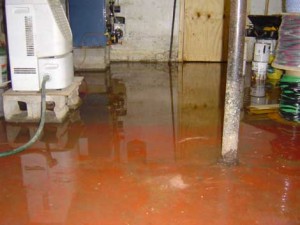
Credit: Homeowner's Blog
It seems that everyone wants a finished basement these days and it’s pretty obvious why. Basements offer valuable square footage to a homes living space if it’s dry and inhabitable. However, many basements are prone to poor ventilation and drainage and even standing water during wet weather.
Fixing wet basements can be an expensive and extensive process. Fixes can be as simple as correcting exterior drainage (proper rain gutters, positive grade pitch away from the building, sufficient foundation drains, etc.) More complicated repairs can include cutting up the basement slab and installing interior foundation drains and a sump pump system. (Check out Homeowner’s Blog for: How To Water Proof A Basement, for an example.)
It has been my experience that standing water like the picture above is a sign that the water table is probably close enough to the basement level that seasonal changes create a flooding problem. While slightly damp basements are typically the result of poor perimeter drainage. Regardless of how your basement looks when it gets wet the following are areas to evaluate and possible repair.
Methods To Fix Wet Basements
- Proper Rain Gutters – I’m a huge fan of installing rain gutters on homes. Even here in New England where we get plenty of snow I feel that gutters are far too important to go without. Gutters help you control and remove significant amounts of water from the perimeter of your foundation. It’s very important that the gutters be connected to piping to ensure that the water is moved away from the home.
- Proper Grading Around Home – Properly grading the landscape to move water away from the foundation is an essential component to keeping your basement dry. Be sure to check that flower gardens, sidewalks, driveways and other landscaping features are graded to allow water to flow away from the house.
- Proper Exterior Foundation Drains – One of the most effective ways to keep water our of a basement is to have proper exterior footing drains installed in such a way that the water can flow under gravity out and away from the foundation. French drains work best for this connected to a solid foundation pipe day-lighted at a point lower than the foundation drains.
- Sump Pumps – Sump pumps are an excellent way to protect your basement from flooding. Sump pumps get installed in a “sump” or shallow well and then connected to a drain pipe. The pipe is used to pump water out of the house and far enough away that it does not just run back into the house.
- Water Proofing Membranes – Water proofing is another method used to control water in basements. However, I must caution that water proofing is best used on the OUTSIDE of the foundation. Each year people spend far too much money on water proofing the inside of foundation walls. While this might be effective in keeping out “moisture” it’s not an effective way of keeping out large quantities of water. The water pressures created on foundation walls are too great to be stopped by membranes that are adhered to the inside of the wall.
I hope this article gives some insight and ideas on how to fix wet basements. Just remember that you should use a top down approach. Start at the top, i.e. the roof, and work your way down to the basement. If you can control all the possible sources of the water you should be able to create a dry basement.









good advice. can become extremely expensive if you don’t know what you’re doing, but can be an easy fix to add so much to your home!
When I bought my 1950’s house 6 years ago, there was no indication of water infiltration in the finished basement. A little over a year after moving in (and beyond the time I could have had any recourse against the seller) we had a heavy rain storm. There were several inches of water in a large portion of the basement, causing $4400 worth of damage. Later, following another storm (with no damage thankfully) there was a puddle around one of the drains. After two estimates from “waterproofing” companies for about $7000, I finally took the advice of a couple of friends and called a plumber to snake the clean outs. The tech asked a few questions, figured out which line needed clearing, and set to work. In less than a minute he knew the trap on the storm line was broken.
Long story short, the plumber solved the problem, and it was covered under the water backup rider on my homeowner’s insurance, so all I had to pay was my deductible, instead of $7000 out of pocket for work that wouldn’t have fixed the problem. Even if I had to pay the plumber, his bill was less than half what the “waterproofers” would have charged me.
I am in the middle of trying to find a way to reduce the humidity in my basement it ran 60+ all winter and even now in the spring. I developed mold in rim joist due to humidity and Fiberglass insulation. I have not found anything leaking to cause the humidity and it makes me wonder if it is coming from under the foundation with humidity seeping up threw the cracks in basement floor. Is this possible? And if so could i coat the basement floor with something to stop this? Im not sure if that even it but im running out of things to test to figure out why such high humidity down there fan and dehumifier run 24/7.
Jason – Humidity in basements is always quite high. This is especially true for newer homes. Concrete holds a tremendous amount of water and water vapor in it for years. There are ways to control that humidity including properly insulating your basement walls (be sure you read my articles on that subject), insulating the floor, and being sure you use some type of fresh air exchanger.
Good luck.
Hi Todd. Great site! I have a new house (1 year old). I had two leaky snap ties that the builder came back and coated with hydraulic cement. Fast forward 6 months and I still have two leaky snap ties. I’d like to finish my basement, but want to ensure that these leaky spots are fixed permanently. Do you have any favorite products/techniques that you can share to help me solve this problem? I’d also like to take preventative action against all the other snap tie locations before finishing the basement.
Matt – Snap ties are definitely problematic at times. Some times they can be drilled out and plugged with hydraulic cement. But that doesn’t always work. Sometimes, the patch needs to be from the outside. My best advice is trying to prevent the water from the outside with good grading, gutters and drainage.