


Foundation Drainage and Damp Proofing

 Proper foundation drainage and damp proofing is critical in keeping your basement dry. This post is another in the Total House Construction Series – Foundation To Finish in which I’m documenting the construction of an energy efficient ranch style home. Having a dry basement is one of many requirements in order to maintain a healthy environment inside the home.
Foundation Drains
The foundation drains are a critical element in helping keep water out of your basement. We use several products in order to create a durable working foundation drain. The drain is built using 4 inch diameter foundation drain pipe. The verticals are solid pipe while the longitudinal pipe at the base of the foundation is a perforated foundation pipe that allows water to leach into it. Foundation filter fabric is placed on the ground, next the foundation pipe is layed on top of the fabric. Crushed stone is then placed on top of the pipe and the fabric is pulled over the top of the stone. The combination of fabric and stone prevents the pipe from being plugged up with silt and sand.
The foundation drain is carried around the entire foundation and then the pipe is extended out into the yard until it “day lights”. Basically that means the the outlet end of the pipe is lower the the foundation drains and it runs to point where it can let the water run out freely onto the ground. Vertical pipes are installed at two locations; we install a pipe at each foundation window location (a window well will also be installed) and a vertical pipe is installed at locations where the rain gutters will drop down.
The vertical drains at the window wells allows for water to drain out of the window well without building up and running into the window. The gutter drains are connected to the foundation drains and the normal flow of rain water helps keep the system cleaned out. The foundation drain allows any water that builds up above the footing elevation to easily drain away from the house.
Foundation Damp Proofing
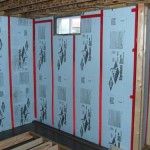
The damp proofing is just that, “damp proofing”. It’s not a guarantee against water leaking but it’s a method used to keep normal damp soil conditions from pushing moisture through the concrete. With proper rain gutters, foundation drains and clean backfill a dry basement is certainly attainable. If you’re looking for a full proof way of “water proofing” your foundation then you’ll want to use a product like Tuff-N-Dry.
 Prior to installing the bituminous damp proofing we apply a thick tar coating to each and every concrete form tie. Form ties are notorious for creating a point of water seepage in concrete foundations. After the tar is applied to each tie location the entire foundation is sprayed with the bituminous damp proofing. Once the damp proofing dries the foundation is ready to be back filled.
Previous Posts:
Total House Construction Series – Foundation to Finish
First Step In Building A New House – Blue Prints
Getting Bids When You Build A New House
New House Energy Efficient Details
House Building Lot
Ranch Style Home Floor Plan
Initial Site Work for House Building Lot
Building Concrete Footings For A New House
Forming Concrete Foundation
Using Concrete Pump Trucks To Pour Foundations








Do leaves, or other debris, ever drain from the roof and clog the foundation drain? That seems like it might be a potential problem that would be difficult to remedy.
Leaves and debris can be a problem. If you have a house near trees then gutter tops should be used and a screen at the downspout connection.
Todd,
I live in Southern New Hampshire, and will be having a new, pre-cast bulkhead installed this summer. I’m going to have the entire rear of the foundation exposed during this process, and would like to have someone apply TUFF-N-DRI H8. Do you know anyone in New Hampshire that could do this? Thanks!
Eric – There’s one that I know of:
Associated Concrete Coatings, Inc.
Manchester, New Hampshire 03103
(603) 669-2780
Great product…good luck!
Todd,
Just got off the phone with Jeff at Associated Concrete Coatings, Inc. Great guy! I will definitely use them for the project this summer. Thanks!