


How To Insulate Basement Walls

How To Insulate Basement Walls
Insulating a basement properly is rather challenging in cold climates. In this article I’d like to discuss how to insulate basement walls in cold climates.
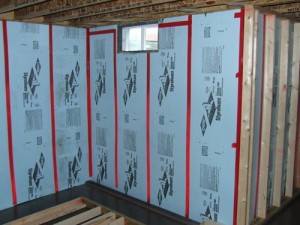 Insulating basement walls in cold climates is a great way to keep your home warmer and drier. However, special care should be used when insulating concrete (or block masonry) basement walls. Below grade concrete foundation walls are very col and damp. If you were to insulate the walls with regular fiberglass batt insulation it is very likely that a mold problem would develop.
Recommended Basement Insulation
Therefore I recommend using a combination of products to insulate basement walls. In order to create a vapor barrier and separation between the concrete walls and wood framing I like to use extruded polystyrene insulation (blue board from DOW).
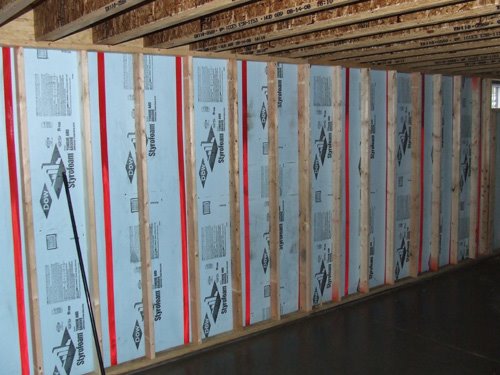 Next we frame a traditional wood stud wall in front of the polystyrene insulation. We do take one special step in framing the wall. First we install a layer of composite decking between the concrete slab and the pressure treated bottom plate of the wall. Finally we install some type of insulation in the wall cavities.
Step 1 – Install Extrude Polystyrene Insulation Boards
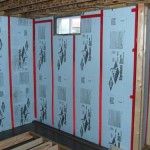
The first step in insulating a basement wall is to install the polystyrene insulation (for more information we recommend reading: R Values Of Foam Board Insulation). We like to use a all purpose adhesive that’s approved for Styrofoam products. After the polystyrene insulation is installed each of the joints is taped with construction tape (there are several available from Dow, Tyvek, and other house wrap manufacturers) or some other approved tape that adheres to polystyrene insulation. By taping the joints you are helping keep moisture and cold air from infiltrating into the stud wall cavity.
I recommend you seal the top and bottom of the foam board using spray foam from a can. You can buy products like Great Stuff that will seal those joints very well. Be sure that you install foam board on top of the concrete wall up tight against the wall plate and seal that well.
Want to see how this is done? What the following short video:

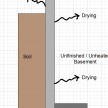








One advantage of using closed cell spray foam insulation is that you can avoid having to put the polystyrene and taping it. Simply offset the studs from the wall, and the foam, when applied, will completely seal the wall and insulate it. The moisture drive in a basement is from the interior to the exterior, so the spray foam prevents any condensation or mold growth while providing the highest R-value per inch (>6).
One thing I’d add that if you go with the foam board approach you should either caulk or spray foam a bead along the bottom of the board and the floor to eliminate any air gaps b/t the likely uneven concrete floor and the bottom edge of the boards.
I like the composite decking idea. I am going to use tigerfoam with offset studs as this is a much better air and vapour barrier and will prevent both condensation – from the moisture inside – and evaporation from the wicked water in the concrete walls.
What’s the best way to frame the wall around piping? I have the drainage pipe running along side two walls. I could either bring the wall outabout 10 inches or frame around the piping creating a sort of ledge.
Also, should I consider doing anything with the floor first or can I let it go until I decide what I want to do with it?
Thanks,
@ Hutty – There are two ways to take care of the pipe, either bump out the wall as you suggested or build a soffit around the pipe itself.
Build your walls first then deal with flooring.
Best of luck.
I’ve read a lot of the posts here on using ridged Styrofoam, properly adhered to the concrete/block basement walls, and made hermetically sealed. Let’s say I do all that and I use 2″ thick or better and instead of building and finishing a stud wall in front of the Styofoam, just plaster over it? Or, Drivet? I’m not concerned about “code” police and I agree with the guy who pointed out that below grade spaces maintain heat very well.
What’s your question? yes those are viable options. Not sure why you call them “code police” as many building code officials that I deal with on a daily basis are extremely helpful and very knowledgeable.
Hi Todd,
I’m using 2″ wallmate XPS to insulate my basement. It is a recatangular basement of a townhouse with one wall shared with the neighbouring unit. For the shared wall i am using Roxul Safe n Sound just for sound. There is a wall about 8′ from the end of my unit that will divide my basement into a heated and unheated space. Is there any problem with stopping my 2″ XPS halfway along a wall, and then insulating the dividing wall with fibreglass batts? I’m mainly concerned with moisture issues. Is it bad to only have half a wall insulated top to bottom? Also, is it bad if some cold air DOES end up behind my studded wall and contacts the XPS?
Is there any problem with stopping my 2″ XPS halfway along a wall, and then insulating the dividing wall with fibreglass batts? No
Is it bad to only have half a wall insulated top to bottom? I see no reason why you’d want to do that, it simply won’t help much.
Also, is it bad if some cold air DOES end up behind my studded wall and contacts the XPS? No
So just so I’m clear I can adhere the rigid insulation directly to the basement walls and then use a cementitious coating of some sort on the inside? Would a gypsum type product like easy sand work as well or what would you recommend for a coating to use directly on the insulation?
Nathan – I guess you probably could do something like that although I’m not sure what the details might be.
Thanks Todd.
It is hard to tell but I believe in your case your walls are non-load bearing and really just partition walls. In the case of bearing walls would you still use a piece of composite decking under a mudsill? I don’t know the compressive strength of the composite or if there would be other factors to consider in that case.
Thank you.
@ Ian – You are correct. The walls shown are just partition walls. I too would not use this detail for a load bearing wall. I’m only suggesting that this detail be used adjacent to a concrete wall in case of water leakage or excess moisture. For interior partitions or load bearing walls this problem would not be a concern.
I like the theory of the composite decking, but doesn’t it have mold issues. I have Trex on our deck and the areas that don’t get sun get pretty moldy. There must be some cellulose in the composite material. I have to clean the deck with a mold cleaner at least once a year.
I have Trex for our back deck and have to clean the mold off at least once a year in the less sunny areas. Mold might be a concern for use of the use of the composite for this application. I like the idea, and there may be other composites that don’t mold as easily now.
New product out called Azek, solid material versus coated like Trek, will not fade or attract mold, and will not stain with oil products. Its made of solid PVC material, pricy but you never have to do any maintenance for the remainder of your life.
I’m not sure your outdoor mold issue is quite the same. After all, mold even grows on vinyl siding and asphalt shingles on the shady side of homes.
The point of the Trex is to have a product that won’t wick the water up into the wood framing, drywall and insulation.
“Step 3 – Insulate Stud Wall Cavity”
Should this be Faced or Unfaced fiberglass insulation?
==========================
One other thing, I have two of those small (1′ x 3′) windows in a room I’m finishing and I don’t see the need for them. Too small as an emergency exit and I never open them in fear they’ll start leaking if I touch them. I’m also having an egress put in next spring in a different room.
Can I frame over the window or should I replace it with foundation block? (pretty sure I know the answer, but I wanted to see if you had another solution.)
I would use kraft faced insulation in this application, kraft faced against warm side.
We typically trim around those windows so that they can be used if wanted. I don’t see any reason why you can’t block over them if you don’t need them anymore.
How thick is the foam board that is used?
The thickness depends on the R value you want to acheive. I used 3/4″ plus the R11 fiberglass.
Be careful in your choice in foam board; less than 0.75/19.05mm will still allow condensation in extreme cold weather. It is only at 1.00/25.4mm that you begin to see the thermal break you are trying to create.
In my own house I’ve went with 2.00/50.8mm on the walls, and an inch and a half /38.1mm on the floor underneath tongue and groove 0.75/19.05mm plywood sheathing.
We have an increase in temperature retention of almost 7f/5c, makes life real comfortable down there… next addition is a redundant heat source… pellet or wood stove.
The only thing I’m unsure about is the proximity of your wall framing to the closed cell foam board. Some people prepare for any water infiltration “water will get through…” by leaving a half inch space, if only to keep your walls square and true(dry).
We will finish our walls with a big overkill, Roxul Flexibatt R22 RSI 3.87 – For 2×6 studs 24″ on centre for a complete insulation value of R32…
cheers
Before insulating the basement walls, is it necessary or needed to put down some kind of coating such as, Drylock etc. .
A foundation coating is not necessary but it’s certainly one more way to help stop moisture. Good belt and suspenders approach in my opinion.
Todd, Poured concrete walls are not perfectly flat. When gluing the foam board on the concrete walls there will be voids behind the foam board where it doesn’t contour exactly to the wall. Is this a concern for moisture or mold in the void? Or, is the foam board still insulating enough to stop moisture from forming in the voids?
You are correct..the foam will not fit very tight to the wall. The idea is to keep the warm moist air from hitting the cold damp concrete. This is also why i recommend you tape the joints with tape to prevent moisture movement through the foam.
Hi Todd, I have just recently started to plan my basement finishing project and i must say i have already learned a lot from your site. I have one question for you regarding using the polystyrene boards. If i am able to get a hold of 2.5 inch boards (Owens Corning)would i still need to use the fibre glass insulation on top? As this would give me more than the minimum R-12 that is needed in my area of Toronto, Canada. Also if i did go the route of using a little of both, is it necessary to use a vapour barrier on the inside? I am a little confused as some other sites say its not. Any advice would be greatly appreciated.
Using 2.5″ polystyrene would be great! The reason we don’t typically do that is cost. You could certainly skip the fiberglass.
As far as vapor barrier this is a bit of a hybrid approach. With a typical framed wall you want the vapor barrier on the warm side of the framing adjacent to the drywall.
Water vapor can then move towards the outside if necessary in a normal drying cycle. In the basement situation there is no place for the water to go and the concrete is extremely damp. So what we are doing here is sealing off the concrete with the foam and tape. If you don’t do this you will have a serious mold problem in the fiberglass.
Todd, You made a comment that an interior wall treatment,such as DryLoc,was not necessary but won’t hurt. A Basement Insulation Systems report from the Building Science Corporation (2002) states that any impermeable interior wall finish such as vinyl or paint systems should not be used in conjunction with the rigid insulation system. It stops the wall from breathing and allowing the moisture, that may accumulate, to dry. Do you agree or has your experience shown that these types of wall sealants won’t affect the rigid insulation system?
I’m not going to dispute their findings. However, that doesn’t make much sense to me when we’re talking about a concrete basement wall.
Here’s why:
Water actually makes concrete stronger and less permeable over time. (Without going into my graduate research thesis concrete with water in it’s pore structure will continue to cure and hydrate for years, thus making it stronger and more permeable).
So stopping the water from escaping to the house side and drying seems like a good thing to me. Plus we’re trying to stop the moisture from moving towards the house and finished wall.
Just my two cents…
Todd, First I would like thank you for this informative website, it has helped me immensely on determining how to finish my basement walls correctly the first time. Now I need to finalize a floor system. I’ve seen the same 1″ rigid foam, seams taped, covered with 5/8″ T/G plywood, and tap-con’d into the floor. 1.Do you agree with this flooring method? 2.Would you also suggest a sealant coating on the floor before laying the foam board? 3. If small sections of the concrete floor are left exposed, like around the sump pit, water softener system, and furnace, be a problem? As a side note for your readers, my basement research has lead me to a great ceiling system I’m going to use called http://www.ceilinglink.com.
I like flooring systems such as the http://www.dricore.com/en/eIndex.aspx
Never tried the foam board screwed to the slab so I can’t give you my opinion.
Todd, What is the minimum thickness of rigid foam board would I need to use in order to not use fiberglass insulation in my stud walls and still have a comfortable basement?
The minimum thickness depends on local energy codes and the minimum R value you need. Polystyrene has an R value of about 4 per inch. So, if you needed R = 13 let’s say that’s over 3″.
Would Foil backed yellow polyisocyanate insulation work in place of polystyrene insulation? If the answer is yes, would I need to go thicker or thinner to get equal insulation value between the two?
My parents have an unfinished basement in the Chicagoland area. My dad wants to use the Polystyrene on the walls just to get additional insulation. What type of adhesive do you reccomend? Is this ok to just use the insulation and adhesive to the walls?
Ellen
Most hardware stores sell adhesive that works on foam products. You just have to read the labels (this stuff comes in tubes like caulking).
Putting the foam up is a great insulator. However, leaving it exposed is certainly a fire hazard.
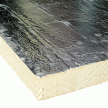
Foil backed yellow polyisocyanate insulation is a great choice. It’s typically used in commercial applications for masonry construction. The problem is it’s quite expensive.
The literature suggest that polyiso insulation with foil facing can be almost twice the R value as polystyrene board.
Where I bought my foam boards (T&G pink) didn't sell the sealing tape. So far I've been using "Great Stuff" in the gaps, especially the wider gaps where my cutting wasn't so precise. I will try to find the tape elsewhere, but what about just draping some 6 mil plastic across it?
Also, how important is it that I be perfect in taping all joints/gaps. There were a lot of mechanicals going in and out of my walls I had to work around and it isn't nearly as pretty as the pictures in your post.
Finally, my ceiling height is 7ft, I plan to take 8 ft lengths of fiberglass (I'm doing it exactly as you describe) but tuck the extra foot up into the cavity created by the floor joists up against the exterior (that area is pretty drafty), see any problem with that?
@ Chris – The tape you need is Tyvek tape or similar. That stuff really adheres to foam board well. I think it’s crucial to seal up the joints as well as you can.
Wrapping the additional fiberglass up into the floor joists is certainly a good idea.
I recently framed the basement with 2×4 and insulated using encapsulated R13 between the studs. During the single digit temps and before hanging the drywall I pulled back the insulation to feel how well it was working and noticed iced had formed between the insulation and the block wall. Pulled all down let dry. Reinstalled with a 4mil sheet of plastic installed on the warm side of the insulation. It appeared to seal all up nicely. I noticed the other day water seeping from behind the wall on the floor. I found this site and read about installing the blue board. Question I have is what will stop the moisture build up between the blue board and the block? How is the warm air getting behind the insulation?
@ LJ – The problem is the block wall and/or concrete wall is full of moisture. Concrete walls have a significant amount of water in them for the life is the concrete. Because of this it’s nearly impossible to stop the migration of water from the concrete into fiberglass insulation.
By installing the foam board you’re creating a vapor barrier that will prevent the moisture from getting to your framing, insulation and wall board. You’re also creating the first line of defense for a cold surface toward the heated zone. Again, as warm most air hits a cold surface it will condensate, therefore you’ll still need a vapor barrier on the warm side of the wall.
Will the moisture build up between the blue board and cement block and potentially become a source of mold? As far as installing the blue board just cover the block and not worry about extendine up to the floor and between the joists?
@ LJ – I don’t think this will cause a mold problem. Mold needs some type of food such as paper, wood, etc. to feed off of. Foam board is applied to the outside of foundations all the time and I’ve never seen mold on it.
Question – when using the foam board against the wall,and studs infront and filled with fiberglass insulation, is a vapour barrier still required over the studs/insulation facing the inside of your basement ?
It’s a good idea especially if you only use an inch or two of foam board. If you’re only partially getting he required R value from foam it can still be a cool surface that could let warm moist air condensate on it. So it’s certainly a good idea to use a vapor barrier behind the wall board.
I have read all your postings about wheather or not to use paper faced insulation over the DOW foam boards. I went on the Dow website and they are saying NOT TO USE PAPER FACED INSULATION WHEN USING THEIR TUFF R FOAMBOARDS. Do you agree? thanks, de
Well as I’ve said several times this is an area that’s complicated and you’re likely to get 100 different answers. I’m a bit curious why you want to use the Tuff R product with foil facing? I haven’t used this product in this application so I’d recommend you follow their specifications for installation. However, depending on the thickness you use, it’s likely that the foil faced board will be cool enough to promote moisture condensation if water vapor get’s through the drywall and past the fiberglass insulation.
I will say that some research indicates that well taped and painted drywall can act as a proper vapor barrier.
Thanks for info! I went with the Tuff R 3/4 inch because that is what my lumber company had lead me to use. I went on the Dow web site under http://www.insulateyourhouse and went under insulating basement walls and saw the directions on how to install the walls. If you think I should use the paper faced insulation let me know.
Thanks, De
@De – It’s really a toss up. I’m torn with following their recommendation so that any warranty they might offer will stand (good luck with that) and the mechanics of what will actually happen in the wall. 3/4″ of polyisocyanurate insulation is only about 5. That’s similar to a window so it will most likely still be cool enough to promote condensation. If you were using 2″ of the stuff then I’d agree with their recommendation. Ultimately this is one you’ll have to decide. Best of luck.
I have a poured concrete foundation, and am considering finishing my basement over time. Is it ok to put up the blue foam boards if it will be a little while before i start framing?
I’d check on a few things, first make sure it has an acceptable flame spread based on your local code requirements and secondly make sure it is ok if exposed to sunlight for extended periods. You may have a hard time having it stay up without support in front of it. The adhesive seems to work well for a short period vs longer periods of time.
Great info here! The partition/supporting walls in my basement were built with the house, and extend all the way to the concrete-block walls, so I already have 2x4s studs up against the walls. If I now finish the exterior walls with the blue-polystyrene followed by the wood framing, will I have problems at the joints with the existing walls? And if so, do you have any thoughts on how to deal with those studs?
It’s hard to say how the studs will do. Most likely they will get damp over time and potentially rot and or mold. You might be able to treat them with something before you cover it all up.
recently framed and insulated basement walls in my new home.now have moisture between insulation and concrete.what’s up with that?
How did you insulate the walls?
typar on inside of framing,then roxol R14
now wondering if more insulation is needed in belt? warm air leaking behind wall may be causing condensation to build between concrete and typar?
Unfortunately Typar is not going to keep out the moisture from the concrete. I hate to say it but you’ll need to remove the fiberglass and seal off the concrete with foam.
Thanks Todd.
Thanks for this website-it’s a really great resource. I have two questions:
I read in a Minnesota Department of Commerce publication that it is recommended to install exterior insulation on the foundation before insulating the interior walls. It says this is “necessary to retard air convection within the wall and vapor transport in the concrete masonry block cores.” Do you feel this is necessary? I really don’t want to dig a trench around my entire foundation if I don’t have to! I also have read that this exterior insulation can act as an entry point for termites.
Also, how do you usually test for dryness in a masonry wall before you insulate?
@ Dan – There are lots of publications that promote exterior insulation. However, there are also lots of successful insulation jobs done with only interior insulation. So long as you follow the necessary steps to stop moisture from entering into your finished space you’ll be doing well. That’s why I stress the importance of taping all the seams and NOT placing fiberglass in direct contact with your foundation.
You can easily test for moisture. Tape a piece of plastic to the masonry wall…..be sure to tape it really well. Leave it for a few days, you’ll likely see moisture build up behind the plastic and condensate. This simple test points out the importance of installing some type of foam against the concrete or masonry to seal out the moisture.
Best of luck.
Todd,
My concern with this method is that by still allowing the moisture to condensate behind the foam board, wont there still be a mold issue that you cant see? this would create an air0quality issue correct? and what about at the top of the wall (the floor joists), would you just use the fiberglass insulation in those cavities as well? or cap off the foundation concrete with the foam board and tape the insulate the remaining cavity with the glass insulation? maybe i am just thinking too much about it, but wanted to get your input. BTW, i live in Western NY.
@ Karl – In order for mold to grow it needs water, temperature and a food source, i.e. some type of wood, paper, cellulose, etc. The food source will not be present and therefor no mold will grow. I’ve actually taken down the blue board after a couple years and there’s no sign of mold. You definitely need to install the foam on top of the concrete and seal it very well with foam spray and tape. You’re not over thinking it at all, it’s a very complicated issue that needs careful thought and planning.
My basement walls are only 5 years old and were poured with a form that makes them look like brick and mortar, so the face of the wall is not smooth. I’m worried that the voids between the wall and the blue board could lead to problems. Should I be worried?
Is there any advantage to using steel studs?
Thanks,
Chris,
(From Michigan)
@ Chris – I wouldn’t be concerned with the voids. The real issue here is creating an insulation layer that won’t mold, rot or collect water and also to create a moisture barrier. Not sure about the metal studs, they have their own set of issues in that type of environment. For sure they won’t lead to any mold issues.
I wonder if you have a thought with my daylight basement. Here in GA, the climate does not get sooo cold, but humidity in the basement is an issue in the summer. I use a dehumidifier to take out the water.
Our house is one year old. Our basement is equivalent to 2 walls of poured cement and 2 walls of timber. The house and basement timber walls are wrapped on the exterior with Tyvek. The concrete had tar sprayed on it, and footing area has drainage pipe against it.
The above article will help me with the concrete area.
I was wondering about the wood frame area. It is basically siding, wrap wood sheathing. The ceiling has batting wedged against it, but I was trying to choose insulation between exterior studs. Would interior faced batting be good? I do not want moisture trapped, so I was thinking of perforated craft paper. Looking on google, I have seen gross images of mold in basement conditions. I do not think we would be that bad, but I want to spend wisely once, and not have to undo something in 2 years time.
@ Walter – The traditional wood framed walls should do just fine with any acceptable insulation method. I have a walk-out basement and the wood framed walls are insulated with fiberglass batts. Be sure to use a vapor barrier on the warm side. Best of luck.
I’m getting ready to start the project of gluing the extruded poly foam boards to my cement basement walls. I was hoping to use ENERFOAM by Dow. I would like to use this because it is polyurethane foam adhesive and is available in a straw-applied version. (I don’t own a foam gun). My second choice would be GREAT STUFF PRO, WALLS & FLOORS by Dow, which can only be applied with a foam gun.
Have you had any experience with the ENERFOAM?
I plan on building a 2X4 wall with R13 one inch in front of the rigid foam. I’m still wrestling with the decision between 1 inch or 2 inch board, since I live in lower Michigan I’m leaning towards 2 inch.
Is there a rule of thumb for choosing the preferred thickness of the rigid foam?
Thanks For The Help!
@ Chris – I’m not familiar with Enerfoam. Lots of people actually end up using great stuff foam from a can. From my experience no matter what you use you’ll need to prop up the foam board till the adhesive cures, typically over night. No rule of thumb on the foam, the more the better. 1″ is a minimum, 2″ will work wonderfully and you won’t need as much fiberglass.
Thanks Todd. I thought there were issues found with moisture and vapor barriers. Was that just with batts placed against masonry, and then a vapor barrier trapping in moisture?
For masonry, foam glued, then frame built and batt in cavity if desired, followed by drywall.
For 2×4, batt insulation in cavity with vapor barrier pointing inside, followed by drywall?
I just want to make sure before I start buying.
@ Walter – Most of the problems in basements have been created when people place fiberglass insulation up against raw concrete then install a vapor barrier on the wall site. This creates a ripe environment for mold. What I suggest is either insulate entirely with foam or use a combination.
And on the exterior 2x walls, using batts (interior facing vapor barrier) is not a problem?
@ Walter – Not sure I understand your question. Let me try…
What I’ve done in the past without a problem is to install the foam board, seal it very well, then frame a wall, then insulate that wall with kraft faced fiberglass. There are folks that say it’s not necessary and I think it really doesn’t matter much so long as the foam is at least 1″ thick.
Sorry about that. I have both masonry and 2×4 on the exterior walls. I found all the details for the masonry portion (glued foam, then frame + batts) in the article and follow up posts.
In a previous reply, you mentioned that batts with a warm facing vapor barrier on the exterior 2×4 walls was good. I was just concerned on the 2×4 exteriors if moisture could be trapped in the cavities. I was wondering if you found that or if you had no issues.
@ Walter – No problems there because you’re insulating a framed wall in it’s normal configuration. The only issue then becomes keeping your basement at a good moisture level that’s not too high.
cool – thanks again for the great info and rapid replies!!!
I have a dehumidifier draining to an exterior rain barrel that I use to water the plants (with mosquito dunk inside) I have the humidity set at 45% and I have a fan in the basement (approx 2000 sqft) that helps keep air moving.
@ Walter – Best of luck and be sure to come back again for other home improvement information.
Hello,
What is your reasoning behind the minimum of 1″ rigid foam board, wouldn’t 3/4″ with a framed 2″ by 4″ stud framed wall with fiberglass insulation work the same?
I also have read in many other articles that when utilizing the rigid foam and fiberglass combination, then no moisture barrier should be used because the rigid foam acts as a moisture barrier. If a kraft paper or a moisture barrier is used with the foam board, then you are creating a potential for trouble with a sandwiched moisture barrier zone?
Any input to settle this?
Thank you!!
@ Jonathan – From my research it appears that 1″ is the minimum to achieve a minimal vapor barrier. In fact most research prefers a minimum of 2″ for the preferred solution. 1″ plus fiberglass is an economical solution that offers the best of both products. The vapor barrier on the fiberglass in this situation is certainly a debatable one. There are many references indicating that an additional vapor barrier might be a problem. However, there are an equal amount of references recommended the vapor barrier. I’ve done it both ways with success and never found a moisture problem. The real issue here is to never place fiberglass against concrete.
Hello Todd,
Thank you for your input. I will go with at least 1″ for safe measures.
As far as you are concerned, you think the vapor barrier fiberglass is the safer bet?
Two new thoughts,
First: I was planning on leaving a little space above the floor when I attach the rigid board and fill that space with spary foam to prevent water wicking up into the foam board? That is at least another suggestion I read about. Any thoughts on that one??
Second: I have read about leaving a space between the foam board and the fiberglass insulation, this doesn’t sound right to me but not sure?
Thank you again!
@ Jonathan – The vapor barrier is a toss up.
I don’t believe water will wick up into foam board because it’s a closed cell foam. Sealing the base with foam spray is a good idea though.
Leaving an air space is a good idea in my opinion but not necessary.
Hello Todd
I started putting drylok on my block in the basement.I did not get very far because of weather and 2 children who cant be left alone for more than 5 minutes.So my question is should I even bother with it if im going to put up rigid foam board,
Thank you
@ Nathan – It certainly won’t hurt to use it. Whether it will make much difference is hard to say.
Hello,
We’re in the process of finishing the basement in my parents home. The house was constructed in 2007 and has a poured wall basement. My dad and brother-in-law framed in two rooms and a bathroom this weekend, which I was supposed to help out on, but couldn’t do to a sick little one, which has left me to reading DIY articles all weekend online.
The question is this: They have already framed the rooms with untreated 2x4s directly on the concrete. They haven’t put up blueboard, or any backer behind the wood, and didn’t include a treated sill at the bottom.
Is there anything they could do at this point, short of tearing down what they’ve done to this point, that would provide a sufficient vapor barrier? Can a water sealer be sprayed on the concrete walls? And if so, what type of insulation should be used between the studs, as I’ve read not to let fiberglass insulation touch the concrete.
Thanks for the info.
Nick
@ Nick – Honestly, I’d try to take down those walls. If they shot them to the floor and nailed them to the joists above they should be able to cut them free with a sawzall pretty easily. Then you could easily cut off the bottom plate and replace it with PT. This also would allow you to move the wall forward enough to install a layer of foam board. This small road bump will pay off int he long run and prevent some nasty mold and mildew problems.
I’m not aware of a product that would really fix this current situation.
Best of luck.
Todd,
Thanks for the advice. I passed along the info, which you can imagine how it was received since I’ve been home, not working on it, all weekend.
Thanks again.
Nick
Todd,
Thanks for all the great information on your site.
Have you ever used the Owens Corning pink board, (Foamular 150) instead of the Dow blue board? I’m not sure if there is any difference between the two products, but I can get the pink stuff a few dollars cheaper.
Thanks,
Chris
@ Chris – As far as I know they are the same product. One is Owens Corning and one is Dow. Best of luck!
Thanks for clearing that up for me!
Chris
Here’s a couple of questions – I have an unfinished basement (full concrete walls, but the builder did frame a section to mount the main electric panel. This framed wall (against the concrete) doesn’t allow me enough room to use the poly-styro board between the framing and the wall. However there is enough room to hang a thin sheet of plastic vapor barrier (commonly used on a concrete floor when applying wood flooring) between the framing and the concrete wall. Can I use this thin sheet of plastic barrier to create seperation between the concrete and the framing – and still get away with cutting vertical strips of the poly board to friction fit between the studs? It is just one wall (about 10 ft long) in the same room designated as the furnace room. The remainder of the basement (1600 sq ft) will be completed with the poly-styro board first, then the framing, then the fiberglass.
Second, is there any special attention given when 1″ or 2″ poly board won’t fit behind vertical sewer pipes and concrete walls? Do I butt the poly board directly up to the pipes, or leave an exposed gap? Or, maybe it doesn’t matter.
Thanks in Advance!! I’ve been happy to read many great tips!!
Ryan
@ Ryan –
1. I’d say use the plastic behind those studs, then fill in between with foam board.
2. I’d but the foam up to the pipe and seal it with foam spray.
From what I gathered the moisture problem stems from fiberglass insulation being against the concrete. What if you stud up 2×4 walls agianst concrete but do not insulate and then hang dry wall on the studs? Also can you put padding and carpet directly on top of a concrete floor?
@ Dennis – If you just put up the drywall you haven’t prevented warm moist air from hitting the concrete and condensating. That water will cause mold on the studs and back side of the drywall.
Carpet is installed directly on concrete slabs all the time.
I have a home built in 2001. The builder insulated the top have of the basemant walls with fiberglass insultion (presumably to grade). I want to finish my basement walls correctly. Do I need to tear all this down and add the 1″ polystyrene? Are there any alternatives?
Thanks
@ Tom – If the fiberglass is installed adjacent to concrete I’d say you should definitely remove it. I hate to say it but that fiberglass will do you no favors down the road.
Todd, isn’t this exactly what was done in the video above? I was surprised the fiberglass was put behind the board. What’s the best solution to the framed areq?
Not sure I understand your question. In the video there are two areas of interest that are very different. The area of the concrete walls is insulated with foam board. The walk-out (wood framed) walls are insulated with fiberglass.
I’m sorry, I wasn’t clear. In the video it looks like you put the foam board over the top of the fiberglass batts on top of the pony wall. Is that OK to do? I have the same exact setup in my basement and wasn’t sure if I should pull out the batts and use the foam board instead (for the framed pony wall) or go ahead and put the foam board directly over the top of the unfaced batts which is what it looks like in the video.
Thanks again for posting this. I’ve been researching this for weeks and this is by far and above the most helpful information out there. THANKS!
Colin – I did it in the one location, but the only reason I did so was this basement is so dry. It sits on “beach sand” and there’s very little moisture. In most situations I would not do that.
Good luck.
Todd,
Thanks for the advice. I am refinishing my basement and need some further advice on the walls. I have a poured foundation, but on some walls the concrete walls do not go the full height of the basement. There is 2×6 framing on top of the concrete with fiberglass insulation between the studs. There is plywood on the outside face (I have a full brick house) and presumably the brick is on the other side. As mentioned, the builder insulated this portion of the wall in the basement.
I understand I need to use the 1″ polystyrene against the cement walls but what do I do about the half height walls? What do I do about the upper portion where the insulated studs are?
Thanks
@ Tom – Your situation is not unique. You have “pony” walls sitting on top of short height concrete walls. You basically have two options here and it depends on how you want to finish those walls. Do you want to have a “step” in those walls? or do you want the finish framing to run from floor to ceiling without a step?
Either way you’ll need to install foam on the lower half including the top edge of concrete. Be sure to seal the foam board to the concrete well with foam spray and tape. At this point you can either frame only a low wall up to the top of concrete then step back to the original framing or you can frame a new wall in front of the concrete all the way up to the ceiling.
Leave the original fiberglass insulation in place. Depending on which framing you go with then you can further insulate the upper portion with fiberglass if you frame the wall continuous. Does this make sense?
Thanks for the reply- I had never thought about a “step” wall. I had always planned to build a seperate 2×4 wall from the floor to the ceiling. I will give that some thought as it may add a unique look to the finished result.
Also, I failed to mention that the 2×6 framed insulation portion has un-backed insulation betwen the studs, as well as an additional “blanket” insulation covering the whole wall with a silver aluminum backing. Should I take this down and just leave the insulation between the studs, and if I go with the “step” wall attach wallboard direct to the these studs? what should I do if I go with a continuous wall on theis portion?
Thanks a bunch.
@ Tom – A stepped wall can be quite appealing in certain situations. In fact, some people use it as a focal point to install a flat screen TV above, some use it for built in shelving above or similar ideas.
If you frame a 2×4 wall from floor to ceiling I’d leave all the existing insulation in place. If you’re going to step the wall then you should remove the foil faced, install a vapor barrier (6 mil poly) over the stud cavity insulation, then you can install your drywall directly onto the old studs.
Great…I will probably go the ‘stepped” route. One last question, is the fact I can use the 6 mil poly as a vapor barrer on this portion due to the fact that the outer wall is above grade and plywood and not concrete?
Thanks for all your help.
@ Tom – That’s correct. In your main house there is some type of vapor barrier on the “warm” side of the construction. Typically that is either kraft facing or poly. This keeps moisture from the warm room from migrating towards the cold plywood surface and condensating. The plywood itself is MUCH drier than a concrete wall.
Great- I think I have a plan now. Is it possible to send pictures so you can confirm my installation?
Thanks again.
@ Tom – By all means! Send along some photos and I’ll do an article on how to insulate your basement.
Great! I’ll take someome “before” shots, for your review then perfom the work for some ‘after” shots.
Thanks for helping me do this right.
Hi i’m redoing my basement i’m going to use blue board from DOW my question is which adhesive should i use to install it to the concrete foundation i’ve talked with different people and get different answers. some say even the stuff made for foam board installation eats the board.any suggestions thanks
@ Bob – There are several products you can use. Most hardware stores carry a foam board adhesive in a caulking tube. You can also use “great stuff” in a can. Regardless of what you choose you’ll most likely have to use temporary supports to hold the foam in place until the adhesive cures.
Hi, I’m redoing my basement, and have read an article that uses the foam board on masonry wall, then 2×4 structure and reflective insulation in between studs and wrapped over the studs and drywall. Would you recommend reflective insulation over fiberglass, and would it be ok to skip the foam board since the reflective insulation provides also a moisture barrier? Any suggestions would be greatly appreciated.
@ David – First let me say that you SHOULD NOT skip the foam. All masonry construction today uses masonry, air space, foam, then framing. Are you referring to reflective foil faced fiberglass? Here’s what I recommend:
Masonry – Foam (seams taped) – Framing – Fiberglass – Vapor Barrier – Drywall.
Todd, the reflective insulation that I’m referring to is aluminum foil attached to some sort of backing material or two layers of foil with foam or plastic bubbles in between creating an airspace to reduce convective heat transfer also. The aluminum foil component in reflective insulation will reduce radiant heat transfer by as much as 97%. I’m just afraid of putting fiberglass insulation with a paper vapor barrier because I had some bad experience with this in the basement and mold, of course that basement did not have the foam board.
Hi Todd – a quick question regarding insulating:
The person who framed in the basement here at my home just framed a wall away from the concrete and put drywall over the framing. Now I have a basement that’s always cold in the winter. I want to insulate it, but don’t want to put lots of money into it. I’ve heard that the blow in cellulose is good for this because it fills in the space between the studs as well as the gap between the studs and concrete. What is your opinion? Does this work? I have no desire to pull the drywall off the walls, otherwise the job will become a lot bigger than I can afford. Thanks!
Dan
@ Daniel – Blown in cellulose can be quite effective in this situation. However, you need to talk to the installer and make sure the cellulose has anti-mold inhibitor in it. Some of the cellulose is specifically made to be installed directly against concrete.
Hi Todd,
I have another quick question, one of my walls in the basement is already framed and 3/4″ is the maximum thickness of the foam I can squeeze in between the masonry wall and 2×4 without tearing it apart. My question is, instead of fiberglass with vapor barrier, can I install another layer of foam in between the studs? If so, what kind of thickness would you recommend? If not, what’s the reason behind it?
Thanks a lot,
David
@ David – You certainly can install another layer of foam and frankly that’s a better system. I’d be sure to seal all the foam to the framing with Great Stuff spray foam. The thickness depends on your local code. Most foam boards have R values from 5 and up. So it’s best to go with a value of 5. Assuming you want R11 You’re going to want 2 to 3 inches.
Thanks for the advice!
I’m exhausted researching how to do this exactly. I like what you’ve done the best, so I’ll do exactly what you say. My basement is below grade, block walls, I want to use 3/4 foam unless its gonna cause problems I’ll try and find some 1″. Then frame 2×4 tight against that. Do I really need fiberglass insulation since below grade, and if so would I then put plastic over that on the drywall side? It seems like the plastic would make a nice moldy insulation sandwich. I mentioned your method to a couple people and they were all saying you have to have a gap between the block and the wall for water vapor to escape or something? I appreciate your help.
@ Jake – What part of the country do you live in? The total R value you need will dictate if you need more than the 1″ of foam board. Using fiberglass is a way to keep the cost down. Ideally you’d do it all with foam board. The answer about the plastic really depends on where you live.
sorry i forgot to add that. I live in the southern piedmont of north carolina. thanks again. Walkout basement, finished half completely below grade. Room will be heated.
While I’m here, one more question. Where does the moisture and condensation go once its trapped behind the foam? Thanks
I am curious too about the mold sandwich question that jake asked- installing a vapor barrier after using the foam board and fiberglass.
Thanks
Todd,
With an well insulated basement..do you ever worry about freeze-thaw cycles damaging (i.e. expanding cracks) in the foundation?
@ Steve O – Interesting question. Most modern day concrete contains “air entrainment” (tiny air bubbles) that prevent damage due to freeze-thaw cycles. The only concrete that might be exposed to that would be the outer exposed surfaces. So to answer your question I really don’t think insulating the wall will affect freeze thaw one way or the other.
Most cracking is typically due to shrinkage stresses and or large thermal changes over time. Again, most modern day concrete is reinforced with rebar to account for those forces.
Great question!
Hey thanks
Todd,
My insulation requirement is for a Northern Mich. basement walkout. Walls are concrete block which will have a Dry-Lok waterproofing applied on the block walls first.
I wanted to leave approx. 3/4″ airspace from block wall to 1″ blueboard fastened to back of stud wall. Then I would fill stud cavity with faced fiberglass insul. Should I use a plastic vapor barrier against the block wall first? Other than the airspace and the possible use of visqueen,it would incorporate your system.
Can you comment on the additions/changes that I’ve described?
Thanks for your taking time to analyze the above. Steve
@ Steve – I’d rather see you install the foam up against the wall so you can properly seal all the joints first before framing your wall. The foam will be your vapor barrier. Best of luck.
Hi. Im wading into this and getting confused. I want to insulate my walkout basement. I had a moisture problem from blocked drainage which Ive addressed on the exterior (french drains and some siding where possible.) For the inside, I hear two main options:
1- Masonry – hard foam (seams taped) – Framing – Fiberglass – Vapor Barrier – Drywall.
2- spray foam on the concrete plus framing and drywall.
option 2 has the advantage that it seals up the irregular space in the floor joists but may be cost prohibitive. Other than this, do you favor one over the other?
Other questions:
If option 1, I also hear about blowing a fan behind the studs to move the air. What do you think of that?
If option 2, do you use a moisture barrier in addition to the spray foam?
Regarding moisture barrier:
a) Do you recommend against drylock?
b) what about the micro space between wall and hard insulation or between wall and spray foam insulation?
Are there any methods that would conserve more living space?
I was thinking of using metal studs to prevent mold from possibly getting onto wood studs. Do you like this?
If you go to all this trouble to protect walls from forming moisture by having warm air meet cold in a dark stagnant space, what happens on the floors??
Is there more to consider?
thanks very much.
@ Chris – You’ve asked a ton of questions but I hope to give you some basic responses. It really comes down to money, option #1 costs less but option #2 works better. In both cases the foam creates the vapor barrier to prevent moisture from getting to your framing materials. I think metal studs and wood studs are a wash. There’s very little you can do to minimize the few inches that it takes to do this correctly.
Yes, I can confirm that if you were to insulate the walls with regular fiberglass batt insulation it is very likely that a mold problem would develop in the basement.
I like this combined approach, and would suggest for anyone starting a basement finishing.
How can I reach you via email to send pictures of my basement situation (interior waterproofing with gap between wall and floor?)
I used the email link in your “about” section and I am not sure you are getting the mail.
Thank you for your time
Todd,
I have a question regarding your wall system for basements. I plan to finish mine. In certain portions of the basement I will have to create a closet or rather deep air space (6-12″) to accomondate plumbing. One wall has many plumbing drains routed on it. Another area has the well pump. My question is, how best to attach the foam board in these situations to the concrete? Can I avoid doubling up on 1x & sheet rock? Without pictures tough to describe but maybe this helps.
#1 concrete + Foam + 6″ air + 2×4 + sheet rock = nice long wall
#2 concrete + Foam + 24″ air + 2×4 + sheet rock = well pump closet.
I live in CT, so hoping foam with R3-4 will be enough and avoid fiber glass and vapor barrier?
Thanks,
Todd
@ Todd – Couple of thoughts. Even in CT I think you’ll be far short of the recommended/required insulation values for a finished space. The latest Energy Codes are fairly aggressive and require a decent amount of insulation. I would recommend you install at least 2″ thick foam at a very minimum if you’re not going to install the fiberglass. Be sure that your well tank closet does not get too cold. The air spaces are a good thing!
My thoughts as well Todd, I will plan to add Fiber as well.
Given I have areas where 2×4 wall won’t be against foam board. What’s the best method to attach to the concrete? Powder nailer?
Thanks,
Todd
@ Todd – I would only fasten it at the bottom and top. Use Powder actuated nailer at the bottom and screw or nail the top plate to the floor above.
Hi Todd-
I’m looking to finish the basement of a house I purchased 3 years ago. It is in Minnesota and is 15 years old. The basement foundation is concrete block. The builder framed the walls, but the studs are against the concrete block. Currently there is roll insulation between the studs. What is going to be the best solution without breaking the bank? Any advice is greatly appreciated. Thanks for your help!
@ Ryan – Are the walls sheathed already? If not then I would “cut” them free at the bottom and top plate, move them away from the wall far enough to install foam. Make sense?
After you put up the vertical XPS board, do you also put the foam board on top of the blocks to meet the sill plate?
How do I install a fireblock to meet code? Can you recommend any articles on this?
Thanks.
@ Sam – You are correct, foam should be installed on top of the concrete or block up to the sill plate.
As far as the fire block goes, can you be more specific? Not sure if a fire block is required between the concrete wall and floor above.
Sorry but the more I read the more confused I get. The foam board does or does not touch the floor. If it does not then does it set on the composite or the treated sill plate? The only composite I can find in the area is a 1×4 or actual decking. Can I use the 1×4? I was going to use this under the treated wood but if the water would ever go over the composite wouldn’t I have the same problem as just using the treated wood for both layers of the sill plate? Don’t understand why you don’t recommend composite for both layers of sill… Any wood with retain the moisture correct? I also see you have blue board: can the white board be used, since I was told the only difference is in the production process. For my area here in Michigan I was going to use 1” or 1.5” foam board and maybe r-11 in the walls but this seems redundant as most of the cold will still come up from the floor.
Thanks in advance.
@ Rob – I run the foam down to the floor. Then we rip the 1×4 decking down to the width of the wall framing. The decking and wall framing all go up against the foam. The composite decking just keeps minimal moisture from wicking up into the framing. If you actually get more than 3/4 of an inch of water you’ll have other problems to deal with. White foam and “blue or pink” foam are definitely not the same.
Check out: http://www.homeconstructionimprovement.com/foam-board-insulation-values/
I live in the Seattle area. We’ve done a remodel on our house and I have put insulation in my basement ceiling. My main concern in keeping the upstairs warm and doing what I can in the basement to help with that. My basement walls are 1/2 concrete foundation and the other above it framed wall. I don’t really want to take away from the size of my basement by framing another wall. Will it help me much to simply put insulation board on the existing wall?
@ John – There are two issues. 1 is how much will it help and the 2nd is whether your local building code requires it. If you’re really worried about losing space then I would consider applying the foam board and then using 1×3 strapping, shot directly into the concrete. This would limit the thickness to under 3 inches. I really do think it helps significantly to insulate the concrete. Concrete is damp and cool year round.
Thanks Todd-
Building code isn’t an issue. I’ve already received my final as it is. Are you saying that I should put the strapping on the concrete with insulation board over the top of that. The framing and sheathing above the foundation wall is pretty close to being even on the inside with the concrete. I’m planning on just using the insulation board as my finished surface and putting storage shelving over the top of that. What’s the best type of board to use? Is it best to use the stuff with the foil face? I’m thinking of using the board on my basement ceiling as well which already has insulation between the floor joists. Is that a good idea?
@ John – What I meant was install the foam first, then attach the 1×3 strapping over it so it holds the foam in place. This also gives you something to attach things to after. Foil faced Polyiso is really good. If you’re not going to cover the wall then I really recommend you use the foil faced. The ceiling would work well also.
Thanks Todd-
Can you use an adhesive to put the board on with or screw it on in the area I have wood underneath? Is there a particular thickness I should use?
I live in southwestern Ohio and was wanting to know if it is necessary to insulate the full height of the basement walls? I’m refinishing my basement and planned on putting 3/4″ foam on then studding out my walls. Do I need to put fiberglass insulation all the way down the wall or can I just go below the frost line?
Thanks,
Steve
@ Steve – You definitely should insulate all the way to the bottom. I’d also recommend that you use at least 1 inch minimum thickness foam to ensure a good vapor barrier.
Todd,
Should I insulate my concrete floor as well? How much heat is lost through the floor versus the foundation walls?
@ Rich – That really depends on whether your slab was insulated underneath or not. If it wasn’t insulated then you may want to consider insulating the slab and placing a sub-floor over that.
Todd, as a vapor barrier goes, wouldn’t 4mil visqueen work as well, if not better than the foam board?
@ Steve – Not sure as I’ve not used that product before. Anyone else care to comment?
Todd, great website. I have a concrete block basement that I am about to finish. Ere are weep holes low on the walls, near the interior french drain system. After a thaw or heavy rain, water drizzles out of some of weep holes, and there can also be damp spots on some blocks from pressure pushing water through the pores.
The idea of 2″ xps foam sealed to the block wall addresses my moisture concerns related to condensation, but I am still fuzzy on if it addresses hydraulic pressure related dampness/moisture concerns. I am picturing pressure would build up in the block wall and any water would trickle out the pores (and weep holes) and down between the block and xps, and land in the french drain.
My question is this – should I seal the 2″ xps right tight to the wall all the way down and seal it tight to the floor, right over the weep holes? Or should I keep the xps an inch shorter, and seal it to the wall just above the weep holes – leaving them exposed?
Thanks!
You can’t possibly seal the XPS tight enough to stop the water. Having said that, the water will find it’s way to the drain. I’d go ahead and install directly over the wall and holes.
Good luck.
Todd,
On insulating the floor: Would something that has an R value of around 3.2 be enough?
@ Rich – That would certainly help. Plus if you build a sub-floor that’s going to improve the situation as well.
Rich,
Check out http://www.ovrx.com. They have a tile subfloor system that combines 3/4 inch XPS foam board with 3/8 inch T&G OSB board. This is what I’ll be using on my floor.
Jeff Mazey
Todd,
Ilive in northern Ohio and I am partitioning off a room in our basement. Two of the room’s walls will be against the poured concrete basement walls. Due to space limitations I have to use one and a half inch thick Dow blue board instead of 2 inch. I do not plan on using composite decking under the sill plate but I am using pressure treated lumber for the sill plate. Is this a total major mistake? When I am ready to install the fiberglass insulation do I use kraft faced or unfaced fiberglass insulation between the studs?
Thanks,
Dennis
@ Dennis – The composite decking is just an improvement over PT. It helps prevent wicking of moisture from the concrete slab up into the framing. So it’s certainly not a game ender! The question about faced or unfaced is debatable and really depends on how damp your basement is. If you read previous comments and responses you’ll get an idea of what I mean. If you do use kraft faced, be sure you seal the foam VERY well and be sure you basement is on the drier side of things.
Todd,
Our basement is on the drier side we keep the windows closed and we use a dehumidifier to keep the air dry. If I use unfaced how do you secure it between the studs since there is no paper to staple to the studs? Most unfaced applications I have seen is in attics where the insulation lies horizontal.
Thanks,
Dennis
@ Dennis – The insulation is slightly wider than typical stud bays so friction holds it in place.
Todd,
Thanks for the info on your site about insulating basement walls. It has been very helpful.
I found some information on another site about insulating rim joists, which suggests cutting pieces of 2 inch extruded foam and sealing them in with caulk. I am sealing the joints in the pocket and then sealing the pieces of insulation in. Do you have any suggestions on this topic? I live in upstate NY and I heat my basement with a pellet stove. I have had problems with dampness on the rim joist. I have tried using insulation batts(faced and unfaced, flat and folded), which didn’t work. In your opinion, do you feel that the extruded foam will be effective enough? I am sure that the best solution would be spray foam, but it is very costly.
Thanks,
Jim
@ Jim – I would certainly recommend using foam board on the rim joists. However, I would recommend you seal it in place using foam out of can like Great Stuff.
Todd,
Thanks for the quick reply on my previous post. One more question…would you recommend leaving a gap of about 1/4″ all the way around the foam board and then filling it w/spray foam?
Thanks,
Jim
@ Jim – It certainly is an interesting concept and one that might work well. The problem might be trying to hold the panels in place, foam them and not create a huge mess. We’ve had great luck using tongue & groove foam board and sealing the joints with Tyvek tape.
Todd,
What I plan to do is to cut and glue the foam board pieces to the rim joist with a compatible adhesive. After the adhesive dries, I will then fill the gaps with the foam.
@ Jim – forgive me…forgot you asked about rim joist. You can actually skip the adhesive and use the foam to seal them in place while you hold them. The spray foam holds them well! That’s exactly how we do it.
Todd,
Nice article.
It’s important to note the importance of sealing the seams or condensation will occur. I experienced how much water this actually creates when I put up panels during the winter months as I hadn’t yet sealed/taped the seams.
Could you also add insulation between the joists. If so, should this be faced or unfaced.
Roger
@ Roger – are you asking about insulating between studs or between joists along the rim joist? In either case it’s ok to use either fiberglass or foam. Foam is the preferred solution as it’s much more forgiving when it comes to moisture. Often times we cut foam board to fit between joists and then foam them into place using spray foam from a can (Great Stuff).
Todd,
Thanks for posting the insulation info. I was wondering what your thoughts were, given the following: We moved into a house that has a finished basement; however, with the exception of the rim joist, there is no insulation and no vapor barrier. (Perhaps the prior home owner mistakenly thought it was unnecessary, since the foundation is poured concrete.) While I have yet to see a drop of moisture, I am thinking it would be more comfortable if insulated. We have a drop ceiling, so there is access to the space between the foundation and the drywall. The walls were secured (along with the non-pressurized plate) in front of the space for the french drain (floating floor). What is your recommendation? There is a lot of drywall, so I would rather not have to redo, if possible. Thanks for your anticipated response.
@ Laurence – Obviously your choices are limited if you choose not to remove the drywall. You might be able to use blown in cellulose but we typically install that after a layer of foam board so I’m not sure it’s a great idea. I’m not sure but possibly using spray foam might work but again I have no experience with that. Honestly I think if you want an insulated basement you’re going to have to take down the drywall.
Todd,
Thanks for your response. I was afraid of that. At least I can keep the framing and electrical in place, along with the untreated plate.
Hey todd was wandering how thick of dow board do you use. I was thinking the 2″ stuff but was wandering what you used?
Also nice work on your site!
@ David – Thanks for the compliment. 2″ foam works fantastic. Some folks go with a thinner foam depending on where you’re located. If you can afford the 2″ use it.
Dave, I am insulating my concrete basement wall with 2″ dow foam board, framing with 2×4’s the sheet rocking. My question deals with the floor. I plan to carpet it and was going to use Platon then 1/2″ plywood befor I carpet. With this method how would I deal with the area where the floor and walls meet? Would you recommend running the Platon up the wall a few inches befor installing the foam?
@ Glen – I think that’s a great idea. Does Platon sell some sort of sealing tape? If so I’d make sure that you tape the foam/Platon seam with either their tape or the Tyvek tape depending on which seals better.
Todd,
I have a question. After you glue the rigid insulation boards to the basement wall, frame the wall, then install the insulation batts, do you need a 6mil vapour and any type of vapour barrier over the insulation batts prior to installing drywall?? I’m just a bit confursed. I’ve started insulating my basement with 2″ rigid insulation boards and plan on tuck tapoing all joints. I’ll then frame the walls with 2×4 and installed R14 batt insulation, then i was wondering if i should put a vapor barrier over the batt insulation or not.
Hope you can help me!!
Thanks,
Paul
@ Paul – There are so many different thoughts about vapor barriers in this situation. Me personally I would skip the vapor barrier if you use a min of 2″ of foam and seal the joints.
I leave in Toronto, Ontario, Canada. I have the exact same question as Paul except I have installed 1 1/2″ r7.5 foam with a 2×4 studded wall in front and r14 roxal batt insulation finished with drywall. I am not getting a straight answer with repect to vapour barrier ……… will i need a vapour barrier between the drywall and batt insulation??????
Thanks tonyle1
@ Tonyle1 – Being that far north it’s likely that the 1 1/2″ foam could still be cold on an extremely cold day. This poses a bit of a problem if damp air travels from the conditioned space, through the fiberglass and hits the cold foam surface. Because of that I would use a vapor barrier in your situation.
Todd,
I live in MA and just purchased a home (built in 1953) that has the basement walls already framed up. Currently there are only studded walls with a plastic vapor barrier up against the concrete walls. No insulation no wall surface. There is only about 1/4″ between the studded wall and the concrete wall. Certainly not enough room to slip in a ridgid insulation material. My basement is dry with only the usual summer humidity. What is the correct way to insulate the walls? The last thing I want to have to do in 5 years is tear out molded walls. I will only be using minimal heat there as I will be using it for a wood shop.
I appreciate any help you can provide.
Win the day!
Mike
@ Mike – There are two options.
Option #1 – You could move the walls out away from the concrete far enough to put up foam board. Typically most walls are framed and stood up, then nailed to the concrete and the framing above. If you cut those nails you could move the walls.
Option #2 – If you don’t want to move the walls then I guess I would suggest installing foam board inside the stud cavities. Be sure to seal the studs to the foam board with some “Great Stuff” or something similar.
Best of luck.
Todd,
Thanks for the advice
One more question how do you recommend i install the vapour barrier ……
Do I install a vapour barrier just above foam into rim joist …. sealed with tuct tape to foam [if so what is the preffered type foam vs. typar house wrap vs 6 mil plastic] and then another vapour barrier from floor to rim joist again …. and what is the preferred product.
OR
no vapour barrier at rim joist just above foam but further fill in cavity with batt insulation till it lines up with wall batt insulation. Then vapour barrier floor to ceiling joist with only 1 vapour barrier.
I need to understand the best way to vapour barrier including best product to use given i’m half way done adhereing the 1 1/2 inch foam to my basement walls.
Thanks Todd
@ Tonyle1 – First off be sure you insulate the rim joist with foam board as well. In fact, i would install at least 2 inch thick foam against the rim joist. Be sure to seal the foam to the joists with spray foam from a can (Great Stuff or similar). That way you can end the vapor barrier at the top of the wall framing. Tyvek tape works very well as it adheres to almost anything.
Todd,
Thanks for the help. I would rather not move all the walls. If I follow your instructions will the wall studs be subject to moisture damage or dry rot?
Win the day!
Mike
@ Mike – It’s really hard to say. It really depends on how damp that area will be behind the foam. It’s not a perfect solution but it’s better than using fiberglass. Wish I could say for sure but I just don’t know.
Todd,
sorry for asking so many questions ….. Do you want me to seal the rim joist at the outer most cavity of the wall in line with the foam i just installed ……. i think thats what your recommending
Also, what about the vapour barrier in front of the studded wall …..will it run floor to ceiling including ceiling joist…… if so, am i not trapping air between the foam and batt insulation …… i need to understand the best route for my vapour barrier including the studded wall which will be filled with Roxul R14 [watrer rsistant & fireproof batt insulation]
regards, tony
@ Tonyle1 – No problem on the questions. This stuff is complicated and not easy to describe with words.
I recommend you cut pieces of foam board (2″ min thickness) that will fit between each joist. Install them tight to the rim joist and then seal them with foam along all 4 sides. The vapor barrier should run from the floor up to the top of the framing and then be sealed to the foam on the rim joist as best you can. Try to visualize warm, moist air, traveling until it hits a cool surface. The floor above should NOT be cool so no need to prevent vapor from traveling up. Make sense?
Thanks for all the great suggestions. I have a cinder block foundation. The house was built in the 80’s and though there is no signs of leaking there are some areas where there is some white furry stuff – I think it is called efflorescence. I am planning to go this route.
Clean and Durock the walls, with adhesive install the 2″ dow foam panels,tape them, use 2×4 trek as the bottom plate, and normal 2×4’s for framing. Once framed I was planning on only spray foaming any gaps in joists and around piping. Please tell me know vapor barrier needed…..
I am using 4×8 wood not Sheetrock, for the walls and ceiling. Do you see any corrections.
Also am I better to use a ram set for the trek flooring or drill in mason screws with a hammer drill
Thanks again
James in New Jersey
@ James – Sounds like a good plan! No vapor barrier required. I would use the ramset.
HI,
I am refinishing my basement and have started by attaching 1 inch rigid foam on the foundation walls( i plan then to build at 2 x 4 framing with additional fiberglass insulation). I want to add ridgid insulation to the concrete floor followed by a 3/4 inch tongue and groove osb board fastened to the floor with a ramset.
I have a french cut drain(1 1/2 cut around entire basement floor) and was wondering if i attach the ridgid insulation to the floor butting it to the bottom of the wall insulation and covering the french drain opening and taping where the wall and floor insulation meet would work?
Can I also build my interior wall on top of the 1 inch ridgit insulation i’m putting down on the floor so it will act as a barrier between the bottom plate and the concrete floor?
@ Rich – Lots of folks do their basements just as you propose. I’d be sure to use a sub-floor product like AdvanTech if it were my house.
Would ICF be a better option?
@ Derek – ICF’s are certainly an option with new construction. If the only issue were insulation then I’d say ICF are the best. But they have other issues, how to treat the exterior exposed portion, attachment of materials to the inside and outside, etc. Another product on the market that is making a big impact is a precast concrete panel that has foam insulation cast directly into it. There is a company called Superior Walls that I’m aware of. The product has been used on This Old House and Extreme Home Makeover with success.
Hi
Great article. You reference 2″ foam board in several places. the Dow site only specs out 1″ Super TUFF-R max. Is there another product or am I missing something?
Thanks for the info.
Marc
@ MarcM – Marc it really depends on where you live and what the energy code requires. Here in NH it’s almost impossible to get the basement to pass the code requirement without at least 2″.
I am finishing a very dry basement in Michigan. I am glueing and nailing studs to the poured wall and using 1 – 1/2″ foam between the studs, covering with thick plastic, and drywalling over this. Paneling will then be nailed and glued to the drywall.
Is this an acceptable practice ? Do I need to insulate the walls that I am covering with storage cabinets?
Thank You !
@ Patrick – I would not use your method in a basement. Having the studs in direct contact with the concrete will eventually lead to rot and possibly mold problems. It would be preferable if you install the 1-1/2″ foam first, then attach the studs in front of the foam. I believe it’s always better to insulate a basement and make your home as energy efficient as possible.
todd, thanks for all the insight on this insulation topic. after reading all the comments, my question is why is the batt insulation needed between the studs if the foam board acts as an insulator and vapor barrior? is it only for added r value or is there another reason?
@ Patrick – In many places across the Country energy codes have now been passed which specify minimum insulation values within the homes envelope based very complicated models including window/door areas, heating systems, geographical location, etc. Using a combination of foam board and fiberglass is one approach that limits the cost while benefiting from an approach that works. As with any issue there are many solutions to consider.
Have you seen any basements where the floor is done similar to the wall insulation you’ve described. 2″ foam board, seams taped and spray expanding foam into gaps between floor and wall insulation. Cover the boards with plywood. Then you can do your walls and they are protected from the damp floor bt the foam board. You can then put any flooring at all.
@ Chris – I have seen this done. Typically people end up using tapcon screws to secure the plywood to the concrete.
Great article Todd! I do have a questions for you though. I live in a 4 year old home with a walkout basement (in minnesota). I’ve recently been pondering to finish the basement, but when I was drawing it out and started looking closely at the walls, there are dime to half dollars spots of mold behind the plastic / infront of the paperless fiberglass insulation. The mold spots are in random locations, about 4 feet in frequecy. They are high and low, and have little to no rhyme or reason to where they are located.
To my inspection, the plastic was put up as “air tight” as possible. They taped and caulked all seams (is that normal?) We have never had water damage and it’s never seemed damp or moist. They did not use any foam board. I guess my question would be… do I start over? Should I tare everything out and redo it? also, any thoughts or comments on what they did wrong?
For the mean time, I’ve been contemplating perforating the plastic and opening up the air vent (there is only one) all the way to get air moving. Would that help or hurt?
Any feedback would be greatly appreciated. Thanks!
@ Greg – Can you be more specific where the mold is occurring? Exterior framed walk-out walls? Concrete walls with insulation?
@ Todd – after looking at it a little closer, there is only mold on exterior framed walls, not where the concrete is. So the entire west side wall, and mid/upper portions of the north and south have mold (all above grade). From what I can tell, the East side has no mold.
@ Greg – Your situation is fairly common with walk-out basement walls above grade. It’s hard to say what has caused the problem but I’d have to guess it’s caused by excess moisture in the wood framing when the house was new, trapped between the vapor barrier and exterior sheathing. If it were my house I’d remove that insulation, let things dry out, remove the mold and start over after it dries really well. You might want to wait till summer.
Thanks Todd. would you switch to foam or stay with fiberglass?
@ Greg – Do you walk out walls have Tyvek or similar on them? Are you controlling humidity in your basement? You should be able to use fiberglass on the wood framed walls if you get the moisture under control. Definitely foam for the concrete walls.
@ Todd – Yep, we have some brand of house wrap; not sure it’s tyvek. We have a humidifier added onto the furnace, but we do not have a dehumidifier, so I guess the answer is no.
Todd,
Very nice article. I live in Chicago and plan on insulating the basement as you have described. I have two questions about it though. 1) what about painting the concrete walls with DryLock before putting up the EXPS? 2) When applying the adhesive on the foamboard due you go back and forth or just up and down. My thought is if I go back and forth and any condensation builds up it might get trapped by the adhesive. It I put the adhesive vertically any moisture can run down and hopefully down between the slab and footing and into the ground (that is probably a stretch though)
thanks
Joe
@ Joe – I think DryLock can provide some benefit but frankly it’s not necessary in my opinion. I think the adhesive issue is a good thought…worth trying. Thanks for stopping by….good luck.
I want to insulate a block basement wall that is half above grade and half below grade. I want to spray polyurethane foam on the wall, then put fiberglass in a 2X4 wall that will be against the foam. Can you tell me how thick I should make the foam? I live in Northern Virginia.
I like the idea of the spray foam, it seems like that should seal air away from the block surface better than I could do with foam boards.
@ Nate – Spray foam is definitely a great option. I would say you’re going to need an inch or so depending on what product you use. I definitely recommend a closed cell foam. Check out the following: http://www.oneprojectcloser.com/vapor-barrier-for-closed-cell-spray-foam-insulation/
It’s a pretty good discussion on vapor barriers from foam.
I plan to tackle this project this winter. My question is whether to use a craft backed fiberglass insulation or not. My thought is that if i use the craft back it will create a double vapor barrier and trap moisture in between the rigid and fiberglass insulation.
Thanks
@ Eric – Check out this article: http://www.homeconstructionimprovement.com/vapor-barriers-for-basement-insulation/
Todd,
I am going to follow your instructions on insulating a basement concrete wall with Extrude Polystyrene Insulation Boards. I have electrical conduits screwed to the concrete wall in several places now. Should I un do these conduits and mount them to the front of the new insulation? thanks
@ Fred – I would do that just so the conduit doesn’t corrode from trapped moisture. Good luck.
How can I insulate my basement floors from the cold. I have a walkout and the floors are cold.
@ Nate – There are quite a few ways to insulate the cold concrete floors. Some folks install a layer of foam insulation followed by a plywood sub-floor. There are also quite a few products on the market that create insulated sub-floors. We will be featuring an article on that topic in the next month or so. Stay tuned!
Todd,
Great article; great information.
You mention the importance of taping the joints of the foam panel, but is it necessary to tape the top and bottom of the panel as well? It is hard to tell from the photos. My concern is that the Tyvek tape would eventually release from the concrete thus breaking the seal. I plan on installing a subfloor prior to adding carpet or engineered hardwood.
Thanks,
Frank
@ Frank – I recommend you seal the top and bottom with spray foam from a can…like Great Stuff.
Great information!!!
We have a Michigan daylight ranch that’s about 5 years old. We are in the process of completing the basement. The upper half of the walls have cellulose insulation and drywall, no tape or mud. The lower half (comes up 42″ from the floor, just below the windows) is poured concrete and is currently bare. There is a ledge between the poured wall thand the framed, insulated and drywalled upper portion. We DONT want a ledge around the perimeter of the basement, so we’re having the builder build the walls straight up from floor to floor, leaving about a 5″ air gap in the upper half…
I plan to use 1.5″ xps for the lower section and non-backed fiberglass. >>>Is it ok to use kraft backed fiberglass from the concrete wall up??? If not, what should we do! Thanks!
@ Michael – Before that wall is framed I would install foam directly to the exposed concrete wall and be sure all the seams are sealed. Also install the foam on the top “Ledge” of concrete. Then frame the wall as planned and you can insulate it with Kraft Faced fiberglass. Good luck.
Todd,
How much adhesive should I use on the foam before I install it? Should I put the adhesive on the concrete or the foam?
One last question- My basement concrete walls are a little rough in some areas. Should I try to smooth them out before putting the insulation on them?
@ Fred – You can run a bead about 16″ apart. I typically install it on the foam, let it dry for 5 mins or so…then apply to the wall. This let’s the glue get a skim on it which makes it stick better. You only need to smooth out areas that have bumps so big that the foam board won’t make good contact to stick.
Todd, thank you!
So, to recap, 1.5 inch polystyrene over the poured foundation walls including the “cap” at the top of the wall. Tape all joints. Frame walls straight from floor to ceiling and use kraft faced fiberglass from floor to ceiling… Got it.
Couple follow ups:
1. The adhesive is really meant to get everything to stick or does it serve as an air break, etc? Just a few beads vertically?
2. I plan to fill any voids with great stuff after everything is complete. This would include the joint between the top cap and the previously installed drywall above grade and at the bottom of the foam where it meets the concrete floor. I will then trim any excess that will get in the way of framing, etc… Basically, filling ANY potential air passage. Does that all sound good?
Thanks again!!!!
@ Michael – You’re correct on all of it! Good luck…let us know how it turns out!
Todd,
Any suggestions on what to do with a concrete basement floor? Do I lose heat through the floor? Do I need to insulate the fllor to?
@ Fred – Check out this post: http://www.homeconstructionimprovement.com/how-to-insulate-a-concrete-floor/
It really depends on whether you can deal with the loss of height and make it work with doors, stairs, etc.
We live in southern Wisconsin, very cold. Big old house with a huge old basement of block and rock foundation walls. Lots of lumps and bumps. The ceilings are pretty low and the ductwork is below the floor joists, so we can never truly “finish” the basement. So for the most part would not be ever drywalling much of it. Would like to use spray foam insulation on all walls. There is also a sill plate area with old, old windows. Would we spray foam right up into there? Also, are glass block windows pretty efficient?
@ Amber – Spray foam is the only way to go with an old stone foundation. Not sure I understand your question about the windows…are there foundation windows below the joists?
Yes, the windows are below the joists. Also, if we do the spray foam, can we just leave it exposed?
@ Amber – I would build a surround for the window and foam up to that. Some foams are non-flammable and are ok to leave exposed. You’ll need to check with your local building inspector. Glass block windows aren’t too bad…not great but not horrible.
Hi,
Thanx so much for your article on basement insulation and vapor barriers.It was of great help!
I do have one question.
I plan to build some interior walls offset of the block wall up to 4 feet. This is where there is the utilities up against the block wall ( water pump,heater,etc. ). I will make storage closets out of these spaces.
Should i attempt to place the rigid foam against the bl ock wall in these spaces ( which will be difficult ) or place it against the back of the 2×4 wall that is offset the block wall?
hope this is understandable.
David
@ David – Not sure I completely understand your question. However, you can certainly install the foam to the back of the framing before you stand up the framing. Be sure you seal it before hand.
Todd,
Thanx for the response.
To simplify my question, imagine the 2×4 wall not directly against the block wall, but 4 feet away. essentially a 4 foot void space behind the finished wall to the block wall.
Would I have the same protection by installing the rigid foam to the back of the finsihed wall ( facing the block wall ) as by adhering the rigid foam directly to the block wall 4 feet away?
I have obstacles on the block wall where it will be difficult to get the full foam covered and sealed
David
@ David – I think you’re better off putting it on the framed wall so you can completely seal it vs on the block wall with stuff in the way. Good luck.
Hi Todd,
What is the best adhesive to use to adhere the XPS to a concrete basement wall? Is there a product that cures quickly or do I need to support the XPS until it does? If so, what is the best method? Thanks,
Scott
@ Scott – We typically just use a foam panel adhesive. The trick is to apply it to the foam and let it stands for 5 mins or so until it skims over..then apply it to the wall. Sometimes you will need to hold it up for a bit.
Thanks. Can you recommend a type/brand? My local lumberyard doesn’t seem to be too knowledgeable about this kind of stuff.
Thanks,
Scott
@ Scott – Not sure on the brand. Typically it’s located with the caulking and panel adhesives. Most Big Box stores and lumber yards carry it. Look closely at labels because some of the all purpose adhesives also work on foam board.
Hello Todd, again, thanks for your help and prompt responses.
Somehow, I found two more questions. Since the framing is starting on Wednesday, I won’t have time to ask any more. :)
1. As we discussed, I will cover the concrete foundation with foam. The upper half of the basement wall in the daylight basement has cellulose insulation with sheetrock over it to meet code. The sheetrock is bare, no mud or tape or anything. Question – Should I go through the trouble to mud all the joints prior to putting up the new stud wall from floor to ceiling or leave it as is???
2. I see that you put the composite decking board down first, to add a break between the floor and the bottom of the stud wall. I like that idea but my wife is running out of patients (haha), I thought that maybe I could use the thin foam seal that is normally placed between the concrete foundation and the framing instead. Any thoughts?
@ Michael – Now you don’t want your wife loosing faith in your basement project!
1. I wouldn’t bother taping those joints. If you’re worried about fire, I’d focus on the new wall covering and making sure it’s fire rated.
2. The composite decking piece is something we started doing last year after an insulation company showed us that tip. It goes down to help keep moisture from wicking up into the plate and then into the framing above. It’s a nice feature but not absolutely necessary. I don’t think the sill seal will do the same thing.
Good luck!
Todd,
I checked out the website on how to insulate concrete floors and noticed the Barracade subfloor tiles and wall panels. Have you ever worked with these or know much about them? They look like they would insulate the walls and floors pretty good without doing any framework which would save a lot of time to. Just thought I would ask your opinion before I got to excited. There probably expensive I would presume also? Thanks
@ Fred – They are a good product but you’re correct..they are expensive. I’ve seen the floor panels used with success….never seen the wall panels used.
Great article, as usual.
We are building our home out of a lightweight concrete panel block thing. (The technical term!) It’s not one of the common systems, so maybe you’ll need more info, but do you have any handy tips for insulating that kind of basement?
@ Alison – If I were building a new home today I’d consider two insulation options for the basement.
1. Spray Foam Insulation
2. Spray Applied Dense Packed Cellulose.
Todd,
I just wanted to say Thanks for answering all my questions. I have one more question about my basement walls.
In a few areas of my basement the walls are concrete on the bottom and framed on the top. Where the concrete and framed part meets,the framed part is recessed and not level with the concrete wall. Is there a way to make the whole wall level? Do I need to frame the framed part out more to be level with the concrete? Thanks
@ Fred – Do you mean the framed wall is not flush with the front of the concrete? Do you have pictures you can send me via email?
Yes, that is what I meant. The framed wall is not flush with the concrete. I can take some pictures of it if that would help? I’ll need an email address to send them to also. Thanks
Hi Todd,
Just read your article on vapor barriers and realized I bought the wrong EXPS. I bought 1 inch tongue and groove, not 1.5 inch. Should I take it back and get 1.5″ or can I put 3 mil plastic on top of the 1″ EXPS (all taped seems of course) to get a a solid vapor barrier?
Thanks
Joe
@ Joe – If it were my house……I’d spring for the 1.5 inch……just my two cents.
Todd,
My house is a 2 year old split level. The basement was finished as part of the agreement with the contractor. Well aparently the contractor did not insulate the lower 44″ of the basement wall (Pretty mad and just discovered it now that we started using that room more). The basement is poured concrete 44″ up to grade and the rest is 2x6s with fiberglass. From what I can tell he framed the lower half out with 2x4s and put them 1/2″ off the cement wall. So there is a “shelf” going around the room on 3 sides.
The cheapest option (I don’t want to do closed cell polyurethane) is to tear a strip of drywall out (~24″) midway and use 1/2″ expanded polystyrene and then use 3.5″ R13 fiberglass to finish. Then put new drywall up, tape, mud, and paint (lots of work).
Will a 1/2″ of extruded polystyrene slid behind the studs into the 1/2″ gap be a good enough vapor barrier? Also should the polystyrene have the plastic facing? Seems like this plastic facing will make it vapor impermeable.
@ Andy – You really are in a bit of a predicament. Depending on where you live the problem is going to be difficult at best to fix. First off 1/2″ foam isn’t going to do much to stop warm moist air from hitting it and condensing (the 1/2 foam will be quite cool against the concrete). Secondly, 1/2″ won’t really provide a vapor barrier.
If you really think this is your only solution then you’ve got to try and install some poly behind the 1/2 foam (between foam and concrete). Then you need to seal the joints in the foam as well as you can. Then install the fiberglass and use a good vapor barrier under the drywall. Frankly I’m just not sure how well this will work. If you can keep the moisture out of that wall assembly you’ll be ok. Good luck.
@Todd
I live in Nebraska, the other night it was -17F outside.
What if I did 1/2″ foam behind the studs (seal all foam to foam joints with Tyvek tape) and then another 1″ of foam between the studs and sealed the edges of the foam with Great Stuff?
I found some Polyisocyanurate (DOW Super Tuff-R) and it has a perm rating of < 0.03 @ 1" so I would think a 1/2" piece would still be pretty good? Seems to me that is almost as good as a plastic vapor barrier?
http://www.dow.com/PublishedLiterature/dh_01a7/0901b803801a7e37.pdf?filepath=styrofoam/pdfs/noreg/179-07932.pdf&fromPage=GetDoc
The extruded polystyrene (Foamular 150 from Owens Corning) has a much higher perm rating of 1.1
http://insulation.owenscorning.com/WorkArea/linkit.aspx?LinkIdentifier=id&ItemID=780
@ Andy – That’s actually a great idea and I think it will accomplish what you need to do. Plus…there won’t be fiberglass in there to mold if you get some moisture. Great tip!!!
Todd:
I live in Charlotte, NC where we have very warm, VERY humid summers. I have an unfinished walk-out basement with poured concrete step walls below grade with 2×6 framing on top of the them with full brick veneer above grade.
I’m more concerned about mold than maximum energy efficiency. What is your opinion on using kraft-faced fiberglass in the stud walls (above grade) and foam board against the concrete (below grade) and NO vapor barrier so that the walls can “breathe”?
Thank you!
Rick
@ Rick – That’s an acceptable approach. Just be sure that you keep all the Kraft facing sealed well.
Todd — thanks for all the great info on basements and insulation. Wish I had found your articles sooner.
I have a problem, maybe you can help.
I live in a 40 year old house, octagon shape, that has a full unfinished basement (1900sqft). We recently hired a structural engineer, from a reputable firm, to provide plans for finishing the basement. We live in a cold dry climate, that is warm and dry in the summer.
The basement had 2 single car garage stalls, and man door, and it’s constructed of 8″ reinforced concrete poured walls. Obviously the front wall (that had garage doors) and portions of the two adjacent side walls, are exposed (not burried by dirt).
The engineers design required 2×6 framing @24″ on center against the concrete walls with 2×6 pressure treated bottom plate and double 2×6 top sill, with a 15# felt paper sandwiched between the studs and the concrete, insulated to r21. We’ve never had any moisture (at all!!) in the basement, house is built into a light slope, good drainage.
We’ve finished all the framing (used #2 or better green studs), including the interior partion walls (2×4’s @16″ on center per the plans, #2 green), the heating ducts are in and functional, no insulation or electrical has been run yet. The front wall (in-filled with 2×8’s and 2 5ft slider doors) is complete with siding outside.
Now to the problem…. All of the studs adjacent to the felt paper are becoming moldy, and the tar paper is dripping with condensation, one area has a puddle at the base of the wall, the humidity inside basement is 70% constant even with the heat on (45% upstairs).
After reading your articles I’m beginning to question what the engineer designed, and I’m afraid we’re going to have to tear the framing out and rebuild per your suggestions.
Do you think the condensation is just from the green studs, and no insulation yet? Are we doomed? Should I have the engineer do an evaluation? ($$$)
Thanks for any advise.
@ Syndy – First of all thanks for the compliments and I’m sorry to hear about your troubles. Insulating and finishing basements is EXTREMELY challenging and that’s why NO SINGLE article gives the same advice. Also, without seeing your situation in person I can only give you my thoughts and you really should seek advice from a local expert.
Having said that I think you do have some issues.
– First of all pressure treated lumber is absolutely FULL of water. Fiberglass insulation should really never be placed up against it (in my opinion) because it takes so long to dry out.
– Tar paper isn’t a bad idea to keep the wood from rotting at the contact points. However, it’s not exactly a vapor barrier and I fear it’s helping draw moisture from the concrete up against the lumber.
– Without seeing photos I’m guessing at this…..Is it possible to move those walls out away from the concrete a few inches? If you haven’t run electrical you should be able to free them at the top and bottom and move them out 3 or 4 inches and re-secure them to the ceiling and floor.
– If you can move the walls then the cost will be minimal and you’ll be able to get some foam board insulation behind it.
Does any of this make sense?
Thanks for the quick reply! Here’s a bit more detail on the situation.
The 2×6 studs are not PT, they are just #2 or better green studs. We installed them flush against the concrete walls with the felt paper sandwiched in between (that’s how it’s shown on the engineer’s plans). The only PT we used is for the bottom plates of the 2×6 walls, directly on top of the concrete slab, and up flush to the exterior concrete wall.
And, the condensation is occuring (mostly) where the studs/felt paper are tightest to the concrete walls. We used 3ft wide felt hung horizontal, hung it from the top of the concrete wall stapling it to the first floor sill plates on top of the concrete wall, then used duct tape to layer the next 3′ row of felt, and so on to cover the 8′ tall concrete walls.
As for moving the walls, we’ve already framed the interior rooms’ dividing walls anchoring them perpendicular to the 2×6 walls that are against the concrete exterior walls; and we’ve framed all of the soffits to cover the upstairs ducting that extrudes out into the basement ceilings. So moving the walls out and away from the exterior can be done, but likely lot’s of work, time, and more expense. I’d rather do that however than rebuild in a year or so after mold/mildew issues. It’s been difficult to convince my husband that it needs to be done — he is thinking the “green” wet lumber is the issue.
So… if we move the walls out, apply 2″ foam and seal it, should we avoid the batt fiberglass in the stud wall cavity? I don’t think we’ll meet the r21 that is in the engineer’s plans. (I’d rather have less insulation and sounds walls however).
Thanks again for reading and advising on our situation. Your site is awesome!
@ Syndy – The other option you could look into is using either spray foam or spray applied cellulose (http://www.homeconstructionimprovement.com/installing-cellulose-spray-in-place/). The spray foam is probably your best bet at this point. Frankly that might be cheaper than moving the walls and installing the R21 insulation.
Todd;
I have recently added a 300 square foot addition to the back of my home on a full basement. About three feet of the basement is exposed above the soil line. The outside was waterproofed below the soil line, but now I want to finish the inside. I was planing on painting the inside with drylock, or something similar, then using the adhesive that is recomended, and gluing 2″ dow blue board directly to the cement block, and sealing all of the joints. Then framing the walls with 2X4’s as usual with PT sill. Would this work, in your opinion? I am still not sure if I will need the drylock sealer on the walls. Thank you in advance!!! Shawn in NJ
@ Shawn – Sounds like a fun project! I’m not really sure you’ll need the Drylock if you’re using 2″ of foam and properly sealing it. On the other hand, if you’re a conservative person it’s like wearing a belt and suspenders. Good luck.
Todd- The east wall of my circa 1950’s house in NW Indiana is a walk-out basement. The entire length of the wall, 34′, is exposed cinder block. In an effort to insulate it I added 1″ of polystyrene foam, taped all the joints with Tyvek tape, and then framed a 2 x 4 wall inside. The block wall leans out about an 1-1/2″ at the top so I framed the wall tight at the bottom making it plumb so there is an 1-1/2″ gap at the top between the framing and the foam board. I installed R-13 Kraft faced fiberglass insulation in the stud cavities, kraft face on the living side. I have not yet installed drywall. Now after several weeks I noticed that there is a considerable amount of condensation on the polystyrene insulation next to the stud wall. I seems to primarily be the lower 4′ of the wall What do you think is happening? Do I need to have a larger air gap between the stud wall and the foam insulation or a more substantial vapor barrier? I do believe the humidity inside my home is higher than is normal as I continue to run my de-humidifier in the winter. Any suggestions you can provide are appreciated as I am now stumped!
@ Doug – I recommend a minimum of 1-1/2 inches preferably 2″ of foam…if you don’t have that much the foam is still cold and promotes condensation. Right now you’ve got moist air passing through the insulation, hitting the cold foam and condensating.
Todd- Thank you for the response. What confuses me is where I have not installed r-13 fiberglass the foam stays dry, no condensation.?
@ Doug – The moisture is drying out….whereas the fiberglass holds it in place. Once drywall goes on and it’s painted…it creates a pretty good vapor barrier as well.
todd- thank you for the input. It has been helpful. I will add another layer of 1″ foam. Very informative site!
First off let me compliment you on the most practical method of insulating a cold basement wall I have seen anywhere.
Just a couple things I wish to clarify.
Basement walls like the ones in your sample project are typically only insulated on the upper half. I’ve been told that this is to allow the cold foundation air/moisture to mix with the warm interior air and prevent typical mold growth at the bottom of the wall.
My question is this:
With the 1 1/2 polystyrene in place and the wall framed, does the entire wall cavity get insulated with batts (Roxul)?
Second question:
If the 1 1/2 polystyrene constitutes a vapor barrier against the concrete, does a second vapor barrier then get installed on the interior stud surface as usual (under drywall)?
Does this not create a potential vapor lock? (=mold)
I install a lot of bathroom tile and know not to double vapor barrier with interior waterproofing membranes for this reason.
Thanks again for a great system description.
@ DoubleA – First off thanks for the compliments.
We always insulate the entire height of the wall. When you install 1-1/2 of foam you might want to consider 2″ comparing the price of that to the added fiberglass. And yes..the entire wall get’s insulated as well with fiberglass.
Most people don’t realize but drywall with a good quality paint acts as a decent vapor barrier….so you should be ok without any on the fiberglass.
Good luck.
Todd, love the site – has given me the confidence to at least insulate if not frame 45+ feet on North and East sides of my basement. Sorry in advance for length of this comment/question!
Our house was built in 1951 and is in central Ohio, rarely below zero in winter, but it does happen occassionally. Basement is divided by a block wall, 2 halves about 32×12 each side. One side was “finished” the other is mechanical and laundry. Last year we un-finished and waterproofed the North (32′) and East (12′) walls and added a sump pump to mitigate a water problem. Water issue seems to be resolved so no more late night shop-vac’ing for me!
Our foundation uses 12″ deep blocks for all but the top course, which creates a strange ledge effect. My plan is to use XPS (1.5″) and “L” it on top of the ledge and then up along the face of top course that sits a few inches back from all courses below it. Taping all seams and sealing top at the plate with Great Stuff. Hopefully this makes sense and its a suitable solution. I plan to put fiberglass in the stud cavities as well, not sure what to use, faced/not and R value recommendation…
On the West side of the finished space we have a basement fireplace. The stone surround only sticks out about 4″ from the block foundation. This doesn’t leave enough room to use the same insulation system. I am leaning towards 2″ XPS between 2×2 slats, then drywall. This means no electric but it is only about 3-4′ on each side of fireplace so we can live with that. Comments sugggestions on this approach? Also, I’m planning nothing for the unfinished half, the whole South side has heated crawl space behind it from a 20 year old addition. Not planning anything for 12′ East and West of that half.
@ Mike – Thanks for the nice compliment about the site.
1. Basically there are several approaches that can be used; spray foam the entire thing (great solution but pricey and not a DIY project), use a minimum of 1.5″ of XPS and supplement with fiberglass to get an R value that meets your current energy code (this is a solution that is sometimes cheaper than using all foam), or you could use 2″ of foam if that gives you sufficient R value for your area. All this really comes down to pricing and labor. Frankly, if 2″ of foam are sufficient for your area it’s probably the easiest and best approach based on cost.
2. If you do use fiberglass then I would suggest not using a vapor barrier but be sure you install drywall as soon as possible after the insulation, tape the seems and get a good coat of primer on it.
3. I think your approach with the fireplace is fine.
So far it sounds like you’ve got a good plan. Good luck!
Hey thanks for responding!
I’ve still got some considering to do.
I don’t think I agree about paint being a vapor barrier at all, a retarder maybe but…
Reason I say this is along the lines of what I brought up earlier- waterproofing.
There are two kinds of membranes I will use under wall tile-one being a sheet membrane and the other liquid.
The liquid membrane is rolled on like paint to the thickness of a credit card-much thicker than paint and meant to be waterproof.
Anywho- this stuff, at the thickness of a credit card and intended for waterproofing- CAN be overlapped with a vapor barrier because though it is waterproof it is NOT vapor proof.
However, basement walls are not shower walls- and I think the question to vapor barrier or not depends on the amount of moisture in the actual basement. In a dry basement the paint scenario may work, but if there is any more moisture than usual maybe the vapor barrier should go in behind the drywall.
Doesn’t sound like a question anymore but I’m still asking for your thoughts.
@ DoubleA – There are quite a few primers/paints on the market that are indeed vapor barriers:
http://www.benjaminmoore.com/bmpsweb/portals/bmps.portal;jsessionid=YdbRKH4SZpqJHQMJdG3kwH22FNZw18yQ32pH51LFhh7yfZp3G3xn!7275762?_nfpb=true&_windowLabel=contentrenderer_1_10&contentrenderer_1_10_actionOverride=%2Fbm%2Fcms%2FContentRenderer%2FrenderContent&contentrenderer_1_10cnp=public_site%2Farticles%2Fproducts_specs%2Fps_int_primers&contentrenderer_1_10np=productcatalog%2Fproduct_pages%2Fpaint%2Fprd_260&_pageLabel=fc_productsspecs
You are correct that it can be a bad thing to have a double vapor barrier. However, basements are very difficult to deal with. You’re fighting moisture movement from two sides. With this approach the foam seals out moisture from the concrete side and the paint can stop moisture from the other side but still help let it breath. THere is no perfect answer short of spray foam.
Todd, this is a great article and is similar to what a contractor just proposed to me. The question I have is regarding preparation of the wall. Since moving in we have corrected the one major water issue which was caused by a clogged down spout. We do see some moisture on the lower part of the wall in a couple spots but never any moving water. We also have a very high water table and the sump pump turns on several times per hour. The previous owner jackhammered out a 3 inch wide drain around base of the wall that leads to the pump. Waterproofing pro’s say it’s inadequate but we have never even seen water moving in the drain. They also drilled weep holes in some of the block. The contractor suggested leaving everything as is and putting the insulation right on the block and seal the joints with tape. He said if any water does come in it would run down the insulation into the drain. He would then build the walls about 3 inches in front of the drain using sheetrock for the walls. Would you recommend plugging the holes and painting the walls with Dry-Lock or go with his recommendation? My primary concern is mold.
@ MikeD – I tend to agree with their approach. I don’t think the Dry-Lock will do much for you and I also think the weep holes should remain. I think you should consider sitting the bottom pressure treated wall plate on top of a piece of composite decking. That way if you do get some water on the floor it won’t wick up into the PT plate.
Hi,
Using the information you have provided, how do I seal the top areas of the wall where concrete stops and framing for the walls of the house begin?
Great site!
@ Ted – Thanks for the compliment.
The foam should run up to the top of the wall. Then you need to place a small piece on top of the concrete. I also recommend you seal the rim joist.
Thanks, If you can direct me to pictures, that would be of great assistance.
While this might be off topic, what do you recommend for the floor? I have been reading about Dricore, Platon and Delta FL. I think these are similar to the Extruded Polystyrene you describ above (Foamular, BlueBoard), but is much thinner with little insulating properties.
I am worried about using Avantech/OSB/ over these product with tapcon screws might work however, as my concrete floor is not very level.
Again, thanks for the pictures so far, I hope you can post more!
@ Ted – Take a look at diagram #3 on this article:
http://www.homeconstructionimprovement.com/vapor-barriers-for-basement-insulation/
If you click on the image and look closely you’ll see the foam above the top of concrete. You’ll also need to install it between joists up against the rim joist.
As far as the floor goes I’ve had experience with Dricore and Delta FL, both are great products.
Todd,
After reading tons of articles and listen dozens of different advices I am really confused,how to properly insulate cinder block walls on my upcoming basement renovation project.I think moisture is not an big issue for us, since We install interior “french” drain system couple years ago.The only problem to install any type of insulation directly onto the wall is that every chamber of each block was drilled out(3/4″)right below floor grade, to allow any water condensation inside (that seeping throughout foundation spider cracks)to be safely drive away by corrugated pipes,however this system required air supply (again 3/4″ holes that is located on course second from the top,with special plastic inserts that should prevent potential clog in air flow).Rigid mineral wool is my choice so far,since is very resistible to mold and insects.I am looking for at least R-15 rating ,which should be more than enough for Bergen County in New Jersey.I afraid create air tight system that could create more problem down the road.I am eager to hear your opinion about it.
@ Jarek – Basements are VERY difficult to insulate properly so don’t feel alone in your frustrations. I guess it really depends on whether block drains are showing signs of water or not. If they are not then I’d go with the foam. If they do have signs of water coming out I’m not sure you want to cover them up with any material. If there is only an occasional drip of water I’d say go with the foam application. Sorry I can’t be more certain.
Todd,
Thank you for your quick response.Yes,there is a water coming out of block drains during torrential rains.Do you think if I create approx.1″ air gap in between masonry wall and framed foam 24″ O.C insulated wall,that will help to keep basement warm and protected against mold? Should I create vapor barrier then? Walls will be covered with 1/2″ Mold Tough drywall.Many thanks for advice.
@ Jarek – Honestly…when basements have that amount of water I don’t recommend finishing them. I’m sure that’s not what you wanted to hear. I think you need to solve the water problem first.
Todd, following up on Jarek’s question, and pertaining to my proposed solution from last week, I am now somewhat concerned about insulating/finishing our basement.
We have ‘weep holes’ that were drilled below the slab for our waterproofing system last year. They cut out about 6 inches of our slab away from the block wall to drill holes in every block cavity so water would drain into a gutter like system they put down over new gravel then cemented back over it. This gutter system leaves a 1/4″ gap right where wall meets floor, I suppose for any water on wall to run down below slab instead of on top of it. And FWIW, I also used 2 coats drylock over entire wall after sump/gutter system was installed.
Since waterproofing system was installed (11 months ago) we have had some very rainy periods and I have not seen a drop of water on our walls or floor, but the sump runs regularly even without much rain and I believe we have a higher water table than I’d like. I run two dehumidifiers, but only as needed during the winter. Our basement still sometimes gets that damp smell/feel but I don’t SEE any water. Is moisture still a concern or only if you see it on walls/floor?
@ MikeU – For me the question is always about seeing water. If you haven’t seen water you may be ok. Obviously it would be nice to see how it performs through several big rain events. Jarek’s situation clearly has running water which I wouldn’t recommend covering up. Your situation may not be that bad. I just hate seeing finished basements that are put into homes where the risk of flooding is too high.
Todd,
Seems like MikeU (thanks Mike) and I have similar drainage system installed.Maybe I didn’t specified this clear enough,but water is going behind floor gutter,not into basement area,there is no water signs what so ever.The only concerns I have,that I can’t put insulation directly against cinder blocks because it require air supply.I would love to post some pictures,but this forum doesn’t allowed to do it.
@ Jarek – I’ll email you and you can send me some photos.
@ Todd – I have completed your first major step. (Glued the polystyrene (XPS) to the cement foundation walls and taped seems). Problem is I plan on using XPS 2 inch for the floors to help create an insulated sub floor. I’m in Michigan and the concrete slab floor is cold. This brings up many questions.
1. What should be completed first the subfloor or the wall stud framing as you described?
a. Should I first XPS the floors then build the stud walls? (This way the XPS can meet the XPS on the walls.) Then the stud walls can be built on top of the subfloor.
b. Or must the bottom plate/plastic decking strategy you described always be placed on the concrete slab. Then the subfloor can be built to the stud framed wall.
2. Should I run “sleepers” on the floor then XPS between them, or should I XPS just like the walls then put plywood on top?
3. Do you have a webpage for building and insulating a basement subfloor, that compliments your wall strategy?
@ Dennis,
I don’t think it really matters which you do first as your walls are not structural. I suppose in a perfect world you’d do the floor first but frankly it won’t matter much. You can read about insulating a concrete floor here: http://www.homeconstructionimprovement.com/how-to-insulate-a-concrete-floor/
There are many different ways to do the floor and frankly it comes down to how much head room you have available.
I was given 4×8 sheets of 1 1/2″ rigid foam insullation, paper backing on front and back. The only marking one side states “this side up”. I want to insullate my cellar walls. It is poured walls with a 3″ perimeter drain around the entire foundation. I would like to leave the drain area open and would like to find out how to go about framing to within 6″ of drain and would the “this side up” side be against the concrete or to the interior. With the paper backing being on both sides, would this cause a problem concerning vapor barrier. Any advice would be appreciated.
@ Richard – I’m not familiar with any foam board with paper faces. The paper face will be prone to mold problems….do you have any pictures?
It is a charcoal colored backing material perferated on both sides. I think it could have been used in a roofing application. Charging camera battery as we speak. Will forward photos to you tomorrow.
I’m very impressed with such a surprisingly quick response.
Thank you very much.
@ Richard – Sounds like a sound board or roofing board. Send some photos tomorrow and I’ll see what’s going on.
Don’t know how to forward photos … is there an email address or what do you recommend? Thanks again
Todd…photos were sent by my daughter to your email address (subcription by email address). Hope the photos were clear enough for you to make out what this material is. Thanks again.
@ Richard – Definitely looks like some type of polyiso roofing insulation board. I would be definitely be cautious of using that in a basement with the paper facing.
I have a hundred year old home with clay block walls that are plastered with cement in Iowa and I would like to be able to finish it. I do get moister in my basement from time to time, but I think that with a little outside ground work and new gutters would take care of most of the issues. What I am getting to is I am think of using Delta FL on my basement floor and I am interested in your method of using the blue board and composite decking, but I don’t know how to combine the two products together. When I read some articles about the Delta Fl on the floor it says to leave a little space between the wall and the Delta FL product. The only concern that I have is if I leave a little gap between the Delta FL product and the composite decking that it would leave space for moisture to creap up. Do you have any recommendation to help me with this issue.
@ Jay C – Install the Delta FL first, leave a gap at the wall. Then from your wall on top of that, omit the composite decking. Good luck.
Todd,
Great site! Sorry about the length. November of 2008 we moved into our new home that we had built in Central Indiana. About this time last year I was going to do a small project so I decided to remove a few pieces of unfaced insulation that the builder installed between the sill plate and the subfloor up against the band board (no vapor barrier). When doing this I found mold and a couple of sizable gaps where the trusses stuck out past the poured wall causing a gap of at least an 1″ to 2″ (also explains the extra critters). Subsequently we also found a few more gaps and mold all along the band board. After going back and forth with the builder he agreed to have it re-mediated by a company of my choice and then spray foamed the band board from the sill plate to the corner of the subfloor.
I plan to install 1-1/2″ XPS up against the 9′ walls and seal the seams with tyvek tape. I then plan on adding spray foam where the XPS meets up with the sprayed foam at the seal plate. Is it OK to take the tyvek tape and tape the XPS to the floor or is there a better solution? I plan to butt the framed walls against the XPS. I will be using PT for the bottom plate, with it being PT do I still need to add the thin foam gasket between the concrete floor and the bottom plate? I’m not sure about whether I’m going to added any batt insulation between the studs. The basement currently stays around 67 degrees in the winter compared to 62 last winter. I did close the basement ducts this year cause I was trying to get more flow in my daughters room. I’m not sure that drywall will be installed before late summer or early fall.
At the bottom of the poured walls and floor I see a slight separation around the perimeter should I worry about caulking this or spray foaming since the XPS will be sitting on top of this and sealed. I’ve checked during every rain storm and I’ve never seen any water? The sump pump does cycle quite frequently during heavy rain and then occasionally during the day with the dehumidifier dumping into the pit.
Any other suggestions that you might have would be greatly appreciated. Thanks you site has helped quite a bit.
@ Drake – Sure sounds like you’re on the right track. I wouldn’t bother trying to seal the bottom. I also would skip the foam seal.
@ Todd,
Thanks for your response. Head room is no issue for me. Almost 9 feet to floor joists. My strategy for subfloor will be platon –> XPS –> osb/ply –> stud walls.
Thanks for putting together this very informative webpage. I can’t believe how much warmer the temp in my basement is after putting up the XPS as you described. Doing this work was simple even for an inexperienced craftsman such as me. The XPS is an easy material to work with and you don’t have to deal with the itchy fiberglass. The feds energy tax credit on the XPS didn’t hurt either. The job didn’t even cost that much to do and is already saving me money on the heating bills.
@ Dennis – That’s why I’ve written about this option. Spray foam is great but pricey and not much of a DIY project. Good luck!
Todd,
So you don’t think that I need to worry about sealing the XPS at the floor? Or were you commenting on the seperation between the floor and wall?
Just curious how much moisture wicks up into PT 2×4 that is attached to a concrete floor? I was wondering about whether I need to think about using the composite decking? The reason I ask is I’ve never seen any builders in my area do this. I’m sure cost is the major reason.
Thanks,
Drake
@ Drake – I wouldn’t worry about sealing the XPS to the floor. We put the composite down to prevent moisture from wicking up into the wall in the event the floor get’s wet. If you install the sub-floor first then there’s no need.
I’m back..My question was regarding the double-faced insullation. Do you think if I removed the paper backing on both sides that it would be a good product for the basement? And if it is, is a vapor barrier required?
Also, I’m not able to go back into your previous comments, am I doing something wrong?
Thanks in advance…
@ Richard – Without knowing what type of foam it is I can’t really say. If it’s a closed cell foam then it would be fine. However, it could be an open cell foam in which case it wouldn’t be a good choice at all.
Todd,
Great website! I am in northern MN and in process of planning a basement remodel on my split entry. It currently has painted block walls, but we want to add sheet rock and proper wiring. Is the insulation even necessary if the exterior wall has insulation? I am going to dig around in the snow and try to figure out what we have.
For now assuming we don’t, then I think my plan will be a 1-1.5″ extruded foam layer, then a framed wall in front of that. One guy that gave us framing estimates wants to use metal studs. Any issues or benefits with them regarding moisture?
Also, another method suggested to me was to attach 2x2s to the wall, insulate with extruded foam between them, then attach drywall to the 2x2s. I guess wires would run vertically where the foam meets the 2×2. What do you think of that in comparison to your described method?
I really appreciate your website and any comments you might have. Thank you!
@ Mark – Thanks for the nice compliments.
It’s unlikely that you have sufficient insulation on the outside of your foundation so my recommendation would be to install some on the inside. I would definitely recommend installing at least 1-1/2″ of closed cell foam board. Metal studs will be fine if the foam board is applied to the wall and sealed very well. The metal stud wall should have some kind of thermal break below the bottom plate.
I’m not a fan of applying wood to the wall and insulating between the furring. This creates a discontinuous insulation layer.
One more thing I forgot to ask…we have hot water heat and the upstairs lines run along top the cinder block wall. A plumber is worried that once we seal off this area with drywall that it will be too cold and could possibly freeze. Should we be concerned about that?
@ Mark – Yes you should. PEX tubing is faily inexpensive these days, I could consider relocating those lines just above the new framing…..also you really should insulate the top of the block wall as well.
I am probably over thinking this, but does it matter how the foam adhesive is applied to the foam board? For example, should I run a horizontal line along the top and bottom edge?
@ Mark – It really doesn’t matter.
Todd, this is an excellent website to help us do-it-yourselfers! I had heard about the use of pressure treated bottom plates before, but I had never heard about the use of composite board under the PT bottom plate. I do not plan to install a subfloor as my ceiling height just meets code. 1st question – Will moisture be able to wick up through the PT bottom plate (I did not see a response to this question above)? 2nd question – Do you recommend raising the bottom side of the drywall so that it does not touch the floor and, if so, how high off the basement floor should I raise the bottom side of the drywall from the basement floor (water clearly wicks up drywall)? Thanks in advance for your responses to the above questions.
@ Bob – Thanks for the nice compliments.
Wicking up is really a function of depth of water. If your basement get’s standing water that’s obviously different than some occasional moisture. I like to keep the drywall at least 1/2″ off the concrete surface at a minimum.
It’s Richard again…would it be possible to send you a piece of this insullation to determine if it is open or closed cell. If so, where can I send it to…
Many thanks again..
@ Richard – Honestly I wouldn’t be able to tell looking at it.
Great information. One question, our basement has a “B-Dry” type system which means there was trench dug inside the footer then filled with a pipe, gravel and then covered in concrete. I hesitate to nail the base-plate into this layer of concrete as it is thinner than the standard foundation. Also I don’t want to provide moisture (should there be any) a “path of least resistance”. My plan was to use an aggressive construction adhesive on the base-plate and then toe the studs into it on the bottom and of course secure them into the top-plate/floor joists on top. Thoughts?
@ Randy – Just use a really good adhesive and then screw the studs into the bottom plate. No problem!
Would the density be an indication..because I can stand on it without making an indentation? Who could I approach for an answer as to what type of insullation this is?
I appreciate the help…thanks
@ Richard – I would bring a piece to a local insulation contractor and ask them. Without marking it’s really hard to know.
Hi Todd,
I have another insulating question, which is not totally related to a basement, but wondering if you have suggestions? Our house is split-entry, where the upper floor cantilevers about 2-3′ over the cinder block foundation. While doing the basement remodel I have full access to the space below the cantilever and would like to add some insulation. I am finding mixed opinions on how to properly do this. From the outside looking up at the cantilever I can see they have a piece of plywood screwed over rigid foam. It’s caulked all the way around. From the inside of the basement looking into the slots between joists (2×10 joists) I see batt insulation that’s really matted. It’s about 3″ thick and sitting at the bottom of each slot, then wraps up the rim joist. The floor of the slots is plywood.
My questions: Should I fill the slots between each joist entirely or leave some air space in there? R25 batt insulation (8.25″ height) would pretty much fill it up. Faced or unfaced and how should it be placed? I also read that these ‘slots’ should really have blocking placed where they meet the cinder block wall, thus making them an enclosed space. The only issue with that is a few of them have boiler pipes that lead to upper level baseboards. What do you think on all of this? We are not really noticing cold floors above, but I want to take this opportunity to improve since it’s all opened up right now.
Thank you!
Mark
Northern MN
@ Mark – Without seeing photos it’s a bit hard to understand the existing condition. However, you really just need to follow standard insulation practice. Keep in mind which faces are the warm side (probably above and basement side if you’ll be heating) for vapor barrier. In a perfect world you’d just spray foam these areas.
I live in Annapolis MD in waterfront house. 25′ from the water. My house is the onlyone in my neighborhood with a basement. There are two sump pumps but have had no water in basement since moving here 2 1/2 years ago and prior owner said no problems with water but who knows. Basement level is approximately 5 ft above mean high tide.
Anyway, house was built in 1972, renovated in 2004. The basement is CMU and has been painted several coats of white paint, appears to be latex. It is semi-finished with suspended ceiling and industrial grade carpet. Again, no evidence of water. I want to install 2×4 walls and partitions for drywall and engineering wood flooring.
My question: if the walls are already painted, is the paint serving as a vapor/moisture barrier? I like your ideas for keeping the bottom plate dry with decking and also the blueboard with insullation, but it seems that i really don’t need or want a vapor barrier. What do you think?
@ Bob – The paint may help a bit. However, if you install the blue board and tape it real well you’ll be in good shape.
Todd, I have the blue dow board on the outside of my foundation. The concrete walls inside always feel warm,even at 0 degrees. Do I still need to insulate my wall after typical framing? Thanks
@ Brian – You might consider using an inexpensive Thermal Heat Detector to check the actual wall temperature compared to one in your heated living space. It may feel warm but it may still be cool enough to condensate water vapor.
I am finishing a basement laundry room (10 x 10) of a 1952 house. The walls are painted block and moisture has never been an issue. There is a drain in the cement floor by the washer. There is no finished ceiling. I would like to apply styrofoam sheets to the block for additional insulation. What would you recommend? Metal chanel studs are in place 25” on center.
Thank you
Jill
@ Jill – Depending on where you live I’d recommend a minimum of 1-1/2″ Foam Board. Just be sure you cover that foam board with drywall as it’s a fire hazard if left uncovered.
I live in the Atlanta, GA area. We are about to start framing our basement. Before I do, I want to insulate the concrete walls. Due to being a high humidity zone, do I need thicker rigid foam, or less? Does it matter?
@ Todd H – Down there I would only use foam, 1-1/2″ to 2″ with NO fiberglass.
This is a great website. Could you please answer my question.
The area of the basement I want to finish has waste pipes, the main water lines, main electrical box and stairs next to the basement walls. There is not enough room to get 1 1/2 (or any size) foam board behind these items. Should I just cut the foam board around those items, and leave them next to the exterior wall?
@ Tom – You do the best you can. Obviously some older homes have things that interfere with a perfect solution. Good luck.
I am finishing a basement in Rochester NY and our basement is a floating slab with a drip edge around the perimeter. What steps should be taken with the DOW board at the bottom near the drip edge?
Thanks
@ Paul – Do you mean a French Drain around the perimeter?
Yes, there is a drainage gap between the floor and the wall.
@ Paul – I would bring the foam down to the top of the stone. Then when you frame the walls, leave them out in front of the French Drain..sitting on solid concrete.
So I am going to use XPS on the walls before framing. Im in KY and I have found recycled XPS 2″ 2×4 sheets for 3each. I think this would do, but adding to the dtud fram would be a 4inch from concrete wall. is 2″ just too much? or is this just the cost of good insulation.
@ Andy – 2″ is perfect in IMHO……
Hi there:
Great article… I live in Toronto … and just started covering concrete wall with Foam board insulation. I have a question …
The foam borad does not flush with the concrete wall… I have tried different Glue type (Premium PL300 to PL500) and push lot of pressure but board just does not flush tight with the lower half of the wall (below grade)…and leave a gap between Concrete wall and board.
Will this gap cause problem? I guess, my concerte walls are not straight…
Can you please advise…
Thanks.
Pradeep – You can fill the gaps with spray foam from a can, products like Great Stuff. The gaps should be filled and the seams taped.
Thanks for your reply.
I am applying Great Stuff around the boam board and between two Foam boards and taping with “Red Tape”.
But how can it fill the gap between back of the foam board and Concrete. Lower part of Board is not flush completely against the concrete wall.
Thanks again!!
Pradeep – The back doesn’t matter. What you want is for the “plane” of foam to be sealed. If you need to seal the bottom as well. You’re just trying to create an insulation layer that has no holes in it. Make sense?
Perfect !!
Yes I am sealing around (including bottom) the plane of the foam.
Thanks again for your prompt reply!!
Have a nice day.
I removed the existing drywall and fiberglas insulation so I could check for cracks in my below ground cinder block basement wall. Now that I’ve seen the wall, I wonder if I should paint the block wall with a water proofing paint before installing the “blue board” insulation. What do you recommend I do? Our basement has always been very cool and damp. So damp that we have to use a dehumidifier to make it comfortable. How do you recommend I finish the wall?
Burnselk – If you’re going to install foam I don’t think the paint is necessary.
NEW CONSTRUCTION. BASEMENT WALL, FOAM BOARD THICKNESS (ALSO TYPE BOARD)IN NASHVILLE, TN.
Walker – It depends on your local/state energy code. Typically we like to see a minimum of 1-1/2 inch thickness which should be sufficient down there. Check your local code to be sure. I prefer a closed cell blue board (or pink). You can also use foil faced polyiso.
I have a framed out basement in North Dakota the walls are all in place with no foam board behind them. Can I just put foam board up in between the studs? Do I use an 1.5 inch and then put fiberglass in front of that or should I use a 3 in product to get close to the front of the stud
Aaron – Ideally you’d move the walls and put it behind. If you can’t/don’t do that then there are a couple options. One is to have the cavities spray foamed and the 2nd option is to install the foam between stud bays, however that makes it VERY difficult to seal properly and keep moisture out. Put in as much foam as you can afford.
Todd,
I have started hanging up the blue board, and I was wondering if you would answer a couple of questions. I assume I leave the main electrical panel attached to the concrete wall. So how close do I put the blue board to the panel? If there is a gap, do I fill it, if so, with what?
My second question is, how close to the HVAC ducts do I put the blue board? Do I just leave a gap, or do I fill it the “Great stuff”, maybe the high temp stuff.
Thanks for all of your help on my project.
Tom – There are practical limits to this approach obviously without disconnecting all the utilities. Having said that I think you’re on the right track. I would install the blue board up as close as possible to the electrical panel so long as you don’t hinder it’s safe access. As far as the duct work it really shouldn’t be an issue unless it’s a flu pipe.
Hi Todd:
I have built the frame in front of Foam board. But there is little time before I put the Batt insulation and drywall. Can you suggest how to keep wood frame (& 2x4s) from NOT bending? I heard if I do not put the drywall quick enough … wood stud will start to bend.
Thanks for your help!!
Pradeep – How long? Stud framing will be ok for several months or more if you’ve purchased fairly dry lumber.
Hi Todd:
It is 2x4s from Homedopet (I have to find out if they are dry lumber… I assume so). I have to give a break from now until mid-June. I hope hot season is not going to ruin my hard work.
Thanks,
Pradeep Puri.
Pradeep – You should be fine, keep the sun off them and things will be ok.
Todd,
Thanks again for the great site. I have the foamboard up on the basement wall and have taped all the seams.
We are currently not planning to anything with the floor at this time. There are slight gaps on the flooring side should I spray foam the gaps to completely seal this in before I butt the walls up to the foam.
Thanks,
Drake
Drake – I would while you can still reach the gaps.
Todd,
I have a house with brick on the first floor and siding on the second. I have started the basement but I have a problem. Yesterday it was very winding and rained all day, very heavy. I have some water coming in the basement. It is coming in above the glass block window. I do not see anything wrong with the mortar around the window and I have checked the siding. I read that if there is driving rain the rain could be absorbed thru the brick, and that I should put on water repelent on the brick. Have you heard of this. If so do you know of a product? I do not want to contiue the basement until I stop the water. I would appreciate any help. Thanks
Tom – That can happen but more than likely you’ve got a bad flashing detail. How is the siding flashed above the brick?
There is a 1×6 piece of wood that goes the length of the house. Half of it is above, half is below the top of the brick. On top of the 1×6 is a piece of aluminum trim, that bends over the top of it. It is 1″ above the 1×6, bends the thickness of the 1×6 and then extends down 1/2″. Above that is the siding starter strip. That is it. Can you tell me how it should be.
Tom – I emailed you, can you send me a photo?
Todd,
Great site, thanks for answering all of the questions that are posed – it really adds a great deal of depth to the discussion.
I have a question regarding adhesives used for bonding the XPS to the foundation wall. It appears that the “industry standard” adhesive is PL300 (specifically for foamboard) but after reading the warning statements on the tube it raises some concerns. I am interested in using products in my basement finish that offer as low as possible VOC levels; I found a Loctite PowerGrab product that is also specifically formulated for foamboard (and is much friendlier) but haven’t found anyone who has used it in practice. Has anyone here used the Loctite product?
Thanks,
Chad
Chad – We’ve never used that product. Frankly most adhesives do a poor job with the foam. We’ve been using Great Stuff Pro lately with very good success. Having said that it’s an aerosol product which speaks poorly for VOC’s most likely. The one thing is the adhesive goes between the foam board and concrete which most likely seals it out.
I used the Loctite adhesive with good results.
The Loctite “Foamboard” specific adhesive is more for ceiling tiles I think. It doesn’t say it bonds to concrete. So I used the Loctite “General Purpose” which it says is ok for foamboard.
I haven’t used the Great Stuff Pro so I can’t compare, but I can say it worked better than PL300 and it doesn’t smell much at all. I did have to use some bracing along some of the top and bottom edges where the board and/or walls were a bit crooked, what I used for that is plate weights on the bottom and scrap wood screwed into the trusses on the top.
I’m no expert by any means but that seems to have worked for me.
Phil – That’s a good solution as well. Lately we’ve been using the Great Stuff Pro and it works beautifully, by far the best thing we’ve tried. Thanks for sharing your experience with Loctite
I have a concrete block foundation in which someone drilled holes at the bottom of the blocks for drainage (although i’ve never seen water). I’m guessing this is so that the water that may seep into the center of the blocks from the outside has a place to go instead of seeping through the walls. There is about an inch gap between the wall and floor with crushed stone in it for any potential water to drain into. I intended to put rigid foam board on the wall, but what should I do at the bottom of the wall where these holes exist? Should I just run the foam down to right above the holes then then frame the walls a few inches away or is there a better plan of attack?
Zach – Here’s what I would do if it were my house or one of my projects.
1. Adhere the foam board to the wall and stop just short of the holes. Tape all the seams well.
2. Install a small piece of foam along the bottom so that it over laps the first layer and leaves a gap at the concrete. The gap will be the size of the thickness of the first layer. Seal that small piece well to the first layer.
3. Frame your wall in front of the second layer. This allows the weep holes to still work properly if you do get water.
Excellent, that makes the job easier. Using your suggestion, and assuming i’m using 1.5 inch foam board, i’ll be 3 inches away from the concrete wall, and can frame my walls there. I assume there is no need for a vapor barrier with this configuration and then use standard fiberglass insulation and then drywall, correct?
Zack – You are correct. Just be sure to seal all the joints VERY WELL. Good luck.
HELP!!!
I’m finishing my basement and it’s already partialy framed with 2×3 studs.. I figured I’d get some rigid foam pink board and cut the boards to fill the studs.
Now I see these boards are a fire hazzard… Even if I cover them with Sheetrock, won’t the backsides be exposed and flamable – heck there will be electrical wires runnig behind and thru the foam board – will a spark set these things off?
Should I just use regular roll out batt insulation – maybe put a section of foam on the bottom for moisture reasons?
Steve – Foam board is only an issue for flame spread. Putting it inside the wall and covering with a layer of sheetrock is perfectly acceptable. DO not put plain fiberglass, it will mold!!
BUT.. the inside of the wall (facing the cinderblock wall) won’t have sheetrock covering the foam board… Only my interior (finished portion) will be covered…
Sounds to me like that’s still a fire issue?
tks
Steve – Not at all, it’s done every day. You would have to have a flame source to even consider it an issue.
OK… I guess I just don’t get it.
You do realize I have a 1 ft gap in between the framing /insulation and the Cinderblock, right? Maybe that wasn’t clear – it was framed that way already with wood paneling that I took down.
In my opinion, you would “Need a flame source” for anything to be a fire issue.
Your prompt feedback is AWESOME btw…
Can you come help me? ;)
tks
Steve – If it makes you feel any better you could use a foil faced foam. Foil faced foam has a really good flame spread resistance.
quick question
1.5″ Foamboard on basement walls. Do I frame right against the foamboard or should I leave a space.
thanks.
Trez – I’m not sure it really matters much to be honest, which ever is easier.
I have a finished basement and noticed the walls over the concrete area are finished in this order concrete wall vapor barrier (plastic) foam insulation and wall frame then vapor barrier plastic and wall board. They seem fine.
Do I need to re-do these walls
thanks
Mark – I think you’re ok. The fact that you’ve got plastic, then foam, then framing should keep any moisture out.
great thanks Todd
Our basement is a concrete poured basement (Wisconsin) and the builder installed a rough in walls w/ fiberglass insulation. We’re now in the process of finishing off the basement, and I want to add foam board insulation to the floor sills then spray foam it in place. There is already fiberglass insulation there, can I keep it there along with the foam board?
Thanks
Brent – Not sure I completely understand your situation. Are you saying that you want to use foam board to insulate the rim joist? Where is the existing fiberglass? Fiberglass does VERY poorly by itself in the basement and will most likely mold at some point if it’s touching the concrete directly without some type of foam insulation as a buffer.
I am currently building a new home. My plan was to put 4 mil plastic against the concrete wall, than 2×4 studs with fiberglass batts in between studs, followed by another layer of 4 mil plastic over that. Is this a good method? Where do you see this being a problem?
David – I wouldn’t recommend that method at all. It’s the classic wrong way to insulate a basement wall.
First off you’re creating two vapor barriers with in a sandwich with fiberglass, a classic recipe for mold. Secondly the first layer of plastic will always be cold/cool, any water vapor in the cavity will condense on that cool/cold surface.
thats kind of what i was thinking. what about an inch foam board adhered to the concrete than 2×4 stud wall with bat fiberglass and 4 mil over that. is this a good way to do it? i guess just tell me what would be the best method and that is what i will do. i can insulate the outside side if that is the best way. thank you for any and all help.
David, if you read through the article you’ll see that I recommend a minimum of 1-1/2 inches of foam. You need that much to create a vapor barrier.
I live in Northern IL and my basement is cool and damp. I will be installing the 1.5 inch foam board as suggested. My brother-in-law used a plastic sheet material on the wall first, then nailed studs to the cement wall. Then, used fiberglass insulation in the stud wall. What do you think?
John – I think it will have problems. Unless that plastic material carries a strong R value it will get cold/cool and any moisture inside the wall cavity will condense on that surface, get the fiberglass wet and cause mold/mildew.
Great Article, I am finishing my basement and I have completed all the stud work. Due to the number of sewage pipes in the basement my framed walls are located between 12 and 20 inches away from the poured concrete foundation.
I live in New England and I am unsure how to insulate the walls. Do you recommend me using foam board on the concrete walls and then fiberglass insulation inbetweeen the studs with a vapor barrior towards the drywall?
Thanks
Steve O – Well you have a unique situation with the walls being so far from the concrete. Typically we install foam board and use the walls to keep the foam in place. You don’t have that luxury with your situation. So….I guess if I were you I’d install foam on the concrete and use a few pieces of strapping to hold it in place. If you use at least 2″ you really won’t need fiberglass unless your local energy code requires more.
Our basement has the insulation, blue board, installed on the outside of the foundation walls, full height. Should I or do I need to install it on the inside also. I was told installing it in bothe sides will give the concrete moisture no where to go and one side needs to be able to breathe. It was also suggested that if I want insulation on the inside for sound issues that I use a white styrofoam board.
Josh – without knowing how much you have on the outside and what details were used (does the foam run up onto the house in a continuous manner?) it’s hard to say if you need more. Frankly concrete will ALWAYS be full of water for it’s entire life, it’s a result of the internal chemical composition. So, saying that concrete needs to breath is a big off base. Concrete does like to go through drying and wetting stages and it’s important to not allow the water vapor to enter places that it’s unwanted, like a wall cavity. If you exterior foam runs from the foundation, up over the wall framing up to the roof then I would agree in part with what you’re saying. However, if it stops at grade or slightly below then I would argue that the water vapor can dry to the outside above the foam. In that case I would still insulate the basement with closed cell foam.
Whom ever suggested the white foam is suggesting you use an open cell foam. The problem with that is it can actually let water vapor pass through it, into the framing and likely the back side of drywall or plaster. I wouldn’t recommend allowing that to happen. Make sense?
I have 1″ blue styrofoam on the outside, full height of the foundation walls which comes a few inches above grade. Above that I have vinyl siding over the same 1″ blue styrofoam over the wall framing. Any different thoughts with that info?
Josh – Does the lower blue board run continuous or is there at break at grade level? If there is a break then the foundation can dry to the outside, above grade, which means I would still insulate inside with additional foam. 1″ on the exterior isn’t sufficient to meet most energy codes.
Todd,
I have the foam boards and 2×4 up. I have a couple of questions if you could please answer them. Thanks
I am install four new circuit breakers and I want to extend the HVAC ducts down to the floor. How do I route the wires around the duct in the wall. The duct is an oval 3″x8″. Do I just drill holes thru the 2×4, route the wires though the holes, and then route the wires behind the HVAC duct?
Thanks for answering my question
Tom – Sounds like a plan to me. Often times wire are routed along side duct work.
Todd, I thought I remember reading that you wanted to leave a 1″ gap between studs and foam for air circ.? Above you mentioned that you can put the studs against the foam.
Also, if I use 2″ foam and it meets the code it is okay to not use fiberglass? Basement is pretty warm in the winter with nothing right now. I think the foam is enough.?
Roger – If you can get 2″ and it meets code then it’s absolutely better not to use the fiberglass. The 1″ air space is a nice thing to have if you’re using the fiberglass but not 100% necessary.
Thanks for the quick response. I thought of two more minor things.
On my one wall I mounted my piping with uni-strut on the wall. I was going to bring the foam to it from underneath and down from the top. Then spray foam the gap in between (behind the PVC drain)
Second… On the two walls that will face the unfinished washroom and storage areas I was thinking of using that thin foil bubble type insulation stapled to the back of the studs.
They claim a pretty good R value with sufficient space. I would have 3 1/2″ on the one side and 8′ or so on the other. Plus it would be clean when walking near it. What do you think?
BTW excellent site, I was glad to have found it. Thanks.
Roger – Sounds like a decent plan. Most basements have issues with utilities and it’s always a battle between cost and best approach. I’d stick with your plan.
Todd –
A few questions about a new basement remodel. We are in a new house in Colorado. The basement is poured foundation walls. Some exterior walls are full height- Some are not and or completed with 2×6 framing on the tops.
When considering using foam board for the first layer of insulation applied to the concrete before the studs, how do I deal with the upper section that has been framed in with 2×6’s and insulated with regular open faced insulation and covered with a plastic vapor barrier ?
The basement slab has a 1/4-1/2″ gap around the exterior. Is there anything special I need to do to be sure that any type of radon gas is able to escape ? They have installed a radon powered vent into our slab, but the edges are not sealed and some of the expansion joints have cracked a little. Can I fill them with flexable driveway cauck ? Thanks Walt
Walter – You can either stop the foam at the transition or run it over the framing.
As far as the cracks I’d fill them with a flexible concrete crack filler.
Todd,
We are finishing our basement in a Townhouse…do we use the foam board on concrete walls that are adjoining other basements as well.
Deona – Foam board or spray foam is the only material that I recommend in direct contact with concrete or block wall.
Great resource! Thank you.
Living in Southern California, I have a basement that has a crawl space: Part stem wall that’s poured concrete and part masonry … roughly 40′(l) x 2′(w) x 2′(h) or 160 cubic ft. The basement has an exterior french drain, but hydrostatic pressure pushed moisture thru the control joints and random spots on the plate.
This space contains mechanical, electrical and plumbing of sorts that services the upstairs and finished basement. Do you recommend venting this space with exhaust fans? One on each end of the space?
Do you let fresh air? or does this promote moisture?
Slightly confused. Any info is greatly appreciated!
Than
Justin – Crawl spaces are a real challenge regardless of where you live. There are now two different approaches used for crawl spaces today. In the past ventilated crawl spaces were considered the best approach. Today more and more building officials are embracing the unventilated crawl space. Each of these methods are drastically different with pros and cons.
With unventilated crawl spaces the idea is to insulate the walls and not the floor above. However, if you have mechanical equipment in there you’ll need to be sure it’s properly ventilated. You would also install a vapor diffusion retarder on the sub-grade to control moisture. The idea here is that the space gets dried out, then additional moisture is locked out.
With a ventilated crawl space you insulate the floor system and install a vapor barrier on the bottom of the insulation. This can be difficult to do properly if there are lots of electrical and mechanical penetrations. Running ventilation can be expensive and prone to periodic maintenance.
Considering your water problem I’d suggest trying to get the water away from the house and then deciding if you want to insulate the floor or the walls. Once you determine that it’s pretty clear whether to ventilate or not.
Make sense?
Todd-
Lots of great information here, wish I would have found this a few months ago when I started my basement project. After reading the site I am trying to determine my best course of action. Here is what I have already done:
– I am only partially framed with wood studs (about half way around a small basement ~ 700 sq ft)
– Bottom plate is PT and is fastened directly to slab with powder actuated fasteners.
– Back of studs are about 3/4″ from painted block foundation walls.
– For what its worth, my basement was created by deepening the crawl-space of the original house, probably in the early 80’s according to seller. This creates a shelf all the way around the basement with the original concrete crawl-space wall at the top 3 feet and a newer masonry foundation wall about 1′-6″ inside of that for the bottom 5 feet.
My issues. I want to do this properly (I thought I was), but I also don’t want to rip everything out that I have already done (money and time).
1) I could probably get a vapor barrier and 3/4″ foam in behind the studs. Would this be okay with batts placed between studs?
2) I noticed some dark spots appeared on the slab below and around the bottom plate (in isolated areas). This is obviously moisture, and it makes me concerned that there will be a problem when I close the walls in and lay carpet. Should I replace the bottom plate with the composite plate as you recommend and if so, any idea how this could be done simply?
3) Along the same line, I am also thinking that I should put in a prefab panel floor system like dri-core as vapor barrier/insulator. Raising the door frames shouldn’t be too bad. I don’t really need any comments here, unless you think this will not be adequate to address the minor moisture issues we are having with the slab.
I appreciate your time,
Nate (Rockville, MD)
Nate, Thanks for the compliment and stopping by the site.
1. Being from MD certainly helps your situation a bit as your really cold weather probably isn’t as severe is it can be up here in New England. 3/4″ foam plus a vapor barrier can stop moisture from the foundation side from entering the framing. However, if moisture from the finished side, enters the wall cavity, and hits the 3/4″ foam (which may or may not be cold (at least at the dew point) it could possibly condensate on a really cold day. The 1-1/2″ minimum requirement tends to exist for two reasons: First because 1-1/2″ will generally provide a good vapor barrier and secondly 1-1/2″ which generally be enough R value to keep the surface from reaching the dew point.
Having said all that I suppose you’re in a gray area. If you could afford it I would recommend spray foaming the stud cavities in place with closed cell foam, that way you’d get good R value, good vapor barrier and a super product. Short of that you could install the 3/4″, seal it very well, then install another 3/4″ between studs and seal that to each stud with spray foam in a can.
2 & 3. Anytime you place a material down on a concrete slab you’re going to see that. If you tape plastic to the slab you’d see this happen. At this point I would worry about the composite decking unless you take down the framing to install foam (which is another option for #1. You might be able to cut free your walls, lay them down, install foam, stand the walls back up).
I hope this helps.
Good luck.
This is one reason I try to steer folks away from carpet unless you install some type of sub-floor. Dri-core is a great product and likely to take care of any problems from moisture.
Thanks for the advise. I am going to go with taking down the walls and putting up the 1.5″ foamboard insulation. I will be installing dricore (or similar system) on the slab, thus I will just set my walls directly on this sub floor. This should keep moisture off of the bottom plate (which will also be PT).
Dricore recommends a 1″ gap from the concrete wall, I would think in my case that would be from the insulation (I assume this is for air flow). Since our basement is small I may turn the studs to save space. Another option would be to replace everything with thinner metal studs and run the electrical behind the studs (in the 1 inch “cavity”). Does this seem reasonable?
Thanks again, I am very happy I am finding this out now so I don’t end up with a much bigger problem later.
Nate
Nate – All sounds pretty good. Why not just frame the walls with 2×3’s?
All right, I think I am on the right track. Last couple questions then I will leave you alone.
Could I use non treated wood as bottom plate since it will be on top of the subfloor? (hard to find PT 2×3)
Also, as mentioned in my original post, this basement was an afterthought add-on to the original house. This brings up a few items I am unsure about.
1) The original crawlspace walls have a tar-like substance with some form of yellow fiberglass insulation adhered to the wall. My plan has been to leave this in place, but seems like I should remove that to apply foamboard insulation. I assume I should not install the foam over top of the this stuff?
2) The shelf around the perimeter of the basement is being preserved. Would it be okay to just use the subfloor material up there, or should I lay the insulation flat on that level about 5′-0″ up? I figure I can maintain that air void from low slab to top of wall if I use the subfloor panels. Thoughts?
3) There are several areas where walls are uneven and bumpy. I should just do my best with the foamboard and tape then fill with ‘great-stuff’?
Thanks again, Nate
Nate – No worries on questions….
1. Not sure what that insulation is. Does it make any sense to frame your walls from the floor up past the “shelf” and make that disappear? If so you could run the foam up to the ceiling, seal it and forget about all that back there. Just a thought..hard to say without seeing a photo.
2. I’d put foam on top of the shelf.
3. You are correct.
Good luck!
Todd,
Thanks for all the great advice. I live in the Buffalo area and just purchased a bungalow that’s 4 years old and want to finish the basement for my kids.
My plan from the wall out: 2 inch foam board glued and taped, composite 2×4 fastened with concrete screws around perimeter where PT bottom plate of frame will be fastened, fibreglass insulation in wall cavity and drywall.
What the best type of foam board? Do I need fiberglass insulation?
Should I spray foam the floor joist space?
I’ve read to put foam board on the concreate floor and put two layers of 1/2 inch plywood on top, is this necessary? What’s the best flooring option? What’s adequate?
Finally, what’s the best ventilation set-up for the basement.
Should I set-up a return air in the basement?
Thanks,
Steve
Steven
With 2″ of foam board it’s a toss up. It partly depends on if you have a State Energy code requirement and what R value is required. 2 inches provides a pretty nice insulation for basements.
Just be sure to use XPS foam (closed cell), either the blue stuff or pink stuff is fine.
I like to cut foam board to fit between joists, see: http://www.homeconstructionimprovement.com/rim-joist-insulation-insulating-options/
Insulating the floor is an option. Just depends really on how warm you want it and the type of flooring. I prefer doing tile in basements here in New England then doing area rugs if you want some warmth. If you go with carpet then insulating and sub-floor is a good bet. However, ONLY do that if you’re certain that flooding isn’t going to be a problem. See: http://www.homeconstructionimprovement.com/how-to-insulate-a-concrete-floor/ Note: there are many versions of this approach that work well.
Ventilation is a tough one. For starters be sure you ventilate any bathrooms. Also be sure that if you close off the furnace room that you tell your heating people so they are sure plenty of make up air is available. Finally installing a simple exhaust fan with a timer wouldn’t be a bad idea, especially if you run it occasionally to help more the air.
Todd,
Does it help to paint concrete walls and floors first?
There are products that contain dimples that act as subfloors, do you have any experience with these products?
Finally, if I use laminate or cork flooring do I need to go through the process of creating a subfloor?
I basically want to achieve as much height as possible in the basement and have a warm floor.
Thanks,
Steve
Steven,
Most of these questions can be answered if you follow the questions from other readers. However, here are some short answers.
1. I’m not convinced that “paint” or “sealing” the interior of concrete walls will pay off that much. I say this assuming that you may install a good layer of foam to help seal things up.
2. The products you’re referring to do work very well. We’ve used them several times and never had a problem.
3. Really depends on if you have any moisture problems and how cold that floor is. Many commercial buildings install laminate directly on the slab without any issues. It’s really a decision based on cost, available height and if you think there’s any potential for water.
I have insulated the exterior walls of my walk out basement with
kraft faced insulation ( which I found out is not code)
The building inspector advised me that there is a product that is fire rated that I can put over this to meet code, he did not know the name of the product. I am not ready to put up the drywall yet do you know the name of the product
Bruce – Depending on where you live the issue is flame spread. What you need to do is find out which building code you have, and what the flame spread criteria is. It’s possible that some kraft faced products actually meet that criteria if installed properly. If not I’d seriously consider drywall as the product itself is rather inexpensive if you can install it yourself.
Todd,
What do you think about using PVC trim board in lieu of the composite decking? It’s half the cost of composite decking, however I’m not sure if will crack when I nail it. Also, I can’t find deck boards in widths less than 6 inches. Do you rip the boards when you install them or just let the sheet rock take up the last 1/2 inch (1.5 inches foam + 3.5 inches pressure treated)?
Thanks,
Matt
Matt – PVC trim would work just as well, great idea! We rip it down to width.
Todd,
Great article. We live in North NJ and we had a sump pump fail in our finished basement (done about 1974) and as a result everything had to be ripped out. We are getting ready to rebuild but unsure what to do with the walls. When we ripped the paneling off the walls we noticed the walls were framed out with cedar planks which were offset off the wall by furring strips. The cinderblock walls have a black/aluminum finished ( I think tar and aluminum ) with this cedar on top.
Basement has a new sump pump with a back up , so no issue there and it was dug up at some point and French drain piping was put around the perimeter.
my question is, do I leave the cedar and XPS then sheet rock over that? or should I tear that down as well and install the XPS/2×5 frame method you suggest in the article.
thanks
Mike
Mike – I would tear it all out and here’s why. What you want to do is eliminate any materials that would mold (wood) from between the block and foam.
Hello Todd,
I’ve been following your site (and your patience) for some time now. My semi unfinished daylight basement in the Pacific NW has some stud walls we need to leave. This negates the ability to build walls on a subfloor. So far I have glued pink 2″ xps all around the 3 concrete walls. We are then framing with 2x4s up against that. I meticulously taped all seams, and put either 2 or 1 inch pink on top of the concrete horizontal portions, spray foaming or taping them to the vertical boards for a vapor barrier.
Questions: in one small space tearing out the studs that are close to the concrete would be a nightmare. Any issues using great stuff behind the studs, then xps between them, using the spray stuff as a sealant?
Also, here in Oregon code says R15 for basement walls, 2″ pink says R10. You seem fairly clear to avoid fiberglass, but any issues with it in the studs up against the foam board?
Finally, this basement, for being 25 years old, was done really well. No leaks at all, plenty of headroom, etc. We planned on tile in the kitchen area, bath, and maybe the resilient tile for storage and craft areas, using like a low pile commercial carpet for the family area. With no water issues, what would you do with the floor considering the walls are in place first? My main helper-a contractor, is wanting to tile to the slab, rubber pad over slab for the carpet. I’m thinking you won’t like that approach.. :) Subfloor or not, if so, ideas?
Thank you,
Dave in Oregon
Dave – Thanks for following the site and the compliment.
So far you’re doing a great job!!
Everyone has a small area that is impossible to do much with, old wall framed in front of stairs, etc. In these cases you do the best you can and your approach is exactly what I would do.
You can actually install fiberglass in that stud bay as you’ve described. I’ve done this in my own basement and it works fine so long as things have been sealed properly. The real question then is weather to use a faced or unfaced insulation. I prefer using a kraft faced insulation or no vapor barrier at all. I would avoid poly at all costs.
I think your flooring approach is fine. Just be sure to discuss the fact that this is on a slab with your flooring people. You need to be sure and use a pad/carpet that is acceptable for on slab applications. Sounds like your basement is plenty dry.
Good luck!! Thanks for sharing your project with us.
Thank you as well….I will update as I go!
Kind regards,
Dave
I am in the very early stages of finishing my basement(planing and pricing), and am going to be following your and building science advise, xps on concrete then insulated 2×4 wall. My problem/question is that 2 of the 4 concrete block exterior walls are thicker at the bottom then the top. So basically about 4 feet up the wall their is a four inch angled shelf. What I was thinking is run the xps up the wall, cut the xps at the shelf, put xps ontop of the shelf then continue up the wall. Now when I build the wall in front it will be up against the xps at the lower half of the wall and a 4″ gap at the top half. Is this 4″ gap a problem, any other solutions?
Thanks for the informative site and any advise you can give me.
Im sure I’ll be back. as this is only the beginning.
Mark
Mark – Your plan is fine. No issues at all. Good luck and hope to see you back. Be sure to sign up for the new forums and post questions there as well.
Hi!
I have two questions. My parents bought a house in Birmingham, Alabama which had a very bad mold/mildew problem in the basement. We located where the moisture was coming in treated the mold, painted the cement block walls with a sealer, framed the walls, added fiberglass insulation and a plastic vapor barrier, then sheetrock. Did we do too much? After reading your articles and comments I’m afraid the over kill will kill us. I plan on following the same steps in my Queens, NY basement. What would you recommend we do? I really hope we did the right thing.
Zillah
Zillah – It’s likely that the basement will develop mold over time. Installing fiberglass against concrete block (even though it’s painted) is a bad idea. Concrete block is typically cooler than the surrounding air, full of moisture and likely to cause condensation to develop. Once that happens the fiberglass will absorb that moisture and things will start to mold.
So…I wouldn’t recommend you do that in Queens and I wouldn’t be surprised if the AL house develops mold.
Hello Todd,
Great article. I was looking for something that had examples of the Dow blue board and framing. We bought our house four years ago from foreclosure. The previous owners had already put up the Dow blue board, however they fastened it to the wall using a board and some sort of concrete (?) screws in the gap where you show red Tyvek tape. Due to the tell-tale signs of cut-outs with plastic conduit in certain pieces, my guess is, they intended to just put drywall directly over the Dow blue boards. Should I remove the boards and screws holding up the Dow blue boards and then properly adhere them to the wall with adhesive and then apply the Tyvek tape? I’ll definitely be using the composite decking on the slab and putting in proper framing. I just want to make sure I get the Dow board installed right.
Thanks!
Marc
Marc – Your suggestion to remove the boards and properly seal it is the best approach. Without doing that it’s really hard to seal it and frankly the fasteners and board will have issues after years of repeated moisture exposure from the wall.
Todd,
Great site and great information.
I am in the process of restoring a 1915 Victorian, two-story house in Central Wisconsin with the intent of moving in when completed. The basement foundation walls are 19″ thick stone. Drain tile and a sump pump are installed. The basement height is 7′ with approximately 4′ below grade and 3′ exposed cut Limestone above grade. The 2×8 floor joists sit on top of the 19″ stone wall (no sill plate). Mortar is angled between each joist space from about 4″ high at the rim joist down to the top of the foundation wall approximately 6′ to 8″ in from the rim joist. The interior face of the foundation wall extends up between the 2×8 floor joists tight to the floor boards to a depth of 8″ to 12″. The interior foundation wall was originally plastered. The 16″ OC floor joists start at the rear of the house over the 19″ foundation wall which creates inaccessable joist spaces above the foundation wall at both ends of the house.
The Plan (in progress):
The few foundation cracks below grade where there is leakage will be undercut and patched with hydraulic cement. I expect the patching along with the exterior grading will eliminate all leakage. In the event of any leakage at a couple areas, there will be a raceway created between the bottom plate and the foundation wall to direct any infiltratiion to a point near a floor drain.
The angled plaster at the rim joist will be left in place. The infill above the wall between the joists will be removed for insulation.
The perimeter will be insulated with either 1 1/2″ or 2″ XPS with taped seams and a 2×4 stud wall unfaced fiberglass insulation.
The pressure treated bottom plate will be set on top of a composite plate.
The top of the 19″ foundation wall will be insulated.
The inaccessable joist spaces will be insulated with blow-in cellulose through 1″ holes drilled through the center of the joists after the new electrical is completed.
The Questions:
1. Due to no sill plate, would you recommend some sort of anchoring of the floor joists to the foundation? If so, any suggestions? Possibly a flat strap from the side of the joist with a twist to the face of the foundation wall.
2. My assumption is the 3′ exposed exterior foundation will help with the drying of the foundation towards the exterior vs. a basement with less exposed wall. Is this correct?
3. What is your opinion on the cellulouse for the inaccessable areas?
4. You recommend 1 1/2″ to 2″ XPS in order to keep the inside surface temperature warm enough to prevent condensation from forming between the XPS and fiberglass. With 3′ of the foundation wall being exposed is there a greater chance of the inside surface of the XPS becomming too cool in sub-zero weather vs. a foundation with less exposure. Would you recommend using a minimum 2″ XPS?
5. I’ve been reading about the benifits of foil faced products for reflecting radiant heat. Foil-faced Poly sheeting with no R value, XPS with R value 5 per inch and Polyiso, R value 6.5 per inch at a much higher cost. It’s my understanding that a minimum 3/4″ air space is required in front of the foil surface for it to be effevtive. Thirty-three years ago I used foil-backed drywall in a second floor bedroom and was convinced that it was the warmest room afterwards. Do you see any benefits for these products in a basement situation?
6. I have always used a vapor barrier and have second thoughts about not using one here. Typically I would use a 4 Mill poly sheeting. What don’t you like about poly?
Thank for a great site!
Bill
Bill – I’ve moved your question over to our forums. You can find it here:
http://www.homeconstructionimprovement.com/forum/insulation/re-restoring-a-1915-victorian-two-story-house-in-central-wisconsin/
Hi, thank you for your great site! My name is Chris, and I am having a house built. I live in a mixed-humid climate – southern Illinois. My basement will be mostly unfinished. I say mostly because we decided to finish a bathroom. Two sides of the bathroom are the basement concrete wall.
I told the contractor to install rigid foam insulation along the concrete walls, and frame the wood studs in front of it, like you suggest. What he did was attach the studs sideways (3.5-inch side)directly to the concrete wall, and then but 1.5-inch rigid foam in-between them.
My question is, what should I do? Should I rip it all out? Can I do another standard wall frame out over this and put insulation = rigid foam or spray foam,in that wall and then drywayll, or can I leave it as is and put drywall over. Any advice appreciated!
Chris – If it were my house I’d do one of two things. 1. tear it out and start over. 2. building another wall in front of the other one, install another inch or so of foam over the old wall/foam, then frame maybe with 2×3, then drywall. The real question is whether that approach will work geometrically if you have drains in the slab already. Good luck.
Love your website.
Question, redoing basement like everyone else.
house build in 69, basement wall is under garage, I removed old wood paneling, and before i found your site, i threw away the old insulation, and did not look at it to see if there was mold. My point is the wall is very dry, and i have never had a moisture problem, I was just going to paint some dryloc(to be safe on the vapor , moisture if i were to have any) on and put unbatted insulation on and sheet rock. I have been told now you paint a moisture barrier on the sheetrock (like they did when they redid my upstairs.
Also the studs are against the wall, not set back, so I not could but the insulation foam board under the wood..Would you still do the insualtion paneling between the wood?
basement is heated….cool in summer and cool in winter months
no mold on boards, or can i see any water damage on wood.
Bellevue Wa
I’m probabaly over thinking this.
thanks a bunch
Comments?
Bruce – Thanks for the compliment. You’re not over thinking it at all. I don’t EVERY recommend fiberglass up against concrete whether it’s sealed or not. If you can’t move the walls I’d still use foam board. THe walls may look dry but concrete regardless of age holds water in the form of water vapor.
thanks,
what do you use to adhere the foam board to the concrete?
thanks for your time
Bruce – We typically use Great Stuff Pro
If I am not ready to finish my basement but want to insulate it, can foil faced poly be used and meet fire codes?
Chris – It depends on your local code. Most codes require that materials meet a minimum flame spread criteria. Check with your local building code official then print out the product spec sheet. Should work.
Thank you Todd. The problem is, I live in a rural location, and the County has no building codes what-so-ever. I’m not kidding. You can check, Saline County, Illinois.
Chris – Sometimes a small town, county, etc will then default to the state building code. I really can’t tell you the answer as I’m not from that area. Foil faced insulation certainly is a better option when left unfinished.
First of all thank you for your efforts and in posting this information. It is immensely helpful and nice that it doesn’t try to sell anything.
I have a home in Maryland, not near the shore or anything. It is a poured concrete foundation and was built in 1973. It seems a little moist, a slight mold smell and I mean slight. I honestly think it is from the drain in the basement. I but a dehumidifier down there and it is fine now. I plan on dealing with a couple exterior issues. The basement flooded only one time due to sump failure. I am going to install a backup to avoid this. Other that than there is no water in the basement.
I plan on using your technique completely. My question is…
When I put up the framing should I put is flush against the foam or leave a 1/2″ gap? the reason I ask is the gap would leave a larger airspace for airflow to keep the moisture down even more.
My other question is I am looking into flooring so if you have a link to a specific article you have done that would be great. If not I will keep searching.
thanks again,
Jeff
Jeff – Thanks for the nice compliment. I hope you’ll bookmark the site and come back often!
The airspace certainly can’t hurt but most people end up not wanting to lose more space. If you can afford the extra 1/2″ then go for it. Some people decide to install just foam board (thicker pieces) and then completely disregard the fiberglass. In that case the air space is not needed.
Flooring really depends on whether you decide to insulate the floor and create a sub-floor. If you can’t because of headroom or decide not to for cost reasons then I recommend using a product based on the history of potential water damage. If you have a full walk-out basement that could never flood then the sky’s the limit, carpet, wood and tile. If you’ve got a basement that might flood then there should be a heavy weight put towards tile as it could most easily survive a flooding situation.
The following are some of our other articles:
Basement Flooring Options
Insulating Basement Floors
Good luck.
I’ve been reading through the questions and answers, and have seen some similarities, but decided to present my individual situation. We bought a split level home in Missouri a little over a year ago. The basement has had no water leakage or mold problems, always appears dry. The basement was not finished when we bought the home, so we paid a company to finish it. I know next to nothing about construction, so I’ll do my best here. They used wood framing, which was applied directly against the concrete walls, then sheet rock was applied. It was VERY cold in the basement last winter, so my wife and I had planned to use blow in insulation by drilling through the sheet rock. We looked around at Lowe’s at the blow in insultion- they had Johns Manville fiber glass blow in insultion (which claims to be mold and fire resistant in the brochure), and Cocoon Green Fiber blow in insulation (which says nothing about being mold resistant that I can find). I want the walls to be insulated, but I’m a bit worried now after trying to do some research, as I don’t want to trap in moisture. What would you recommend we do? Thanks for your time.
Jeremi – Unfortunately I think you’re in quite a poor predicament. First of all your contractor really dropped the ball. Finishing a basement without insulating it was a major mistake for many reasons. At this point I would not recommend blowing anything into the wall cavities as anything you put in will hold moisture and create a serious mold and mildew problem.
The only good solution is removing the drywall and insulating the wall with some type of foam insulation. I wish I had better advice but I strongly discourage you from blowing insulation into that cavity.
I would also encourage you to check with your local building officials and see if there is an energy code that should have been followed by the contractor. If that was the case I think your contractor owes you an explanation and a fix to this problem.
Thanks for the response. So even spray foam would not be a good answer?
Jeremi – The problem is spray foam needs to be sprayed over the entire surface, can’t really be sprayed from holes.
Actually, I was thinking something more like this:
http://fomofoam.com/existing_homes.htm#crawlspace
Wouldn’t this work?
Jeremi – That will work if you take down the drywall and spray it.
Hello Todd,
I’m in the process of finishing my basement in MD. The front of the basement is underground while the back in above, the typical MD home built within the last 10 years.
Thus far, the framing is complete. I may have at least an inch betweek the comcrete walls and the stubs. What type of insulation is prefered at a reasonable cost?
Hank – as indicated in the article you really need 1-1/2 inches of foam to be effective as a vapor barrier. Anything less than that and you risk having moisture problems. XPS foam is the best to use.
Can I put XPS between the studs and spray area behind studs with foam? Or is there a better option?
Hank – You can do that but it’s no where near as good as having a continuous layer behind the studs. Concrete and/or block walls have so much moisture in them even when they appear dry. You REALLY want to gave a good barrier behind the studs.
This is a great site, very informative and very quick responses…
After reading through almost all of these posts, I’m getting excited to start…
Just a quick question have you ever seen or done a basement with just furring strips attached to the foam board with tapcons?
I was reading another article where a guy adhered his blueboard up and then put up furring strips, 1×2, onto the boards?
Is this an acceptable alternative? or is it just asking for trouble?
Thanks again…
-chris
Chris – Thanks for the nice compliment. Furring strips can work the one down side is creating holes at each tapcon or concrete nail. However, it is certainly an acceptable approach. Good luck.
Thank you for all this information, I just need validation for my plan of finishing my basement. I live just North of Greensboro, NC. We have a completely below grade basement with concrete block walls. I am planning on using a 2″ Dow Foam board against the walls that have been sealed (Drylok) Then framing with metal studs for the exterior walls and traditional 2×6 for the interior. Do I need to insulate with fiberglass the exterior walls as well? I am planning on insulating the interior for sound, but just didn’t know about the exterior. Thanks again.
Jason – No need for fiberglass, the 2 inches will be fine especially where you live. Good luck.
Wow, this website is such a great resource – Thank you!!
I want to finish my basement in northern Wisconsin. The house is 5 years old, in the woods, never had water in the basement, and sump pump rarely kicks off. That said, the basement is cool/damp and I run a dehumidifier to keep it at 50% humidity. The exterior basement walls have 1″ pink poly boards from bottom to top (the top is anywhere from 1′ to 2′ above grade). The basement walls are 8′ poured concrete with an addition layer of cinder blocks for added height.
I originally planned on gluing 1″ pink poly boards against the interior walls of the basement, studding tight against the poly boards with 2×4’s, and using faced fiberglass insulation between the studs.
After reading information on your site, I have a few questions…
1) Should I put a gap between the wall and the studs so the fiberglass does not touch the poly boards?
2) If I use 1.5″ poly boards instead of 1″, then is it ok to put the studs against the poly boards and have the fiberglass touch?
3) Does the facing on fiberglass insulation act as a vapor barrier, thus giving me an unwanted double barrier? I see the phrase “vapor retarder”, but I’m not sure what the difference is. I find it easier to work with faced batts, but I don’t want to create condensation/mold problems.
4) There are sections of my basement walls that I will not be able to get the poly boards on to the walls (behind staircases, pipes, etc.). What do you recommend for these areas?
5) There is an existing utility room with 2 exterior walls. If I don’t insulate this room, will it negatively affect the rest of the basement (mainly concerned in terms of moisture)?
6) Should I use faced or unfaced batts for the ceiling?
7) The basement floor is setup for radiant heat, but I haven’t made it operational yet. Will having radiant heat in the future affect how I insulate the basement today?
8) I plan on carpeting the basement floor… what do you recommend for keeping moisture away from the pad/carpeting?
Sorry for hijacking the forum with so many questions, but hopefully these questions/answers will help out others as well.
Thanks in advance,
David
David – Thanks for the kind words and visiting the site. Many of your questions have been asked but I’ll try to quickly recap. I would recommend reading other questions and answers for more discussion on the topic. Trust me when I say this stuff is complicated and there are no 100% correct answers.
1. The gap is an optional “good” detail if room allows. Allowing for air spaces between materials is always a good thing.
2. See #1 above.
3. This is probably the most complicated question and one that is difficult to answer. In my opinion it doesn’t matter if…and I stress if you seal the foam board REALLY well. If there’s not place for water vapor to get into the fiberglass then I think it’s a moot point. It’s also important that you seal the fiberglass well, tape each joint and be sure there are not holes.
4. Ahh….the million dollar question. You really need to just do the best you can. That means thinking about what causes problems and trying to use a solution that avoids the problems. So….no fiberglass touching concrete. No fiberglass touching poly that’s installed in direct contact with the concrete (the concrete surface will be cold, thus the poly will be cold and moist air can condensate against it.
5. You should then insulate the walls that separate that room from the conditioned spaces.
6. I don’t think it really matters all that much unless you have a very damp basement.
7. No…..the one thing to be cautious of is the first few heating seasons will result in high humidity as water vapor is driven out of the slab. Keep up with your de-humidifier.
8. Not sure that’s going to be all that easy. I would recommend keeping up with the de-humidifier and fresh air.
Good luck!
Thanks so much for your reply. Once again, excellent website with valuable feedback/information. You’ve been very helpful.
Thanks again,
David
Todd,
Thank you for your website.
I have 2″ foam board, a 1″ space and then my 2X4 wall. I am going to put in R13 fiberglass insulation that does not have a vapor barrior. If I fiberglass insulation that does not have batting. I can not staple it to the studs. How do I install the fiberglass insullation such that it does not fall back against the foam board against the cement wall? Thanks for your help.
Tom – There are several ways of doing this including using those metal rods that usually hold insulation in place, you can put those in before the fiberglass. You could also use some Tyvek or Typar type materials stapled to the back of the framing before you stand it.
I have concrete blocks basement walls, I coated with two layers of Drylock . I still get some mold showing through near the bottom of walls.
I can remove mold with the proper solution with no problem. My question is after I install the 1-1/2″ rigid foam insulation board will or is it possible for that mold to bleed through the insulation board?
Jerry – Mold needs water / air / and food to grow. You may have some type of algae or fungus. If you clean/kill it there’s no reason it should come back. Plus…it won’t bleed through…it would have to grow on the outside of the foam.
Todd,
First, thank you for providing such an informative resource for everyone. I’ve already learned a ton reading the basement insulation articles, thank you! I’ve been trying to find someone else with a situation similar to mine in the comments of your various articles but have not been successful so here is my question:
I recently purchased a 1920 craftsman style house with the original stone foundation walls that are about 20″ thick and roughly 10′ tall. The front wall is completely below grade but the ground quickly slopes away to the rear of the house and the back is all above grade. This back wall is actually cinder block done during a basement renovation about 20 years ago. This current renovation has 2×4 wood framed walls placed roughly 2 inches away from the foundation walls depending on the uneven nature of the large stones that were used to create the original foundation wall. These walls have regular gypsum board drywall on the interior side, fiberglass insulation within the framing cavity and then some kind of much harder drywall on the outside that faces the stone foundation. This harder drywall is paper faced but made of material that almost breaks like clay and is brown instead of white like normal drywall.
Because of an unusual flood incident this spring in my basement I had to cut away about 2 feet of drywall and insulation, both the regular and clay stuff, along the front wall of the house because water came in at the bottom of the front foundation wall. I left it as is with the framing and stone foundation exposed while fixing the problem of the water coming in from the outside to make sure it was really working and I’m confident that the flooding issue is resolved.
I’m at a loss though as to what the best thing to do is regarding fixing the section of the wall I cut away. I have no way to fix the old drywall from the side facing the foundation without rebuilding the whole wall and I’m pretty sure having drywall, even if it’s made from a clay like substance, is not what i want facing the foundation anyway. Because the foundation stone is very uneven, I can’t readily attached XPS foam to it and closed cell spray foam is not an option at the moment because of cost, although it could be something to consider in the future. Have you ever heard of something like this and do you have a recommendation for what the best way to repair the cut out section would be?
Thank you in advance for any help you can provide,
John
John – That material is new to me! Without seeing the magnitude of what needs to be done it’s hard to say what I would do. Am I correct in assuming there is electrical, plumbing, heating, etc in those walls? If not I’d take them down (not demo, just remove drywall, then lay down, remove back stuff, install foam on the back then re-stand and new drywall).
If that’s difficult I would probably try installing 2 inches of blue board in each stud cavity, pushed back to the rear of the stud bay, then sealed with spray foam from a can as best you can. I’d put in pieces slightly taller (maybe 28″). Then patch the drywall. This isn’t a super great alternative but one i’d use to; replace the back material and replace the fiberglass”.
Hi Todd,
Thanks so much for your reply. That outside drywall material was new to me as well and can only guess that maybe it was something in use 20 odd years ago for mold/mildew prevention when the basement was built out? I have no idea though.
In the wall that is against the front foundation there is electrical running through it. Laying down that wall is probably more than I can take on by myself at this point. I could hire out the work but I’ve had thoughts of properly renovating the entire basement at some point in the future so I don’t want to get into anything too expensive at this stage to fix the immediate problem. Your second option, although I do understand it’s the best alternative, sounds more realistic for me. I did have a concern that only filling each stud cavity with blue board would leave the stud edges themselves exposed to the open area between the wall and the foundation and that could pose a possible risk to mold/mildew growing on the framing?
Thank you so much for your advice with my situation.
John – Your concern is valid but there’s little you can do without spending much money. I suppose one option might be to put a good coat of exterior paint on the lower framing before you close it up, to give it some protection.
Todd,
My walls are insulated with fiberglass and vapour barrier four feet below grade. Should I rip this out and foam board the whole thing or can I foam board the remaining wall?
Also, I don’t like the idea of PT bottome plate in my house. What if I just use composite board or wrap the bottom of the bottom plate with the same dimple wrap used around the foundation exterier wall.
Steve
Steve – First off I would test a section of the existing and see what it’s like behind it. If there’s no sign of trouble it may be ok to leave. If there’s even the slightest evidence of moisture I’d remove it and foam all of it.
If you’re opposed to having PT in your home then I would use composite decking below a regular KD bottom plate.
Todd,
There is only two spots below the windows where some moisture is behind the insulation, mainly because the tuck tape was not sealing well. It even looks like some black mold has appeared on the wall. Otherwise the entire basement in clean.
What does KD stand for?
On last question about the slab. I was considering using a product like super seal on the slab, then putting foam then laminate on top of that? If so, can I run the bottom plate on top of this material(super seal)?
Thanks,
Steve
Just to be clear. When I say foam in the above comment, I don’t mean XPS foam, but the thin stuff that is used with laminate flooring.
Steve
KD – Kiln Dried or standard framing material.
As far as the slab goes I would at a minimum check with the laminate flooring folks to see what they recommend for a vapor barrier in order to maintain their warranty.
I am going to be finishing my basement and i wanted to insulate the walls and floor. I understand all of the information on your site for insulating the walls. It is very helpful; thank you. I have researched a couple of different ways to insulate the floor.
1. Using DRIcore panels
2. Using foam board that is secured to the concrete floor and topped with plywood.
3. Using a plastic sheeting across the floor and spacing out 2X4’s topped with plywood to create the floor; leaving a space below for air flow.
4. Using a plastic subfloor with dimples that create a 1/4 or 5/16 space allowing for air floor; could be topped with plywood or laminate foam and laminate.
My question is which is the best way in your opinion, or if you have another possible way as i am trying to price each method. Also should i insulate the walls prior to insulating the floor?
Thanks for your help.
Will – Insulating the floor really comes down to price, comfort and function. Price and comfort are easy, but sometimes the decision is made based on the impact of raising the floor. For instance, if you install foam, plywood and flooring will the extra height impact doors and stairs.
If price and function are not impacted then using insulation under a sub-floor is the best method for comfort.
Thanks for you response. I was also wondering if i could frame out the walls without using any foam board against the walls. But not completely enclose the walls, as i was going to use a drop ceiling. What i mean is frame out the walls, leave a gap in between them and the foundation and not sheet rock completely to the ceiling. Would that create a problem with condensation? Thanks for your help
Will – I would not recommend it. First of all if you’re going to spend money finishing it take advantage of insulating it. Furthermore, most states have energy codes that require it. Finally insulating it properly is the best way to stop the significant moisture problems.
Todd – I have a walk out basement where 1/2 of my basement wall is poured concrete and the upper 1/2 is a studwall (brick exterior). I would like to follow your technique and start with XPS, however where stud wall and the concrete meet is often uneven (some walls have the bottom plate hang over the concrete, other walls it is set back). Is that an issue? Or can I just put up the XPS and have varying gaps behind it?
Matt – Most foundations are fairly uneven so this is not a problem. Just be sure that you seal all the foam really well so it creates and effective vapor barrier.
Good luck.
Todd – Thank you very much for the quick response. I do have one other question: can I used the bottom channel of a metal stud wall directly on the basement floor rather than using a piece of composite decking + a wood bottom plate? I have a friend who did some work in his basement and said that was a very easy way to build the wall (vertical wood studs directly into the bottom metal U channel).
Matt – You can do that but I’d worry about corrosion over the long haul. If you do that I would put some bitchuthane under it as a barrier.
Good luck.
Todd,
Great article. I am looking at finishing my walkout basement and am curious how to avoid moisture problems around the framed walls attached to the concrete walls that are only a few feet high. How should I insulate / frame the walls when the concrete is 4 feet high with a fiberglass insulated stud wall sitting on top it? I hope my question is clear… A sketch would say it all!! Thanks!
Steve – I’d recommend installing foam in front of the lower walls and sealing it to the sill plate. Then frame a wall in front of that. You can either frame that wall straight up or you can step it with a shelf/ledge at the 4′ height where it meats the existing framed wall.
Todd, Excellent article. If I use a product like dry-lock on the poured walls is there a need for the Blue Board insulation? Or can I go directly with studded walls up against the dry-lock and use traditional R-13 batts in the cavities? I want to conserve as much square footage as possible.
Greg – I would say absolutely not. If you read through all the comments you’ll see why. The basic concept is this.
1. Drylock is best thought of as a second line of defense. I’m not 100% convinced that a product like that can stop any moderate amount of water pressure that might build up on a foundation wall at any depth. It’s probably capable of stopping minor amounts of vapor movement.
2. The bigger issue is this. Any warm, moist air that gets into the wall cavity will come up against a cold concrete wall (whether it has drylock or not it’s still cold). Once the warm air hits that cold surface it’s likely to condensate and turn to water. Now the water is in contact with fiberglass and you know what that leads to.
Sorry it’s not what you want to hear but basements are just far too complicated and risky to cut corners. Good luck.
Thanks for the quick reply. I kind of knew the answer but you can always hope.
Hate to bother you with another question, in your companion article to this one you recommend 1 1/2″ foam. When my builder roughed in the plumbing for the toilet I don’t believe he left the 17″ that would be needed to do the 1 1/2″ foam plus the stud wall. What is the minimum foam that can reasonably be used to get around this inadequate distance? Going from memory I believe I will be pushing to get 1/2″ of foam and keep the 12″ rough-in for the toilet from the finished wall. Or would it be better to go with as much foam as possible and drop down to smaller dimension stud wall?
Greg – No worries….questions are good!
Well I have a couple thoughts. One you can do a couple different things.
1. First off you can select a 10″ rough-in toilet, not the standard but usually available.
2. You could use either a 2×3 framed wall, or shoot 1×3 strapping over the foam, then drywall.
3. Another option which is used in commercial building quite a bit is to install the foam using light gauge “Z” studs. Check out the details for Z Furring systems in the following:
http://www.silvercote.com/PDF/ThermaxValueRLit.pdf
That might be your best approach at least behind the toilet. You really want 1-1/2″ minimum if you can find a way.
I live in Buffalo, N.Y. and was looking to finish my basement. I was going to put 2″ polystyrene right on the concrete walls and seal the seams with tuck tape. I was then going to start my 2×4 walls an inch or so from the polystyrene. Do I need to put any sort of plastic vapor barrier between the polystyrene and the 2×4 walls? I keep getting mixed opinions. Can you give me the best answer, please?
Eric – It’s not necessary. Then again it won’t hurt anything. The 2 inches of polystyrene will do the trick when it comes to vapor barrier.
Can I install foamboard on top of my interior perimeter drain?
Matt – Can you be more specific?
I am installing 2 inch polystyrene pink stuff on my basement walls and I have an interior perimeter drain in the floor.The eggshell liner of the drain system comes up the wall about 1 inch.Can I place the polystyrene on top of the the eggshell liner that is against the wall or do i need to place the polystyrene albove the liner and keep it from contacting the drain liner.
Matt – Just run it in front of the liner and down to the floor. Not a problem.
Hi Todd;
I am about to start the foamboard insulation per your guidelines, but I wanted to check on one thing first — I have three windows in the block walls, old metal frames attached directly to the blocks and sitting about 5 inches back into the walls. I plan on eventually getting them replaced with new, better windows, but wanted to get the walls insulated and framed out first.
How should I work around the windows in terms of the foam board?
I assume I should install the boards to the blocks just up to the window recess?
Once the new windows are in I was thinking of constructing a wooden frame to set in the window recess to finish off the space — is this the correct idea or is there something I am missing?
In your article you took special care to mention insulating the top of the block wall around the rim joists — I wasn’t sure if leaving the exposed block around the window recess uninsulated was ok — but also wasn’t sure how else to proceed.
Any advice would be appreciated.
Also — my ceilings are quite low and adding to the floor height is not really an option — right now it is just the bare concrete slab. I am thinking of doing engineered hardwood eventually. What is the best course of action for me in terms of keeping moisture from coming up from the floor if I can’t do foam boards, etc? Is there a paint/epoxy/coating you would suggest, or maybe just thick plastic sheeting as a vapro barrier?
What do you think?
Thanks so much
Tom
Tom – Replacing those windows may not be all that easy. Most basement windows are cast into the foundation wall during construction. Depending on the type you have replacement options are slim at best. Having said that I think the thing to do is foam up to the window frame. You can always cut the foam back later during the replacement process if necessary.
You are correct about using some sort of window “buck” to frame them out to meet the finished wall surface.
It really depends on how long you plan on leaving them exposed. If you are planning on replacing them then I wouldn’t lose sleep over the exposed frames. The idea is to seal off as much concrete/block as feasible.
Frankly when it comes to flooring I’d ask laminate floor suppliers for advice as they really know what works best with their product. If you’re using a floating floor it’s likely that some sort of coating will work best.
Good luck.
Todd:
I have a concrete block (faux brick type) basement that needs insulated. Part of it is above grade and part is below, as I have a split foyer home. The basement is very damp in the summer (the dehumidifier runs constantly) and very dry, cold and drafty in the winter. The walls are somewhat finished, in that they have the electrical box, electrical conduit, pipes for the washer and dryer and plumbing for the bathroom up against/attached to the walls. At this point, I’d like to use foam board as you have suggested.
1. Will I need to move all of the pipes, etc. out away from the wall or do I just cut holes in the insulation board and spray foam insulation around the holes…what do you suggest? Do I need to do anything special for the electrical box? Similarly, if we continue on to build a finished wall and add fiberglass insulation and drywall, do we also cut holes for the pipes, etc. in the drywall (I’d still like access to the pipes)?
2. Will cutting holes in the foam board compromise the anti-mold and moisture properties of the board? Will I have to be careful about allowing the fiberglass to touch the board near these areas?
3. Will insulating in this way also stop any air that may be coming through (sometimes it seems like I can feel a draft near the wall)?
4. How durable is the foam board if I wanted to start with that this year and finish the wall at a later time?
5. What thickness of board do you recommend for this type of wall?
6. Do I need to clean the walls in order for the adhesive to stick?
7. I will be going around full-size and basement-size windows. How should I seal the edges of the board as the board will make the window seem to be “set into” the wall, as it is currently flush with the wall. (The windows are new, energy efficient windows, if that makes a difference).
Thank you for all your help and your detailed “how to” for this insulation project! I look forward to your response!
Sincerely,
Andrew
Andrew – Below are some responses to your questions.
1. The more pipes you can move away from the wall the better. While that’s not always 100% possible I do recommend moving as many as possible. If you have any water lines it’s VERY important that you move them, otherwise you could cause a freezing issue. As far as electrical you should be able to “loosen” them from the wall and pull them forward in front of the foam. Once you frame walls then I would secure them in code approved boxes as if you were framing a normal wall. Typically people will install mechanical access panels near any control valves, junction boxes, etc. for future access.
2. Cutting holes will allow a certain amount of air/water vapor movement. So try to limit the number of holes and try to seal them as best you can. Also see #5.
3. YES! If you insulate with foam and seal everything very well then one of the biggest advantages will be stopping the cold draft.
4. Couple thoughts here. First off foam board is very durable and able to withstand even moderate abuse. If you’re going to leave it exposed for a year you might want to consider using a foil faced foam. Depending on local codes regular exposed foam might pose a fire hazard. You should check with your code enforcement official.
5. This depends on where you live and which approach you want to take ($$$). If you live in a cold environment (I’m assuming) then you need to meet any local energy codes for minimum R value. At a very minimum you need 1-1/2″ of foam to stop water vapor. So you can use 1-1/2″ plus some fiberglass or you can install 2 or more inches of just foam. Again it really depends on how warm you want it and how much money you want to spend.
6. Most likely not. I’d use Great Stuff Pro which works really well.
7. You should build a window extension jamb which will be deep enough for the insulation and framing. Then seal that well to the windows and but the insulation up to that.
Good luck!
Todd, Thank you so much for your quick response!
I do have one more question:
If I choose a thicker foam, is it possible to simply put sheet rock on top of the foam board without building a frame?
Thanks, again!
Andrew
Andrew – It is possible to do. There are a couple different approaches.
1. After installing the foam board you can attach strapping (1×3) boards over the top of the foam board. You can shoot them on with a concrete nailing system.
2. You can install the foam board using Z furing strips and screw the drywall to the flanges of the Z furing. Z furing is a light gauge metal Z shape that you shoot one leg onto the concrete and the other leg holds the foam board.
Todd, I live in western, NY i have a block basement that has weep holes drilled in the very bottom block. They installed drain tile around the perimeter going into a sump pump. There is a 4″ peice of plastic trim that is installed over the weep holes but along the entire perimeter. It sticks out about a half inch and goes behind the new concrete that covers the drain tile.
I would like to ask you the best way to install the foam insulation. Should I remove the trim and cut small vertical channels in the foam? Or use 1.5″ above it and 1″ over the trim and keep it there?
Nick – I’d leave that “drain” trim in place as best you can. I think your suggestion for a thicker and thinner foam would work ok. You may want to go to 2″ foam and 1-1/2″ down lower.
Good luck.
Todd, Thank you for your for the fast response, I think i will go that route then. Thanks.
Todd:
What a great website. Finally some straight answers on insulating a basement.
I want to finish off part of the basement of my 6-year-old house. The basement is dry, and a freestanding humidifier eliminates any moisture in summer. The above-ground portions of the poured concrete walls are covered inside with fiberglass insulation with a foil vapor barrier to help qualify for an Energy Star rating. The builder advised us that if we finish the basement we should leave the insulation in place and build stud walls in front of it, far enough away to keep from compressing the insulation. He also advised adding vents at top and bottom of any stud walls to ventilate the space.
I would prefer to remove the existing insulation and proceed as you have recommended, with rigid polystyrene from top to bottom of the walls. I will probably do that regardless, but do you know if this would cause issues with the Energy Star rating?
John – Thanks for the kind words.
Energy Star ratings are really based on a formula that calculates how efficient your home is with respect to insulation and mechanical equipment. If you remove the foil faced and replace with foam that has the same or greater R value then you will be fine (from my understanding of the rating system).
Good luck!
Great website.Looked at all the FAQ.Couldn’t find what i was looking for.My basement is already framed out and needs to be insulated.Can i use the blue board between the studs?What would you recommend?
Thanks,Chris
Chris – Thank you.
That’s an option but it does have risks. By using blue board between the studs it’s not practical to think that all the moisture can be prevented from entering the stud cavity. Furthermore it’s likely that the back of the studs will eventually decay and possibly promote mold growth.
Is it possible to “cut free” the wall (I assume it’s nailed at the top and bottom plates) and pull it forward enough to insulate behind?
I bought this house a year ago and the basement is already studded.The wood laying on the floor is pressure treated lumber.Do i have any options like sliding a vapor barrier[Like plastic sheathing]between the studs and cinder-blocks?I didn’t think anything about moisture.I was ready to put the fiberglass up.
Thanks for your quick reply,Chris
PS I could possibly move all the walls,but alot of work.How thick of blue board all you talking.26711 WV
Chris – You can probably cut the plates free from the slab and joist above and move them pretty easily. Sounds like work but trust me it’s the best approach. You really need a minimum of 1-1/2 inches of foam.
Todd:
Fantastic website, I’ve learned a great deal from reading these posts.
My question concerns the area underneath my front porch (sometimes called a fruit cellar or cold room). This room is about 200 sq ft with block walls and corrugated steel ceiling. My plan is to finish this area for storage before I tackle finishing the rest of the basement. The room is very cool/moist and condensation forms on the ceiling sometimes. I assume insulating the walls would be the same as all of the previous posts, but how about the corrogated ceiling?
Eric – Thanks for the compliment.
Very interesting project. Well the walls can be handled with the approaches listed in the article. The ceiling….very good question.
Well I guess I’d want to know what is above the corrugated metal? Just air? Concrete?
Todd
Above the corrogated ceiling is the concrete floor of my front porch.
Eric – That’s pretty much what I suspected. You have a suspended concrete ceiling. Obviously if price were not an issue I’d recommend spray foam for the ceiling and walls.
Another approach is attaching furring strips to the bottom of the steel concrete forms, then foam insulation, then drywall or some other ceiling material. You’ll want to use at least 2 inches of XPS foam or PolyIso.
Todd:
Thanks for your time and advice. I definitely want this project done right so I will look into the spray foam. Thanks again, I really appreciate it.
Todd:
One more question..you mentioned furring strips should be used if I go the XPS route on the metal ceiling. Are furring strips necessary or could i use adhesive to attach the XPS directly to the metal? If furring strips are needed, how do I attach them to the metal without putting holes in the metal?
Eric – Good questions.
I’d use furring strips so you have something you can attach the ceiling to afterward. I’d never rely on adhesive in an overhead situation.
There are several ways to do this. In commercial buildings that use steel pan forms like yours we would use a Hilti gun with steel “pins”. The gun will actually shoot a nail through the steel into the concrete. I think it’s probably also possible to use self tapping screws into the steel. The holes won’t hurt it a bit.
Todd:
Thanks for your prompt responses. You have definitely answered all of my questions and I’m excited about getting started. Your site and your knowledge have been a tremendous help. Thanks again for your time. I have many DIY projects in mind so I’m sure I’ll reach out to you again in the future.
Eric – You’re VERY welcome. Good luck!
Todd,
Thanks for all this great info!
Here Is my situation: I have a 1977 split outside of Cleveland OH. We have 7’3″ ceilings in an unfinished basement. I am starting the planning now for bedrooms and a game room. The basement seems pretty dry. I will be installing a couple of egress windows and plan on tying drains for the egress wells into the existing footer drain that is working well. I will be using a mini excavator for the wells. Would it be worth “water proofing” as much of the outside of the basement as possible? Can I insulate with xps outside and below grade? I too have heavily texured poured walls. What are your thoughts on foam kits(e.g. Foam Kit Soloutions, Foam it Green)? They say 1/2″ will form a vapor barrier.
I mentioned the height because I was thinking of insulating the floor as well and am worriedthat I am losing space. I was looking at the 1-1/2″ foam under t&g plywood. Thoughts? Any other ideas for a floor?
Thanks
Ed
OH
Ed – Thanks for the compliment.
First off I’d be careful how much height you lose because most modern codes require a 7’3″ minimum ceiling height.
Anytime you can waterproof the exterior of a foundation with ease I say do it! There are quite a few membrane systems on the market that even provide warranties. Tuff-N-Dry (sp?) is one that we’ve used in the past and it works very well. Adding a drain membrane and insulation (foam board) would work as well.
Foam kits work ok for small projects like foaming rim joists, air sealing, etc. I’m not sure they would work all that well on a complete wall insulating project.
Foam board works well because it’s easy to do, relatively inexpensive (compared to spray foam) and forgiving with uneven walls.
Good luck!
Todd, Thanks for the heads up on the height. I checked and 7′ is code in my area.
I am going to use the method that you have recommended but I do have one more question.
After I set my foam tape it. I build the wall with a small gap between. What type of fiberglass insulation? Faced/unfaced? Should I install a vapor barrier between fiberglass and drywall?
Thanks
Ed
You’re welcome.
The question of fiberglass and vapor barrier is a tough one. In a perfect world you’d insulate with just foam and be done with it. Unfortunately most people can’t afford that approach. So, the answer on faced/unfaced really depends on the application. For instance, if you use 2 inches of foam and you have a relatively dry basement I’d skip the facing. If you only use 1-1/2″ (minimum) and you have a pretty humid basement i’d use a faced insulation. The problem is you create a bit of a double vapor barrier situation which in itself shouldn’t be a problem unless you get moisture in that zone.
Todd,
Should a gap be left around the entire perimeter of the XPS then foamed or tape the vertical seams and foam the bottom floor and top to wall?
If I use Roxull insulation in my framed walls, do I have to use a type that has some sort of facing?
Lastly, I’ve considered to have the Rim joists foamed by a contractor. Is there any health risk with off gassing?
Thanks,
Steve
Steve – I would leave a gap at the bottom so any water can escape. I typically seal the top.
No facing.
Not really, I just say open the windows a bit for awhile after.
Good luck.
I was just wondering what the recommendations for insulating a poured cement basement wall that is completely above grade are.
Also, in the house we recently bought, there is a really nice set of pantry cabinets built against one basement wall. THe wall was painted with a dry-lok type product and insulated with 1 inch rigid foam behind the plywood. Does that sound okay,
Thanks
Mark – Insulating above grade walls is really the same. I’d follow the same recommendations.
Depending on where you live that 1″ might be ok. If you live in a very cold region it’s possible that over time you might get moisture moving through the foam. How hard would it be to remove them and install another inch?
What type of clearances do you maintain for the foam? Rigid foam is highly flammable (so they say). I’m wondering what type of clearances you maintain from heat sources. An example might be a water heater or gas furnace flue pipe (which gets incredibly hot – don’t ask me how I know that ;-). I plan on using steel studs and Roxul fire resistant insulation so I assume I can get fairly close to such things. Of course, for appliances the manufacturer might have additional clearance requirements but I’m just wondering from a pure “heat source” perspective.
Steve – Anytime you’re dealing with heat sources it’s a good idea to use flame resistant insulation like Roxul. Typically this is something that we discuss with the local building official but a general rule of thumb for me is about 3′. When in doubt you should check with your local fire official as well.
Most foam boards have a pretty good flame spread resistant rating meaning there must be a VERY hot flame source to ignite it. Far less dangerous than traditional fiberglass for sure.
Todd,
We finished one room of our basement and now I’m concerned. The previous owners had painted the walls. We framed the 2 walls, used kraft faced fiberglass insulation, drywalled and painted (no plastic vapor barrier). The ceiling rafters we just shellac primed and painted, since the height was so low (built in the 50’s). All the other cinderblock outside walls are just painted in the rest of the basement. We live in Wisconsin, so the temperature varies alot.
Did we create a mold haven? Or is there enough air circulation for the moisture to move in and out?
Amy – Hate to say it but you’ve created a perfect environment for mold to grow. I would say a vast majority of walls that are framed and insulated as you have described will indeed have a mold problem.
3′ even if there is roxul between it and the foam? Holy cow. I will check with my inspector.
No….Roxul can be much closer. I meant combustible materials in general.
TODD; GREAT WEBSITE -COUPLE OF QUESTIONS- IN YOUR PHOTOS OF THE BASEMENT-WAS THERE A GAP BETWEEN THE STUDS AND FOAMBOARD THERE-OR YOU DIDNT HAVE ONE BECAUSE OF THE WET SPRAY CELLULOSE YOU WERE USING- THIS IS EXACTLY THE WAY I WANT TO DO MINE- JUST COULDNT DECIDE- AND ON THE TOP OF THE WALL I HAVE A 2.5 INCH GAP BETWEEN RAFTER AND 6IN DEEP TO PLATE- JUST CLOSE THAT UP THE BEST I CAN? WHAT DO YOU RECOMMEND FOR BASEMENT CEILING INSULATION- STANDARD OR FIRE AND DOES THAT NEED A VAPOR BARRIER? THANKS
Doug – There is no space between the studs and foam.
At the top you want to install foam board as well and seal it very well.
The ceiling really depends on several factors, what is the heating system, mechanicals, etc.
Todd,
Great site!
What do you think of metal stud framing in the basement?
When you insulate the Rim joist with foam. Does the two inches of rigid foam cover enough of the concrete wall on top or do you have to do more? Would you stuff Roxull in the cavity?
Thanks,
Steve
Steve – Thanks for the compliment. Typically we put foam board on top of the foundation wall, and seal it to the wall insulation and the rim joist. The idea is to complete a seal over all it. Roxul will give you some added R value as well.
Good luck.
Hello There!
First and foremost, fantastic website! It has really been helpful!
Now, I know you have answered a ton of questions regarding insulating basements..but unfortunately, I haven’t been able to come across a solution for my little dilemma. We’re finishing our cinder block, walk out basment via 2×4 walls. I understand the ideal situation would be to have 1 1/2 – 2″ foam insulation sealed against the block, and then unfaced insulation in the 2×4 cavities, correct?
However, our basement really isn’t that large, and we do not really want to give up 2″ per side, in addition to the 2×4 walls.
What can we do? A friend suggested using 4 mil poly as a vapor barrier right up against the block…then using Kraft Faced R13. This sounds like a double vapor barrier which I’ve read about and could cause more harm than good…true? However, it is much easier to work with. What about using the “comfort therm” by Johns Manville?
Any other suggestions?
thanks!
Casey
Casey – Thanks for the compliment. Quite a few people have asked the same question in the comments section and my answer is always the same. What you propose is a VERY bad idea. The poly will be touching a cold surface, any damp air inside the finished wall that hits the cold poly will turn to condensate….you’ll have a major mold problem.
If space is that big of an issue…(talking only 4″) then I recommend doing at least 2 inches of foam, then attaching 1×3 strapping over that, then drywall. Having only 2 inches of foam is far better than the process you propose.
Make sense?
not sure if you were able to see my additional comments, but I should mention that we are using 1×6 T&G pine siding, not drywall…to remain consistent with our log home. how about this approach:
4 mil poly against block wall…then 1″ XPS…then 2×4 wall. from here, i could either insulate with faced or unfaced (thoughts?), or if it’s in the budget, 1 1/2″ – 2″ foam in the 2×4 cavities. thoughts?
I was considering this approach for one wall, as the finish stairs join one wall (the only wall completely below grade), which really, really restricts our finished wall depth. make sense?
thanks again for your help!
Oh – I should mention that we have a log home…so in order to remain consistent with the rest of our home, we will not be drywalling the basement..but rather using a 1×6 T&G pine siding….not sure if that makes a difference as to what our options are or not….thanks!
I should also mention that the reason for going 2×4 walls is for electrical purposes…
Todd,
I’m finishing my basement, put 1.5″ of dow score board on the walls which is a 7.5R. Foundation wall is 8″ poured concrete. Want to know if that will be sufficient? Plan on framing my walls about 1/2″ off of foam and not putting any other insulation in cavity. My home is in Western North Carolina and our weather is no where near as cold as New Hampshire in the winter. Basement is also 1/2 walkout wood framed.
Also, I was wondering if there are any insulation board products I could lay directly onto the concrete slab w/o framing a wood floor w/ sleepers. I plan on using a commercial carpet tile with a stiff backing (not the kind with the cushion backside). The carpet I’m getting isn’t considered a thermal barrier like 1/2″ gyp. My main concern is the floor being cold. While putting up insulation on walls my feet got cold while working.
Josh – The R value topic is really a question of local energy code requirements. 1.5″ will certainly make it a LOT warmer even in cold climates. If I had to guess it’s probably sufficient down there, then again, more is always better :)
The floor is interesting, it doesn’t take much to make it feel warmer, you could install poly, then a thin layer of foam, then plywood. I’d stay away from using just foam, not sure how well the carpet would hold up and how solid the floor would feel.
i am about to insulate a basement i wanted to know if you are putting the blue board right up against the concrete or if you are leaving an inch or 2 between the conctrete wall and fiberglass board. thanks in advance
db – Did you watch the video? You’ll see that I put the foam directly against the concrete. The issue of gap or no gap with the fiberglass really depends on how dry the basement is. If you will never get water then put it tight as it won’t matter. If there’s any chance of water I’d leave a gap.
heres the deal my house is 3 years old with 8 and half foot concrete walls. i have had 2 water problems in the past both were seepage (never reached the floor to create a puddle) and both were created from above grade water problems 1. right below siding (and above foundation) water leaked in and 2. crack in foundation above ground water seeped in on bad storm. both problems were created because that wall is open to sideways rain as it is a corner house and there is no protection on that side. I have fixed both problems and it has been fine for 6 months. The rest of the basement has been fine so far. I also have just applied 2 coats of drylok on the interior and the exterior has waterproofing all around. My question is what do you believe would be the best insulation for this basement it is approximately 1000 square feet. thanks
db – First of all you’ve taken the right steps fixing the exterior drainage problems. Secondly the level of insulation depends on your local energy code, your budget and the use of the space. Once you know that you can come up with a plan.
The best solution is spray foam but most people can’t afford it.
The next best solution is enough foam board to reach the needed R value.
The final solution is a hybrid, foam board at least 1-1/2″ followed by fiberglass to get the desired R value.
thanks for your response if i do go with the foam board or the hybrid how far of a gap would you leave from the concrete wall, knowing i have had 2 seepage problems in the past.
db – The foam should be tight against the concrete, sealed very well as described. Then I’d leave an inch or so gap between foam and fiberglass. Frankly I’d use all foam though and not use the fiberglass option.
im confused i thought i read somewhere on the site that if there is any history of water problems do not put foam up against concrete. sorry about all the questions.
db – You didn’t read that on this site. I’ve said many times to leave an air space between the fiberglass and foam. I’ve also said that houses with a history of water should really avoid fiberglass if they can afford it.
ok i must have misunderstood the space between foam and fiberglass. now if i do put this foam up right against the concrete and there is seepage at some point in the future from the concrete wall will mold grow between the concrete and foam board or is the material waterproof and the water will somehow evaporate.
db – I can answer these questions but they have all been asked in the comments and in the article.
XPS foam board is a closed cell product that will not absorb water and is considered a vapor barrier when a minimum thickness of 1-1/2″ is used.
For mold to grow you need warm temperatures, water and food. Neither foam nor concrete are food sources for mold, thus no mold in that space.
If you get water there is a chance that it will drain from the bottom of the foam panels, this is why the details of the wall construction is really important. That’s why I recommend a composite lumber sill plate. It’s also why I discourage folks from finishing a basement unless they are pretty certain that the water problems have been solved. There is no perfect way of stopping water from inside.
Todd,
You responded to my question about the nails left from the blanket insulation on another thread. Thanks for your prompt and helpful response. I have another question. We have been in our house for over 5 years and have never had surface water. Also, the basement slab was poured over a vapor barior. In these circumstances, do you still feel that the composite decking is important to protect the framed wall from water “wicking” into it?
Paul – Is it necessary? No….is it a good measure? Yes…
All concrete contains water and will continue to have water in it for life. So, the composite decking is a great way to separate wood from the moisture. Even PT lumber has a fixed life span so it won’t last forever. Frankly it doesn’t cost much and it provides a good insurance.
Good luck.
Thanks, Todd! Very clear and helpful! One more question. Based on some of the other threads, it seems that if we are going to be using 1.5″ foam board you don’t feel that it is necessary to leave an air barier between the foam and framed wall/fiberglass insulation. Do I have that correct?
Paul – That’s not entirely true. It really depends on the situation. If you’ve got a really dry basement, no history of water then that is ok. If you’ve got a history of water in the basement you should consider not using the fiberglass (using more foam) or at the very least leaving an air space.
Hi Todd,
Interesting long dialogue on basement insulation. I think my situation is somewhat unique so I wonder if I need to follow the conventional insulation procedure.
My house is in NH. I have a new basement (poured concrete) addition that will become a workshop. One side is a common wall to the existing house. One side is open/above grade with two doors. The other two sides are 100% below grade (10 foot retaining wall with an asphalt drive on surface). All of the fill around the house and the entire yard is 100% fine well drained soil. The basement floor has 4″ of foam with radient PEX tubing capped with 4″ concrete. My builder says that since the ground is so well drained (I have no water problems anywhere) that I don’t need to insulate the walls before putting up studs for wallboard. I have been told that the radient will keep the basement including the walls warm and dry. Since I am not using the shop yet, I have not hooked up the radient.
What do you think?
Pete – I think your builder is mis-guided. Listen, the ground itself is 50F or less depending on the depth. The concrete will then be that temperature or lower as well. In addition the concrete has a significant amount of water in it and will for the life of the concrete. So if you throw up studs, throw up drywall or some other finish wall board then start heating the shop….eventually damp air will get into the framing, hit the cold concrete and condense. Once that happens it’s prime conditions for mold.
It seems to me that you’ve spared little expense in building this shop, so install 2″ of XPS foam on the walls prior to framing. You’ll be glad you did!
Good luck!
Todd,
Thanks for the advice. It makes total sense to insulate the concrete walls – I was trying to save a buck. You are right, I have invested a lot in this addition.
I assume that with the foam I don’t need a secondary vapor barrier.
The only reason I thought that I might get away without the foam is because the slab has radient heat that will eventually warm the walls and ceiling too – that is what the plumber told me.
I appreciate the rapid response. Your site is great!
Pete
Pete – You are very welcome. You really don’t need a secondary vapor barrier especially if you drywall the walls and paint. Most latex paints today create a fairly decent semi-permeable vapor barrier.
Good luck.
Todd, do you run into situations where utilities (load center, gas manifold, water manifold) are attached to plywood and attached to the wall? Do you cover the plywood with foam, leave it uncovered or even remove the utility from the wall, put foam behind it and replace?
Steve – This is a very common situation. When we build new we install foam under the plywood long before any mechanical subs show up. However, that’s not always the case. Typically in renovations the owner will not want to spend the money to remove all that and insulate behind it. So we end up insulating up as close as possible, sealing the edges and being done with it. It’s very difficult to get everything perfect and this is one situation where you have to weight the benefit vs cost.
Thx. So, would you ever put foam over the plywood? My fear would be trapping moisture that wood rot the plywood. On the other hand my builder put real large pieces of drywall (much larger then the utility itself) so I’d prefer to insulate the area as much as possible. I’m considering trimming the plywood down as much as possible but that may be difficult.
Steve – I think if you put the foam over the plywood you’ll trap moisture even more. If you can I’d cut some of it down so you can get closer.
Good luck.
DOH. Drywall doesn’t belong in the sentence ;-)
Todd,
A couple of follow up questions on the composite decking. First, I’ve seen in some places that you may see mold or mildew growing on your composite decking, and as they are partially lumber, you may eventually see signs of decay. I have also see that PT lumber has an expected life of 20-40 years. In light of this, how much time of extra protection do you get with the composite decking?
Second question is my contractor quoted me an extra 4-6 hundred for the composite decking in my basement permiter walls. The permiter of the footprint is aprox. 140 feet. Does that price make sense?
Paul – The idea behind the composite decking is to try and stop wicking of water up into the wood framing. Some composite decking ends up getting a mildew type growth on it in shady areas, however, I’m not sure that will happen in a basement without sun light.
Most composite decking runs $2-$4 per lineal foot, so the cost seems about right.
This really is a belt and suspender type approach and something that’s nice to have. If you need to cut costs I’d cut it here instead of other things like thickness of foam.
Good luck.
Todd,
Thanks again for your invaluable assistance! They are acutally under way with installing the foam board. To the extent that there is plumming affixed to the foundation wall, or the like, is there some particular approach that you like to use with the foam board?
Paul
Paul – Honestly you just do the best you can. Install foam tight up against the plumbing an foam the gaps with Great Stuff or similar.
Todd,
I’m just looking for some confirmation. My wife pointed out to me today that the manufacturer instructions on the regid foam board say:
(i) That the board should be drilled into the foundation wall; and
(ii) That the framed wall should be firmly against the rigid foam board.
I just wanted to confirm that your preferrence, notwithstanding manufacturer instructions, is to glue the board (I believe to ensure the integrity of the vapor barior; and that you prefer an air gap between the foam board and framed wall to protect against condensation on a the cold surface of the foam board (particularly, I would note, at the joints (where two pieces of foam board meet).
Thanks a ton for all your help!!
Paul
Paul – Interesting instructions from the manufacturer. Honestly there’s really no technical reason for this as the foam can’t really fall down once the wall is in place.
Todd,
What if you leave an air gap (.25 inch) between the framed wall and the foam board?
Paul
Paul – I would just use spray foam adhesive…..it won’t go anywhere.
Todd,
I’m remodeling my basement and I’m located in NJ. My basement is relatively dry all year round and has very little moisture.
I have drylocked the walls and plan to glue 1 1/2″ XPS foamboard to the walls and rim joists and seal with tyvek tape and great stuff. Then I plan to frame a 2 X 4 wall 1/2″ from the foam board. Then I plan to use faced fiberglass insulation in the batt cavities and 1/2 ” mold resistant sheetrock. I also plan to use a vapor barrier between the sheetrock and fiberglass insulation so if the foam gets too cool there will be no condensation developing in the wall cavity.
1) Does this sound like an acceptable insulation plan?
2) For cinderblock pillars that protrude out from the basement wall to support the mainbeam can I go thinner with the foamboard on the cinderblock face? I don’t want to lose too much room space.
3) Should a gap be used between the foamboard and the 2 X 4 wall?
Thanks,
John
John
You really don’t need to have two vapor barriers, you mentioned faced fiberglass and a vapor barrier, they are both vapor barriers.
1. I think it will do ok, I would eliminate that vapor barrier.
2. I would NOT go thinner, use 2×3 framing around those if you need more space.
3. With really dry basements you don’t really need a space.
Hi Todd,
I also have a couple questions about your insulation method:
You say to fit the board tight on the wall to the floor joists. this covers up the sill plate or wall plate too?… Does this trap too much humidity or moisture on that plate, that will then promote rott, mold, etc.? Does that plate need to breath?
Also, I believe you mention to install another piece of foam board horizontally on the top part of the exposed cement foundation wall, which will connect to the foundation wall board, and the foam board in the rim joist cavity, is this correct? And if so, no moisture problems are created for the sill plate underneath which is now completely enclosed in foam board? If you leave off this piece what is the effect?
And, great site! It is becoming my renovation go to.
Kieran
Kieran – All good questions. This method is also promoted by the Building Science group and they do the same approach. You are correct that there should be continuous insulation up the wall, over the top of wall, then on the rim joist. Some of the plate will be covered but not all of it in most cases. Frankly there isn’t much difference (in my opinion) between covering that plate and not. you see, the bottom of the plate is in contact with concrete which means it will be “wet/damp” almost always. SO that condition isn’t any different than covering it.
At any rate, pressure treated plates should last a very long time even in that situation.
thanks Todd.
I don’t have pressure treated plates… Should I be worried? And then should i treat it differently? As a note, every house I’ve seen built here, up in Alberta, Canada, does not have pressure treated sill plates. On mine it is an 8 inch concrete wall, with a 2*4 on either side of the top of the wall (interior and exterior side).
Kieran – Wow…I’ve never heard of modern day homes being built without pressure treated plates. Hmmmm…..I guess you need to be sure the plates have some area exposed for air. Do you have any photos of this?
yes, do you have an email address I can send them too?
todd at frontstepsmedia dot com
Hi Todd,
First of all I would just like to say that I love the site, really made me rethink my plans for insulating my garage. I do have a few questions however.
For starters I would like to insulate my exterior garage which is made out of cement cinder blocks. The problem I have with this is that in the cold Minnesota winters I get frost all over the walls. I should also mention that the garage does have a furnace but its only on when I am out there working which is only a few times a week. My main goal for the garage remodel is more to get framing and wood walls up rather then having it insulated to the max.
This being said I am wondering if by using your method what thickness of foam board I would need. I was hoping that I could get away with using 1 inch boards or thinner rather then using 2 inch boards. And if I did need to use 2 inch boards would i need to used fiberglass insulation between studs, would it harm anything to not put insulation into the wall cavities.
I do not plan on using the garage as a living space but just a place to hang out on occasion so having it insulated the best it can be is not my main priority. Also in this situation would I still have an issue with frost if I put up a vapor barrier over the block and then built my framing over that.
Thanks for all your help and once again love your sight.
Matt – Thanks for the compliments.
Here’s what I’d do.
Install 1-1/2″ foam board insulation (if you can’t find 1-1/2 then install two layers of 3/4″).
If you want to reduce the depth of framing then use either 2×3 framing or 2×4 mounted flat. If you choose the flat you’ll need to screw through foam with masonry screws into the block. This method isn’t as strong if you want to hang things off finished walls.
For your application I’d skip the fiberglass, then finish walls with drywall, plywood or other sheathing material.
Good luck!
Todd,
Great articles, learned a lot from all the different sites that you have linked here.
I am planning on finishing my basement. I live in a cold climate in in the Chicago Suburbs, no water coming in from anywhere, basement is somewhat humid, have not had to use a dehumidifier though at all. My plan was to use 1 1/2″ blue board, 1/2″ to 1″ gap, 2×4 stud wall and R-13 fiberglass in between studs.
Here are a few questions that I have
1. You say that 1 1/2″ blue board is a minimum, does that mean by me using the 1.5″ blue board I am using just enough to block out the vapor, or is there some factor of safety there? Would something like dry-lock on the wall and then the 1.5″ board be better off?
2. Do i need a vapor barrier between the drywall and the insulation, so it would be blue board barrier, stud wall with fiberglass, vapor barrier, dry wall? Doing that would put the stud wall with fiberglass in between two vapor barriers. If any water/condensation were to get in there, it would not have anywhere to go.
3. Is a 1/2″ gap good enough for the gap between the blue board and the stud wall, or should i use 1″ min.
4. Last question, you touched on this in another post, but was confused which walls you were talking about insulating. I am not going to fully finish the basement, there will be a portion that stays unfinished, this area is with the water heater, furnace etc. That wall that separates the finished/unfinished rooms, should it be insulated and dry walled on both sides? Do i need any vapor barriers on either side of this wall since the unfinished side may have higher humidity? Should i at least use something like dry-lock on the unfinished concrete walls to help with water?
Thanks
Steve
Steve – Thanks for stopping by.
Here are my thoughts.
1. yes….1-1/2″ is the minimum that most literature suggests. Using 2″ would be better for sure. Dryloc can help with some moisture but it’s not the end all be all.
2. If you use 2″ of foam board then I would skip the vapor barrier. If you do use a vapor barrier then use Kraft Faced.
3. 1/2″ to 1″ is fine…no big deal.
4. I would use Kraft faced insulation, paper towards heated side.
Good luck!
Todd,
I’m a first time homeowner and the tips on your site have helped a ton.
Our basement has about a 3′ concrete foundation wall with a two inch lip at the top and then brick on top of that up to the basement ceiling.
Is it best to double up on the foam board on the upper part of the wall and then add another layer over the wall top to bottom or is it acceptable to add 2″ foam board on the two different sections, leaving a horizontal lip (also foam boarded) on top of the concrete part of the wall?
Also, will I need to have my breaker box pulled away from the brick wall to allow for foam board to be placed behind it?
Thanks.
_________
]
] <–Brick
]
–|
| <–Concrete
|
Chris – It’s fine to run 2″ foam up the concrete, then out over the lip, then back over the brick. Just be sure to tape/seal the transitions really well.
Most people can’t afford to relocate the electrical panel. I recommend insulating up to it but be sure you don’t close off proper access. Sometimes it’s necessary to stop short in order to leave access.
Unfortunately, I found your extremely useful site about three months too late. However, I’ll give you my situation and hopeful your input will help. I had my basement waterproofed a year ago. The company who did the work suggested I put 6 mil plastic attached to the walls with water-tight anchors. I put up metal studs and when it came time to insulate, I decided that the regular fiberglass was a bad idea. I put up a foam board but was limited on space. I put up 1 inch on two walls, but only 1/2 inch on the third wall. After reading about the 1.5 inch minimum, I am fearful that the wall with 1/2 inch will create condensation as it is slightly cooler than the other walls. I’d have no problem moving the wall except for plumbing and electric has been run. AM I in trouble or is there anything else I can do. Thanks Todd
Tim – So you have a layer of poly, then some foam, then metal studs?
This is correct, and I also have the scenario described in diagram 3 earlier in the post, which I plan to cut the foam and run along the top of the concrete. Originally I ran the foam directly up to the floor joist, leaving the top of the concrete exposed.
Do you then have fiberglass? Honestly 1/2 foam won’t really do much to insulate the cold concrete. I’m afraid it will likely cause problems.
Todd, I understand your recommendations, but with my scenario do you suggest using the fiberglass with the 1/2 inch foam?
No…I wouldn’t risk it. You’d be better off just sticking with foam between the studs.
That was the original plan, to then fill in with fiberglass, however, after reading on the subject, I found myself question if I should even use the fiberglass.
Hi Todd, I’ve learned a lot from your site. I am planning on starting to refinish my basement…poured concrete walls. You made mention that drylock (or another coating) can be used on the concrete as a belt and suspenders approach to eliminating water infiltration. Is there any compatability issues between the coating (say Drylock) and the adhesive used for the rigid insulation?
Jeff – Not that I know of. Also, I wouldn’t say it will stop water infiltration but I can in some cases help stop water vapor. These type of products will stop some “moisture” but not free flowing water.
Todd,
I left a message back on Feb 16th regarding insulating a wall that will separate finished and unfinished portion of basement.
The wall that I will have between the finished/unfinished sides, you had said to use the kraft paper towards the heated side. Do i need to drywall the unheated side of this wall to protect the insulation?
Also, do you have any websites I can go to, to see good ways to lay out a bathroom. I am looking for dimensions such as, from face of wall to centerline of toilet drain, sizes of typical showers/tubs/sinks.
Thanks,
Steve
Todd,
One last question
Where can you buy blue board at, I seen you like to use blue board from DOW, can you only get this online? Do stores like Home Depot/Lowes carry something similar?
Thanks,
Steve
Most all hardware/lumber store carry some type of XPS foam board. HD and Lowes also carry some types. Owens Corning makes the pink stuff and DOW makes the blue stuff. Both work fine.
Thanks for the quick responses
Not sure if this post below got erased or what, but i do not see it on the list anymore.
I left a message back on Feb 16th regarding insulating a wall that will separate finished and unfinished portion of basement.
The wall that I will have between the finished/unfinished sides, you had said to use the kraft paper towards the heated side. Do i need to drywall the unheated side of this wall to protect the insulation?
Also, do you have any websites I can go to, to see good ways to lay out a bathroom. I am looking for dimensions such as, from face of wall to centerline of toilet drain, sizes of typical showers/tubs/sinks.
Thanks,
Steve
Steve – Yes you should drywall it for fire safety. Typically I prefer to search for products that you like, then down load the specification sheets which provide measurements, rough in dimensions, etc.
Todd what are your thoughts on metal studs in an installation like this with 2″ foam on the walls. Building sciences doesn’t seem to ever mention metal studs. I’ve read a couple places including fine home building that metal studs could be bad in a basement because they have the potential to turn water vapor into liquid were as wood will absorb and let go of water vapor. Of course metal studs have no potential to mold. If one installs the 2″ of foam and isolates the wood or metal studs from the concrete, is either (wood or metal) a better option or the same. Metal seems to be more expensive from a cost perspective.
Steve – You hit the head on the nail! In some areas metal studs can be cheaper than wood framing and they won’t mold. However, they are still susceptible to corrosion and they will certainly be cool enough to allow for condensation to develop in certain situations. Having said that if they are placed behind two inches of foam board that is properly sealed it’s likely they will do quite well. In my opinion they are probably safe to use if you have a relatively dry basement and you use 2″ of foam properly sealed.
Sounds like “6 of one, half dozen of another”. I was planning on steel studs but they seem more expensive in PA. Plus I’m worried about hanging stuff on them even with blocking. I may just go with good ole wood. I finished my 2″ XPS installation and taping. Thanks for all your information.
Good luck. Let me know how it all turns out.
Todd, how would you handle the top of the foundation and fireblock (asked above but not answered)? My jurisdiction requires fireblock above any exterior basement wall plate back to the sill plate. This fireblock is most usually 1/2″ drywall. Even without this fireblock only 1.5″ XPS would fit between the top of the foundation and the joists. With fireblock that is cut to 1″. It is most likely impractical to think that 1″ foam + 1/2″ drywall could be jammed in there. Choices are probably great stuff (could get expensive) or < 1" foam + great stuff. Either way the 2" "vapor barrier" won't fit.
Steve – Can you explain the fireblock better? Are you trying to run 1/2″ drywall up the foundation wall all the way to the bottom of the sub-floor? Or are you trying to drywall the ceiling and run that all the way out to the rim-joist?
Sure. It is required above the top plate of any exterior wall to the sill plate. An example is “continuous fire blocking” here:
http://www.phoenixmason.com/images/detailsimage/figure4typicalfireblocking.jpg
“existing insulation” would be the 2″ XPS attached to the foundation which in my case stops at the top of the foundation. My question is about the 1″ space between the top of the foundation and the fireblock (extends from the sill plate to the new stud wall).
steve – That’s a pretty overly conservative interpretation of the code in my opinion. However, if that’s what your local building official is requiring then I’d do the same detail and use 1″ foam on top of the concrete. It won’t be perfect but it will be better than nothing. Out of curiosity what building code are you governed by?
I think I’ll be hard pressed to get 1″ in there. It will most likely have to be 3/4″ and great stuff.
My code is Pennsylvania UCC 2003 ICC Codes. But in honesty I’m fairly certain that is pretty standard fire blocking. The link I provided you was VA.
I haven’t seen that detail unless there is a rated assembly required. Typically so long as any penetrations are sealed from the basement level up into the first floor framing there’s not an issue. The detail you should would provide a 1 hour rated assembly, drywall + 3/4″ floor sheathing in a floor assembly. It’s not a bad detail just think it’s likely overkill unless the local jurisdiction is enforcing something not required by the code.
I wish I didn’t have to do it but I know my neighbor failed inspection for not having it. I’m going to try to fit 1″ in there but if there is one thing I’ve learned over the past 3 months, I’m better off making rigid foam smaller and using great stuff to fill in the gaps. Bigger gaps are easier to fill then smaller gaps.
Thanks.
Hi Todd,
We’re just getting started with a basement remodel and I (of course) have some questions about insulation and framing.
Background: house is in Seattle, built 1904. Basement is full height, with the concrete wall height following grade: at the high end it’s about 6’high, at the low about 3.5 feet. Above it is a variable height pony wall framed with 2×6, incl double top plate.
We’re actually re-remodeling – it had been framed in twice before by others. First with sheetrock attached to furring strips; later, and in front of that, 2×4 stud walls with sheetrock. There was no insulation with either wall system, and we found a couple areas with mold/mildew and some rotten bottom plates in the 2×4 walls. I’m pretty sure the moisture was a grade/drainage problem, and we’re fixing that with some regrading and a perimeter French drain on the outside.
The pony wall is a little funky, too. On the outside is attached steel screen with a concrete stucco tooled to look like stone block. On the inside aspect is shiplap. both are in pretty good shape, though there are some obvious areas where the stucco has broken down and you can see daylight through it.
So…we want to both do a seismic retrofit as well as finishing the area better for more livable space (mostly for the 15 year old and his friends!)
My plan is to use 2″ XPS directly adhered to the concrete. Then 2×4 framing with fiberglass in the inter-stud space – that’s pretty straightforward.
The question is, what to do with the pony wall itself. The shiplap has to go to allow access for the sill plate anchor bolts, and then sheets of 1/2 plywood to provide anti-racking bracing. The seismic prescriptive plans I’ve seen call for venting in the plywood, to allow moisture to escape, however, that would seem to defeat the purpose of the insulation. I’m wondering if spray foam into the ponywall prior to the plywood would be a good idea, or should I just repair the stucco where it’s failed and leave the airspace behind with vents? Should I attach foam XPS or polyiso to the interior aspect of the plywood? Cut holes in it for the vents? No vents?
Please advise. Also, given the relative mild winters here, is 1″ XPS on the concrete enough?
Thanks!
Michael – Seems you have a rather complicated application! Am I correct in assuming you have an exterior pony wall that sits on the foundation and then an interior framed wall from slab up to floor above?
Do you have any photos you could email? todd at frontstepsmedia dot com
Hi Todd
Sorry I wasn’t clearer. The basement HAD been framed that way – the furring strips/drywall followed by 2×4/drywall. However, it was done badly (not square/plumb, bad taping, etc) and we tore it all out. That’s where we found the mildewed drywall and some rot in the sole plates.
We’re now down to unfinished basement/original construction: concrete floor and stemwall of varying height, with framed pony wall on top.
The pony wall is 2×6 construction. On the exterior side of the pony wall is steel mesh with concrete stucco. On the interior side of the pony wall is shiplap.
We want to do two things: refinish the basement interior to make it a comfortable bedroom/hangout for our teenager, and do a seismic retrofit. The seismic work is to include bolting sillplate to concrete, replacing shiplap with 1/2 inch plywood, and using framing anchors (A35s) to attach the rim joists to the top of the ponywall below and subfloor above.
My question is about insulation. The shiplap has to come off to both do the sill plate bolting and to replace it with sturdier plywood. The Seattle seismic plans call for vents in the plywood to allow moisture to escape. I’m confused about where the moisture/vapor barrier is in this ponywall – should I foam insulate the back(inside) side of the stucco, and put the vents in the plywood? Should I not do that, but put rigid insulation on the inside aspect of the plywood? With or without vents? Rigid insulation in the pony wall interjoist space, between the interior plywood and exterior stucco?
For the larger finishing job, my plan was to adhere 1-2″ of XPS to the concrete, and fill the new 2×4 framing (which will run from the floor joists to the concrete floor) with fiberglass. I’m just concerned that the pony wall will be insufficiently insulated if I do nothing there, and the venting seems to be a path from outside air into the back of the framing structure.
Michael – It all makes sense now. I’d love to know why they require venting for the pony walls. All of the seismic tie-down’s that we install end up being buried in the insulation. If it were my home I’d want to insulate that wall solid with NO vents. Can you ask for a waiver of that requirement?
The rest of your plan sounds fine.
Hello,
I am finishing my basement following the guidlines on “how to insulate you basement” from this website. My basement is divided into 3 rooms seperated my concrete block walls. I am planning on finishing one of those rooms at this time. The room in question has only 2 exterior walls.
1) Should I insulate/vapor block the interior walls with foam? It seems unecessary to me.
2) Will the adjacent exterior walls that are not covered with foam transfer moisture to the corner of the interior walls and cause moisture problems behind my drywall?
Thanks
No need to insulate the interior walls unless they are fairly new in which case they may be really full of additional water. If things have dried out a bit then I wouldn’t worry about those interior corners.
Todd,
Thank you so much for your website. I was getting ready to make a huge mistake before I came across it. It is great!
The insulation phase is done and I think I did it right (all credit to you).
Thanks again.
Dave – Thank you for the nice compliment. If you’d like to help me out I’d love to have you LIKE our Facebook Fan page to help spread the word!
Todd,
Let me start off by saying I have no clue what i’m doing. I decided to finish a rec room in our basement. This is an old house with concrete block walls that were previously painted with latex paint.
I went to lowes and asked a random person about what type of insulation I would need. He suggested faced batt and then asked if I had put up a vaper barrier between the wall and the frame. I said no but if that is the best way to go I can still do that without too much trouble. Long story short, here is my current setup which after looking on the internet seems to be a terrible one.
I wrapped the back, sides, top, and bottom of my frames with plastic sheets I got from lowes. I have the frames directly against the concrete blocks. I then added the r-13 insulation with the paper facing the inside, and drywall over top. so from inside out I have drywall, frame/insulation, plastic sheet, block wall.
The basement is fairly dry. The few spots suspected of any moisture had drylok applied. There is a ledge about 5 feet from the ground that moves the wall out about 4 inched to the outside, so the upper two feet of the frame is not touching the wall directly leaving 4 inches of space between the wall and frame.
I am kicking myself for just trusting someone and not doing any other research. Do you see any way to salvage this setup or do I need to remove the drywall and the vapor barrier. If it is possible to leave the frame against the wall what do you recommend using?
Any help or suggestions are greatly appreciated.
Thank you!
oh, forgot to mention the setup is pretty much the same as this guys youtube video
http://www.youtube.com/watch?v=t-OtAvBMT9k
Thomas – Sorry that you got such bad advice and sorry that there are folks putting really bad information on YouTube like that. Unfortunately your current situation will likely end in a really bad mold problem. Check out my short video here: http://youtu.be/iRXnHRsAgGw
You need to understand that the block wall is not only full of moisture but it’s cold/cool ranging from 40 to 50 degrees. When damp air gets into the wall framing and hits the plastic (the plastic will be at the same temp as the concrete) it’s going to condense on the poly and then be water which will be absorbed by the fiberglass.
Honestly…if it were my home I’d remove all the insulation, poly and then move the walls forward and insulate the block wall with 1-1/2″ or 2″ XPS foam board. It’s just too risky otherwise.
I wish I had better advice for you. Good luck and let us know how hit all turns out.
Todd,
I’m renovating an old house and will be removing and re-pouring the basement floor due to some heaving in concrete from a flood. We will have the basement lowered about 2 feet to increase the headroom in the basement and to allow for sand/gravel/drainage under the floor. We’re cutting the current concrete floor about 1ft out from the foundation wall, leaving a 1ft curb wall that will have a thin block in front of that. We’ve elected to do this instead of underpinning. I’m thinking about placing the basement wall in front of that 1ft curb instead of against the outer wall, effectively giving me 1ft of space between the studs and the wall. We have plumbing and some other things that are above the floor and this will allow me to hide all of that behind the wall and do some other things with built-ins, etc.
What I’m asking is will this 1 foot of space between the studs and wall cause a problem and would adding foam board to the vertical side of the curb wall be beneficial as well. Hope that made sense and thanks for the input.
Here are several thoughts on your project.
1. I would install foam board on the new curb and the old foundation wall. All sealed and continuous.
2. I’m not 100% certain your excavation method is sound. What you are proposing to do sounds structurally deficient. By cutting a vertical face down 2′ only 1′ away from the existing footing is likely to excavate soil that lays within the zone of influence. Basically most engineers (myself included) would draw a line from the outer edge of the footing down at a 45 degree angle. Anything inside that “cone” would be loaded and should not be excavated. Does that make sense to you? In that assumption you’d likely need to be 2 to 3 feet away from the face of the old wall. Otherwise you’re going to increase the bearing pressure under the footing and potentially cause settling or even significant movement. I would suggest having your idea examined by an engineer.
I have a “French Drain” around the perimeter of my basement.
How do you recommend bringing the foam board to meet the floor in this case? The drain has a riser pc. that goes against the wall with a gap to accept any water that would possibly come down the wall.
I’m thinking I could notch the bottom of the foam around that gap and continue the last 3″ or so to the floor?
The drain type is the Basement Systems water guard if you are familiar with it. Thank You.
I think you have the right approach.
Todd, Did a slight variation on the blue board at the bottom.
Instead of notching (which would of been a royal pain)
I brought it down to the Fr. drain tile lip on the wall. I then used the big gap foam and filled the 1 1/2″ opening between the board and the floor (covering the tile board) and trimmed flush to the foam board. What do you think? Okay I hope? lol
I know that they usually leave an air gap around the load bearing header beams. Is it okay to foam tight to them because it will still “breathe” enough with the foam?
A thousand thanks again!
PS I won’t be pestering you too much more. I’ve done much framing, piping and electrical. I just wanted to get the darn insulation right this time! lol
Roger
The foam sounds fine.
Not sure what you mean about the header. Frankly a load bearing header moves so little (fractions of an inch) that foam is not going to hinder it structually.
I’m still trying to understand a few things about my basement project. I have purchased the 2″ xps foam. I plan to glue this right up against my block walls and put my framing right up next to that. (no air)What I am unsure about is the subfloor. I was looking at either the delta fl or Dricore. Both of the products require a 1/4″ gap. So I’m thinking that it would be better to put up my outer walls before I do the dricore/delta fl because the xps is going to be right on the blocks thus preventing any airflow. With that said, I’m wondering if it would be better for me to stick with my method of sealing everything off instead of using the systems that require airflow? Any suggestions?
This maybe a weird thought, but does anybody ever wonder if there are little critters crawling around under your dricore with easy access around the whole perimeter?
Here’s what I would do with the systems you are proposing.
1. Install dricore/delta fl, up to within 1/4″ of concrete wall.
2. Install 2″ blue board down on top of that.
3. Frame wall in front of blue board.
This does a few things. First it allows the entire sub-floor to be above any moisture. Secondly it allows any moisture that might be on the concrete wall behind the foam to fall into the 1/4″ gap and get under the sub-floor.
Anyway, if it were me and I was using those products that’s how I’d set it up.
I think I like this.
So the first the delta fl
then the plywood over that, leaving my quarter inch gap.
Then 2″ blue board on the walls touching down on the plywood.
Would you seal the front bottom of the blue board where it touches the plywood with “great stuff”?
Or would you pull the plywood out far enough from the wall that the blue board goes straight down behind it and touches the delta fl?
I’d do the second, foam down to delta, the plywood up to that.
Todd, I can’t thank you enoough for your help and all the information you provide here. I am now ready to proceed with confindence. You ARE tha Man!
Thank you
My pleasure! I hope you’ve signed up for our newsletter or LIKE us on Facebook http://www.facebook.com/homeconstructionimprovement
I have a few questions that have cropped up. I heard my cold area (Nebraska) should have about R9 or R10 on the basement walls. Is that correct? Will more insulation than that result in moisture problems?
My house is a Ranch, I have poured concrete basement walls. It’s a walkout basement so some of it is above ground and some below. Do I have to figure out where the ground is and insulate differently based on it being above or below ground?
Currently I’m planning on installing 2″ extruded polystyrene foam right against the concrete on all of the walls including the non-excavated area under the garage. I planned on using furring strips, or drilling and fastening it to the wall with the special screws. Unless the Styrofoam adhesive is better and doesn’t mess with the insulation? I, plan on sealing all of the insulation joints with tape and sealing the top and bottom with spray foam.
From here, I’ve seen 2 options. Either put dry wall right on top of the foam using furring strips (how on earth do you run electrical?) or do a traditional 2×4 framed wall and installing additional unfaced insulation between the studs, and putting drywall over it.
In the first choice would the 2″ foam be enough insulation? Or in the 2nd option would the additional unfaced insulation be too much? I’m using information from page 12/13 of this: http://www.buildingscience.com/documents/reports/rr-0202-basement-insulation-systems
Joe – First off I’m not sure R10 is sufficient but I don’t know what your code is there. I can tell you that R10 will certainly make your basement feel far more comfortable.
The issue of above grade versus below grade is one that has many theories, options, and opinions. In my experience I’ve settled on using XPS everywhere against concrete, above grade, below grade etc.
I like to glue the panels to the concrete using Great Stuff Pro Adhesive Foam. Then seal the joints with DOW construction tape or Tyvek tape.
My preference is to frame a 2×4 or 2×3 wall in front of the foam so you’re not driving tons of fasteners through the foam into the concrete. This also helps with electrical.
The additional fiberglass is a good way to create extra R value. The whole thing will work fine so long as you’ve sealed all the foam really well so moisture doesn’t get in the wall cavity.
Good luck!
Todd, thanks for the reply.
Just to clarify. In your first sentence on R10 did you mean to put the “not”? You are not sure if it’s enough? Or you are sure?
Do you have any pictures of how to properly apply the spray foam adhesive? Can you apply too much?
I’ve never framed 2×3 walls before. Are there any downsides to that, any “gotchas”?
R10 isn’t very much insulation value. However, many states have different energy codes so in your location it might be sufficient.
You only need a couple of small dabs of spray foam on the back of the panel to hold it in place. Once the framing is done that adhesive doesn’t really do anything.
Framing a 2×3 wall is no different, however, I would recommend buying premium lumber that’s REALLY straight.
Hey Todd, I have one question I think hasn’t been covered. I plan on leaving my original basement windows. They do not leak and are large enough to crawl through. Only single pane but oh well.
The problem is they are not really framed out. I’m sure you’ve seen these they go right up to the block with just the thin metal frame. I wouldn’t be able to foam the two sides of exposed block. (about 24″ x 3″ on ea. side)
I was thinking of dry walling up to it and finishing with a wide pc. of trim on either side against the concrete after liquid sealing the block.??
For the wall cavities that face the unfinished laundry room side of the basement what would you recommend for insulation and finishing of the back side?
Thanks, Roger
That will certainly work. If it were my home I’d take those single pane windows out and install a new window.
Fiberglass will probably work but it’s still likely a damp room. If it were me I’d use foam board for that as well.
“Nail the top plate into the first floor joists and then nail the bottom plate into the composite decking”
When nailing the top plate into the first floor joist is a single 3″ nail through the center of the top plate into the joists sufficient or are multiple nails per joist required?
For non-load bearing walls (which these typically are) that will be sufficient.
Todd,
This is a great site and extremely helpful. I was hoping you could help me with a couple of things.
I have a poured concrete basement where I am finishing several parts. Along the concrete wall, there is a 4″ sewer pipe (PVC) that runs almost horizontally along the wall with a slight slope. It is hung so that it leans against the wall.
I am planning 2″ XPS boards against the wall above and below the pipe. I will then frame the wall with 2×4 and fiberglass insulation. I can likely pull the pipe away from the wall to fit 1″ XPS behind it without repiping. I can then fill the gap between the 1″ and 2″ with spray foam. Do you think that will be OK for moisture in front of the pipe?
Also, there are several access points (clean outs) along the pipe (two that open on top, one horizontal at the end). If I follow the method above and in order to unscrew those and access, there will only be 1″ foam above or next to the access points.
Will this be OK from a temp standpoint in those sections? I am guessing I have to do something to fix this.
A few options I am considering:
1. Follow the method above and then use fiberglass with craft facing to prevent moisture from getting into the space behind the wall.
2. Follow the method above. Cut and fit XPS foam around the access points to add more insulation.
3. Repipe to allow more XPS behind the pipe.
One other issue:
The metal hangers that hold the sewer pipe can conduct cold and are a potential source for cold after insulating the wall. Right now I was planning on cutting the XPS and spray foaming around them. Any thoughts on this?
Thank you very much for your help.
Joe A.
One clarification. The spray foam would fill the gap above and below the pipe. Ultimately, the thinnest section behind the pipe would remain 1″.
Joe – Thanks for the kind words, it’s certainly my pleasure.
This is a very common situation in basements so don’t fret over it. The idea here is to do the best you can. Installing the foam up tight against the pipe, getting some behind it where possible, this is exactly what I would do. By all means be sure you build access points to those clean-outs or at the very least document their location very well. Clean-outs are not used all that often but when they are needed there’s no getting around their use.
The hangers are certainly something to be cautious of. I’d be inclined to just replace them with plastic hangers. Most all hardware and large box stores carry them in stock.
Thanks again for visiting this site. If you found it useful please bookmark it and LIKE our Facebook Page. By doing that you can easily find additional Home Improvement tips and also help support what we do here. Thanks!
Thanks. Do you think with just 1″hind the pipe I should use fiberglass with a vapor barrier, or will the air in the pipe be sufficient additional insulation?
Joe
I think you’ll be fine as is.
Hi Todd,
I first wanted to echo the other compliments on your site – what a great resource! I am getting ready to put 2″ rigid foam on our basement walls, and I have a couple of questions to run by you:
1. We have 9′ poured walls but I can’t find any XPS supplier that has 4×9 sheets of 2″ board available. Assuming I have to go 4×8, how would you recommend installing those sheets? I was thinking 8′ vertical sheet with 1′ piece on top (taped seams of course) – is there any issue to consider with approach like staggering the patchwork of boards / seams?
2. Also, I’m putting 2″ boards against the rim joist and on top of the concrete wall. However, some of the long walls have electrical wires running across the top of the wall (attached to the side of the sill plate). Should I just spray foam over those, or try to place foam with cut-outs to accomodate those wires first?
3. The parallel floor joist on two of the walls is extremely tight to the basement concrete, and I’m not sure I’ll even be able to fit foam in for the rim joist. If not, I was going to use a pro-style foam gun to try to fill this space. It’s possible that I could fit it two 3/4″ sheets – any experience in the past with this type of situation?
4. Lastly (for now!), I also want to insulate the walls in the unfinished utility / storage area. I know that XPS would need to be covered, but do you think foil-faced ISO would be a better solution in that space?
Thanks again for your help!
Allen – Thanks for the kind words, it’s my pleasure to provide my experience.
1. That’s exactly how I would do it. Nothing special required.
2. Just do the best you can. Sometimes you can create a little “box” around the wires so long as the geometry doesn’t interfere with the framing.
3. This is very common. When we build homes we always insulate “narrow” joist bays during construction otherwise it’s hard to get to later. What type of joists? If you have I-Joists you might want to consider blowing cellulose into that space. In order to do that you’d need to seal off the bottom, then you could blow through small holes in webs of the I-joists.
Otherwise you should get whatever you can in there, either thin layers of foam board or something like Roxul which is fire resistant and mold resistant.
4. Foil faced shouldn’t come in contact with the concrete. The aluminum and concrete end up having a corrosive reaction.
Thanks again for visiting the site. I hope you’ll bookmark it for future reference and consider LIKE’ing Our Facebook Page to help support us.
Hey Todd, another HUGE fan here! (won and used a paint kit on facebook!)
I am getting plans together to finish off a poured basement near Indianapolis. House is a couple years old and the basement is dry. It’s plumbed for a bathroom and the plumbing is set so that there will only be 1″ of space behind the framing for XPS. I am going to go with 2″ everywhere else.
For the bathroom area, will !” xps be enough behind the framing? Would you add another 1″ between the 2x4s?
Thanks so much!
Tim
Hey Todd,
Came up with a slight variation with the blue board at my french drain. I ran it to the top of the drain tile that is against the wall instead of notching, which would have taken forever. I then used the big gap foam to fill the void (about 1 1/2″) between the board and the floor and trimmed flush with the foam board.
What do you think? OK I hope? lol
I know that you normally leave a gap around the load bearing wood header beams where they land on the concrete.
Is it okay to foam around and up to the header because the foam does “breathe” a little bit?
A thousand thanks again!!!
PS I won’t be pestering you too much anymore. I’ve done much piping, electrical and framing. I just wanted to get this darn insulation right on this one!!lol
Thanks again! I got you on FB and the newsletter!
Todd,
Can you use the foam board and spray foam up against the sides of the electrical panel? The panel is attached directly to the concrete wall. Any other suggestions?
Thanks.
If it were me, I’d shut down the power, remove the screws and put the foam behind the panel and then re-attach the panel. Might be a job for an electrician if you’re not comfortable or knowledgeable about electrical panels.
To answer your question, those panels can be set inside walls and up against insulation so the foam shouldn’t be a problem.
Code around here say that the panel must be mounted on 3/4″ plywood. It will eventually rust in direct contact!
I assume you mean the panel must be mounted to plywood and NOT concrete in direct contact.
Exactly. 3/4″ plywood attached to concrete wall then the breaker panel is fastened to the plywood.
Re: June 23rd comment….
What is your opinion of my foam board installation at the floor/ french drain mentioned above?
How about foaming tight around the load bearing header beam is that okay?
Thanks!
As I said previously the foam against the header is fine. The drain detail sounds fine as well.
Thanks Todd!
Have a great 4th!
Todd,
Thank you for this great resource – many of my questions have already been answered. I do have one left. I live in MA and am finishing my basement. There was 1″ foil faced rigid insulation attached with concrete nails along the top half of the wall to start with. I see 3 options on how to proceed:
1. Complete the 1″ layer of foil faced insulation and build the stud wall (given foil faced has a higher R value per inch)
2. Complete the 1″ layer then add an additional 1/2-1″ layer on top, then build the wall.
3. Take off the current insulation and start from scratch with a thicker layer.
Which option do you think would be best?
Thanks,
John
John – Glad I can be of assistance. I hope you will bookmark the site for future reference or considering LIKE’ng our Facebook Fan Page.
Foil faced insulation should not be used in direct contact with concrete. The aluminum facing will corrode over time (aluminum and concrete have a very adverse affect) which will ultimately leave the insulation with little vapor barrier properties. If it were my home I’d remove the old insulation, install at least 1-1/2″ of XPS foam board. You could re-use the foil faced over the new XPS if you wanted for greater R value.
Good luck!
Hey Todd, Back again….briefly I hope!
Didn’t know where to place this post (checked framing pages)
I want to use steel studs in the basement (first time) on the exterior walls and wood for the walls facing my wash area so I can use the wood to support shelving.
Any tips for the steel framing? I was told to place a piece of wood in the bottom channel to make it easier to install the wood baseboard trim. I only have one doorway which is already wood framed ’cause it is a bearing wall under the kitchen.
I did check out the “must have” tool page.
Thanks again –Roger
I guess the first question is why metal? Metal has one downfall in basements in my opinion and that’s the threat of being “cold” and creating a surface for water vapor to condense on. Frankly I prefer wood in basement framing. Typically we actually use an adhesive on the baseboard along with finish nails shot into the metal studs. Seems to work fine. Installing wood is difficult to do as it doesn’t fit inside the metal studs well.
I thought it might be better. (no chance for mold?)
But thanks for the reply. After all the time spent on insulating properly I wouldn’t want to risk the condensation problem you are speaking of!
THANKS AGAIN! I’ll stick with the wood! –Roger
Todd, thanks for the info. I have a question. When you seal the bottom of the board with foam do you put some great stuff on the concrete floor then set the foam boards on it, or do you just put the boards on and run the foam along the cememt floor/foam board junction? What type of Great stuff do you use for that, the Pro, ie. what expansion properties? Seems like it might get kind of messy? Same on the top, do you just run a “bead” of spray foam along the foam board/wall juncture?
the easiest way it to shoot the foam in along the bottom after. In some situations I cut the bottom with a slight bevel to make it easier. Great Stuff Pro works very well but any type will work. Yes, seal the top after you’ve installed the sheet. Frankly you can use any method you want as long as you get it sealed.
Thanks for the info. I have 2 other quick questions. First, can I use regular construction adhesive to put up the foam boards? Second on my upstairs I will be using 2×6 construction,could I seal the 1.5 or 2 inch foam in between the studs, then use R-11 3.5 inch to fill the rest? Can I use XPS for the foam? Any help would be greatly appreciated. Jim
Some construction adhesives will work. However, I’ve found that foam is easier to use and quicker.
You could certainly use that approach. You’ll want to do this before any siding is installed because once there are nails popping through the sheathing it gets very hard to install. XPS is what I would suggest.
Oh yeah I see, will the nails from the siding go all the way through the 1 1/2″ or 2″ of foam? If so that would defeat my purpose of creating a better draft barrier. I know the spray in foam is a lot more expensive, so I was thinking of a hybrid way to do this to get good R-value and get better draft/vapor barrier than just putting fiberglass in the 2×6 space and perhaps save a little money at the same time.
Not at all. Most siding nails are 1-1/4″ long. Depending on the siding type the siding will take 3/8″ or so, then 1/2″ sheathing so the nails only protrude into the framing cavity by 3/8″ to 1/2″.
Hi Todd,
I’m a first time homebuyer in Pa and last year our heating cost were unreal. Ive decided to start to insulate the block walls with insulpink 1.5inch foam board attached with furring strips. They say you can then mount the drywall right too it and that was what I was doing to save space. My question is with a r value of 7.5 do you think I will notice a difference in heating costs? If not I can go back to plan b which was to frame a traditional wall to add insulation and loose the space. At $11.20 a sheet this stuff is getting expensive and I’m only half way there. I have also taken your advice and pulled out all the batt insulation, cut foam board to place in the cavity and foamed around each one. Batts are going back in tonight.
Thanks for the help.
Mike
The key here Mike is R7.5. From my experience that is on the low side of things. While I think it will make a difference I’m not sure how much difference you’re going to see in your heating bill. Now is the time to install as much as you can afford.
Hi There,
I was skimming through the recent posts and decided I would just go ahead and ask my question.
I live in a split level ranch, with a cinder block foundation and poured concrete slab (with vinyl tiles on top) in the finished basement and concrete poured over dirt in the crawl space.
In the finished basement, there are notty pine boards with fiberglass insulation between the frame supporting the knotty pine.
I intend to pull this out and replace it with Extruded Polystyrene Insulation (XPS), but am unsure if I should place it between the existing frame (leaving a 1-2 inch air gap between the insulation and cinderblock) or use an adhesive and place the XPS against the wall?
Please advise and thank you in advance.
Rob
It’s best to get that insulation up tight against the concrete and seal it well.
Hi Todd,
You mentioned in a post some time ago that the adhesive doesn’t work that well over the long term. At present all of my XPS boards are friction fit into place, and have stayed put since I put them up in March. Since I seem to have a pretty good tight fit anyway, I’m wondering if it would be sufficient to put the adhesive at the tops and bottoms of each vertical piece and along the sides of just the pieces at the ends of each wall — just in the corners of the space in other words. I would still add the spray foam on all perimeter edges and any large gaps and tape the seams. Also, should the stud wall be tight to the XPS (I was planning to leave a gap for running wire) in light of the possibility that the adhesive might eventually fail and the XPS would drift away from the wall — or would the pressure of the fiberglass batts between the studs keep the XPS tight enough to the concrete block? Another idea is to leave the gap as planned but place a spacer horizontally along the back of the stud wall to keep the XPS tight to the concrete — say 12″ from top and bottom and across the middle?? (As well as for ease of running wire, I’m wanting the gap so that I can accommodate R20 fiberglass using 2 x 4 studs.) Thanks in advance for your advice.
Beth (near Barrie, Ontario, Canada)
I don’t remember the comment on the adhesive but it doesn’t really matter much. The adhesive is really to hold things in place while you build the wall, do inspections, etc. The real key is sealing things up and your approach is spot on.
The gap isn’t super crucial I just like to have it to help dry things out as a line of last defense is moisture gets in there. No spacer required, if the panel does move it’s not the end of the world.
Good luck!
Hi Todd,
Im finishing my basement, I live in Omaha, Nebraska. I have a 1 yr old house, with poured foundation. I planned on using the dow foam board glued directly to concrete. Is the minimum thickness here have to be 1 inch, they also sell 1/2 (R-3) inch here so i was wondering on that.. Planned on framing 2×4 directly to the foam board then putting in R-13 insulation, my question on this is does it have to be the kind that has a face that you staple or can it be regular batt insulation, then I plan on putting drywall directly over 2X4’s and insulation, does there need to be another vapor barrier directly behind the drywall. thanks for your time….Our code here is only to have a total of R-13 in the basement…
You need a minimum of 1-1/2″ of closed cell foam for a proper vapor barrier. Anything less than that is not effective in my opinion. You can use either faced or unfaced fiberglass after.
Todd, I am ready to start my basement project this weekend, I decided to use the Great Stuff Pro gaps and cracks to adhere rather than the the Great Stuff for foam board adhesive. One question, where and how much of the Great stuff do I put on the back to put it on? How long should I leave it on before I put it up, as it still expands some for a while? Or do I just put it on and put it up and hold for a while? I appreciate your help and replies! Excited to get it done! Will let you know how it comes out! Jim
Jim – You need VERY little. It only take one or two small dabs to help hold the foam in place. In some situations I don’t use any if I cut the foam for a tight fit. If you use just a little you can hold it in place for a minute or so then move on to the next sheet.
Good luck!!
Hey James, what size foam board are you going with?
I used 1.5 inch
Todd,
If I were to use 2″ foam board rating of R-10, would I need anymore insulation or could I just 2×4 and drywall over the top? Code here is minimum of R-10..
Thanks..
Sounds like that would work for minimum code. Although, this is the time that’s easiest and cheapest to add some more….heating/cooling our homes will continue to get more expensive.
Todd,
I plan to insulate my basement with XPS 2″. In the section where we will not be framing and drywalling, do you have a recommended insulation that does not need a separate thermal barrier or do I have to build a wall in front?
Thanks.
Honestly I don’t really have any recommendation. To cut costs I would just nail up 1×3 strapping over it and install 1/2″ drywall. It doesn’t have to be fancy and drywall is one of the cheapest building materials still.
Todd, going to start with the 1.5 foam board next to concrete. One of the issues is a 2 inch vent pipe that runs down the wall, no room to get foam behind it…any suggestions about sealing around that?
Mark
Butt the foam up to it, seal well. That will work fine. Good luck.
Hello-this thread is great as we have just ripped out a moldy basement down to the bare walls..Will the foam board approach be generally all you need for a water vapor barrier for a below grade basement? do you need to do anything else for a cement block basement (masonry waterproofer? plastic barrier?)
Our basement also has a “chair rail” effect all the way around (i can best describe it as a “lip” in the middle of the wall) any special considerations there?
Any potential fire issues with the foam?
Thank you very much!
Vapor barriers are like anything else, they are only as good as he quality of installation. So if you can do a really great job with just foam board, sealing, etc then that will work fine. If you’re concerned that you’ll have a hard time sealing everything really well then you might want to use some sort of damp proofing or sealer like drylock.
The “shelf” detail only matters as far as being sure you seal around it.
Fire is certainly an issue, almost all building codes require that the foam be covered with an approved 20 minute heat rated covering like 1/2″ drywall.
oh..we also have have an interior french drain installed with flahsing installed so any condensation falls into the system..does that have an effect on anything?
I hope this hasn’t been asked already. I’m getting ready to install some XPS board on a concrete wall. I bought the spray adhesive to attach it to the wall. However, the wall it’s going on has some EMT conduit for an electrical outlet against it. How do you like to handle that? Should I redo the electrical? Or is there a good way to work around it?
The best choice is to move the conduit so the insulation is behind it. Otherwise you’ll have to insulate over it by routing a channel in the insulation. This isn’t great because it can eventually corrode and become a maintenance issue.
Hi Todd,
Great website and resource!
Wanted to get your thoughts on my basement, which Im planning on renovating soon. I’ve pulled out all the drywall which revealed – plastic vapor barrier, insulation followed by felt paper, which is directly in contact with the concrete, behind the studs.
Given the mold growth, Im assuming the setup isn’t that great. My primary question is whether there is a way to adquatey insulate the wall with the studs in place? Or is that wishful thinking?? Thes studs are in good shape, so the preference would be not to have to take it down.
Thanks!
Thanks for the kind words, I hope you come back often, sign up for our FREE Newsletter and follow us on Facebook.
I’d recommend two different approaches, anything else is prone to problems.
1. Have the stud cavities spray foamed.
2. Slide the walls forward so you have space behind them to install 2″ blue board. This isn’t all that difficult if you cut the top and bottom plates free from the floor and framing above, slide them forward, then re-attach them.
Good luck.
Hello Todd,
My question is which is the most effective way to insulate a concrete wall, inside or outside. Could not find any discussion of this on 2 of your sites.
I currently have 2″ of EPS on the interior wall of the crawl space. I am doing some excavation work and could add foam insulation on the outside if more effective… A foot of foam would be above grade and the rest below. I live in Montana
Appreciate your advice about which inside or outside and if outside, what product…. thank you…. todd
I prefer keeping all the insulation together. So either put it all on the outside or put it all on the inside. Seeing you already have it on the inside i’d add more there.
Good luck and thanks for the nice compliment.
Hi Todd,
I appreciate your advice over the years. I’ve searched the 3+ year history of patient answers on this forum but can’t find an answer to my exact situation.
I have poured concrete walls with pony walls along one side of the basement, roughly 1/2 height of the wall. I haven’t opened the pony walls, but they are 2x construction, fiberglass insulated, drywalled but not painted. I assume there is a vapor barrier behind the drywall but I can’t tell.
I’ve glued 2″ XPS to the walls, floor to ceiling and also up into the rim joists. At the pony walls I didn’t want a stepped wall so I ran XPS straight from floor to ceiling, over the drywall. (I thought this was acceptable but am now concerned I misunderstood some of the discussion history). I have one area along the pony wall at an “outside” corner with a 4″ drain pipe that the XPS doesn’t meet because of the pipe. The gap is about 8 inches on one side of the “L” making the corner. Directly above this un-XPS’d corner is a steel beam resting on the pony wall. You can see both the concrete lower wall and drywalled pony wall at the back of this gap. I’ve sealed along the edge of XPS but the steel beam left an opening on top of the pony wall that wasn’t well sealed. All other joints were well taped and foamed.
My concern is that coming from this corner, strongest near the beam support at the pony wall, I now have a mildewy smell that is noticeable only at this 8″ break in the XPS. The basement has always been dry, I have no reason to suspect water coming from outside.
My concern, is if the drywall has a vapor barrier behind it and I’ve built an XPS wall / vapor barrier in front of it, have I trapped moisture between two vapor barriers which will create mold feeding on the drywall? I live in Michigan and the XPS has been up 6-7 months as I finish the rest of the basement.
If this makes sense as the root of the problem, it seems I have to tear down the wall in front of the pony wall, remove the drywall, ensure the vapor barrier over the pony wall is intact and then rebuild the XPS in front of it.
Does this make sense and do you have any other suggestions or ideas?
Thanks,
Dave
Without being there to see all the details it’s hard to say. But, I think you’re onto the problem. You’ve created the classic double vapor barrier that people worry about. In essence you’ve trapped the drywall in a potentially moisture laden area where mold could be a problem.
The other potential problem with your situation is that steel beam. Steel can be many degrees cooler than the other building materials and promote moisture condensation. So if humid warm air in the basement comes in contact with that steel beam it’s pretty likely that it’s much cooler and able to condense the moist air. If that happens small drops of water could be dripping back into that space and causing mold/mildew on either framing materials, fiberglass insulation or drywall.
Thanks Todd for the feedback and reading through my lengthy post. As a corrective action, I’m considering to remove the drywall and leave the pony wall vapor barrier against the backside of the XPS. If I understand correctly, this should be okay because even though there are two vapor barriers, there isn’t any food for mold between them. Are there other fixes to consider here or should this work?
Thanks again,
Dave
Typically I like to see the pony wall insulated and then a false wall (uninsulated) framed in front of it. In that situation you’d check the fiberglass and make sure it’s dry and mold free, then install poly, then your foam board tight against the studs. Seal all that up. Now frame the new wall in front of that to make the “shelf” disappear. Your approach is quite similar and will likely work ok as well.
Todd,
I opened the wall, the musty smell was from a past plumbing leak that I didn’t realize got into this wall cavity. There is not visible mold on the insulation but I’m going to change it out just in case.
The 2″ XPS I removed didn’t come off the wall cleanly and I have large broken sections, that could be re-used. In the 2×6 pony wall cavities, instead of using fiberglas, could I build up 4″ to 5.5″ of XPS instead? I plan to run new XPS sheets floor to ceiling over both the lower concrete and upper pony wall after insulating the pony wall.
I assume I still need to install a vapor barrier over the pony wall studs, even if there is XPS in the pony wall cavity? I don’t want trapped moisture behind the floor-to-ceiling XPS sheets to breed mold on the pony wall framing edges.
Thanks,
Dave
That’s all good news. Yes you can use the XPS and yes I’d use a vapor barrier to help seal things up.
My basement walls are not “straight” from floor to ceiling. The lowest 3 ft (up to ground level) are poured concrete, and the upper 4 ft (above ground) are recessed 2 inches and already insulated and covered with particle board.
Which method would you recommend:
1) covering only the concrete section with XPS and then using foam spray for the upper section once the framing is in place
2) filling out the upper section with XPS until I had a flush wall
3) something else?
Thanks for your advice.
Dave
Dave – Sounds like a classic pony wall situation. Basically you have a stud wall sitting on top of the concrete, likely insulated with fiberglass unless it’s a newer home.
First off I’d remove a sheet of plywood and inspect the current insulation. Check for moisture, mold, mildew and proper installation including a vapor barrier.
if you’re happy with that then you can keep it as is and just insulate the concrete portion.
If you don’t like what you see then remove it all and create a new layer of insulation in the stud wall. It can be foam, cellulose or fiberglass.
Hi Todd,
Used 1.5 inch pink xps foam board, does it matter weather you use regular batt insulation or kraft faced insulation? Seems like kraft faced is a little easier to get at the stores around here…
It really doesn’t matter all that much. If it’s a really dry basement you can go with Kraft faced…if there’s a high humidity level or chance of moisture then i’d go without.
I just bought Dow Blue Board Styrofoam boards to insulate the foundation walls of a crawlspace. Is it OK to put 15-mil poly OVER the Styrofoam? In other words, the styrofoam will be directly attached to the foundation walls with adhesive. Then the poly sheet will be attached to the wall OVER the Styrofoam (and also over the floor). Will the vapor barrier on the outside of the styrofoam cause any problems? Thanks
should be fine.
Thanks. Do you know of a water-based adhesive that will hold the foam boards to concrete? I say “water-based” because I’m looking for a no-VOC adhesive, unlike a polyurethane foam, etc. I’m not sure if 3M Fastbond would hold up over time on concrete..
Thanks again..
Many times we end up not using adhesive when we’re framing a wall in front of the foam or using nailers.
There are “latex” type adhesives for foam board but we’ve never had much luck with them.
Todd,
I am about to finish my basement, and had some questions:
1. One foundation wall is made up of two block thicknesses. Basically, the bottom half of the wall is 4″ thicker than the top half of the wall. When I install the XPS, should I just install it from the floor to ceiling (causing a 4″ void, on the top half of the wall, between the block and the XPS), or should I follow the contour of the wall?
2. On the interior wall, half of it is cement block, with a 2×4 wall on top of it (causing a shelf-like effect). The other side of this wall is the garage (unheated). There is fiberglass insulation already in this wall. Should I run the XPS from the the floor to the ceiling, leaving a void between the XPS, andthe top halkf of this wall, or id there a better solution?
3. I have already purchased 1″ Owen’s Corning XPS, but in reading some of you replies, I am planning on exchanging it for 1.5″. I was planning on framing the space using 1.5″ metal studs. I like the metal because of there straightness, and that they are smaller than a 2×4 wall. What would be the best way to insulate these studs?
Thank You,
Fernando
1. I’d follow the contour (although it probably doesn’t matter all that much).
2. I’d only use the xps on the exposed block. If the upper half already has fiberglass you want to be sure there’s not some type of double vapor barrier going on.
3. If you use the 1-1/2″ min foam then you can use some fiberglass for the remaining space. Unfortunately you’ll have to peel apart bats to get it thin enough.
Good luck. Please consider signing up for my FREE Newsletter.
Todd,
Thank you for the reply, it’s much appreciated.
I have some follow-up questions to your replies.
1. If I follow the contour of the block wall, I will have a 4″ space, between the XPS and the framed wall. Would you recommend installing insulation in these void? My choice would be roxul.
2. On the other side of this framed wall, and there’s a garage. This garage as 5/8″ fire-rated sheet-rook, 1″ XPS and then, the fiberglass, between the studs. Would you still recommend putting a vapor barrier over the studs, on the basement side?
Would you recommend putting some XPS, on the floor, prior to framing? If so, would 1″ be okay?
Thank You,
Fernando
1. It certainly won’t hurt and Roxul is a great option.
2. Yes.
3. Under the entire floor or just the framing?
Todd,
Thank you again for the replies.
Regarding laying down the XPS on the floor… I was thinking of gluing (with foam-board adhesive) 1″ of XPS directly to the concrete floor, making contact with the XPS that runs up the foundation walls, and sealing the joints with foam-board adhesive/tape. I would then frame on top of the XPS.
What do you think?
Thank You
Check this article out.
http://www.homeconstructionimprovement.com/how-to-insulate-a-concrete-floor/
Hi Todd,
I live in a split-entry style home. I am in the process of adding polystyrene to my 4 foot concrete wall then a 2X4 stud wall with fiberglass between the studs vapor barrier then gyprock. When I bought the foam boards I was told that when I apply the polystyrene that I should not cover 4 ft concrete wall all the way to the top. That I should not go higher than the outside of the home’s earth line (that’s aprox. 4 inches from the top of the inside of my wall. Slip my plastic vapor barrier over the top of the concrete down to cover the polystyrene, then add my studded wall with fiberglass and if I want to have a vapor barrier over the fiberglass, staple it under and over the top 2X4. The reason was that , at the top of the wall, the humidity draws from the inside to the outside if for any reason I get some humidity on the concrete I will have provided a place for it to go. Would you give me a 2nd opinion?
That’s really the old thought process. Most people really don’t understand the issue very well. I’d recommend reading this as well. http://www.homeconstructionimprovement.com/vapor-barriers-for-basement-insulation/
You might also want to check out the information over at Building Science as they have similar approaches to mine.
Todd,
In reading, “http://www.homeconstructionimprovement.com/how-to-insulate-a-concrete-floor/”, it indicated a 25 PSI (which is what I am using), and a 40 PSI. How would I know if the 25 PSI is enough for what I am trying to do? I would like to install the 1″ XPS, and then, use metal stud directly over it. Do you see a problem with this approach? I would not be able to give up any headroom, but at the same time, like the idea of running the XPS on the floor, so that moisture doesn’t get in, and having a warmer floor.
Thank You
It depends on if you’re going to have any concentrated loads on the floor and also the type of sub-floor you’re going to install.
I was not planning on intalling a sub-floor and was hoping that the 1″ XPS would be enough. I wanted to install the framing directly over the XPS, and I was going to use a floating floor, as my finished floor. This room is going to function as an office.
You have to have a layer of plywood over the foam. Can’t see any other way around it.
How does this sound, since I am planning on installing radiant heat?
1. Glue 1″ ISO to the concrete, leaving the aluminum side facing up.
2. Install 5/8″ tongue-and-groove plywood over the ISO.
3. Create the slots for the 3/8″ radiant tube, in the plywood, so that, the tubes hit the aluminum side of the ISO.
If you can get ISO with only one side having aluminum that will work ok. Why are you routing your own sub-floor? I would just buy the wood that’s pre-routed.
Todd-
Thank you for posting all of this incredibly helpful information, this website rocks. Unfortunately for me, I am coming to you in the middle of a project.
Here is my situation/question: will removing fiberglass batts from an existing wall reduce/eliminate a mold problem? I understand that this will likely result in a very energy inefficient space.
Our contractor has framed, insulated with fiberglass batts in contact with the brick exterior wall, and has drywall up already. Mold developed during the project, after the hurricane came through here (Washington DC) followed by another week of very heavy rain. As it turns out, the sewer drainage pipe that one of our downspouts drains into was blocked, causing a lot of water to collect right next to the basement (that has been fixed).
I don’t think we can afford the expense of removing all of the framing to insulate correctly (I recognize that this is in part the contractor’s fault, but we’ll see if he agrees with that).
Is there a solution that would not require removing all of the framing? Going with no insulation? Cutting foam board to fit between the framing, then sealing the foam to the frame?
Thanks in advance for any advice you can provide.
Thank you for the kind words. I sure hope you’ll consider signing up for my FREE Weekly Newsletter so you can get help on all your home improvement projects.
Ok…to your situation. Sorry to hear about the bad luck you’re currently having. I sure wish more contractors would learn how to insulate basements correctly so that home owners like yourself are not caught with such horrible issues. My first question is did your contractor pull all the necessary permits? Did you have any inspections by the city/town where you live? I have a feeling he did not or you’d likely not be in this situation.
The only viable option in my opinion for this type of situation is using spray foam. Installing blue board after the fact like this really won’t work all that great. I’d push the issue with your builder and try to get spray foam, anything short of that isn’t going to work. Be SURE it’s closed cell foam and NOT open cell.
Good luck!
Thanks. So in order of preference you would go with: 1) taking out the frame and doing the insulation correctly, 2) spraying the closed cell insulation between the studs while leaving the frame in place? How much of a concern would you have about mold forming on the framing? Is that concern reduced if the framing is PT, which I will find out when I meet with the guy tonight.
Thanks again Todd.
It’s a hard call, quite a few of the details that we see today is conventional framing 1″ away from the foundation with the cavity filled with spray foam. This allows the foam to encapsulate the stud. By spraying the cavity even with the studs up against the masonry it will likely last a long time. You’ll be locking most if not all oxygen which mold also needs to grow.
Todd,
I tried to reply, to you above, but the “Reply to this comment” Link is not showing-up…
“If you can get ISO with only one side having aluminum that will work ok. Why are you routing your own sub-floor? I would just buy the wood that’s pre-routed.”
The ISO that I am planning to use is the one made by Dow, were there is aluminum, on one side, and a blue coating, on the other. Would this blue coating accept the foam board glue?
Regarding the routing of the plywood… my first reason is coast. Some of the boards out there, like WarmBoard, Uponor’s Track System, Watt’s Track System, is substantially more expensive. The second reason is for rigidness… if I use plywood, I could frame my walls directly on top of it, whereas, these other systems are not meant to be a sub-floor and a track system to run radiant.
If you know of a track system that can double-up as a sub-floor, please let me know? Also, Do you see any better way of doing this, with sacrificing to much headroom?
Thank You
Honestly I’m not familiar with that particular product from DOW. If it were me I’d just use the regular blue board and be done with it.
As far as the subfloor/track system I’m not sure it matters that you’ll install the walls over it. First of all your walls are not structural (i’m assuming this correctly??) and secondly the foam and plywood will be fully supported by the slab.
Just my 2cents….seems like a real hassle to route your own.
This is the ISO that I am refering to:
http://www.lowes.com/pd_42864-236-263065_4294858106_4294937087_?productId=3057515&Ns=p_product_prd_lis_ord_nbr|0||p_product_qty_sales_dollar|1&pl=1¤tURL=%2Fpl_Insulated%2BSheathing_4294858106_4294937087_%3Fpage%3D2%26Ns%3Dp_product_prd_lis_ord_nbr|0||p_product_qty_sales_dollar|1&facetInfo=
I like it becasue one side of it, is aluminum, which reflects heat, from the radiant tubing. I believe that it’s the same one you used and wrote about, in previous articles, to insulate the sill.
It’s not the same stuff. I use two sided foil faced polyiso on the box sills. However, this stuff looks fine for your application.
I have glued down the 1″ ISO, on the concrete slab, and now have a concern about attaching the radiant floor panels. I decided to take your advice and go with ones already made. I went with these:
http://www.warmboard.com/radiant-heat/warmboard-r/
I was planning on using, either a TapCon screw, or a wedge nail, plus some glue in fastening the WarmBoard, directly over the ISO, and into the slap. The concern here, is that, the fastener will carry the 50 degree temperature, from the slap, and contact the aluminum, that’s on top of the WarmBoard. In the winter, as the radiant is on, it will cause condensation, and possibly rot-out the wood-side (which is OSB) of the WarmBoard.
Is there any other way of avoiding this, or it should not be a concern?
Thank You,
Fernando
I think you’re over thinking this a bit. The only way for condensation to start is you’d have to have a bunch of moist air present……I think your plan will work just fine.
I have a basement with poured walls. 3/4″ or 1″ foam and rubberwall coating on exterior. Located in KY and only 3/4″ and 1″ XPS is carried around here, everything else is special order. With 1″ on the exterior and the rubberwall will 3/4″ or 1″ on the interior be sufficient to provide a thermal break/vabor barrier?
Thanks
Jeff – In my opinion this is not sufficient. 1 inch of XPS is not considered a vapor barrier. The exterior layer will not help keep moisture that’s in the concrete from entering the interior space. You need the vapor barrier completely on the inside. Have you checked with a local building supply company or have you just visited a local box store?
Checked with all the local supply houses – they don’t stock, HD stocks 3/4. Local supply houses said people around here don’t use it simply space the studs off the wall and go with fiberglass in between the studs. Will check with the local inspector to see what he sees in use.
If you take one piece of advice from this site DO NOT do as they local supply company has suggested. You will have a wonderful mold problem in no time flat. Check out the Building Science website as well.
Todd- Great website, excellent information!
A few questions: Im about to start a basement renovation in Arlington, VA. I have a concrete floor with cinder block walls. I have a french drain around the entire perimeter, with two sump pumps. The french drain has a 1″ drainboard sticking out of the floor. Overall the walls are in good shape, a little effervesance on the walls here and there.
MY PLAN: I was initially going to follow your directions under the “How to Insulate Basement Walls” guide. I was going to use 2″ poly foam, glue it to the cinder block wall, and let the foam sit on top of the 1″ drainboard tile. I figure any water that may come in on the wall will drain down behind the foam and into the french drain. After the foam, I was planning on building a standard frame wall and add open faced insulation. Drywall to finish it out.
I recently discovered the Barricade Insulated Basement systems, http://www.ovrx.com/. Their process gets rid of the framed wall completely. It looks like a good system, although it appears the R value would be a little less since there is no additional open faced insulation. It appears that this system however requires less space from the wall.
ANYWAYS, Im confused as to which system to choose and which will be more effective in my situation. Any suggestions or ideas?
I think you’ll be fine either way. Have you priced that system yet? Also, the ovrx system doesn’t make electrical easy.
I am planning a 24 x 28 detached garage with a walkout workshop under a prestressed concrete floor. This is in No. Wisconsin, where it gets very cold. I want to heat the basement workshop but not the garage above, assuming I”ll have some heat from the basement working its way upward anyway. For the basement walls I plan on 2″ XPS glued to the poured concrete walls, then 2 x 4 stud walls, filled with fiberglass. I am struggling with how to get R50 or better ceiling under the bottom of the prestressed concrete ceiling. In the end I want to finish the ceiling with steel panels.
You might want to look into steel insulated panels. The panels are used quite often on metal buildings. You could attach them to the concrete and just be finished.
That’s a good idea. Will I be able to attach them to the concrete ceiling if they are 5-6″ thick?
I’m sure there’s a way. Typically they have a clip system for attaching them to the wall girts. I bet if you check with some manufacturers they have details that can be used.
ok thanks. I’ll keep you posted.
Todd,
Things are going really well in my basement remodel. Thanks for all your help.
I now have one corner that I have not yet put up my XPS. There is plenty of mildew on the wall, and I have sprayed with vinegar and scrubbed with baking soda. If I am cutting off most oxygen to the wall, anyway, how much of the mildew has to be eradicated before the XPS goes up on that portion?
Thanks again,
John
I’d just get what you can. A good scrubbing with bleach wouldn’t hurt either.
Glad things are progressing well.
i have a walkout basement, i want to insulate and finish it. my problem is how to insulate and re-finish wall that is concrete about 4ft, from the floor, on top of that there is framing thats insulated with fiberglass and drywall. if i insulate the bottom of the concrete wall there is going to be a 2 in. step. i frame it to make flush wall without step there will be drywall behind the new drywalled wall how do i insulate that?
I would insulate using 2″ of foam in front of the exposed concrete followed by a framed wall. When the framing gets up above the existing drywall you’ll discontinue the foam board. It works just fine that way.
Todd,
I have used the suggested insulation approach, in finishing my basement… XPS (1″) on the block wall. I then used 1 5/8″ steel studs to frame. I now wanted to add some more insulation and wasn’t sure what my best option would be?
1. Roxul – If I select this approach, would I still need to attach a vapor barrier to the steel studs?
2. Blown in Cellulose – Attaching a plastic vapor barrier to the steel studs, and then blowing in cellulose. if this is the best approach, how would I be able to attach the vapor barrier to the studs, so that, when I blow-in the cellulose, the vapor barrier will not detach itself, from the steel studs?
Thank You,
Fernando
First off 1″ isn’t sufficient to create a proper vapor barrier between the block wall and the framing. So you’ll have to decide what to do with that issue (you need at least 1-1/2″ and I prefer 2″ in order to stop moisture from leaving the block and getting into your framing cavity.
If you don’t correct the 1″ issue then I’d say spray foam or additional foam board is your best bet. Next would be Roxul….NOT cellulose.
Good luck.
Todd,
Thank you for the reply. Would I still need to install a vapar barrier, prior to installing the drywall?
One of my walls, divides the garage, and the basement. This wall is made-up of 2×4’s, and on the garage-side, there is 1″ XPS. Should I install a vapor barrier on the basement-side (on the 2×4’s?
Thank You,
Fernando
The vapor barrier depends on which products you use. Which solution will you use?
Is your garage/basement divider wall just wood framing?
Haven’t decided yet. What would I need to do it it was cellulose and closed-cell foam? The garage wall is made-up of wood 2×4’s.
Thank You,
Fernando
As I previously indicated I would not use cellulose in this situation because you only used 1″ of foam. I’d still to close cell foam only.
The garage wall can be insulated almost anyway you want, be sure there is a vapor barrier on the warmer side.
My apologies, I said cellulose, but meant Roxul. Would I still need to install a vapor barrier? If so, what would be the best way to attach it to the metal studs?
I would certainly think a vapor barrier is warranted in this situation. How you attach it is certainly going to be fun…..I guess tape is the only logical product….not sure how well it will work!
Todd,
I have replied twice to my previous comment, but I am not seeing the “Waiting for moderation” Status?
Fernando
Sorry…been away from the office.
Hi Todd
Great site, I’ve read extensively and found it very helpful. I plan to add some foam insulation to my poured concrete basement walls for insulation purposes only, I have no plans to finish with a framed wall. I am in Maine and occasionally supplement my oil fired HWBB heat by firing up the woodstove in the basement. I am most interested in maximizing the heat from the stove to the upper levels of the home by insulating the concrete so that the heat isn’t sucked up by the concrete. I read on a different site (http://www.eere.energy.gov/buildings/building_america/pdfs/db/35017.pdf) that the most cost effective way to do this is to add foil-faced polyisocyanurate to the top half of the concrete leaving the bottom half exposed. From that site “This approach will eliminate the greatest source of heat transferthrough the foundation wall while still allowing the lower half of the wall to dry to the interior. If at a later date the wall is to be finished, expanded polystyrene (EPS) can be used to cover the lower half of the wall (Figure 12). Expanded polystyrene is semi-permeable to water vapor and will allow the lower portion of the wall to continue to dry inwards.” I have a couple of questions. The foil-faced polyisocyanurate is specd for this due to fire retardation? Will the great suff pro adhesive be sufficient to hold the foam with no stud wall to be installed. I’d appreciate any comments.
Dave,
Glad you’re finding the site useful. Here are a couple thoughts on your situation.
1. All foam board products need to be protected by a 20 min thermal layer (according to most building codes). This is usually done by 1/2″ drywall or some sort of rated wall board.
2. My approach differs from the governments, and mine is much more in line with the Building Science folks. I don’t think the concrete should breath to the inside, I’d rather keep the moisture pushed to the outside. Because of that I’d insulate the entire wall height.
3. Most adhesives will not hold it there permanently without some sort of wall or fasteners.
Thanks Todd
What do you think of the Dow Thermax white finish? I’m not sure about the cost of that product compared to the foam and wall board, but Dow says that it does not need to be covered with wall board to meet fire code.
I understand what you are saying about the concrete drying. The outside of the concrete below ground on my home is painted with asphalt. Do you think that negates any drying to the outside?
Dave
The Thermax looks like a great option for people that don’t want to finish the space with drywall. I’d check with your local building official to be certain they will accept it.
No worries on the asphalt coating, the upper, exposed concrete will do the trick.
Todd,
I’m building a house right now. I wonder what you think about this setup. First of all, the outside of the foundation (to grade level) has been sprayed with a waterproof coating and covered with heavy plastic. The interior of the basement has 1.5″ Dow Styrofoam 4×8 boards nailed to the backside of 2×4 framed walls. The bottom plate for the framed walls are pressure treated. The walls (and foam boards) are offset from the concrete approximately 3/4″ to 1″. Currently we haven’t used any tape on the seams, although they do fit pretty snug together. I’m planning on insulating the frames like the rest of the home which will use damp spray cellulose. Because of energy code standards for my climate zone(4)here in North Georgia, the extra insulation will be needed to meet the R13 batt or R10 continuous requirement (since the 1.5 foam is only R7). I guess my only fear is that the foam is not glued or in direct contact with the concrete. Also, the foam not being taped is another questionable thing I’m wondering about. It would seem that the gap between the two walls would allow the concrete to dry to the inside and with the foam and offset, there’d be quite a ways until water actually was able to contact any food source (not to mention that the 1.5″ foam should stop this from happening). Also, I think the cellulose should act as a good air infiltration blocker to make taping the seams negligible. However, these things I’ve rationalized because it is the way my builder has done it. I guess I’m going back and forth between leaving it or making them change it. Do you have any suggesstions? Bye the way, the basement walls are 9ft, currently the framed walls and insulation is 8ft; howevever, regardless of the final outcome, I plan to insulate the final foot of wall in some form when I have the rim joists insulated.
You’ve got an interesting set-up. I’m curious as to why they attached it to the framing and not the foundation?
Regardless the system as a whole will work pretty well if…and I stress if the cellulose installation doesn’t push all the foam board apart at the seams. The process uses fairly high pressure to blow the insulation and it hits with quite a force. Assuming the joints don’t open up I think it will do ok…not perfect but probably not a detail I’d pay to change at this point.
Now I will tell you that we’re no longer using wet applied cellulose. Most professional now feel (and I tend to agree) that you can’t possibly dry it out well enough prior to drywall. We prefer using dry cellulose or fiberglass blown into the cavity with a fabric that holds it in place.
That top foot bothers me as well, How will you insulate that and keep that in place?
That makes sense. I may just put tape over the seams and then use fiberglass. I’ll talk to the builder. I guess it could be possible at this point to just tack the foam to the concrete with tapcons.
The dry cellulose is interesting, but I’m not sure I want to have to worry about it blowing the foam apart at the seams.
As for the top part, I plan to probably buy 2″ foam and attach it with glue. The only problem there is that I’m back to needing a fire barrier over it. That area will be where a drop ceiling would cover it, so I don’t know if I might postpone it long enough to pass inspection and then glue it without covering with drywall or not. I guess I could use the foil faced type of foam, but I’d have to find out where to buy it from.
The foil faced doesn’t’ pass the fire regulations.
when you have at least 1-1/2″ of XPS foam, it’s considered a vapor barrier by most standards.
The water won’t hurt the foam, it will eventually dry up or be absorbed by the concrete.
I was doing research on Platon for both the walls and the floor in my basement. The guy from Platon said I can tack it to the walls and run it continuous to the floor, creating a seal. He then said to frame out the walls and spray foam over the Platon. I think I will end up going this way, but my main question was: If I have poured concrete with drylok masonry paint, then platon, then spray foam, will I be ok if I do not have a sump or any type of drainage system? I would imagine there is a decent footer drain because the basement never gets water. I am mainly torn between the idea that if any water enters, the Platon system will let the water dry out, whereas if I went with XPS boards, the air gap is so minimal I can see it creating problems. I’m being overly cautious as I don’t get water, but I still am thinking what to do.
I’m not that familiar with Platon but I was under the impression that it’s used don the exterior only. Regardless of which approach, if you get that much “Water” and not “vapor” then neither product is going to stop potential damage. Having vapor and water behind XPS won’t hurt the foam.
It works as a vapor barrier when used inside, but the dimples in it allow any slight water seepage to dry out underneath the Platon membrane. I’m still going back and forth with them on how exactly I can use it, but people have used it to create a seamless boundary from wall to floor to wall. If I don’t end up using it I will probably frame 2 inches from the concrete wall and spray foam in that two inches and also inside the stud cavity. I would use XPS boards, but it would be pretty tough to keep them flush to wall.
When I said water before, I was talking about that occasional seepage from a small crack after a full week of heavy rain. I’ve never needed to pump anything out of there :)
The beauty of the foam board is it doesn’t need to be perfectly flush on the wall. It just needs to be sealed well. From the sounds of your basement it would work just fine and be WAY cheaper.
I’m worried about that little puddle of water I may one day get though. If I use foam board, what happens to that water? It won’t make it to the drain or be able to dry out on it’s own will it? I think price isn’t too far off…and I’m really liking this Platon stuff right now ;) I’m a while away from actually buying supplies, so I will make my choice soon.
The water isn’t a problem behind the foam. All concrete has water in it all the time, it’s part of the chemical make up, so it’s not a problem for the foam or concrete.
That’s true, but what happens when you get a little leak in the basement and you have foam pressed against the concrete? Where does that water make it to? I also was under the impression that XPS actually is more of a vapor retarder, not so much a vapor barrier like the 24mil Platon.
Hi I also have a condensation problem in my basement but its only around the egress windows. This is the 3rd winter for the house and noticed it last year also. Ive checked other walls in the basement and they are all fine. The exterior of the house is brick. Last year I noticed it looked like frost on the walls in these areas I checked tonight and took down the bat insulation it looks like it is starting where the foam starts at the top of the wall and surrounds the windows for about 3 feet. The egress area is poured concrete with about a 4×8 opening about 7 feet deep. Any ideas? Thanks Matt
Matt – Can you email me some photos? It would be far easier to answer than way. You can send them to todd @ frontstepsmedia dot com
Matt – After viewing your pictures I’m not surprised at all. This is the very reason I suggest that basements first be insulated with a minimum of 1-1/2″ of closed cell foam board or spray foam. What’s happening is warmer, moist air, is hitting the cold concrete and condensing. You REALLY should cut free that wall (don’t completely destroy it, just cut it free so you can move it out of the way), insulate the wall with foam, then put the wall back up. It’s the ONLY way to stop that from happening.
Hi Todd,
I would like to insulate and seal the space between the joists on the sill plate. Our house was built in the 1940’s. The joists rest on the concrete block and are imbedded in brick. No wood construction in this place. It’s concrete block and brick.
I have read that you shouldn’t seal when joists are imbedded in concrete I was wondering if the joists imbedded in brick pose the same problem as imbedded in concrete.
Thank you
Roman
I can’t imagine a situation where installing insulation in that space would be a bad thing. I’d seal it up.
Hi Todd
Im using 2in foam board on my foundation basement walls and on the rim joist. My question is I have four large bay windows across the whole back of the house with ducts,plumbing and power running into them. I cant really get foam board or even spray foam in most of the areas under the bays. Can I use the foam board to block off the holes under the bays? or will that make a mositure problem. They are stuffed with fiberglass now.
Thanks
Bay windows are a real challenge. You can certainly use some spray foam to seal off those holes. I’d also recommend using a sheet of foam board on the bottom side of the windows followed by a new wood bottom. This will give a much better solution and it’s on the outside so you won’t have to bother with all the utilities.
Regarding joists embedded in masonary walls.
Hi Todd thank you for your reply.
When I read this it tells me not too. There are other sources that say not to also. This is all very confusing.
Natural Resources Canada says “If the joists are embedded in concrete, it is better not to insulate the joist area. This will help to keep the joist ends warm and dry. However, you should still air seal around each joist.” Further reading here.
http://oee.nrcan.gc.ca/residential/home-improvement/choosing/insulation-sealing/basement/16034
Thanks again,
Roman
After doing some additional research it appears that you should likely follow the recommendations set forth in that document. Unfortunately for houses built with that detail there is little you can do short of installing insulation over the outside of the foundation in that area.
Thank you Todd. It really is interesting (sad) how many people in this old neighbourhood of mine don’t do their homework and cover everything up. Even with spry foam. Hopefully they won’t run into any problems.
Roman.
Todd,
In the process of finishing my basement. House was built in 2003. Basement is dry. Have poured concrete walls. Have already Drylocked walls, just in case, and have the 2″ rigid insulation ready to go. Before I do that, should I seal the gap between the wall and floor? I’ve heard conflicting thoughts on this. One, it should be sealed with a flexible, self leveling silicone to lock out moisture. Two, don’t touch it at all as it acts as a way for water to run out if it should happen to get in. Your thoughts. Great site by the way. Jim
Jim – This is a situation that “depends”. If you’re pretty confident that you have a dry basement I’d seal it. There are at least two good reasons to do so:
1. This can help seal out dangerous radon gases if present in your area.
2. This will also help keep out moisture.
Good luck!
Todd,
Thanks for all the great advice. I’m getting ready to finish my basement and will be using 2″ rigid foam for the insulation on the walls. When the house was inspected the guy had mentioned using too much insulation may allow the ground to freeze against the foundation possibly causing frost heave? I’ve never heard of this happening but wanted to run it by you. I live in Lower Michigan by the way. Any thoughts?
Wow….that’s a first for me!!! I assume you have footings that are more than 4′ below grade for frost protection? If you don’t then you’ve got other problems that insulation alone is not going to cause! Let’s just say I don’t agree :)
My basement is 65″ high poured concrete below grade and then the 28″ above grade to the top of the floor joists is brick wall. I am attaching 1.5″ XPS board on the concrete, will frame it with 2×4 and fill the cavity with unfaced bat insullation then drywall. My question is: Should I insulate the brick the same way including around the 2×8 floor joists and seal with great stuff? Will the brick still be able to dry to the interior? Will the wood joists retain moisture and rot? Thanks
Are the joists in brick pockets or just sitting on top of brick/concrete?
I think they are in brick pockets. Not sure I understand the difference. Any way I can send you a photo?
Sure….send it to todd at frontstepsmedia dot com
Todd,
You have some great information posted here. I have been doing research for finishing below grade (80%) basement walls the proper way. I live in Washington DC and the previous home owners had water issues so we have two sump pumps and the water issue was taken care of. I wanted to make sure we do it the best way if we are going to spend the money. Our home was built in 1958 and the basement is cinder block. Our plan is to do dry lock, 1 inch of rigid foam board (would like to do 2 inch, but want to minimize square footage lost), 2 x 4 framing, additional insulation (this is my question) and then gympsum board. Without cost being a factor: My question is can I do addional foam board cut to fit between the framing and to be placed on top of the one inch so it maintains water resistence or should I just do regular fiberglass on top. Also we don’t plan to put vapor barrior. I also am uncertain on what type of rigid board to go with, even after reading your links. The two types we have been looking at that Home Depot offer are Owens Corning Foamular F-250 tongue and grove R-5(less expensive) or TUFF-R 1 in. x 4 ft. x 8 ft. Super Tuff-R R-6.5 Insulation. Thank you in advance for your opinion as my wife and I have lost countless hours of research and would just like to make a decision. Also, sorry for the lengthy question.
Mark – I’m glad you find the site useful. I sure hope you’ll consider signing up for our FREE Weekly Newsletter that offers FREE home improvement tips, product reviews and even giveaways.
Ok…on to your project.
I HIGHLY recommend you spend the money and buy at least 1-1/2″ thick foam board. If they don’t have that they go with 2″ thick. To minimize the room lost then I’d recommend installing 2×4’s on the flat, up against the foam, and attached to the concrete using TapCon type screws. If you do this with 2″ foam I’d probably skip the fiberglass all together. 2″ of foam board in your area will make a HUGE difference.
Either of those foam board products are fine. Again what really important is having it thick enough to stop water vapor from getting to your new finished walls.
I hope this helps.
Good luck!
Todd,
Thank you for the quick reply. So 2 inches would put us at R 10 or 13 depending on which brand and that’s exactly what is recommended for my location. However, I wanted to double check so I understand you correctly. It is fine then to leave the cavity empty between the rigid foam board and the dry wall? If I did want to put an additional layer of foam board on top of the 2 inch in the cavities is that okay? If so is it bad to use two different brands?
Thanks again
Additional foam between the studs would be fine. Mixing brands is ok, just be sure both brands are XPS foam board and NOT EPS.
My pleasure!!!
Awesome, thanks.
I’ve read mixed reviews about Polyisocyanurate. Is it a better option than XPS in this case? Some say XPS has greater moisture resistence and others say Polyiso. I’ve also read that Polyiso loses it’s R value over time. Is it a safer bet to just us XPS in my case?
Thanks
I don’t recommend Polyiso against concrete. I do like it against wood rim joists and areas like that. Stick with XPS.
Last questions. I’ve read different things on this blog. If I do 2 inch XPS against wall and 2×4 framing and then drywall. Do I need do put additional insulation in the cavities or can I leave them empty?
Thanks
It depends on the R value that you need for the code and how well you want it insulated. The minimum 1-1/2″ is to stop moisture. Anything after that is purely for insulating value.
Todd,
Great site with a plethora of information. Plan on finishing basement with 1.5″ XPS, 1/2″ gap, 2×4 stud wall with fiberglass and then drywall. Have 8′ tall poured concrete walls, about 85% underground, live in Chicago area. My question is regarding installing the XPS board. On one wall, i have my fuse box, cable and phone wire hub, along with other electrical attached to the foundation. Can you put XPS board right up next to fuse box and other electrical attached to concrete, is that a potential fire hazard? It would take a lot of cutting, basically would need to build a puzzle to surround all of the stuff that’s attached to the wall.
Second question, i have a 6 or 8″ pvc sewer main that runs along the wall (about 6″ above ground) on 2 different walls, and then eventually drops a few feet, and runs outside through the foundation towards the street. Should I just cut the XPS board and put it up snug to the top and bottom of the PVC pipe, and then tape the joint between the PVC & XPS?
Thanks,
Steve
Glad you found the site useful. Please consider signing up for our FREE Weekly Newsletter with all kinds of Home Improvement Tips, product reviews and even giveaways.
You can install the foam up to the panel box. Just be sure you understand foam board needs to be covered with a thermal barrier according to most codes. Typically a 20 min protection.
Yes you can but up to the drains. Then I’d use spray foam to seal it.
So do i need to place a thermal barrier between the fuse box/other electrical and the XPS board? I am going to place drywall on the stud wall, which would then cover all of the XPS board.
Thanks,
Steve
No thermal break required, just has to be covered with the drywall. Good luck.
I meant the pipe is 6 ft above ground not 6 inches, as written in second question.
Thanks,
Steve
The pipe is tight to the wall correct? If so you just butt the insulation to it above and below.
Yes it is, thanks for the answers and info.
Todd,
Is it required to insulate/waterproof the basement concrete slab prior to installing flooring (tile, carpet, laminate, etc) to prevent any moisture from wicking up from the concrete into the new floor?
I live in chicago area, so the cold winters cause the floor to be quite cold.
I have read on numerous sites that this should be done when finishing a basement. Do you have any experience or recommendations on doing this, or with any of the products listed below? It seems like the most popular products are 1. DRICore Subfloor 2. BARRICADE Subfloor tiles 3. ThermalDry 4. DELTA FL and 5. Superseal.
#1 and #2 seem pretty similar to each other, #3 has to be installed by Basement systems (its proprietary), #4 just seems like a vapor barrier, and #5 seems like a thick plastic.
Any info you can provide on this would be great.
Thanks in advance
Steve,
Check out this article:
http://www.homeconstructionimprovement.com/how-to-insulate-a-concrete-floor/
Is it necessary? No. Does it make the space warmer and more comfortable? Yes.
DriCore, Barricade and DeltaFL are all top notch products as well.
Good luck.
Steve and Todd,
I have been looking into subfloor material pretty thoroughly and have come across a product called Tyroc. Check it out on their website. Seems like the first real answer for basement subfloor that makes total sense and is reasonably priced for the do it your selfer or contractor. I would expect this stuff will catch on pretty fast when word gets out on it.
Hope this helps,
Joe
PS Todd, can you please answer Stephen’s question because I have the same one.
Joe – I’ll check that product out, thanks for the tip.
The space is an extra “nice to have” measure to help let things dry out if water and/or vapor get between the walls. Many people don’t have the luxury of that extra space but I like having it if possible. Call it a “belt and suspenders” approach.
Todd,
Great sites you have here.
I plan on using 1.5″ XPS using adhesive to attach it to the wall and then put 2×4 stud wall with insulation right up next to the XPS board.
I have seen quite a few posts in here talk about leaving a small gap between the XPS board and the 2×4 stud wall. What is the purpose of the gap?
Is there potential for the adhesive to fail over time, eventually causing the XPS board to not be attached to the wall anymore, and if you leave a gap, that just gives room for the XPS to fall off, which then you wouldnt have a proper sealed barrier anymore. Should the XPS foam be anchored to the wall also? By putting the stud wall right up next to the XPS, that will help hold it in place if the adhesive does ever fail.
Thanks,
Steve
Todd,
Great sites you have here.
I am going to be installing 1.5″ of XPS, and then place the stud wall with Fiberglass right up next to it. I have noticed a few posts on here talk about leaving a small gap between the XPS & Stud wall. What purpose does the small gap serve and is it required?
Thanks,
Steve
Steve – Glad you found the site useful. The air space is a “nice to have” bonus. It just helps let things dry out easier if you get moisture behind the wall. Not 100% necessary.
Hello,
I currently am finishing a walk out basement with bat insulation all around. I framed 2×4 after the bat insulation around 3 1/2 inches from the foundation walls thinking the bat insulation was fine. There are no moisture issues in the basement leak wise on a 4 year old house. BUT during the hottest month in the summer (Virginia) I noticed some condensation under the bat insulation on one section of wall that is under ground. Not much, no mold growth but it did happen for a couple weeks in the hottest period.
So after reading your site I will need to use 2″XPS and tear down the bat insulation before going to drywall. My question is…can I keep the bat insulation on the poured concrete walls that are above ground. The walk out side of the walls are completely above ground. Would I have potential moisture issues on the concrete walls above ground? I could save quite a bit of money if I could keep the bat insulation on that one side…Thanks.
Batt insulation should NEVER be used adjacent to concrete without some type of foam insulation/vapor barrier in my opinion. Regardless of whether the concrete is underground, it contains lots of water within the pore structure. Wood framed walls in the walkout are fine.
Hi Todd,
I wish I would have seen your website 6 years ago. I finished off my basement with 2×4’s up against the poured wall. Then I added fiberglass insulation between the studs and added drywall to cover everything up. I also dry walled the ceiling and added insulation in between the floor joists. As of now I have not noticed or located any signs of mold or mildew or moisture. It is a walk out basement with only 1 1/2 of the walls studded and framed in this manner. Do you have any advice on how to help prevent mold from starting?
Thanks
Ryan
At this point all you can do is work hard to control humidity levels and monitor the situation. Have you cut a small hole to check the situation?
Thanks for the quick reply, Yes I have checked in the furnace room where I can look behind the studded wall and I have not seen any evidence. I have also looked where the electrical box is framed around in the main room and I have not seen anything to indicate this is happening. I have never had any issues with moisture in the basement in the finished area or the unfinished area. My sump pump never runs but it does work.
Looking forward to the future if I do finish off another basement, is it ok to insulate the ceiling with fiberglass insulation? I am assuming fiberglass above the sill plate is a no no?
Ryan – Sounds like you are looking at spaces that are not completely sealed off which means moisture can get out. The real moisture problem in your house won’t be a leak, it will be what escapes from the foundation walls. If it were mine, I’d cut a small hole in the main part of the walls and check for mold. You’ll have to patch it up, but at least you’ll know for sure.
The insulation is fine with fiberglass. The rim joist (above sill plate) is best insulated with foam. Check this out: http://www.homeconstructionimprovement.com/rim-joist-insulation-insulating-options/
Hello Tod,
This is a great informative website!
I have a quick question for you that I have not seen addressed by previous posters.
I will be using DriCore sub-flooring in my basement and 2″ blueboard on the walls.
Should I run the blueboard to the concrete flooring and then butt the Dricore to the blueboard, or install the blueboard after the subfloor is installed and have it rest on the DriCore?
In either situation I will be installing the wall framing onto the DriCore.
Thakns again for a great site.
Ron
Ron – It doesn’t really matter. My preference would be to insulate the wall all the way to the slab. Good luck.
Hello
Is it advisable to use a plastic sheet vapor barrier between the fiberglass and gypsum board when insulating with the XPS/fiberglass/gypsum system described by Building Science Corp?
Also in another article BSC published on basement floor they described a “floating” floor of 2×4 and then plywood above an XPS layer. Is that floating layer not fixed to the concrete? or is it like the laminate floating floors that are just fixed together?
Tom
I would not use plastic. The use of a vapor barrier in this situation is a topic of debate. If you’re going to use one I’d only use kraft faced fiberglass as it breathes better.
There are numerous ways to do the floor. One way that I like to do them is here: http://www.homeconstructionimprovement.com/how-to-insulate-a-concrete-floor/
You could easily leave the sleepers just floating over the foam. Frankly either method will work.
Hello Todd,
Many thanks for the prompt reply. Your page was the main source of advice that I stuck with while surfing this topic. The advice seemed to match BSC published material and made the most sense even to a newbie to this stuff like me.
I read up your flooring report and the Advan Tech web. Had a question about spacing the sheets. AT advises to use 1/4 in spacers on the 4ft ends and not the t/g sides. But what about the perimeter? Seems like you would want some expansion space there also.
Thanks
Tom
You can certainly leave a small gap, 1/4″ is more than sufficient. Most of the engineered products like AdvanTech are quite stable thermally and moisture content wise.
Glad you found our information helpful.
Todd Sorry that should read Advan tech suggest 1/8 in spacers not 1/4.
Tom
Todd
Thanks again for the good prompt replies. Have referred others with basement projects your way.
Maybe you should do TV. “Todd’s Terrific Basement Makeovers”
,
Seriously you are a good find in all the various info that is floating out there in cyberspace on the subject and we amateurs do appreciate your time and energy in helping us out.
AMny thanks
Tom
My pleasure Tom. I’ve got a few videos out there and working on others. Not enough time in the day!!
Hello
I started to do the work and ran into another foggy area for me. There is a partition down the center which I think I want to insulate under. It is made of several large (5″x7″)vertical posts which support a horizontal beam of the same dimensions. The posts rest on raised cement pedestals. So no need to worry about water/insulation issues there.
However, between the posts there is a framework of 2×4 – 24″ on center with the 2×4 plate on the bare cement.
Given the basement is dry should I just end the insulation up to the 2×4 plate or would it be advisable to insulate under the 2×4 plate and replace it with PT plate?
Tom
Tom – If there are no signs of rotting of that original bottom plate I’d leave it in place. Does that partition wall have conditioned space on both sides?
Todd
No sign of any serious rot on the plate. Apparently there was some leakage ages ago (15years+) from a basement widow that traveled under the partition to the drain but nothing since past owners replaced the windows. Those past leaks left some water spots but little of anything else on the plate.
We plan to use both sides for living space so both will be conditioned eventually.
What about the 2×4 that butt up against the outside cement wall at the end of the partition? Looks solid also but would our heating/conditioning cause moisture to develop.
I am leery of moving these vertical 2×4’s/installing XPS/etc/ and repositioning them as even with the major 5×7 posts supporting the beam I am concerned about causing some shifting that will lead to settling issues.
Many thanks for the good and timely responses.
Tom
If you’re conditioning both sides I wouldn’t insulate that wall. If the sill plate looks good leave it alone. The studs that touch the wall, I’d cut that last stud out, install the foam, then put the stud back. Removing that one stud won’t cause any settling issues especially if you have structural posts holding up the beam.
Todd
Thanks so much again. Will do the insulation in the wall as suggested.
Tom
Hi Todd I am renovating a house built 60 yrs old and the walls are cinder block that have movement in some areas.leaving joints that have opened which i have corrected by chasing out the joints and refilling then painting over the ares with drylock extreme. where the joints have opened the blocks have moved the wall bending the furring strips on the wall holding the old wood paneling which i have removed. leaving me with a problem of do i remove them and risk more movement or leave them and try to covr it with rigid board insulation board. the question is do i place the board between the furring stripps and filling the gap with spry foam or go over the furring with the boards and leave a gap behind them. thanks
Mark – I’d leave them in place and fur out the wall to get it straight and plumb again. Then I’d install the foam over the top of all that.
Todd,
I have a basement with poured concrete walls where, in a corner, about 8 feet of each side are unfinished and very cold to the touch. IN that unfinished corner are the water heater and well pressure tank with copper pipe soldered in place making movement difficult. The problem is that there is only about 3/4 inch between the tanks and the walls.
We have no zoning or inspection requirements here, but with foam board requiring a full inch to be a vapor barrier, and another half inch of “required” fire barrier – especially right up against the electric 80 gallon water heater tank – is there a way to insulate the cold cement wall without desoldering the pipes and moving the tanks?
Is there a sandwiched drywall product I could place with 1/4 inch of insulation of some sort? Perhaps the bubblewrap plastic?
Also, I’m assuming I must grind off the metal sticking out of the poured wall, correct?
Thank you for your generosity!
Honestly there’s not much you can do with that tight of space. Either move the equipment or live with it the way it is. There are some foam products starting to come to market that appear to be fire proof but I’m not sure of the specific details.
Typically we just hammer off the high spots…it doesn’t have to be perfect.
Thank you for your time.
JB
Todd,
I’m in the process of finishing my basement. The lower 4′ of an 8′ wall is concrete block and below grade. The upper half is 2×6 with fiberglass and vapor barrier.
In order to optimize space, I ripped 2x4s, making them 1.5″ and used them to build the lower walls. I wish I had seen the tip on putting up the foam BEFORE putting up the walls, but it’s a bit too late as I have all the walls on a 44×24 house finished, wired, and plummed(sp?)by placing the wood right up against the block.
I have used 1.5″ pink board foam in the areas where I don’t have any wiring, which is a perfect fit. I used Great Stuff to fill in the gaps and it looks pretty good. What I’m wondering is if I should use 1.5″ on the rest of the walls and “carve” out channels where the wiring is to make sure everything fits nicely, or use 1″ pink board and fill in gaps with Great Stuff? We had horrible moisture problems in the upper half of the wall until we installed an air-to-air heat exchanger. Now the moisture is gone. Thanks for the help!!
Andy – Thanks for visiting our site. I hope you’ll considering signing up for our FREE Weekly Newsletter. It’s full of free tips, product reviews and even giveaways.
Your situation is certainly not one I would recommend. Even with the foam between studs it’s likely to have moisture problems. Yes you can cut channels but you need to know that you will likely have issues with mold on those studs. You’ll also likely get moisture that will get to the back of drywall if that’s what you’re doing to use.
Good luck.
Dang. I had a feeling that’s what you were going to say. The house is only 6 years old, so I’m guessing I had best do it right the first time and take the wood off the block and put 1″ pink foam behind it. Does it make a difference that the block is sealed on the inside? I’m assuming no. Thanks for the advice.
-Andy
Makes no difference. You really should use a minimum of 1-1/2″ foam. Otherwise you won’t have a proper vapor barrier.
Thanks for the many great articles on your site. I’m starting the basement and have just about everything planned. I’ve been searching for a low-cost foam option for the walls. I missed a recent sale on 2″ XPS for $20 per sheet. What do you think of this: http://staging.specjm.com/files/pdf/RS-5174_ValuTherm.pdf ?
I’m just not sure if the facing will cause a moisture issue. It’s only $22 for a 2″ sheet, compared to $30 for XPS, and more for foil polyiso.
On another topic, I’ve read conflicting information about a thermal barrier being necessary over spray foam for rim joist insulation. I believe there is an exception under IRC R314.5.11 (http://www.icc-es.org/News/eNews/0708/Introduction_Spray_Polyurethane_Foam-SPF.pdf , slide 19). Any insight?
Thanks again.
Aaron – Thanks for the nice compliment. I sure hope you’ll sign up for our FREE Weekly Newsletter as well.
The product you are suggesting is a commercial roof insulation product. It’s meant to be installed under a membrane roof. Could you use it in the basement? I suppose it’s possible but I can’t say for sure how it would hold up over time. I would try to stick with an XPS product if you can.
I don’t have my IBC Code in front of me and I’m not sure which version that exception comes from. It looks (again I cannot confirm this) as though there is some room in the provision allowing for certain types of spray foam used in rim joists to be used without a thermal barrier. From what I can see it must be a Class 1 Foam, Closed Cell Foam, 3.5″ max thickness, and Type V construction.
Even so, you might find serious reluctance from the Building Inspector. I would bet that person will require a 15 min barrier like 1/2″ drywall.
Good luck.
Thanks for the reply. Would you have a preference between 2″ XPS or 2″ foil-faced polyiso?
I also received a reply from my building inspector about the spray foam. I’m not sure if it will be useful for others, but it’s a good reference point at least.
“No problem with the application of spray foam to the
sill plates and headers (or rim joists) per R316.5.11 of the 2009 Michigan Residential Code as long as the following are met:
1. The maximum thickness of the foam plastic shall be 3.25
inches.
2. The density of the foam plastic shall be in the range of 0.5
to 2.0 pounds per cubic foot.
3. The foam plastic shall have a flame spread index of 25 or
less and an accompanying smoke developed index of 450 or less when
tested in accordance with ASTM E 84.
If you have any other questions, please feel free to contact me”
Aaron – I prefer XPS against concrete and foil faced poliso against the rim joist (wood). The foil facing does not react well in contact with concrete.
Glad to see your inspector is keeping up to date :)
Hi Todd –
Great site! I’m a follower on FB as well, and appreciate all of your advice. I have insulated my block wall basement to your suggestions (1 1/2″ xps foam, then 2×4 stud framed, and will use kraft faced fiberglass insulation in the wall cavities). My question is in regards to the thermal break / fire rating needed due to the flamable foam board I used…any chance 1×6″ tongue and grove pine or cedar along with the fiberglass insulation provide the necessary thermal break? I will be finishing my walls this way, as I have a log home and this will allow for the most consistent look & feel throughout, as opposed to drywall.
I look forward to hearing your thoughts!
CS
Casey – In some situations T&G wood does meet the code. I do know that in some places you need a 5/4 (full 1″) to meet the code. You’ll need to check with your local building official. One solution might be a thin layer of plywood/osb before the T&G. Good luck.
Todd,
Great articles and sites, plethora of information. I am planning on finishing my basement with 2″ XPS and 2×4 stud wall with fiberglass, then drywall. My question is regarding some of the cracks I have in my basement foundation. I’m a structural engineer, so I understand that there will be cracks. House is only 4 yrs old, basement underground, Chicago area, majority of the cracks are just surface cracks. I have one crack which I can see a little bit of efflorescence forming on the wall, so at one point, water has came in through the crack. The crack I seem to have an issue with is where an egress window was installed within the wall, and the crack has formed at the corners of the window. After rain, i have kept an eye on the basement, and I’ve never had any pooling or standing water infiltrating in. Ive never actually even noticed the walls being damp after rain. This is the first notice of this that I have seen after 4 years. The efflorescence ring I found is about 2″ in diameter on the wall, and a few trails about 6″ long were formed, so not much water at all. I was wondering what would be the best way to go about this, any recommendations?
1. If i place the XPS right up on the wall, will the efflorescence over time erode away at the XPS?
2. These cracks are quite small, maybe 1/16th of an inch and smaller (going off memory of what they looked like, never measured), should these be repaired? Do i need to do epoxy injection, or would using a SIKA product be ok?
Thanks in advance,
Steve
Steve,
Glad you are finding the site useful. Always good to hear from another fellow structural engineer!
As you know, cracks at re-entrant corners like the window are going to happen. It’s likely that the exterior grade is close to that crack and surface water has managed to get to it. I would be sure to check the grading in that area and be sure water is being focused away from it.
Sealing cracks is VERY hard from the inside. Outside works far better and I really like SIKA products, just match a product to the crack width.
Efflorescence isn’t going to do anything to the XPS.
Good luck and I hope you become a regular reader/subscriber here at HCI.
The crack that formed is at the bottom left corner of the egress window. The top of the window is about 1 ft below ground, where the bottom of the window is about 5 ft below ground. So its well below ground line for surface runoff, but the grade is flowing away from house. Looking from the outside standing in the well of the window, the corner where the crack starts is exposed, but its not exposed to the ground surface because its within the well, but i could see if enough rain came in, it could be soaked into the crack.
Do you like or have you used the polyurethane foam kits you can do at home, with the injection ports, and low pressure sealant they sell, such as this: http://www.emecole.com/10-ft-foundation-crack-repair-kit-polyurethane-foam-diy.html
Thanks,
Steve
Steve – Ahh…does your “well” have a drain in the bottom? I’ve seen so many window wells without floor drains which is a HUGE mistake. Without the drain, heavy rains can build up and cause water to seep in around the window and/or cracks.
I haven’t used that kit but I’ve used similar ones. They work best on fairly wide cracks like 1/4″ or more.
Good luck.
There is a drain in the well, and it works, because I have poured water down the drain and check to make sure it came back into the sump pit. I figured that polyurethane foam sealant worked better on larger cracks, because even the manufacturer’s say on really small cracks, you may need to spend 5 or more minutes per port, to make sure the poly foam can travel up through the whole crack. If you go to fast, it will not seal properly.
I will look more into it, and see if that polyurethane foam kit will work best.
Thanks,
Steve
Todd,
As said in my first post I was going to use 2″ XPS and then 2×4 stud wall with fiberglass and then drywall. My question is in regards to the XPS, and does it need a fire stop every 10′. I have read articles online, where the homeowner was told by inspectors that they are required to have a fire stop within the XPS. So they would place 10′ of XPS, then place a PT 2×4 lumber against the concrete from floor to ceiling (with the 4″ leg sticking out from the wall), and then place another 10′ of XPS, and continue with that pattern.
I talked with our building inspector (Lockport, IL) and he said he does not recall there being any requirement for that. He said the manufacturer’s spec would over rule any code that we have, and according to owen’s corning and there customer service department, the fire stop is not required. The Lockport inspector had said that the XPS must be covered up, so drywall on the 2×4 stud wall, but we also need a fire stop between the top of XPS and bottom of joists. We are allowed to just attach drywall to the bottom of joist to get this fire stop.
Have you ever heard of the code having this requirement needing a fire stop every 10′? You would need to break up the XPS vapor barrier if you were to do this every 10′
Thanks,
Steve
Steve – I have heard of that from a reader several months back. The fact is the codes DOES NOT require that if the framing void is full of insulation like the foam board. So the 10′ horizontal rule is often times misunderstood.
Now the fire block above is one that is often times argued with many different outcomes. Typically I see it resolved by the top plate of the wall (as long as penetrations are sealed). Either way, you do need something.
I hope this clears things up. Good luck.
Todd,
Great site and GREAT idea to use plastic lumber for first course to avoid wicking moisture up!
I’ve a question about insulating the band joist and sill plate. I’ve hydronic heat so there’s many bays with 1/2″ diameter copper pipes running up along the band joist and into the width of the wall above. Most of the time you can barely fit a business card between the band joist and the pipe. Certainly can’t add XPS insulation board between the two, and I don’t want to insulate in front of the pipe for fear it’ll freeze. I figure I’ll just add foam board insulation up to but not over the pipe. Any suggestions?
Also, a number of electrical cables run immediately in front of the sill plate. After caulking the sillplate, do I put the XPS foam boards over the wires (blocking them in), or pull them away from the sill plate before I add the XPS foam boards?
Thanks
Theodore
Here’s a picture, for reference
http://i899.photobucket.com/albums/ac194/millinghill/sillplate.jpg
Theodore – Glad you like out site. I tend to agree with your assessment. Existing basements require quite a bit of “give and take”. Leaving those pipes exposed is certainly better than risking a freeze. I would however insulate as much of that pipe as possible to reduce heat loss in them.
Yes, go ahead and insulate over the wires.
Good luck.
Hey Todd,
Great site, best on the web! My question is how to frame around a waste pipe running along the perimeter of my concrete block basement wall about 7’up? I don’t want to move the wall out that far so can I put 2″ XPS with PT 2X6’s on top anchored with Tapcons. I would attach the wall studs to the PT with blocking. I would then build a box around the pipes. Does this sound right?
Thanks,
George
That’s a good approach.
Hi Todd,
I had a few questions I wanted to run by you before I began my project for installing XPS rigid foam boards on the basement walls in my crawlspace. A few weeks ago I painted DryLok on the cinder block walls to cut back on moisture we were getting (this worked out perfectly). I now want to install 2″ XPS rigid foam on the walls; however, but the walls are uneven. I will be using a water soluble product (Liquid Nails) as UGL advised that I could only use a water soluble adhesive against the DryLok.
I am not quite sure what the best way to approach this is. My biggest concern is creating little air pockets between the wall and the insulation. I am not sure if this would create condensation build up or degrade the stability of the DryLok on the cinder block? Would this happen?
How would you suggest I approach this issue?
I also noticed that when I held the board against the wall, there was a small gap between the wall and the concrete floor (approximately 1cm) in some places. Would I leave this go (and cover with the vapor barrier I plan to use on the floor) or use spray foam?
Thank you for your time!
Best regards, Rob
Rob – The gaps are not a problem. The air/water that is trapped won’t hurt either product as far as I know. The trick for you will be getting the boards to stay in place while you wait for the LiquidNails to cure. You’ll need lots of temporary supports!
You can seal the base with some spray foam from a can.
Good luck.
Hi Todd,
Thank you for the information.
Instead of the composite decking, I plan to staple in a foam sill sealer on the bottom of the bottom plate. Cost saving from $500 to $30.
Any thoughts on doing this versus using composite decking?
Right now my son and I are gluing up 1 1/2″ XPS pink boards all the way to the top. We then plan to nail up a 2×6 fireblock all the way around, build our frame then nail up into the fireblock.
Regarding the installation of the XPS foam boards, do these need to be mounted to the walls where I plan to have them unfinished?
Note: I have already DryLok the basement walls many years prior and the rim joists have been sealed with 2″ Foil faced rigid foam along with the Fireblock Great Stuff.
Thanks in advance,
Arvin
Arvin,
The sill seal won’t really accomplish what I try to do with the composite decking. The decking gets the bottom plate up off the slab by 3/4″…foam sill seal will be 1/16″ at best. The idea is to prevent water/moisture from wicking up into the framing. I’d just leave it at if you don’t want the expense.
You really should insulate all walls, but they will need a fire protective layer, 20 min minimum.
Good luck.
Thanks for the advice Todd.
I will double check with Code Compliance, but here in Ohio I don’t think much is required except for a fireblock and a gap between the frame and XPS board.
Thanks again,
Arvin
Todd,
I am placing 4×8 sheet of 2″ thick XPS foam board on the walls. I was wondering what is the easiest/quickest way to cut the boards. Slab to joists is about 7′-8″, so i need to cut off about 4″.
I have read that table saws/hand saws work quite well, but are messy/dusty so they need a good vacuum system. I already have these in my basement since I had to bring them in thru the window well (does not fit down the stairs). Since cutting inside, most likely was not going to use a power saw. I have read to use a utility knife and cut both sides then break off, box cutters with the break away blades so you can use the longer attached blades to cut all the way through, serrated bread knife. Just looking for somewhat accurate cuts, so i can get tight fit to bottom of joists.
Thanks in advance,
Steve
Steve – When working inside like you are I typically just use a handsaw. It’s quick, fairly easy, and LOTS more effective than a utility knife.
Good luck.
Thanks, one more question.
This is in regards to the bottom plate and whether it needs to be pressure treated or not. I used barricade subfloor tiles ( http://www.ovrx.com/basement-flooring.html ) for my subfloor, and left 1/2″ gap against the walls all around the room. Then will be using 2″ XPS then will place stud wall. Since the walls will be built on the subfloor, the bottom plate will be about 1″ off of the ground (product is supposedly 1 1/8″ thick) and will be 2″ away from the walls, do i still need to use a PT board, for just in case measure?
My 3 options/thoughts for the bottom plate on the subfloor were:
1) Use PT board
2) Use trex decking (or similar product) then non PT board
3) Use non PT board right on subfloor
Any thought on which choice you think would be best, and would all 3 options work? I have a question sent into local building inspector, just to make sure that using a non PT board right on the subfloor would be OK. Wouldn’t want to use that, and then it not get passed when the walls are up.
Thanks,
Steve
Steve – In your situation all 3 would work, frankly you’d be fine using the untreated bottom plate.
Good luck.
Thanks for the quick response
What is the best way to attach the bottom plate to the floor (through the subfloor and anchor to the concrete slab)? I was looking into the powder actuated fasteners, but the max length of the nails for that is 3″, that doesn’t seem long enough, do they make 3.5″?
3″ nail – 1.5″ bottom plate – 1 1/8″ subfloor = 3/8″ embedment of pin into concrete (actuated fasteners call for 1″ min.). If they made a 3 1/2″ pin, that would be good, but I can not find those anywhere. Is 3/8″ embedment into concrete enough since it is also being attached to the OSB subfloor, plus going into concrete? I couldnt find 3.5″ concrete nails either. Would i need to use a longer tapcon screw? I didnt want to have to drill that many holes, and then screw in the concrete tapcon screws. I have approx 150′ of bottom plate to be attached, so at 4′ centers for anchoring, your talking 35-40 anchors minimum.
Thanks again,
Steve
My pleasure. Well seeing that the wall isn’t a load bearing wall, I’d almost be inclined to just glue it to the sub-floor with a good sub-floor adhesive. Today we glue many of the basement walls because of in-floor radiant tubing that we can’t risk puncturing.
i scored the board with utility knife and then used a 3″ spackle knife to cut thru the meat.. worked great. vry ez.
Todd,
Do you know of any businesses that carry 2″ foil faced polyisocyanurate? Menards and Lowes only carry 1″, and HD only has 1/2″.
Also, just to let you know, when I click on the link for Rim Joist Insulation in the article above, I get a warning saying “Reported Attak Page”, and my fire wall and virus security program wont let me view the page. Not sure what was going on with that, thought you many want to know.
Thanks,
Steve
Steve – 2″ foil faced is usually carried by larger building supply companies that handle commercial and residential construction. You’ll likely have to track one of them down vs a box store.
THANK YOU for the heads up. It looks like several pages on our site have been hacked so we’re trying to fix them.
hey todd
with the composite decking as the bottom plate can u use other composite materials like azek trim or composite fencing both are 1×4 that seem to be cheaper than the decking.
Anything like that is fine so long as this is not a load bearing wall.
thanks. no just basement partitions and along the perimeter cement walls
Hi Todd,
I am happy to say that I am finally done adhering the XPS foam boards to my crawlspace wall. It took me a little longer because I had a limited amount of wood supports.
The next question I have for you is about taping the seams. Since I used Owens Corning XPS 2″, I was under the assumption that I should use an Owens product for taping the seams, but could not find the product in my area.
I have DryLok on the walls, with the Owens Corning adhered to the wal with Loctite PL 300 Foam Board Adhesive.
Given this information, is there a specific tape that I should use at the seams between the boards?
Thank you once again.
Best,
Rob
I use several different tape products. I sometimes use DOW or Tyvek brand tapes. They all work about the same.
I must say this is the most informative site I have found thus far. I also must apologize if this question has already been asked previously.
I live in GA and am in the process of finishing my basment. After reading your posts I have decided to use the 3/4″ owens board.
My basement was already framed about an inch off the cement so is it ok to slide the board through the frame and glue it to the cement? How do you hold the board against the cement overnight?
Secondly, the only wall that goes all the way to the top is my back wall. Do I still need to put the Owens backboard and a vapor barrier on this wall since it isn’t facing outside? The other walls go up diagonally and the rest is wood. Do I just backboard the cement and fiber insulate the wood? Also, how would I do the vapor barrier for that? Just the cement? Is there a chance that the wood on top will rot eventually or will the Tyvek wrapping cover this outisde?
Lastly, The front wall is all wood so I am assuming that I just use fiber insulation and no barrier?
Thank you and sorry for all of the questions.
William – Thanks for the nice compliments.
Couple of things you need to consider.
3/4″ foam board is NOT thick enough to be a vapor barrier. You need at least 1-1/2″. In a perfect world you’d take down that wall, put in the 1-1/2″ foam then set the wall back up. If that seems overally complicated, then I’d recommend the 3/4″ behind the studs, then a 2nd layer of 3/4″ foam between studs.
The foam should cover all exposed concrete inside the room. Fiberglass can be used for the walls but I’d certainly prefer dense blown cellulose or fiberglass or spray applied foam.
Good luck.
Thanks for the comment. By putting the 3/4″ foam between the studs, do i just glue it the foam board? Also is the foam board good enough even if put between the studs and on wall since it will only be 3/4″ behind the stud? Lastly, there are some studs in the corner that I cannot get foam behind. What do you suggest for these two areas? Thanks
William – Obviously this isn’t the best approach. However, it’s far better than just a single layer of 3/4″ foam. Gluing it in place is easy enough with a caulking gun. Again….do the best you can and understand that this approach has it’s limitations.
Good luck.
Step 1: Delta fl on the floor leave 1/4″ gap near wall
Step 2: XPS on the wall from ceiling down over and touching Delta fl
Step 3: ??? Seal delta fl/XPS gaps with great stuff or tyvek tape?
Step 4: lay osb tongue and groove touching XPS
Step 5: put of 2×4 walls up next to xps on top on osb?
Step 6: do wiring, do insulation between 2x4s
Step 7: Put up walls
John – That approach is fine. I would just seal the bottom with tape.
Thanks Todd,
Just tape it? Isn’t the purpose of the xps down touching the delta-fl to keep all the moisture within that 1/4 gap in, (away from the wood) until it has time to “dissipate”? I’m just trying to understand. The Delta-FL has those dimples. Do I wanna get that part airtight?
In a perfect world you’d seal everything tight. But the reality is you can’t. Probably the most common detail is installing the Delta-FL on the floor up to the concrete walls first. Then drop the foam down on top of that, then framing, etc. why? Well any water vapor from the slab then rises up into the cavity behind the foam board. Will some escape? Sure….but not enough to create a problem.
Understood, thanks
Todd,
Question regarding the 2″ XPS foam board. I bought the 2″ thick owens corning (pink board). These boards have what looks to be prefab slits, full length, both sides, 3 slits on each 4×8 sheet. It looks like the slits are made to snap the board off to shorter widths if needed. The slits are on both sides, and are almost always exactly 1/2″ in depth of the board, so with that being on both sides, that means at the slits, the board is only 1″ thick. Do I need to tape these slits? That would be 4x as much tyvek tape, compared to just taping the joints. I can take a picture and email it if you’d like to get a better idea.
Will be placing 2×4 stud wall with fiberglass right in front of the XPS if that makes any difference.
Thanks,
Steve
Steve – That particular brand has the slots to make them easy to break in the field when filling in 16″ stud bays. The small holes don’t exactly equate to 1″ foam depth. I wouldn’t really worry about the insulation value as much as it might allow more water vapor through. Can you take it back and buy another type without the slots? I guess I’d rather see you use a full depth sheet than tape that much of it.
I was afraid you were gonna say that. Not the easiest task for returning the boards, they are already in our basement, and in order to get them in, we had to remove the whole window frame in our window well, and then the boards barely fit within the frame, so it was quite a task to get them in.
I am going to be using great stuff pro in a can for gluing the boards to the concrete. Instead of just doing a couple of “S” curves for the glue pattern, can i just make vertical straight lines on top of the slits on the back, that way the foam would expand and seal the slits on the backside when i glue it to the wall, and then once the 2×4 stud wall is up, use more foam to cover up the vertical slits on the front face. That should seal the slits on the front and back. I figured a can of great stuff pro would go a lot farther than extra rolls of tyvek tape. Do you think that would work?
I also may look into using a closed cell spray foam instead of the fiberglass within the studs. If i do that, then the whole thing becomes a non issue right? Because I would have 2″ XPS (1″ at the slits), along with the 3.5″ spray foam within the stud wall
Thanks again in advance,
Steve
That approach will certain improve things drastically. Good luck.
I have seem your recomendations and like them. As every job is diferent, in MI we have the same weather for the most part. I have an Everdry Basement system inside and out. I’m going to 2×4 frame to build walls. I plan on using the hybrid system. I was planning on putting plastic up to drip into the drysystem baseboard cove plate which is buttoned into the wall with a small gap for unlikely wall water. i have 2 dehumidifiers 40 pt and the floor fan vent they instauled. the walls have never leaked except in the window which has been replaced with glass block and regraded outside and a vinal pannel spot which the previous owners had put in at a sill plate stepdown livingroom spot which is a block lower than the rest of the house. I didn’t think that 2″ or 1-1/2″ blueboard was worth the expense, so I was thinking foilface 1/2″ at 3.3R with R-11 unfaced would get me the correct R value. I am also going to us mdf t&g 1×5 double primed and painted for finish with 1×6 painted base under the mdf. I know that mdf isn’t good for below grade but $200 for over 800pc 7′ it’s worth the risk with the right precautions. This is a poured wall built in 1968 on a 100yr high watertable area with lots clay. Is this concept a very bad idea for the $3000 cost savings? I also thought about the frost line half wall foamboard and fill the walls with unfaced after top to bottom which I have seen you shy away from, but the air movement on the bottom might be good for drying purposes.
Mark – I’m not familiar with your Everdry Basement System. However, I can tell you my thoughts on the foam board. First off 1/2″ foil face will be a problem as the foil will react poorly with the concrete. I don’t recommend foil faced in contact wth concrete. Secondly, the point of the 1-1/2″ XPS foam is to ensure a vapor barrier, again, 1/2″ polyiso won’t achieve that level of vapor barrier. So I would not recommend you proposed method.
Good luck.
Todd,
Thanks for all the great information I’ve been browsing through on this site. I’m all ready to pull the trigger but have a couple questions I haven’t seen yet.
I have a boiler with a flue venting through one of the walls to be insulated. The boiler is about 17″ away from current cinderblock wall and of course the flue enters the wall above the boiler. How do I insulate in this area? (is there a concern with the new wall (sheetrocked) being too close to the boiler?
I don’t plan on finishing the basement so my next question is regarding how to insulate the space above the cinderblock wall. If I seal rigid foam (2″polyiso) into that space how do I fire proof it? Can I use maybe 1″ tuffR fire rated over the polyiso? I can’t get anything thicker than 1 3/8″ tuffr locally.
thanks again!
@ Vince – There are numerous things that come into play with the furnace. The fist option is to stay away from that area altogether so as to not cause a fire issue. Next I’d look into the specs on the flu and furnace and see how close drywall and/or insulation products can be. Near furnaces and things like that we like to use Rock Wood type insulation (which is also most resistant). I’d also highly recommend checking with your local building code official or Fire Chief.
The foam MUST be covered with a 20 minute (this is the IBC code, if yours is different this might be different, consult with your local building code official) fire rated enclosure like 1/2″ drywall. Foil faced DOES not protect the foam from fire.
Good luck.
Todd,
This is by far the most useful site I have found to answer my basement questions.
I have two more questions: The first is… I would like to put foam between the rim joists but I’m not drywalling the ceiling, I am putting a drop down ceiling in. Do I need to cover the foam with something for fire safety? If so will fiberglass insulation over the foam be sufficient?
The second question is… what to do with the utility room? The furnace, water heater, sump, and ejection pit are in this room in the corner of the basement. The interior walls are framed up and the two exterior walls are exposed poured concrete. I planned on insulating the interior wall along the living area for sound. Is it ok to leave the rest of the utility room uninsulated or am I wasting my time insulating the rest of the basement and not this room? I also considered just painting the poured “brick” wall in the kitchen area to save floor space because the area is tight. Again, am I wasting my time insulating the rest of basement and not this wall? Kitchen area has heating/cooling vents utility room does not. Sorry for the long post. Thanks
Rod – Thanks for the compliment. I hope you’ll sign up for our FREE Newsletter to get lots more free advice.
1. The foam insulation needs a 20 min (in most codes) thermal barrier. In many cases like yours the foam can be covered up with some type of fire resistant material. I’d recommend looking into use a rock wood product like Roxul. It’s a fire proof insulation similar to fiberglass.
2. You’re not wasting your time at all. The more you insulate the better. Mechanical rooms are always tough. If you can’t get yours then the next best thing is insulating those adjoining walls.
Good luck.
Todd,
Thanks for info. I have another question..this time about the duct work. There are currently hvac ducts in the basement. Since I am going to finish the basement am I correct that there is no need to insulate those ducts?
Also should I install a return air duct? The furnace is in the basement.
Thanks
Rod – First let me say I’m by no means an HVAC expert. I’d consult with your heating contractor.
1. Supply air should always be insulated. We do that in all new homes even when the basement is insulated.
2. Return air can go either way (at least I’ve seen that) but I would refer to the code or a local heating contractor.
Good luck.
Todd,
What are your feelings on the Dow Wallmate system? It provides the 2″ but incorporates slots for the furring strips. This method will save me some floor space as it only requires 2 1/2″ including drywall.
That system is a good alternative. The tough part is sealing between sheets. Be SURE you get a good seal before installing the strapping.
Instant Hot Water Heater Vibration
I have a instant hot water heating system in my basement. This is currently mounted onto a 2×8 set vertically and tacked to the floor joist. The unit itself is quite quiet, but as it works it buzzes and this vibration resonated into the floor joist and is heard in the room above. How can I neutralize this vibration?
Can it be supported from below?
Great site, Todd. I was planning on insulating my basement with 2 inch XPS, until I saw the price. $30 for a 4×8 sheet. I have seen 2 inch EPS for $14 for a 4×8 sheet. I need 35 sheets! The main drawback of EPS is the moisture transfer through the product, right? What about using the 2 inch EPS, and then a moisture barrier, and then studs and drywall? My cost would be cut in half. Thank you for your time!
Dustin – Thanks for the compliment. It’s certainly not cheap to insulate a basement properly. While $30 is expensive ($0.94 per sq. ft), it’s cheaper than spray foam. I would HIGHLY discourage you from using EPS. EPS not only let’s moisture pass through it, but it will trap and hold it. Once it traps the moisture it loses it’s effective R value and really stops working properly. Wish I had better advice but I would not recommend that approach.
Good luck.
I was wondering if this method of insulation will work with old red brick as well. I have a 100+ year old, double brick wall farmhouse with a hodgepodge stone/brick foundation. I have been researching ways to insulate the whole house. Currently the interior is completely gutted with exposed brick exterior walls (floor joists are in pockets in brick) Starting from scratch and cannot find an insulation solution that I like, so progress has halted. In the basement, I am liking the foam board against foundation, then 2×4 framed wall with fiberglass, and sheetrock. Will this method also work on 1st and 2nd stories? Or would you recommend another solution?
I’d use this method in the basement. However, for the upper floors I’d really recommend you go with a closed cell spray foam insulation. In fact, I’d consult directly with several spray foam insulators and get proposals from each. Structural brick is something you really done correctly.
Good luck.
Thanks for the tip on the upper floors. I agree that spray foam is the best option. Was hoping to find another solution since it is so expensive. But I guess dealing with a mold issue down the road and having to do the job twice is more expensive than doing it right the first time. I’m assuming that the spray foam will work in the basement as well as long as the framing is 1-1.5″ away from wall as in method above?
Yes spray foam will work in both situations. Brick is a tough material to deal with that’s why I recommend getting a qualified foam guy in there to get it set up properly.
Good luck.
Hi Todd:
I had a question about leaving space between the framing wall and the foamboard. – Someplace I remember reading where you said, a 1/2 to 1 inch space should be left between the foamboard and the framing.
but in this weblink, you mention at the top = where the pictures are at of the walls, that you install the wood framing right up to the foamboard.
In the pictures on this link – it does look like the framing is right up to the foamboard.
I’m just wondering what that space is for, and why installing the framing right up to the foamboard is bad?
Also wondering what the composite decking board is, is this the same material used to build artifical patio decks?
I’m just about finished installing my Foamular Foam board, and will soon be doing the framing work.
thanks for information on this.
Greg
Minot, ND
The space is really another line of defense in situations where a basement might see water. From the sounds of your previous comments it appears you have a fairly dry situation so I wouldn’t worry about the space. The composite decking is the Trex like material that you can buy for decks.
Todd,
Very informative article and discussions. I have a situation that I would appreciate a comment on. We have an old 1950 rancher with poured concrete basement walls that over the years have had cracks and water infiltration. We recently had the basement waterproofed and all the cracks repaired. The waterproofer added a heavy duty fibered poly sheet over the concrete as what he referred to as a moisture barrier (not vapor barrier) to drain any new seepage that would develop on the wall face along the inside of the poly and into the drain system. The seams were all taped except for the top near the sole plate. This barrier has little if any insulation value. Any thoughts on how to insulate this. I was thinking originally of just framing against the poly sheeting and using Roxul insulation in the framing voids with a poly vapor barrier under the drywall. I later thought of using 1″ blueboard against the moisture barrier just held in place by the framing ( for some insulation value but not air tight) and continuing with Roxul and a vapor barrier. We live in moderately cold SE PA and I will be using a dehumidifier in the basement. Thanks for your ideas.
I would use 1-1/2″ foam board up against the existing drain plane. If you cut the boards so they fit tight top and bottom they should stay in place long enough to frame your wall in front of it. Then you can leave as is or add more roxul to get a higher r value.
Good luck.
Thanks for the reply Todd.
Todd:
i doing my research on this decking material.
Trex tells me in a live chat, their material will warp if put on a flat surface, but if I power drive cement screws thru them into the slab, then put PT on top of that, – it won’t warp right?
I’m also trying to find out what other companies make this stuff.
I don’t need to buy the fancy decorative board, not for this application, just the basic product. –
My question is, what is the basics, and should it be solid composite?
I’ve seen some other composite decking that isn’t solid.
What should I be using? and do they make this stuff the size of a 2×4, also if they don’t can this stuff be cut with a table saw, or do I need a special blade?
thanks much Todd for info.
The only store that is near me is Menards, no home depot, or lowes.
menards in my area, doesn’t sell Trex, but I’m sure they sell something similar.
Greg
Minot, ND
Greg – first off it won’t warp because it’s going to have a wall framed on top of it. Secondly, the brand doesn’t matter, the idea here is to put down a product that won’t rot over time or wick water up into the framing. I would just pick any type of composite decking that’s NOT wood.
Good luck.
Todd:
Again thanks for your replies. – Went to Menards in my town, and couldn’t find any decking board that would be the width of a 2×4. – I’m thinking you must have ripcutted whatever you use, (trex) down to the width you wanted? – The picture you show, the decking board appears to me to be the same width as the PT board above it.
Also wondering about how thick the composite decking should be?
I saw something called, “cladding board” – is this the same thing as decking?
The last question I had, is you mention the use of a Powder Actuated Tool to put nails into the slab. – Just wondering if I could instead use one of Tapcoms fastener products instead, like the blue coating screws they make?
I just don’t think its worth spending $150 on the tool and supplies, for something I will do one time, since I’m not a contractor person by trade.
What is thought on Tapcom screws? If they aren’t a good idea, – then maybe I should rent a powder tool.
thanks for info
Greg
Minot, ND
Greg – Yes most decking comes 5-1/2″ wide (1×6 or 5/4×6). We typically rip it down on the table saw. The composite decking isn’t essential, it’s just another “belt and suspenders” detail that gives more protection.
Tapcons are perfectly fine and a great substitute if you don’t own a powder actuated fastener.
Good luck.
Greg,
Just a heads up, not sure where you got $150 for supplies for the gun, but I am doing the same thing you are, and using a similar tool shown here at menards, i got mine from home depot. Same price, just different brand.
http://menards.com/main/tools-hardware/hand-tools/fastening-tools/strike-tool/p-1742881-c-9135.htm
The gun is $22, charges are $6, and nails are like $12, so around $50. I thought about using tapcon too, but then you need a hammer drill, and you need to drill each hole individually, its alot more work.
Just thought I would share what I found.
Thanks,
Steve
Steve:
thanks much for the link on this. – I was looking at a Ramset Gun – that was $80, and then all the materials, shots and nails – about another $70.
So, this gun you mention, do you just strike it with a regular hammer?
I suppose there is a video someplace online that I can see how it works, as I’m one for safety when it comes to using a tool like this.
thanks again for sending me the link. I’ll check into it.
Greg
Minot, ND
Greg,
This is the ramset tool I got:
http://www.homedepot.com/h_d1/N-5yc1v/R-100091715/h_d2/ProductDisplay?catalogId=10053&langId=-1&keyword=powder+actuated+gun&storeId=10051#more_info
If you scroll down, there is a pdf link for a usage manual. But yes, you just use a hammer to strike the tool. There is a steel rod in the center of the top of the tool, and you just strike that. This model says it only uses up to 2 1/2″ long nails, but numerous reviewers on the gun said that it easily works with 3″ long nails. Plus on the ramset website, it says this gun can use 3″ nails. The link i sent regarding the menards tool looks basically the same, just a different brand.
Thanks,
Steve
Todd,
I have a bit of a problem that I hope you can help with. I plan to cover all my basement walls with 1.5 or 2″ xps. The problem is the staircase is right up against a foundation wall. In some spots there is as little as a 1/4″ space between the staircase and the wall. I cannot move the staircase more than 1/2″ because the door leading down to the basement is in a tight spot.
I was thinking of using some kind of faux brick wall material for this wall. Do you think I could just glue that directly to the foam and be done with it? If so, I could probably squeeze in 1″ xps. I know you recommend 1.5″ min. I just don’t think that will work here.
Another option is to use two 1/2″ polyiso panels stacked on top of each other. Will that work? The builders put 1/2″ polyiso around the top half of the walls and I’m trying to find another use for them rather than throw them away.
Carl – Situations like this occur all the time when the builder doesn’t plan on the future situation. Obviously re-framing your house isn’t an option you’d likely choose. So compromise is the approach here. I would first try to get some sort of vapor barrier installed (plastic), then a layer or two of 1/2″ polyiso, then drywall. Good luck.
Thanks, Todd.
One more question.
I was thinking of putting the extra polyiso on top of 1.5″ xps in the unfinished utility area, then empty stud framing, since the polyiso can be left exposed and I don’t see any reason to drywall that area.
Do you see any issues with that?
Well…..polyiso typically can not be left exposed…that’s a bit of a myth. I’d check the spec’s to be sure.
Hi Todd:
I’ve posted a few questions a few weeks back.
I’ve been working on install my 2 inch foamboard still, now getting ready for the framing work. – I had bought my AC2 Treated lumber for the bottom plates, to go on the composite decking, and now its been 3 weeks since i bought the lumber, and its all bowed and warped up.
Wow! – Guess I have to haul it all back – its worthless wood now.
Question I have:
Since I’m using the composite decking on the slab to prevent wicking should water ever come in, couldn’t I just put regular construction grade 2x4s on top of that, instead of treated lumber?
What is the point of treated lumber, if I’ll have composite decking first on the slab? – I doubt I’ll even have a water issue, since I have fixed all my outside drainage, and had a professional seal installed between the foundation wall and the floor slab.
thanks for info.
Greg Bakke
minot, nd
Treated lumber, left sitting to dry…will almost always end up looking like skis! The answer to your question is sure, you could use regular lumber. However, I choose this approach for a couple reasons.
– Even dry basements have tons of moisture in the slab. The decking boards will stop that moisture from wicking up into the framing. Will it stop all moisture? no…..but it will help. Having said that, it’s likely the bottom plate will see more moisture than most…so I just do it. It’s cheap insurance.
Good luck.
Todd,
Fantastic site! I have read your articles and the Building Science basement insulation paper and leaned much. I am about to start my basement insulation project and have a couple questions for you…
A little background: I have poured foundation walls and a floating slab floor. There is a 2-2.5 inch gap between the foundation walls and the floor along the perimeter of the basement. My house blueprints indicate a 4 inch exterior footer drain, which I asuume drains to daylight and hopefully functions properly. I believe I have located the outlet in the yard. The builder framed 2×4 walls and insulated the cavities with kraft faced fiberglass insulation (placed directly against the foundation wall, exactly how you reccommend NOT doing). We haven’t really had any water problems in the 12 years we’ve been in the house, although there were a couple occasions where some leaked in and formed a puddle on the basement floor. I’m pretty sure this was due to an accidentally detatched downspout. I have disassembled one of the 2×4 walls and the foundation seems dry. I did notice some water down in the aforementioned 2-2.5 inch floor/wall gap after a heavy rain. I would like to re-insulate the foundation walls and re-assemble the 2×4 walls and cover with drywall using your method. I have purchased the 2″ thick XPS foam board. So my question is regarding the installation of the foam board and my gap along the floor. You suggest cutting the XPS such that it fits snugly between the floor and the floor joists above. However, I don’t think I can consistently do that since the foam will fall into the gap (unlessed glued in place). You also reccommend placing the composite decking unter the PT bottom plate of the 2×4 wall. I’ve scoped out the composite materials at Lowes/HD and they all seem to come in 5/4×6″ sizes.
So my question is: can I use this size and place it right up against the wall, and wedge the foam between that and the floor joist above? My concern is whether or not I should be covering up that floor/wall gap? the decking size would be perfect as a base for the foam and the 2×4 wall (i.e. 3.5″ for the wall and 2″ for XPS foam). One other question…I live in Saratoga NY and code requires a minumum R-10 for the foundation walls, which I’ll get from the XPS, however, I was going to further insulate the stud cavities with fiberglass insulation for added comfort. John Mansfield makes an encapsulated FG insulation which I’d like to use. Would that be o.k. to use? or would unfaced be better?
Hope this all makes sense and sorry for the long-winded explanation.
Thanks!
Eric – Glad to help out.
Sounds like you’ve got a good basement for finishing. First off the composite decking is only a nice to have, not a must. Having said that, I’d still use it, any water can get around the back of it. I would fill the stud cavity with unfaced insulation. Good luck!
Thanks for the quick response Todd!
My pleasure.
Hi Todd. Great site. Great patience. I am finishing my daughters basement and I will be insulating and framing exactly as you describe here but I do have a few things I am not clear on. I can not finish the entire basement because of the mechanicals so there will be interior walls with one side conditioned and the other side not. Could you advise on insulation in those walls ?Secondly, how do you go about getting foam sealed up around and behind load center? One other thing I am not clear on is foil faced foam like Tuff R. Does the foil cause any problems with water vapor being trapped between block wall and foil?
John – Many people end up not insulating the entire basement. In most cases you can use fiberglass insulation if you wish. I for one would recommend using foam board again as it won’t have issues with moisture. In either case, you really should cover up both sides to protect from fire hazard. If you use fiberglass, I’d use kraft faced with no poly.
When we build a new home we install foam behind the electrical panel. In most cases that’s just not feasible. You’ll likely insulate as close as possible. Foil isn’t a problem at all, the only problem with foil is when it’s in contact with concrete. Foil will deteriorate so be sure either foam or a plastic material is against the concrete.
Good luck.
Thanks Todd. You’ve provided clarity where there was once nothing but confusion. If you ever have questions on X-ray Engineering send me an email.:-)
Todd,
Question with regards to recessed windows in concrete foundation wall and insulating that area. I placed the xps right up to the edge of the concrete opening where the recessed window is. Within the opening itself, there is about 1/2″ to 3/4″ of exposed concrete, until the actual window frame starts. On that 1/2″ of concrete, I am getting quite a bit of condensation build up. (It is rather cold right now in chicago, 5 degrees), so I know that has something to do with it. My question is in regards on how to insulate it. My windows do come out, I actually had to take one out, so I can get the 4×8 sheets of xps in basement, will need to do same with drywall.
I will try and explain what I plan to do, I hope I explain it well enough so you can get an idea of what it is I am trying to do. The frame of the window is approximately 1.25″ thick all around the window. Once I frame my walls (will frame it so the face of studs are even with the edge of concrete cut out), I was going to use 1/4″ thick trim and put the face of the trim even with the inside edge of window frame (which is where the glass starts, so you theoretically won’t see the 1.25″ window frame anymore). This would leave approx 1″ from back of trim to the edge of window frame/concrete surface cut out for the window. Then would use great stuff foam for windows/doors and fill in that 1″ gap all around. The trim itself will need to be about 6.5″ wide (1/2″ exposed concrete recess, 2″ xps, 3.5″ stud wall, 1/2″ drywall).
Will that be sufficient for insulation of that exposed concrete? Also, will it be ok to place the wood trim right up next to the window frame? Could that be an area of concern for condensation issues for when the window frame itself gets cold? Do you have an email I can send some pictures to with regards to this area that I am talking about if that will help you?
Thanks,
Steve
Steve – That’s a pretty common situation for basements. Instead of spray foam, I’d cut some 1″ foam to fit behind the trim, the just caulk or spray foam the seams. The trim against the window is fine, I’d probably seal or paint the back surface. You can certainly email me if you like. todd “at” frontstepsmedia “dot” com
I’m re-finishing my basement in a 1950’s rambler in the DC area. When the basement was finished many decades ago, they hung a metallic/plastic vapor barrier behind against the foundation and furring strips on top of that. For added insulation, I removed most of the furring strips, covered the walls in 1.5″ foam board and plan to frame studs on top of the foam board (I believe this is what you recommend). The foam board was done a couple weeks ago and I haven’t gotten around to putting up the studs yet.
Now I see condensation forming between the metallic/plastic vapor barrier and the foam board. The front of the foam board facing the studs is dry (I just noticed it at the edges, and then pulled back a piece of foam board to discover the condensation behind the foam board). The affected are is above grade, near a window and therefore exposed the frigid temperatures.
I suspect this isn’t a problem because 1) there’s no mold “food” where the water is, and 2) the water will evaporate through the semi-permeable foam and 3) this will only be a problem when the outside is so cold, which happens about once a year here in DC. However, I’m concerned that maybe I should not have left the vapor barrier between the foundation and the foam board.
Eager to hear your thoughts!
Chris
Chris – What you’ve discovered is EXACTLY why we have to use a product like foam in the basement. The foam STOPS that moisture from getting to our finished wall where mold could occur. What will happen is that moisture will likely go back into the concrete, some will evaporate, but it won’t get to your studs and framing materials. So keep on going and feel good that you made the right choice :)
Todd- thanks for the vote of confidence. I wish I shared it. One followup question- is it a worthwhile investment to spend a bit more for the mold-resistant Greenboard instead of the regular drywall from Home Depot?
Certainly can’t hurt. Remember, this is usually a pretty long term investment. Good luck..have a nice weekend.
I’m planning a basement renovation and would like to use Owen Corning 2″ foamular XPS T&G. However, the concrete foundation walls are covered with 35 yr+ plus trowel applied fibrated asphalt coating. According to the manufacturer, they do not recommend their product applied over a solvent based coating. Any suggestions?
Interesting….
Does the asphalt coating seem to be pretty much cured? i.e. hard? If so I’d probably try installing something like Tyvek or poly over the asphalt followed by the foam.
Todd – A bit confused by all of the info out there. My scenario is I have a finished basement with a furnace room. The furnace room no longer has a furnace, just pipes and hot water heater. There are three areas I am looking at: A concrete foundation on one side, the ceiling, which has no insulation at all, and the wall leading to the finished basement, which also has no insulation. My question is, should I try to insulate the ceiling of this area, the foundation, and the wall? The furnace room is not heated, and no longer vented. We also do not keep the heat on in the basement unless we are down there. It is also a very dry area. Sorry for the long post. Thanks
Insulating the concrete wall at a minimum in that room will help your heating quite a lot. It’s also likely to make the rooms above it just “feel” warmer. I’d also consider doing the wall between that space and the finished. Insulation is cheap compared to the never ending, always increasing cost of fuel.
Todd- Thanks. The walls in the room leading to the basement are open studs, no drywall on the inside. What should I do here? Also, what about the ceiling? It is not finished at all. And you’re right, the bedroom above this room is very cold. Particularly since we have hardwood floors.
You can use either fiberglass or foam board. In either situation you’ll need to cover it with some sort of wall sheathing to protect from fire. I’d use fiberglass for the ceiling above.
Todd,
Thanks for the responses. Very much appreciated. After learning all of this info, I am now beginning to fear that the previous homeowner, who finished the basement, may have placed fiberglass against the foundation. I am dreading the answer to this, but would you recommend removing the drywall and redoing with foam board if in fact they put the fiberglass against the foundation?
Unfortunately yes. The results of molding growing behind those walls can be devastating. At least cut a whole and figure out what was done.
Todd,
One last question. Our house is a split level. Our “basement” is actually at ground level. Does this change anything when compared to a basement wall that is below ground? Btw, I am in PA.
Thanks in advance.
Not really, the part that matters is the concrete. If you have concrete walls, they need to be insulated in this fashion.
Todd,
Thanks for helping clear up all of the conflicting information out there on basement finishing. I hope I’m not repeating a question someone has asked before but I want to make sure I’m doing this correctly before I begin. My basement side walls have 4 step down locations with 2×4’s above poured concrete, the back wall is framework only. Between each stud currently there is open faced fiberglass insulation. I am planning on using blue board you recommend on all of the concrete then framing a new stud wall 1” from the blue board. One question I have is do I need to place anything over the current fiberglass insulation above the concrete such as a poly or blue board? Also, when I create my new wall there will be a cavity between the new wall and the framed outer wall, does this entire area need insulation or is an air gap there ok? I’m trying to attach a picture with this so you can see. Thanks!
[IMG]http://i46.tinypic.com/309sqww.jpg[/IMG]
Ben – Thanks for stopping by HCI. I hope you’ll consider signing up for our Free Newsletter.
So far your plan is starting off pretty good. Here’s what I recommend:
– Remove all of the fiberglass insulation. When you remove it I bet you will find some mold. Be sure to clean it well.
– Insulated the stud cavities with either foam or fiberglass but be sure you install a vapor barrier, i prefer kraft faced in this situation.
– Then install the foam board over concrete surfaces, then frame the wall (be sure seams are taped).
– The space does not have to be insulated.
Todd,
Ive been scrolling through all the posts to find similar situations to mine. Im gonna combine two previous posts into my situations. One was about water draining into an interior sub slab drain and the other was tying a platon mat into the foam board. My question is: I have a sub slab drain that has a built in flange that runs vertical up the block to catch water coming down the wall. I am gluing the dow board to the wall flush to the top of the flange. I obviously cant get it perfectly flush to the flange. How do i fill that void with spray foam to keep from blocking flange gap and/or having water follow bottom of dow foam out toward studs rather than behind flange. 2nd, im not able to get the platon right away and want to finish installing dow boards now. So, should i somehow fill gap between slab, drain flange, and dow board? Then install platon mat and run it up the interior/stud side of foam board before studding wall?
Thanks
bob
Bob – I would run the foam “OVER” the flange and down to the bottom of wall. This should allow any water running down the inside of the wall to get into the drain.
Best of luck.
thanks for the info. Also if i plan on laying a membrane, say a platon mat or detra (i think thats how you spell it) on the slab should i then running it up the stud/interior side of the blue board.
thanks
bob
Bob – Follow the recommended installation guidelines from that product. It’s really hard to say what they will recommend and the last thing you want is to void their warranty.
Todd-
Thank you for this website. I am planning to insulate my concrete walls with xps, do i need to install it differently if i have french drains along the wall? Should i cover the space between the wall and the slab with the foam board?
thanks
anthony
Not at all. Just be sure the bottom is NOT sealed, that way if you get water behind the panels it can leak down and into the drain.
Would it be better to leave a small gap between the bottom of the foam board and the top of the slab, say 1/4 inch? or just have the foam board sit on top of the slab without spraying great stuff at the bottom to seal it?
thanks
just let it sit on top of the slab.
Todd,
I have not used the composite decking under the bottom stud before. The article mentions nailing the deck board directly into the concrete. However, the nails from my concrete nailer often do not drive in flush when using wood. How do you get the stud wall to sit flush on the composite decking if some of the concrete nails stick up an 1/8″.
Thanks,
Brian
Use a bigger hammer Brian :) When we use powder actuated nailers or a pneumatic we typically have no issues.
Todd,
About insulating basement walls. What are your thoughts on this configuration? Starting from the block wall and working my way to the finished side. A liberal coating of Drylock, a 6 mil plastic sheet, 2″ foam board, framing, R13 fiberglass insulation and then of course sheetrock. Overkill, not the right configuration, your thoughts?
I like the idea of the Trex on the floor under the plate. I have always just used PT. But the idea of stopping the wicking is great.
Thanks!
Belts and suspenders :) you can skip the poly if you want.
Todd,
Many thanks for this awesome site!
I’m building a bungalow with full basement. I’m leaving 2” space between the basement poured wall and the 2×4 wall for 2” of R12 Spray Foam. I was considering filling the studs with fiberglass batts, which would be touching the spray foam. It sounds like I do not need to use any Poly vapor barrier in this setup? Any problems using the fiberglass insulation and having it up against the foam or should I leave it out or use something else?
I will be running a dehumidifier.
Thanks,
Jeff
Jeff – Glad you found the site useful, sure hope you’ll share it with friends and family on Social Media.
The answer depends on what type of spray foam. All spray foam is not created equal! You MUST use a closed cell foam, do not get talked into an open cell foam by a salesman. If you use closed cell then you’ll be fine. Good luck.
Hi, (I hioe you get this after all these comments;)), I live outside Winnipeg, Mb Canada. I will use the foam board against my wall. My question though was about using 2×2 instead of 2×4 wall studs and usinf more foam board in the 2×2 wall cavity?
My basment is small and even though it isn’t much, if I could save room I’d like to. Although, i suppose I’d run into problems with the depth of the electrical boxes.
What do you think?
oh also, I plan on installing a radiant heating floor system. should I do that before I do the walls or after I do the walls?
Thanks so much for this site. Im glad to have come across it.
I would do it after.
Ryan – That’s perfectly fine and most likely you can use shallow boxes. Good luck.
Hi Todd,
I’m sure you’ve been asked this many times, but I just want to be certain I follow the correct technique as I begin to insulate my basement. When installing foam board I cover the foundation walls, the top of the walls to the sill plate, and the rim joist. Do I also cover up the sill plate with the xps board or leave it exposed?
Thanks! Your insight is appreciated.
Typically the insulation should be continuous up the wall, over the top, over the sill plate, and up the rim joist.
Hi Todd,
Great article. I have a walk out basement with 2×6 on the walk outside. It has uncrafted insulation in the studs and a vapor barrier on top of that. According to my county i have to put in my basement continuous R-15 and for cavity R-19. My issue is that the insulation already down there is riddled with box elder bugs. So I would like to remove the insulation, put up “Owens Corning FOAMULAR 150 2 in. x 4 ft. x 8 ft. R-10” in between the studs foamed tight and then install R-13 Fiberglass Insulation on top of that..krafted or unkrafted, then drywall. By code says “15/19 shall be permitted to be met with r-13 cavity insulation on the interior of the basement wall plus r-5 continuous insulated sheathing on the interior or exterior of the home”. I felt like r-5 was to little and I don’t want to add a vapor barrier, so I went with the 2″ R-10. Do you see any issues here?
The next is for the non walk outside to put up 3″ Owens Corning FOAMULAR 150 R-15 taped and foamed, then frame in front of that or do I use the same hybrid method for it? Using 2″ Owens Corning FOAMULAR 150 R-10 ,frame and add r-13 spaced and inch from foam and then no vapor barrier between insulation and drywall?
Am I just letting code wording beat me up or are all of these good ways?
Thanks,
Brian
Brian – Lots going on here. Sounds like you have a pretty progressive code there. On the regular framed walls, I see no issue with 2″ of continuous foam over the stud walls after the fiberglass, that fiberglass though should be unfaced in my opinion. For your concrete walls, the 3″ would be great (if it meets the code it alone would be fine), or you can go with 2″, then frame and fill with fiberglass, Both methods will work very well.
Todd,
Yes, progressive to say the least.
Ok as you stated on the regular stud walls to put unfaced in the studs and then put foam over. Doing it that way, I then have to deal with 4 windows and a sliding door. I guess installing jamb extensions would do the trick though. With that any suggestions then to not only make the walkout side air tight? Can’t I add the 2″ foamboard in between the studs then put unfaced insulation over that? I guess on this side my goal is to be air tight, but I do like the idea of inside with the foam as a thermal bridge break.
I like the idea of 3″ because that is code for 15ci, but then I still have to build the wall, so the 2″ with fiberglass is the way I think I am going. In this setup does a vapor barrier go up between the stud and drywall? Does one go up in a bathroom shower area (exhaust fan to outside)?
Thanks for all your comments,
Brian
Extension jambs are the detail you’ll need. When a code specifies a continuous layer of insulation the end result is some sort of extension jamb on the outside or inside, or a window/door buck with is essentially the same thing. We recently built a commercial building with the foam on the outside, sealed all the foam to the window/door flexible interior flashings before installing the windows and doors. So you could do the same from the inside I suppose, seal to the extension jambs.
On the concrete wall situation, there’s no need for a vapor barrier because the 2″ layer is the vapor barrier. To ease the insulation install, we’ll use Kraft faced and then cut holes in the paper to let it ‘breath’. Bathroom is tough…but I think the same approach is applicable, knowing that most good quality latex paints will provide a semi-permeable vapor barrier. The key is definitely a good exhaust fan.
Good luck.
I have placed 2 inches of foam board on the walls of my basement. All studded out and fiber glassed the stud cavities. My Question is how long can I leave it like this or do I have to put up the drywall or some other finished wall system right away?
Dennis – Really should get it covered up for a couple reasons. First and foremost is fire protection. Exposed fiberglass and foam are not allowed by modern building codes. Secondly, without covering it, the fiberglass has the potential to absorb water. Good luck.
Thanks for getting back to be so soon on this. I felt my builder was wrong on current house. He put 2″ of pink insulation on outside walls only, with none on inside except he put about 24″ of plastic sheeting on bottom of floor joists and sprayed cellouse back to outside wall.
I just did not want to make same mistake again on new home. Thanks again for great help and info.
John
Thanks for great info. Do you leave the space between rigid foam and concrete wall at the top (floor joist) expose or find a way to cover that up as well?
Cover all the concrete and seal well. Good luck.
Hi Todd. I am planning on putting in the foam board insulation. I currently have drain tile, with the black plastic material coming up from the floor with poly tucked in as a moisture barrier. The poly is wet on the warm side of the room which is why I am going with the foam board. My question is…Do I make sure the foam board is long enough to go over that black plastic (using spray foam to adhere the board to it, or do I cut the foam right on top of the black plastic and use foam to seal the gap?
Hi Todd,
Awesome website. Thank you for sharing your knowledge here! Just finished reading the posts and have a very good idea on how to proceed with our basement project. We recently bought an 22 yr old house in Raleigh, NC that has a walkout basement. There is a room and 2 car garage in the basement. It’s on the edge of the 100yr flood plain. We recently learned from a neighbor that the last major hurricane that hit 18 yrs ago put 2ft water in the basement. No water since. We’ve had blocks that turned gray heavy rains until I enlarged the gutter downspouts and regraded the yard. We now sometimes get a gray spot but literally only a few inches wide in the corner. The basement has 1 room and a 2 car garage in it. We would like to use the room as a rec room and for storage.
My plan for the ext walls is: block wall, drylock or something similar, 3/4 inch air gap, 2 in xps sealed, 2×3 PT studs on PVC bottom plate, drywall on top half and beadboard on bottom. I am thinking about the airgap so that if any water gets behind the xps I have a chance of it drying out. Beadboard would be attached with finishing screws for easy removal if needed.
What do you think of this plan? What do you think would happen if I had the 2in XPS attached to the block and water got behind it? Would it be absorbed into the block and evap to outside, assuming I didn’t use drylock? Would it be better not to put drylock here? Basement has 8ft block walls with brick veneer on the outside. The ground only covers the bottom 4 ft of the wall so I’m thinking I have the top 4 ft for evaporation to the outside.
Also, there is one interior wall that separates a 2 car garage from the other half of the basement. I ‘m planning on faced R13, seems taped and drywall. Any issues doing this here in NC? Would you do faced batts or unfaced with poly over it?
You have already been a tremendous help and I really appreciate any additional input you can give.
Thank you.
Chris
Chris – Thanks for the kinds words. Your plan sounds pretty good. The air space is certainly a good thing if you can accommodate it. Sometimes, getting the air space and framing, and sealing can be tricky, but it’s not a bad thing if you can accomplish it. If you cannot, the water behind the foam isn’t a huge deal as there is always going to be water (moisture) stored in the block. Couple things to consider.
– When you install the beadboard, be sure it’s not tight to the floor, leave a gap and cover the gap with base trim. This prevents wicking of water.
– Because you’ve had water in the past during a storm, I’d consider foam in that interior wall, it can handle flooding far better than fiberglass.
Good luck!
Thanks you for the quick reply and the advice about the beadboard and not using fiberglass in the interior wall. I have a follow up question. Space is a concern so it would be better to keep the wall as small as possible. I’m assuming if it floods and water finds its way behind the blueboard then it will also eventually drain out by itself, leaving “moisture” behind. Wasn’t sure if I would have to pull down all the board to get rid of some of the moisture.
The room was actually finished when we bought the house. They used poly, 1/2 in foil faced polyiso (i believe) they left 1/2 in spaces around all the sheets, 2×4, then sheetrock. They never put th edoor up so there was never a heat source there. When I pulled down the poly the whole block wall was dark gray. Is that ok? Should I be concerned if the new setup is going to retain that much moisture? Never water, just moisture turning the block dark gray.
I was thinking of using the drylock at least on the bottom 4 ft of wall to help keep water from seeping through the wall if a hurricane came. Parts of the wall on the back are not covered with dirt. It seems like it might be a problem if I drylock the bottom 4 ft and put board up to it then the “moisture” that might get between the board and drylock won’t have anywhere to go.
What are your thoughts? I know this project is a little unconventional but trying to make the best plan I can.
Next time you’re in Raleigh beers are on me!
Thanks,
Chris
Chris – Moisture isn’t an issue for the block. Concrete has water in it throughout it’s life. Water actually gets trapped in the pore structure on a microscopic level. Some of the best/strongest concrete is concrete that stays completely submerged in water. So the only issue is keeping that moisture and water out of the framing and finishes. That’s why we like to use a thick layer of closed cell foam. If there’s a floor, water will certainly get behind the foam, but it won’t hurt the foam or the block. The studs obviously would need to be dried out.
I’m not a huge fan of products like drylock, it can help stop minimal moisture, but it won’t stop water. Think of it like trying to plug a dam with your finger, the pressure is coming from the other side! :)
Todd, Thank you very much for your help. I feel much more confident about the approach I’m taking. Look forward to the newsletters!
Chris
Todd, thinking about using ACH foam control plus 150 on my basement block wall 2″ type II would you recommend that? they claim its closed cell technology and could you use sill seal under the bottom plate instead of composite decking.
Thanks Allan
Allan – EPS foam is OPEN CELL. I would NEVER recommend a product like this in basement. See this article for types. http://www.homeconstructionimprovement.com/foam-board-insulation-values/ ACH lists their as EPS foam which is just like packing peanuts type of insulation.
Sill seal isn’t thick enough to stop whicking of water up into the plates.
Good luck.
Thanks Todd
My wife and I are buying a house and I need to finish a small part of the basement for an office as quickly as possible. The basement is out of the ground a good amount and it currently has the top half or so of the basement walls covered with fiberglass insulation with white plastic (I think it’s plastic) on top. I’ve seen that quite a bit. Is that okay to have? Should I take it down? I’m assuming I’ll at least want to take down the area that I’ll be finishing so I can cover the entire wall with foam board insulation.
Thanks for any help. This site has been great as I’ve been getting ready.
Nick – As you finish off the space I’d recommend removing and replacing it. There’s TONS of that stuff out there because it’s an inexpensive solution for builders. I’m not at all a fan of fiberglass in the basement so I would replace it. Good luck.
Hi Todd. This info above has helped me a lot. I do understand most, but still have a question.
I have a concrete basement wall and floor. around the perimeter of the interior, there is a french drain cut into where the wall and floor meet. Its about 3 inches wide, filled with stones, running around the whole basement interior wall/floor.
If I adhere the foam insulation to the wall, i think once I start framing, i will need to put the base 2×4 or composite deck piece at the edge of that lip. that means this will put the wall about an inche, or probably more (2 to 3) away from the foam.
Is that a big deal? will the bats of insulation that go within the framing suffer any with that, too?
I hope all this makes sense. Thanks.
Peter
Peter – How close is the drain to the wall? If you install 2″ of foam can you then put part of the wall framing over the trench? With this detail I’d be wary of using fiberglass, I’d probably go thicker on the foam. The trench is likely to let moisture get up into that space.
I’d have to measure it when I get home, but it is something like 3″, and it starts right at the wall. I see what you are getting at and the concern. I’d hate to add the expense of doubling up the 2″ foam sheets to bring it out (and have them hovering over the trench), but I cant think of anything else.
Thanks for the advice.
Peter
I’d probably add an inch…..and call it good.
Hello, My mom purchased a 100yr old house that was newly renovated including main floors and basement… now I have a concern and I kinda had a hunch but I cut out a 1′ X 1′ section of the basement wall and found nothing but 3/4″ foam board. they failed to install or afford the vapor bearer. With knowing that, how much in the long run will this damage the house? Also, this seem to be the place of refuge for spiders and other creepy crawlers!! Also, I can look threw the light fixture in the ceiling to find NO insulation between the joist of the basement ceiling/upstairs floor. please tell me how bad all this effects the house for saving energy and heat.. thank you!!
Elisa – Certainly not the worst I’ve seen or heard of.
1. 3/4″ foam is certainly better than having found fiberglass so that’s a huge plus. 3/4″ isn’t thick enough to be a vapor barrier. Typically we install 1-1/2″ to 2″ in order for the foam to be the vapor barrier. The 3/4″ may allow water vapor to get into the wall cavity. If there’s an airspace behind the drywall then it may do fine so long as that basement never gets any water problems. So I’d keep an eye on it and see how it goes.
2. Many basements end up with no insulation in the ceiling. This isn’t the end of the world. Is it deal? No…but it’s pretty minor in the grand scheme of things if both levels are heated.
Good luck.
Hi Todd,
This is a great website – thanks for sharing the information. I’m finishing my basement which is cinder block foundation. The plan is to use 2″ rigid foam board, with batt insulation and no vapour barrier.
Two questions:
1) In the scenario described above am I making a mistake by not adding a vapour barrier? At which thickness would you recommend using a vapour barrier?
2) If I’m looking to insulate the floor as well (with 1″ rigid foam board), should I be constructing the walls first OR can I set the walls on top of the floor foam boards?
… thank you in advance, Al.
Al – My pleasure.
1. The 2″ foam is your actual vapor barrier. Whether you use a fiberglass with paper (another type of vapor barrier) really depends on ease of installation for some people. When/if I use paper faced fiberglass in this situation I typically cut holes in it. We don’t want to create a double vapor barrier situation to trap moisture in the stud cavity.
2. Doesn’t matter which you do first.
Good luck.
Tons of information!
I have a cold room/cellar/storage (under concrete front porch) in our basement. Problem is the humidity (90%) in Toronto summers; no other water problems. I want to reduce humidity as pipes/pumps/water softener electronics are in the cold room. Appears that builder installed 1 inch of XPS to ceiling of cold room. No other insulation/framing in the cold room. Can I glue an extra inch of XPS to the ceiling (using PL 300 adhesive) without any other structural support? Or perhaps even 1/2 inch of XPS will “stick”? I will then seal joints and all cracks to limit air movement. I do not need (or want) to build walls in the cold storage room. I just need to reduce humidity without a dehumidifier running 24/7.
Chris – First off let me give you a word of caution. Most codes require foam board to be protected by a 30 min thermal barrier (drywall, wood sheathing, or similar) as it can be a fire hazard. Having said that, additional layers of foam will certainly help stop vapor from getting into the room. I’d probably use screws and fender washers to attach to the ceiling, then seal those with tape. Good luck.
Hi Todd:
I insulated all my basement walls with 1 1/2″ DOW styrofoam (blue) and built a wall in front on 16″ centers and installed Roxul R14 between studs. Because of a large sewer pipe on one section of Wall, I had to build wall out about 1 foot in that area. This leaves me with about an 8.5″ gap at the top of what would be considered “dead air space”. Since I will not be installing a ceiling, should I close that space at the top with Styrofoam or use the Roxul batts? (or just leave it open?)
Thank You. – Don
I’d close/seal with foam. The Roxul won’t seal the space from vapor movement. Good luck.
Thank you very much for posting this article. One quick question – do I need to do anything special around the windows? Since they are set in the concrete wouldn’t moisture come through the exposed concrete sides?
Raul – You need to build a window jamb extension and insulation tight up to that jamb.
Hello: I don’t want to “over-insulate” the two below grade walls in my basement. I don’t want to loose about 4″ of area (2″ for the foam board and 2 or more inches for metal wall and dry wall). And cost is a factor. (the thicker the board the more it cost).
I see board from 1/2″ thick to 2″ thick. I’m in Western PA, we have cold Winters. So, what would you recommend as to the thickness of the foam board? I did see the clip where the contractor said that 1 1/2″ foam board is effectively a vapor barrier.
Thanks.
Bob – You’ve got to use at least 1-1/2″ or this approach won’t work from a vapor barrier point of view. That’s the absolute minimum I’d use, more likely I’d use 2″, and also supplemental cavity insulation. It really depends on your local energy code requirements.
Thank you Todd. I’m going to go with the 2″ foam board, the metal studs, 1″ of the white foam board and drywall to get just over the R-13 value which seems to be the generally accepted value for basement insulation.
Bob
Todd – thanks for response. Last question: can I do sections of the walls at a time? i.e. could I do one wall then wait 3 months before doing the next or would I just end up getting moisture in the finished wall entering from the finished side (because it faces an unfinished wall)?
Thanks,
Raul
Raul – If you do an entire wall from end to end, seal things up well, you’ll likely be ok.
Todd, this is the best thread i have been able to find on the web about basements. I was just wondering if there would be any issue using the Roxul Comfort Baord IS in place of the foam board against the basement wall? I am looking at finishing an old stone wall and think the Comfort Board will attach to the wall better than foam. Roxul has posted a video showing the Comfort Board being installed directly on the concrete. But it states that the product is “water repellent” so I’m not sure it would be better than foam.
Thanks in advance!
Nick – Roxul makes some great products that I’ve used for years. The ComfortBoard is new and not something I’ve tried. In theory it should work well as an insulation product in a basement. I do worry that it doesn’t provide a vapor barrier (they stay to install wall behind it, against the foundation). But this causes me some concern just like using fiberglass.
– Any interior water vapor that moves from the finished space, into the wall cavity, will pass through (I’m making this assumption, but I’m sure it’s likely) the Roxul and come in contact with the “vapor barrier – assuming poly”. That vapor barrier will likely be at a temperature below the dew point (50 degrees or so), the water vapor will condensate on that surface, then potentially run down the wall and get trapped in the framing, possibly promoting mold/mildew. Will this happen? To some degree it has to based on science, how bad it is, and if it results in anything significant is yet to be seen. This detail is WAY better than traditional fiberglass. I’d say the verdict is still out.
Best of luck.
Hi Todd, I will be removing the foil backed insulation from the poured concrete walls in my basement. The insulation was attached to the wall using an insulation fastener that has a small nail and plastic flange. When I pulled out the firt fastener, it left a small nail hole (3/4″) and a chipped wall. Will removing multiple fasteners and leaving multiple holes/chips in the wall cause me problems or should I just leave the insulation in place. I plan on using the rigid foam and 2×4 technique you describe on your website.
Thank you in advance!!
Steve
Is that old foil insulation fiberglass? if it’s foil faced foam, I’d leave it, if it’s fiberglass I’d remove it. The small holes won’t hurt anything.
Todd,
Thanks a bunch on sharing your expertise. In my L-shaped basement I have installed the 2″XPS foam (by Ownes Corning) and now getting ready to do the next step either framing or subflooring? The plan for the subfloor is using a 1″ XPS foam with 3/4″ OSB screwed to the concrete floor. My question is would you recommend do the subflooring first and then frame with 2×4 on top or do the framing first screwed to the concrete and then do the subfloor after frame?
Doesn’t really matter. If I had to choose an approach I’d do the floor first, but it’s not a big deal either way. Good luck.
Thank you Todd. So the subflooring process has started. Next will be framing.
Cheers.
Hi!
We want to finish our basement but have a floating slab. We never get water in the basement so that is not a concern. The contractors we have spoken to all say they will build the alps a few inches away from the exterior wall since the floor does not go flush to the wall. None of them have mentioned using foam board and after reading all your information and many comments I feel we should use it. Since the walls won’t be right up against the cinder block walls should the foam board be applied to the cinder blocks (although with the wall not touching the floor I’m confused how to have an airtight seal?) or should it go on exterior of the finished wall that will be a few inches away from cinder blocks?
Thank you for any insight. Our basement can feel a little damp and musty at times and I want to do whatever I can to not have mold issues/smell once it’s finished.
Trena
Trena – Not sure I understand your situation exactly but I’ll take a stab at it. Sounds like your slab stops short of the exterior foundation walls? Probably to leave a space for drainage. If that’s the case, I’d install 2″ foam board against the foundation, then frame the wall and slide it up tight to the foam, this may mean the wall only sits on a narrow piece of the slab, but that should be fine. Pictures might help me better understand, you can email them to me, use the contact page to send me a note. Good luck.
Todd: Great information here. After reviewing all the posts, I would like you to comment on the following. House/Basement built in 1982 with cement block in Northern Virginia. There is no water leakage anywhere on the basement wall; the house is at the top of a hill. Six years ago I had the basement framed. First, the cement block was coated with DryLok. Then 1/2″ Dow Tuff-R foam was placed against the cement block and the wood studs put up against the foam with R-15 fiberglass. Fiberglass is dry. From the posts, it looks like I should install at least another 1/2″ of foam board in the stud walls, tape all seams, spray foam around all the edges of the new foam board in and above the stud walls, add 1/2″ strips on the studs for depth, and then add the fiberglass insulation and drywall. Does this make sense? Do you think I can get by with just spray foaming in the edges of the existing stud walls resting against the existing 1/2″ foam and then add the fiberglass before drywalling? Thanks in advance.
Mike – The industry recommended minimum depth of foam is 1-1/2″, in most cases 2″ is the standard today. 1/2″ of foam can’t stop moisture from moving from the block wall into the wall bay. If you were my client I’d recommend sliding the wall away from the foundation, adding another inch, then proceeding to install the fiberglass. Most people are not willing to go through that and want to add additional foam to the stud bay. That solution is better than what you have now, and it will certainly improve things, but it’s not what I’d do in my home or recommend to a client.
Best of luck.
Thanks for the great article. I’m looking at insulating my basement. Not because I want to finish but just for the r value. The problem I have is my house is very old the foundation is the old rubble stone, so very uneven, not even close to being waterproof. Every spring run off you can see water making its way between the stones. Is it still possible to use your method to insulate my walls?
Mike – Probably not…in that situation the water should be fixed and then my recommendation is spray foam. Costly, but with the price of heating fuel it usually pays off after time.
Todd, your site has helped me so much! Thank you for taking the time to do all this. I do have a few questions. We have a 1975 home in Northern Iowa – we want to insulate, but will not be finishing the basement. There will be a finished bathroom when we are done, but the rest has to remain unfinished until we can afford an egress window. That may never happen.
We have waterlines and electrical conduit anchored directly against the block walls. We have 2 long electric heaters mounted a few feet off the floor requiring a 3′ safety zone for flammables. And 2 walls have “Power Brace” steel supports directly against the concrete block. The basement is usually between 60-67 degrees year round and we run a dehumidifier in the summer.
I understand that we cannot install foam board without a fire barrier. Is there another product we can use? I’d like to paint if possible when we are done. Also can we work around the pipes and electrical so they are not covered and still benefit by the insulation? We use our basement like living space.
Vickie – Glad the site is useful. I’m having a tough time visualizing some of this, if you send me an email using the contact page I”ll reply and then you can send some photos. This is a pretty big topic for many people that want the benefit of insulating their basement but can’t afford the costs. In some locations, exposed foam board has been approved but that’s sometimes a tough sell to the local code officials. When someone asks me about insulating it but not finishing it, I recommend foam board, strapping, and then drywall just installed with one coat of mud, but not finished. Not super cheap, but very effective and safe.
Todd – This is a great site.
I am re finishing the basement of house built 1936 in the Washington DC area. The foundation consists of the red hollow core block. The area is wet with under ground springs and we have discovered wall leakage which i have patched and coated with dryloc. The walls appear dry. I plan to frame up stud walls in lieu of attaching furring strips to the block walls because i don’t want to penetrate the block walls. Do you still recommend that I attached foam board insulation directly to the block walls or should i leave an air gap for potential future leakage.
Ned – Glad the site is useful to you. First let me say I always question the ultimate decision to finish a basement if there’s too much risk of water. Just feel better throwing that out there before you invest money that runs the risk of flooding.
The tough thing is keeping the foam in place, so typically we install it on the foundation wall, then frame the wall tight in front of it, this helps keep it all in place. If you’re worried about water, then you might want to frame the wall out away from the foam a bit, with some blocks (spacers) to keep the foam in place.
Good luck.
Todd
This is great information unfortunately I discovered it after already framing my basement stud walls so I am now looking for a retrofit solution. I live near St. Louis which I understand is considered a mixed humid climate. We have a walkout basement with three sides below grade. Currently I have 2×4 studs held 1/2 inch off the concrete walls. I will move the walls if I have to (yikes) but I was wondering if there would be an acceptable alternative to placing the 1-1/2 inch rigid behind the studs? Two options I am considering are 1) sliding 1/2 inch rigid behind the studs, taping the joints, then fitting the 1-1/2 rigid between the studs foaming it into place or 2) hiring a local insulation contractor to spray foam the wall assuming that the foam will flow behind the studs to fill the 1/2 gap to complete the vapor barrier.
Also, there is a product called Ecofoil that is a 5/16″ foil faced bubble wrap that claims pretty high R values in conjunction with a neutral air gap. I am wondering if this could take the place of the continuous rigid foam as I could fit it behind the in-place studs sim to option one above.
Any advice would be greatly appreciated.
Thanks
Lee
Lee – sorry to hear you found this late. The best two solutions are either moving the wall (not that hard really) or spray foaming in place. The other options are not that great as 1/2″ products typically cannot seal out vapor. I wouldn’t do it, but installing something behind the studs then filling the stud cavities with foam board and sealing is at least better than not installing something behind the studs. Good luck.
Hi Todd,
OK so I was all set to start finishing my basement per your techniques when I realized my rim joists are embedded in the concrete. Since the concrete slopes in places I’m guessing the joists where placed on top of blocks and then concrete filled in around. My understanding is that in this situation I should NOT insulate the cavities because that can cause the joists to rot. But if I leave them open, doesn’t that negate the (XPS) vapor barrier added to the walls themselves? Or perhaps because its above grade its OK? I’d appreciate any thoughts you have. All the articles I’ve found simply state not to insulate the cavities but do not explain how (and whether) you can safely finish the basement itself.
Thanks,
Raul
Raul – You’ve found yourself in a situation that does exist and one that has limited options. In my opinion, without seeing it firsthand, I would insulate the wall up to the bottom of the joists. Then I would insulate any exposed rim joist if it exists, leaving open any area adjacent to the concrete. This won’t prevent all vapor from escaping into the finished space, but it also should help prevent the joists from rotting any sooner than they would with this detail. Not perfect…but I think this is the best approach. Good luck.
Todd, I have just purchased a house in NH and need to rebuild my wood shop. I will need to frame the walls, but must insulate first. I already have put on a liberal coat of drylock and have etched and concrete painted the floors. Basement seems relatively dry. I now need to insulate and I wanted to use a tongue and groove 2″ Foamular product, but the walls are not flat. The dimples on the wall from the forms when the foundation was poured are as big as 1/2″ in some places. Is my only choice spray foam, which is expensive? I need to insulate about 126 running feet of wall 8″ high. Plan was to insulate, frame and then put in pegboard.
Don – First off I’d knock off those concrete dimples with a hammer. Then install the foam, it doesn’t need to sit perfectly flat. Seal it up real well, then frame your walls. All will be just fine. Good luck.
I have a block wall and at the top the untreated wood(older construction) sill plate covers the block completely.Should i stop the foam at the top of block or extend it over the sill and back to the rim joist.Where the foam board meets the floor do i seal the bottom also or just the seams between foam.Thanks in advance for reply.
Jamie – Your situation is a toss up. Covering up the untreated plate could accelerate rot in that wood. On the other hand, it may not change the situation much at all. I’m fairly conservative, so I would probably stop the foam at the top of the wall and not seal up the sill plate. We typically only seal the bottom if we can’t get a tight fit. Good luck.
i was thinking about this more…my bigger concern is the moisture problem and not so much the insulation value…so i will take your advice and leave the top area open…so i should still seal the top with spray foam at the base of the sill plate?
I’d seal it, just leave the top of the plate exposed. Good luck.
I love your basement insulation article. I have a quick question and I hope you won’t mind sharing your expertise. I am finishing our basement, it has steel support beams along the cement block foundation walls. How would you suggest insulating the beams, as I would imagine they need some type of insulation between them and the drywall just like the wall does since I’m sure the R-value of steel is almost zero? Should the beams just be covered with rigid foam as well or do you have any other suggestions that may take up less space as the beams themselves already take up 5-6 inches from the cement wall? Thanks.
I would insulate them with foam as well. Then box them out to make them look like columns, or frame the wall in front of them to completely bury them. Good luck.
Todd,
Great website.
Had a flood in the basement last summer.
I gutted the whole basement found mold in several locations.
Basement is all framed and ~60% drywalled.
Walls are ~2-3″ away from Concrete wall. Used a double foil bubble Reflectic product on Stud wall. (installed like a vapor barrier)
I did not insulate in between the studs. Now I’m second guessing myself.
I know you do not like fiberglass in the basement.
1. Should I insulate in between the stud cavities?
2. If so, I only see blown in inulation as my option for the drywalled portion.
3. If so, should I install Green Foam board in between the studs for non-drywalled portion or would that create a double vapor barrier?
Thanks a lot…I’m stressing out over this.
Gary – I’d only recommend three things in your case.
1. Do nothing, stick with no insulation and hope the foil prevents any mold issues (certainly better than nothing I suppose).
2. Tear out all the drywall and start over (insulate with foam)
3. The remaining portions, can you slide foam behind the studs? if so then I’d at least do that in places that are accessible. Foam just in the stud bay isn’t the best solution as the studs are still exposed at the rear.
Good luck.
Thanks for the advice Todd.
Let me clarify about the Reflectix/vapor Barrier. I have things assembled in this order Concrete wall> Air Gap> Reflectix> 2×4 walls> Green Drywall (mold resistant)
Here’s a pic of what it looks like… https://flic.kr/p/qRvQh1
With that said, you’d still recommend NOT insulating in between Studs?
Unfortunately, no I cannot get foam board behind the 2×4 wall. This house has had several vertical posts installed throughout the years, which block out the ability to install foam board now.
Great site. I enjoyed reading the different articles.
Gary – I wouldn’t insulate those cavities. The fact is, that reflective barrier will be cold (touching or almost touching 50 degree concrete walls), any moisture in the wall will condense when it hits that cold surface. The whole reason to install foam between the framing and concrete is to prevent this sort of thing from happening. I think you’re better off without any insulation.
Todd,
Great info in your website/blog!
I have a home built in 1990 on an East Tennessee hill with a basement that has 2 1/2 frame walls and 1 1/2 block walls. I recently began to finish it off and have completed the drywall (over existing ~4″ fiberglass battens). I plan to insulate the 30′ block wall, which has Dry Lock applied and has never had a moisture issue, in the living space in the manner described below and seems to conform to the great guidance you previously provided.
block wall, glue 1″ XPS foam board to the wall, tape joints, apply Good Stuff (or similar) at top and bottom, install a 2×4 wall with a barrier such as tar paper below the treated footer. install ~4″ fiberglass battens, then drywall.
All this seems to reasonably conform to the guidance you have previously provided, but I would like to confirm I got it right.
And then there is one additional nuance. The basement is about 9.5′ high and I plan to install an 8′ tall bookcases along most of this 30′ wall. I recognize that this provides an additional heat insulation barrier in front of the wall, and wanted to confirm that this is not likely to contribute to any future issues with the wall.
I think I should also put a barrier between the bottom of the bookcase and the concrete slab floor and tar paper seems a bit tacky :). Any suggestions of a product for this application?
Thanks!
John – You’ve got it all covered except one minor detail. The foam board needs to be at least 1-1/2″ thick, preferably 2″ otherwise it won’t act as a proper vapor barrier and because it doesn’t have enough insulating value it may become a surface that water vapor can condense on.You could install foam board below the book cases with a piece of plywood on top of that. Then when you install base trim around the case you can cover it up. Good luck.
Todd, thanks for this resource, it’s been a great help. I’m getting ready to have a portion of my basement finished. We just had a perimeter water remediation system put in to replace an older open French drain– partly to reduce radon. We’ve never had water in the basement but prior owners likely did judging by exterior and interior drainage systems in place now. I’m pretty confident in the work that has been done and will test for moisture as you suggest.
My question is, if I do 2″ spray foam, can I leave a void in the cavity of the frame? I assume the studs need to be set off from the block wall to avoid contact which might rot the wood or cause mold. It seems like that would leave a lot of space between the foam and greenboard. Would you use a vapor barrier at all?
I am only insulating two exterior walls so the cost of spray foam might not be prohibitive, I just want to avoid moisture problems knowing there is a history.
Cal – A void is perfectly fine. We almost never fill stud cavities full of foam. ONLY use closed cell foam, no vapor barrier. Best of luck.
Todd, thanks for your website/blog!
If I want to make framed wall thinner, can I use the foam insulation board between (cut pieces) studs instead of fiberglass?
Sure, but you still need at least 1-1/2″ of foam between the concrete and studs.
Todd,
As a novice, can I get away with framing in my basement for walls in a shop where the studs directly connect with the ceiling joists (that are 16″ on center) to eliminate a top sill. I did this and now realize that I may need a building permit. All of these walls are non-load bearing and are used to hold up foam insulation and attach sheetrock.
If they are non-structural I’d say you’re likely ok. However, the local building inspector may not agree. Good luck.
Todd,
Great website! I live in a NJ zone 5 and finishing my basement now and just wanted to verify some things. I’ve found an XPS board, called GreenGuard that Lowes sells and everything I’ve read seems to be either equal to or greater than both Pink or Blue board. Any thoughts? In my installation, my plan is to use 2″ XPS against the block wall followed by 2×4 stud and then sheet rock. No vapor barrier and no additional batt insulation.
My questions are:
1. GreenGuard XPS is sufficient? I thinks it’s from Kingspan?
2. Gap between studs and foam?
3. If I need additional insulation, should I use plastic or paper batt insulation between studs?
4. Confirm that no vapor barrier needed either with or without additional batt insulation.
Thank you
Frank
Frank – Glad you found the site useful.
1. Yes, this is ok.
2. Not necessary.
3. Use unfaced, I like to use Roxul if you can afford it.
4. No vapor barrier (the foam board is the vapor barrier in this situation).
Hi,
We live in a brick house in NY State with a stone foundation – built in 1790. We have a full height basement, with windows. There are interior basement walls (for various rooms)of brick. THe outer basement walls are of course stone.
Is there any way we can insulate the outer basement walls?
I’d use close cell spay foam. Good luck.
I am going to install 2″ blueboard to inside of foundation, then horizontal strapping nailed thru into the concrete, say about 32″ apart, and then vertical strapping 16″ apart.
This should allow me to install electrical boxes and wire chase, before installing GWB.
Any issues, and is a vapor barrier still needed after installing the strapping.
The 2″ foam is your vapor barrier. Should work well.
I have been looking to understand the proper protocols for insulating and keeping moisture and or water out of a chicago building built in 1900 and rehabbed in 1995. what is right wrong and ill fitted for a northern 4 seasoned climate.
i am experiencing intermittent water seepage at the concrete floor level and undetected moisture that is showing up as white thick fuzzy mold on clothes in the closet and on leather goods hanging or stored on on wire shelving in the closets plus black mold in the bathroom all on the lower level of a du[plexed condo.
the closet has one outside wall and a brick inner wall to a unheated storage area where the main water line for the building comes in. frequently see sand on the floor reoccuring after a clean up. guessing it is coming thru the stone wall foundation. guessing dampness is too. seen water occasionally ooze across the floor at the outer wall at the floor line. there is a water spigot pipe that exits the brick outer wall above the foundation line about 2 feet.
the bathroom wall is abutting a zero lot line adjoining to a building to the north. the black mold is outside the shower, however inside the shower at the corner of two outside walls there is 2×4 rot because the wall board and the tile pushed in backwards one day when i stepped on a centipede in the shower. now i don’t what has happened from where and I have to tear apart the wall and shower to see the foundation which goes up 7 feet off the floor. i am worried about the rest of that wall as there is a sauna that is on that wall and continues on into the bedroom. mold spreads and i don’t know what can be done or what has to be done. i have had two severe sinus infections and the mold is most likely the cause or biggest irritant. When it comes out and gets redone i want to know what is the most proper approach to materials and assembling so i don’t hire and get taken by inexperienced “builders” The bedroom went through a busted water pipe and there is fiberglass insulation behind the drywall. reading that this is not the prefered. thank you for you help and advise in advanced.
bob hannan
hannan.b@outlook.com
Bob,
Your situation is complex and really needs someone local that can see the entire project to advise properly. You likely will need an experienced builder/engineer to evaluate and guide you. Best of luck.
Todd
Hello Todd
Great site and thank you for all your previous posts. I have a couple of questions. First Is it ok to have two pieces of rigid foam board up against a concrete block basement wall. The first layer is 3/4″ Dow foam board and then 1′ pink foam board glued to get a thickness of 1 3/4″, sealed with spray foam and tape? Second question is can I secure the foam board to the wall to eliminate any sagging (foam board falling away from the block) using cedar 7/8″ x 2 1/2″ sticks anchoring with 3 1/4″ masonry screws through the sticks and the foam?
Michael – Two layers is absolutely fine. Many people install the foam, then use strapping installed with Tapcons as you describe. Good luck!
Awesome, thank you for your time Todd.
Hi Todd,
I’m using the XPS board 1.5″ glued directly to my poured foundation walls. The walls have always appeared dry.
I finished one wall with the XPS and the stud wall, and after about two weeks I noticed a puddle under the sill! upon closer inspection I found that the water seems to be originating behind the foam, running out from the bottom at the floor, and pooling under the sill plate. I’m confused as to why this would be. is it that the minimal water that would normally be invisible to me coming through the wall and evaporating to the inside air quickly is now trapped behind the foam and running out the bottom?
More importantly, how do I fix this?!
Please help!
Ryan
Ryan – Without being there to see the entire situation it’s hard to speculate. Couple of things to consider.
– Did you just have a big rain event or do you know if there’s a high water table on your property?
– Do you have another wall exposed that has not been finished? If so you might want to tape a piece of plastic to the wall to see how much moisture collects under it.
– All concrete walls are full of water (trapped in the pore structure of the concrete itself). It’s not unusual for the foam to “trap / stop” water vapor that leaves the concrete from passing through the foam (hence the desire for closed cell foam). The fact that there’s so much and pooled leads me to believe that you likely have a leak you didn’t know about. Or….you’ve got so much moisture coming through that foundation (much more than you anticipated) that it’s only now visible due to the foam.
So what to do? First evaluate the exterior, make sure gutters are working, ground is sloped away, all the things we suggest prior to finishing a basement. If you get lots of water vapor under the test plastic, then I’d suggest treating the bare wall with a concrete sealer first (something like Drylock).
Good luck.
My comment disappeared. This is a test
It didn’t disappear….comments have to be approved before they show up..this is to reduce spam on the site.
Hi Todd,
Like others mention, this is one great resource! I’ve read through each question and am amazed at how many people ask the same thing over and over again. You have the patience of a saint!
That being said, I have a new one for you. For my 2″ x 4″ wall that goes in front of the foam board, like others, I’ll be using fiberglass. Just wondering if rather than using a composite board (or pressure treated board) for sill, I could just put a 1-1/2″ piece of foam board right under the wall.
Thanks for sharing!
Paul – You sure can! Great idea. Just be sure you get a long enough fastener from the plate down to the slab to secure the wall well. Thanks for the kind words, best of luck.
Thanks Todd ! ! !
Another question I think hasn’t been addressed. I have a crawl space that was recently added from an addition put on. The crawl space was made using “Nudura” insulated concrete form walls. It is two panels of 2-5/8″ EPS foam building blocks with concrete poured in. I know you mentioned this should not be used for what you have listed in the instructions here. So, do I go over it with 1-1/2″ XPS or can I get by with some thinner XPS?
Paul – I’m familiar with ICF foundations and they are excellent. There is a huge difference between this system where the foam is on the outside, inside, and a core of concrete, and a full concrete foundation that is insulated on the inside with EPS foam. Much harder for moisture to travel through that entire “system” than a regular concrete wall that is a huge sponge of moisture to start with. Also, the ICF foundation needs to be coated on the outside to help prevent moisture from getting in. I’m certainly by no means an expert on ICF foundations, but in my opinion not even apples to apples comparison. Having said that, if you’re going to add more insulation, I’d definitely stick with XPS vs additional EPS.
Well, sad to say, the outside of the ICF foundation was never coated. Ouch.
I should add that the Nudura blocks are designed to add drywall directly to it if needed. They have plastic thin pieces about 1″ deep in the EPS and are about an inch wide and maybe 1/8″ thick. If you say moisture comes through EPS, I’m surprised they allow drywall to be directly attached.
Hi Todd, I live at 8400′ in elevation here in Colorado. I’m trying to reach the required R19 rating on my cinder block walls; however, I don’t want to lose the 8 inches of space required to do blue board behind a frame and gypsum… is there another effective way? I’m also on a very tight budget and have to do about 2000sp ft. or more of wall.
Have you looked into getting a spray foam price? You might be surprised….it may be cheaper. The price has come down quite a bit.
Hi Todd. We are getting ready to insulate our foundation to live in for a few years until the log cabin is ready. We are going to put the 2″ dow board on the concrete block walls (12″ thick solid filled) and then 2×4 stud walls and roxul insulation. We are thinking about using Foundation Armor on the inside of the concrete block walls to keep the moisture down inside. The back (south)is against a hillside and the front wall(north) is exposed and gets all the weather. Our walls don’t leak but are slightly damp. I have a severe mold allergy and we want to do this right. Do you have any suggestions for us. Thank you.
Cindy
Cindy – This is a solid plan. Be sure to tape seams well and also use a dehumidifier to control the humidity level. Good luck.
Hi Todd,
I have a walkout basement (in Michigan) which is half finished; the below grade part has already been done a few years before I bought the house. They stopped right at the part where the full poured wall foundation drops down to a 3′ poured wall with 2×4 wall on top. Now getting ready to finish the remaining partially above grade part (about 800 sqft remains to be done).
Two Questions about the part that was done already –
1) On one side of the finished basement it is fulled framed wall with batts in it that is offset from the foundation about 1/2″ (there is an unfinished closet where I can see behind the finished walls. There is no glued on foam or anything like that. The poured wall foundation has a wall sealant everywhere, and there is no smell or any evidence of excess moisture (so far). It feels like the batts ARE faced by pulling on the fiberglass from the backside, but i can’t be sure. Should I have any concerns? Based on what I have read, seems like maybe yes, but like i said, no smells or visible water problems.
2) on the side where finished meets unfinished, it looks like a visqueen type plastic film (pretty thick!) was put between the concrete wall and the framed and insulated wall (batts, I think faced). Still about a 1/2″ gap in there. The plastic goes all the way from under the sill plate to up into the overhead joists and is “floating”. Not glued or attached to either the concrete or the 2×4 (as far as I can see, which is about 2′ in behind the wall. On top, that plastic looks like it was supposed to be glued in place, but that glue has not stuck well and it may just be kind of open to the overhead joist space.
Other info: house is about 20 years old, the new finished part was done some time between 2010 and 2013. The OUTSIDE of the foundation wall has what looks like 1/4″ insulation (this is strange, but I read in places that this is sometimes done). I’ve had a dehumidifier down in the basement since i bought the place last summer, and it stays around 55-60% in the summer, lower in the winter. No musty smells to date.
Ted – Without seeing your house I’m speculating a bit but here goes.
1. This sort of detail has been used for many years. I think it’s a horrible detail, and over the years I’ve seen so many problems with it that I’d never recommend it. Having said that, if there are no visible issues at the moment I’d likely leave it alone, and try to keep an eye on it.
2. Same comment as above really. This detail is slightly better, but it can also have issues over time. For any new areas I would NOT recommend either approach.
Good luck.
OK thanks Todd. Maybe a useful detail is that the existing finished portion is up against foundation wall which is not exposed to a lot of rain – as in one wall is adjacent to the garage floor, another wall is facing the backside of my house which has a covered deck – no rain can touch the ground within 8-10′ of the wall along that 25′ stretch, and the 3rd part is open (unfinished) because of that closet I mentioned and the laundry room. (can i use that info for some peace of mind?)
I did the plastic taped to the wall test to see how much moisture builds up on the foundation wall immediately next to the finished part. Will see how it looks tonight.
The part which hasnt been finished yet is all next to foundation which IS more exposed to outdoors, just the standard overhang above. I’ll do the RBX when I start tackling that.
While I’m here… question about pony wall foundations. On the 2×4 framed wall above the foundation, can i (should I) take this opportunity to add 2×2 to the 2×4 existing to try to create 2×6 and put up new thicker insulation? The walls and insulation are all exposed so wouldnt be too much work or money to make that happen. Not sure if that is a hokey idea or a valid one.
I’d definitely suggest firing out that wall so you can maximize the insulation. Even concrete that’s not exposed to water can be a problem. Concrete when looked at under magnification looks like a sponge…it contains water and can easily absorb water.
Instead of the 2″ furring strips, can I just lay 2″ XPS on top of the framed walls? Leave the faced batts in the walls, add 2″ XPS and sandwich it with drywall using 3.5″ screws? I wont have electrical in that topside framed portion so no concern about offsetting electrical boxes.
Having foam – fiberglass – foam sandwich isn’t a great idea….it creates a double vapor barrier situation.
Great article! You are giving me the confidence to possibly buy a house that has had moisture issues in the past. The current owner did $10,000 of moisture remediation work, and it seems like most of it was pretty effective. In the basement, they painted Drylok paint over portions of the concrete block walls. I would completely redo the basement. Before I put the foam board on the walls, is there any harm in sealing the rest of the wall with Drylok? I would hate to find out I should have done it after the work was done. The house is in Nashville, TN. Again, great tutorial!
Great forum .I Live in Toronto .I am doing the basement in 2 Inch Blue Board. Then Framing with 2×4 . So my Questions is Adding the Extra Batt Insulation ( warm side) what is the Upside ? Will it giie me more warmth and is the Extra cost worth it.I am getting Some Different suggestions.Cost is my concern The Blue Board I got a Great Deal $10 a Sheet of 2X8 which retails for around $23.00 or more with tax.Small Lumber closing down.So the Cost of the Pink fiberglass will not be cheap .But I just want to know How important is it. Any Thoughts. R value with the Blue board is 7.5 which is Code.
David – It’s all about R value and the return on your investment. Fiberglass is generally very reasonably priced, now is the time to do it vs wishing you had later. R 7.5 is VERY minimal by today’s standards.
Hi Todd. I really enjoy the website and all the useful information it contains. My question, and I apologize if it has been previously asked, is does it matter if XPS or Polyiso is used against the basement foundation wall (poured concrete wall in my case)? I have read that polyiso should not be used for below-grade applications. However, it appears that it could work provided that the proper thickness is used (1-1/2″ minimum).
Aaron – I only use XPS against the concrete. Polyiso is fine against wood framing.
Hi Todd, follow up Q regarding bathrooms in basement.
I’m putting a shower in the basement bathroom, the back wall of the shower is facing the foundation. I have 2″ XPS glued up on the poured wall, then framed 2×4 wall in front of it. Putting up drywall + kerdi + tile for the shower surround. My question: What do i put in the 2×4 framed wall between the kerdi and the XPS? in the other bathroom walls not facing the foundation was going to put in roxul for noise abatement. But in the space between shower wall and XPS, am I creating a problem w/ XPS vapor barrier on one side, and the kerdi on the other side?
I’d fill the bays with more XPS foam, cut to fit. Good luck.
Todd, this is a great resource — thank you. In my finished basement, two walls were cut away as part of a drain tile installation to solve a water problem. On one wall, the drain tile installers attached a vapor barrier (thick plastic sheet) to the uninsulated (long story) concrete wall behind the studs. On the other wall, they ran the vapor barrier over some existing closed-cell spray foam insulation, also behind the studs, but there is room for more insulation in front of the barrier and between the studs.
I ideally would still use foam board directly over the vapor barrier, in part because in some places it has to go higher than the vapor barrier. But is this even possible since the studs are already there? Also, where I’m just going over the vapor barrier, is fiberglass okay, since the condensation presumably won’t make it past the barrier?
The foam board is fine, I wouldn’t use any fiberglass in there though.
Do you recommend insulating the ceiling of a basement if it will be a bedroom with HVAC?
Insulating the room is important if you want to maintain comfortable temperatures separate from other areas of the home.
I’m ready to proceed on my crawl space insulation job (finally!). Rather than put tape at each joint, would it be okay to leave a quarter inch gap and just fill the gap with non-expanding foam? I actually have some 2×3 metal support beams along one wall and was going to leave a quarter inch gap between the foam boards and the beams and foam in there since the tape would probably not seal real good there. Since I’m foaming that joint, I’m thinking why not just do it to all of them for a “sure-tight” seal!
Can foam works very well.
Why not the foil faced against the block walls ? The 2 inch foil faced has a higher r-value.
The foil reacts with the concrete, and that insulation is not rated for damp situations.
Todd,
Love the site– very educational. Thank you for taking the time to maintain it!
My question: Can I add a foam product to the basement walls that is fire-code-compliant without having to also frame out walls?
My situation: I live in southern NH, in a 24 year old 2000sf ranch with a poured concrete unfinished basement. Currently there are (paper side up) fiberglas batts in the ceiling between the joists. The previous owner had a real mouse problem, and I suspect the batts are riddled with feces and perhaps carcasses. I use the space for my hobby workbench and workouts, but it isn’t a great place to spend time. There is a lingering (not moldy, but mousy?) odor that I don’t think will be gone until I get rid of the old FG insulation.
So now I’m looking at replacing the insulation. I will essentially be startgin with a big open basement space with no insulation anywhere.
Some research I’ve done suggests that insulating the basement ceiling (where the temperature differential is only 15 degrees (68 living space vs 53 in the basement); that it is better to insulate the basement walls, where the temp difference can be so much greated in winter.
I have no plans to finish the space, but I would like it to be a more pleasant space for my workbench and workout gear– a bit warmer in the winter. Based on what I’m reading here, covering the walls with foam would be a good first step… but I’m concerned about fire safety.
Other factors:
I have a new hot water heater– one of the electric units with the heatpump and back-up traditional heating elements. It essentially acts a dehumidifier and provides some cooling, and pumps the condensate outside. I realize this is counterprodcutive to keeping the space warm- but on the other hand, perhaps having the insulated walls would mean it will be more efficient in winter.
Bill – There are some foam board products out there that meet the flame spread criteria. If you do a bit of research, and contact the manufacturers, you’ll likely find out which meet that criteria. I’d rather not give advice on that as it’s a bit of a liability issue. But if you do some testing yourself with a lighter, you’ll likely see what I’m talking about. Good luck!
Todd,
I have a basement with a fireplace that only has 4.5″ of space to the front Brick of the fireplace. It has a concrete block wall with a ledge with is typical in raised ranches. I can’t seem to figure out a way to fit the XPS Blueboard behind a 2×4 wall?
-What is the best way to build a narrow wall with 1/2 rock? Should i consider 2×3’s instead?
-How about a vapor barrier?
Any advice would be great.
A 2×3 wall can work fine, also a 2×4 on the flat is sometimes an approach.
Hi Todd,
I leave in southern New Hampshire and I planning to start working on my unfinished basement. I am planning to start with the concrete walls by installing 2 inch rigid foam (R-10), then frame with 2×4 and fill it with faced fiberglass insulation (R-13). I want to do my project by parts, so I wont be installing the dry wall right away. Would it be OK to leave the framed walls like that for a while or do I need to finish the walls? Two of the walls on my basement are half concrete and half stud framed and the stud part has insulation with a vapor barrier, so I am thinking it would be OK, but I am no expert on this. Also I believe the requirement in my area is R 15/19 which means I should be OK with my set up correct?
thank you for your assistance
It really depends on how the local code is being enforced. In some places they don’t care, in others they force home owners to protect the insulation as soon as possible. The code here in NH for energy isn’t really an particular R value, it’s the whole house analysis that drives how much you need.
Thank you for your quick reply Todd
Another question I have is about the above ground walls on my basement that are already insulated with fiberglass and a vapor barrier. These walls have a concrete ledge of about 1 ft high and 2 inches wide (out from the already insulated wall). I am planning to install foam board on the bottom part and frame them all the way up from there, then insulate with fiberglass and drywall after that.
1. Would it be OK to add fiberglass in front of that above ground wall? Any recommendations here?
2. I know I will be losing some space by bringing that wall forward approx. 6 inches above the concrete ledge, but if I don’t do that I will have a “step” on the bottom of the wall. Any recommendations here on what you have done when you have worked in a similar situation?
Again I really appreciate your time and your advice
1. No issues that I can think of….
2. We often finish basements with the ledge in tack….install a wood cap…and it’s a nice feature where people can set things on.
Hi Todd,
Question concerning the vapor barrier on interior wall, how would this stop the moisture from penetrating through electrical receptacles in the wall and light switches?
Thanks,
Jerry
Hi Todd, I have a quick question. We are currently underpinning our basement and the underpinner will install weeping tile and a foundation drainage membrane, all on the inside of the basement wall.
Will it be ok to add the 2 inches of rigid board insulation to the drainage membrane, then frame and insulate the cavities in the frame?
Thanks,
Jakob
Yes. Good luck!
Hi Todd,
I did not see your reply so posting the questions again
We are nearly ready to have our basement finished. We are in climate zone 6 (Toronto, Canada). Just wanted to make sure that we having the basement insulation done properly. We will use 2″ rigid board (XPS or EPS). Framing against the board, fill cavities with mineral wool batts and then drywall. Couple of questions
1. Do we leave space (say 1/2″) between the board and framing?
2. Do you prefer EPS over XPS
3. Do we need vapour barrier between the drywall and batt insulation?
Thanks Todd,
Ash
First off, 2″ will NOT be enough in Canada, that I’m sure of. Without knowing our codes there, I’d guess 3″ to 4″ of foam. NO EPS! Only XPS or closed cell spray foam. No gap required, no vapor barrier. Good luck.
should I use adhesive or Rodenhouse fasteners to attached the foam panels to my CMU block wall ?
Really depends on what you’re putting up over the foam.
Hi Todd,
I did not see your reply so posting this question again.
I hope you could clarify the type of 6mil poly sheet you suggest placing on between top of basement concrete slab and rigid foam insulation (less than 1” thick). Is the poly sheet a clear sheet 6mil plastic or something with dimples like Super-Seal or Delta-Fl. By the way, is there any difference between the Delta-FL and Super-Seal products, or which is better?
Paul – You’ve got several things here that are not the same type of product. If you’re doing a floor the vapor barrier should go directly on the concrete. If you install foam over that it may be hard to use a product like Delta-Fl….typically we’d install plywood over the foam and fasten it to the concrete.
We have a french drain, how do you install the foam on a wall with that. I see attaching the foam to the wall and then use spray foam at the top and bottom. But in our case, it will fill our french drain. What would you suggest or do in this case? Thanks for your time and a great article.
First off we never “foam” the bottom…if water gets behind the foam it needs to get out…so the foam would sit on top of the drain..and NOT sealed.
Hi Todd – I would like to “finish” sections of two basement walls primarily for aesthetic purposes in a 1950s house recently purchased in SE Wisconsin. The walls are concrete block; the floor is a concrete slab. Only approximately 18″ of the walls are above grade. I would like to build 2×4 frame walls with a steel stud track for a base plate to simply cover the concrete block without creating a moisture trap/mold incubator. What would be the best way to do this? Should I bother to insulate these two sections since the remaining walls in the basement would remain exposed concrete block? Should I include a moisture or vapor barrier and, if so, exactly where? Finally, I was originally going to affix the 2×4 studs such that they would essentially be in contact with the concrete block, or perhaps 1/4″ away using small corner brackets. Any advice would be greatly appreciated!
If you’re not heating the space, and not using it for living space then you could skip insulating it. However, insulating even a portion of it can be helpful for overall comfort in other areas of the house. I don’t recommend putting framing tight to the block wall, either an air space or insulation between them. Depending on how you insulate it will determine the vapor barrier situation.
Hi Todd —
On my cinderblock basement walls, my plan was to drylock paint, 2-inch thick rigid foam panels, then frame wall against that.
Is the drylock paint even necessary? Is it a “doesn’t hurt” type layer of protection?
Thanks!
You nailed it…just an extra layer of protection.
Just bought a house with a partial full basement and crawl space. The floors in the house a cold. Is there a way to insulate the basement/crawl space to help with this problem?
Absolutely. Every situation is different, in my opinion closed cell foam (sheets or spray) are the best approach in a crawl space.
Hi Todd,
I really appreciate all of your advice and the time you put into these super informative articles.
I had a contractor come in to give me an estimate on finishing my basement. He wants to do a layer of poly against the wall and use fiberglass insulation, which seems like a very poor choice. For the floor, he wants to do a dimple layer and plywood on top, which seems fine even without insulation, though not ideal. I asked him to get me an estimate for closed cell spray foam in the walls instead, but I’m now leaning toward tackling this myself.
I hate to not trust the contractor. I have one question with the walls, if I opt not to go spray foam:
Can I use EPS instead of XPS (asking due to the obvious cost savings). You have recommended ONLY XPS and not EPS in the past. Has your opinion changed?
I seem to find quite a bit of information suggesting that EPS is suitable for insulating basement walls at 2 – 3 inches.
Could you please shed some light on this for me?
Thank you again!
HI Todd, Thanks for this article. My question is for zone 4 Marine. what is the minimum R-value of EPS or other foam board that is required in combination with a 2×4 wall with Rockwool insulation? I understand the EPS on the concrete basement wall is used to stop warm interior air from condensating on the cool concrete wall. So is there a minimum R-Value of foam needed to meet the minimums?
I have painted a concrete sealer over the concrete walls and framed the walls. There is enough space between the framing and the wall so that the insulation should not touch the concrete. I know you have recommended the foam boards but could I go without them if I already sealed the walls with Drylock?