


How To Transition Hardwood and Tile Floors

Floor Transitions
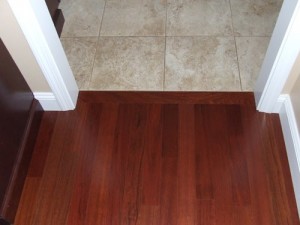 I’d like to share some thoughts on how to transition hardwood and tile floors. Hardwood Flooring has become a very popular DIY project for many home owners. Also every DIY program on television has featured numerous programs on installing your own hardwood and tile floors.
So you might ask why I’m focusing on the floor transition? The answer is simple, I’ve seen so many DIY flooring projects in homes that look really great except for one detail, the floor transition looks awful.
Recommended Reading

Complete Flooring (Stanley Complete) (Paperback)
Whether you’re installing solid hardwood, engineered hardwood, laminate, or tile the issues are all the same. You really need to plan the floor transitions before you start any flooring installation. There are several basic issues that arise at the floor transitions.
You can find many of these transition pieces at: Online Floor Transition Pieces

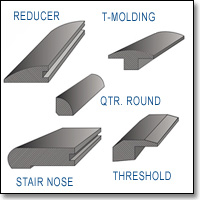
- Elevation – The final floor elevation of each type of material is a major issue that needs proper attention in order for your new floor to look great and not become a maintenance issue.
- Location of Transition -The actual location that you stop one flooring type and start another within a door opening, cased opening or room separation is a very important aesthetic consideration.
- Special Transitions – Stairways can pose some interesting transitions that need special attention and transition pieces.
 Elevation
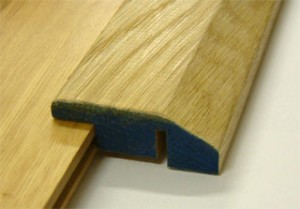
Elevation changes are fairly common in remodeling projects when sub-floors can’t easily be adjusted for different flooring thicknesses. As you can see in the adjacent photo, the use of a transition threshold molding is the easiest way to take care of this problem. This can occur if you install a hardwood floor over an existing floor adjacent to a flooring material that will not be changing.

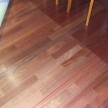










Yes, floor transitions are often botched because they are the last step of the flooring process (absent the shoe molding); therefore, many of us rush the process.
Perry, it’s interesting that I found this comment. My maiden name is Degener as well. I wonder if we are related as I don’t see our last names very often. My grandmother’s name was Mary, my father’s name was Carter William, I had a cousin named Patricia, an aunt named Ruth. Do you know any of these individuals? All their last names are Degener. This is interesting.
I am also installing hardwood floors in my home and I ran across your posting.
Hi we are having 3/4 solid wood floor installed and 5/8″ slate installed next to it. My contractor says the
Slate will be higher than the floor, is there any way to avoid this? I guess I am confused bc I thought the tile
Wild have 1/8″ subfloor underneath and it would all be the same height. Thanks so much for any help.
The tile will have 1/4″ cement board most likely under it, therefore being slightly higher. I’d say the tile will be 1/8 to 3/16″ higher when it’s finished. This is where most situations involve some sort of wood transition strip.
There are transitions that are even more complex. For example, angle transitions from ceramic to hardwood like a fireplace hearth. Also, a doorway transition where the running boards are perpendicular to a doorway.
Hi, I have a situation exactly like the top photo(hardwood and tile floor transition at case opening). What I was wondering is when laying the tile, do I butt right up to the hardwood, or do I leave a grout gap. If so would you use silicone, or grout to fill the gap? Thank you.
@ Stan – I actually left a gap as wide as the grout lines. I’ve seen it done both ways. I just used regular grout. Good luck.
i am being told that when putting a hard wood floor, that i should leave a 1/2 to 3/4 space from the wall. your picture does not have this gap,why. what happens when the wood expands.
Vinny – That is true around the perimeter of each room. If you were to remove the baseboard trim in those photos you would see a 1/2″ gap all around the room. However, it’s not possible to do at door openings without looking awful. I’ve been doing it this way for years with no problems.
with the door you are leaving a gap if you do it correctly. It’s just the gap is under the jam itself. If you are putting hardwood inro your house you should cut the bottom of the jam to fit the flooring under it. Just leave the gap to the stud.
Tod
I am wondering can you explain a little bit about how to get straight flush cut across an already instaled 3/4″ hard wood floor I had already told installer what I wanted and lookes like i was ignored so i will finsh the rest of house myself my idea was to do that first and male straight but was left with of things to deal with.Anything you can tell me i would greatly appercieate!I want it to look like the very top picture on this page when all done tile wood will all be flush and butted.
Help please thank you
carol dawson
Carol – Typically the transition piece is install first and the remaining wood is installed after and tight to the trasition wood.
Todd,
Yes I am aware of that, that is why guy that did it will not be doing rest of my house.I will be finishinerest install myself .I almost have it straited out has not been easy but where there is a will there is a way.
Thank you
Carol
Hi Todd, I have a peculiar Situation, I just installed a floating hardwood floor and want to put caulking for transition between the flooring and tile. Tile is at entry and under wood sove, so 2 edges meet together by float and tile. Wish I could figure how to send pic, what’s the best caulking to use? Every edge has a 1/4-1/2 in gap for movement.
Brenda
I wouldn’t use caulking…it won’t last at all. You need a transition piece that sits over both materials to hide the gap.
Thanks Todd, I appreciate your input.
I have a more complicated tile and wood floor situation since we are using a floating wood flooring that butts up to tile (it’s on concrete). The lines are long and so it will be very obvious. The big issue is whether the transition holds the floating floor in place securely along one side and end. Todd, do you have any thoughts about how to make that transition?
@ Marsha – Without seeing exactly what you’re dealing with it’s hard to say for sure. However, it sounds to me that you need a special transition piece. Have you checked with the manufacturer of the floating floor? Check out this picture
http://www.suite101.com/view_image.cfm/504108
Most likely there is a transition piece that can be glued to the concrete adjacent to the tile.
I have installed a laminate floor between the dining room and family room and am having a great deal of difficulty adding a transition. The problem is that the flooring and tile are curved and the pieces I use look shabby when finished.
Any suggestions? Thanks.
@ Richard – Any chance you could email me some photos?
I’m exp’g the same problem (w/curved tiled) trying to transition to wood flooring. What was your suggestion to Richard?
Can you be more specific?
I understand all the transition strip stuff, but I am having the hardest time finding how to actualy exicute. As in, do I nail, glue, weld???
@ Brian – It really depends on the situation. Lots of times you can just nail them in place, sometimes you need to glue them if you have radiant heat or you don’t want to see nail holes. Do you have a picture of your situation?
Todd, I am researching reducer moldings for a wood laminate – vinyl floor transition. The challenge I have is I need one at least 10ft in length. Everything I’ve found is in the 4-6ft range. I’d rather not segment multiple pieces – the joint always shows no matter how careful you are. Suggestions?
@ Richard – You might be able to special order a piece. However, you’re probably going to have to have it milled or mill it yourself. What type of wood? You’d be surprised how many small mill shops there are around. Ask you local lumber yard.
I just picked up a custom 14′ long reducer in red oak to eliminate a builder’s two-piece mistake in a kitchen family room split. The cost was about $55. Any lumber yard worthy of the name ‘Lumber Yard’ will be able to order longer pieces.
I have a transition dilemma, too. Ceramic tiles are installed in hallway and I’m planning to install hardwood in living room. Imagine the top photo (with no door case) with the ceramic tiles advancing down exactly to the edge/corner of this side of the wall (in other words, extend tiles area by 5-6 inches). How am I supposed to do this? What’s shown in the picture would probably not work for me and the only alternative I could think of – a T molding – would have… awkward ends on both sides. Thanks.
@ Laurentiu – Any chance you could email me some photos? todd@frontstepsmedia.com
I realize this is slightly off-topic, but it is so similar to the topic that I hope you will permit the slight digression. Currently, I have 1/4″ porcelain tiles installed in my kitchen and bathrooms. I have purchased 3/8″ porcelain tiles which are to be installed throughout the remainder of the house. So, the news tiles will be 1/8″ higher than the “old” tiles. Should I use an elevation transition similaar to the shown in your article, Todd? If so, is wood acceptable to use or is there a better solution for porcelain tiles?
After several hours of searching the internet, your piece, Todd, was the closest one I could find that addressed a similar problem. I would be most grateful for any feedback you are willing to supply.
@ Dorothy – Great question and it certainly fits the topic. I’m torn on this one, I think you may find that the 1/8″ difference is so small that it doesn’t end up needing a transition. In fact, the photo in the article shows my transition from wood to tile and there is a very slight 1/16″ to 1/8″ difference (tile higher than the wood). We don’t even notice it a bit. I’d try setting a few tiles down and trying it. I think you’ll have a hard time finding a transition piece. Do you have any of the old tiles left over (spares)? If you do you could take up a row of the old ones and make the transition with thin set? I think a wood transition would look a bit strange. Good luck!
I have a more complex transition:
We’re installing replacing a floating engineered floor in the living room and hallway. How should we transition from the floating floor to a stairwell, with railings?
The house is a split entry, raised ranch, with a standard floor plan. You walk in the front door, to a landing. To the left, a half flight of stairs down to the basement. To the right, a half flight of stairs up to the main level of the house. The living room is to the right, with an open railing, about 8 feet. The hallway runs to left, with an open railing about 3 feet. So the stairwell is roughly 6 feet wide and 8 feet long, and creates an L shaped opening in the floor.
Currently, we have 3/4″ hardward floors, nailed down. The railings are mounted directly to the floor. The railings can be removed and reinstalled or even replaced.
The new flooring will be floating, with glued edges. (Why not use 3/4″ hardwood? Because we’re installing radiant floor heating below, and because the subfloor is 3/4″ wood planks, covered with 3/4 particle board.)
Could we anchor the floor around the stairwell, by gluing it down?
Otherwise, it seems we’d have to use a transition moulding between the floating floor and solid wood around the stairwell perimeter.
Sorry about the long post. Thanks for your advice.
@ Mike T – without seeing your actual application my first thought is to create some type of “curb” to re-mount the railings to. This new wood curb would need to be slightly higher than the new floating floor. This way you could but up against the curb with the floating floor and use a piece of quarter round or similar to cover the transition. The hard part however is at the actual stairs. This is tough for a couple of reasons. First off when you raise the new floor you raise the “rise” of the last step up and this can be somewhat dangerous. Most building codes only allow a small deviation in rise from one step to the other. Having said that I would imagine the floating floor manufacturer must have some type of transition that tapers down to a very thin piece that you can place in front of the steps.
Does any of that make sense? Thanks for the question!
Thanks Todd, that could work!
Yes the flooring company does have a stair nose moulding.
The existing floor is 3/4″, the new floor (with pad) will be maybe 1/8″ lower.
Thanks again.
I need to transition from a tile kitchen to a hardwood dining room. The tile floor is close to 1/2″ higher so a simple T doesn’t work. I was thinking of using a wood threshold piece with the portion that normally rests on top of the wood actually sitting on and overlapping the tile. The other side of the threshold could be dado’d to the right height to lay on top of the wood. Would this work and look OK or do you have a better solution? I prefer to have the tile edge covered because it is not perfectly aligned.
Thanks,
Don
@ Don D – I suppose this solution will work. However, I really don’t like the fact that you’re going to have 3/4″ to 1″ difference between the wood and tile. This may end up causing quite the trip hazard. Any chance you can have the top of transition flush with the top of tile, leave a 1/4″ gap between the two and grout the space? Grout does a great job hiding/blending uneven tile layout.
Point taken about the trip hazard. I think your suggestion would work better. I’ve also seen some wood reducer transitions that could accomodate a 1/2″ difference. These appeared to have a rounded profile rather than the squared off profile I’ve seen with the threshold pieces and might reduce the trip hazard.
Thanks,
Don D
Todd – I’m liking the suggestion of a flush transition and grout seam. I found an unfinished reducer for 3/8″ flooring that when reversed would fill the ~ 3/8″ gap nicely. I’d just stain to match my pre-finished flooring. I have grout left from the tile project and I’d rather do that, but is there any concern that grout would be too rigid and crack or separate during thermal expansion? Would some sort of caulk be more durable/flexible? I’d probably have a problem color matching the caulk so I’d rather not get into that.
Thanks – Don D.
@ Don – You can get sanded caulking now. Not sure how easy it will be to match. I did my transition this way with grout without any problems. Depends on how stiff your floor is. Be sure to use a sanded grout at the very least.
Have you ever seen / recommend fastening one side of a laminate floating floor if you’re looking for a clean transition, and would prefer not to use one of the wood transition pieces? We’re thinking about either using a sanded caulk that matches the grout for the tile, but additionally, thinking about securing the transition side of the laminate to the sub-floor (wood) – leaving all the expansion to happen on the wall-side, where we can better live with the gap concept. Never done this, so one concern is of course, fastening one side securely may present possible cracking, etc – but its sure seems like a cleaner finish – any thoughts on whether this has been done / works / is durable?
Thanks,
Chris
Chris – I haven’t seen it done before. However, I guess my answer would depend on the distance to the opposite wall and how great of a temperature / humidity swing you typically have in your home.
I also was looking at sanded caulk to make the transition. Did you try it?
Gary – I’ve used the sanded color matched caulking before with good results.
Todd,
I’m doing engineered hardwood in my parent’s living room and hallway. The ajoining bedrooms have carpet that have a metal edge that separate the bedrooms from the current hardwood that exists in the hallway. The metal edge is short in each room and it will not allow the carpet to come to the appropriate location directly under the door. Any suggestions how I might transition this area since the carpet will not be replaced? It will not stretch enough for proper transitioning.
Tim
@ Tim – Why not install a narrow piece of additional hardwood between where the hardwood should stop and the existing carpet, re-install the metal transition, then when they change carpet some day they can take out the small piece of wood and install the carpet to where it belongs?
Have a slate entry and putting in hardwood on adjoining living room with door between. Wood will be 3/4″ higher. How does it work to plane out the higher wood for 12-16″ to eliminate the trip problem?
@ Karen – Not sure, never seen it done. In our first home we had a slate entry that opened onto new 3/4″ high wood, it wasn’t too bad actually with a proper transition piece.
Todd,
We will be removing our carpet and staining the concrete in a portion of our house. How can we transistion from concrete to tile? Two areas will have doors (bathrooms) another area is kitchen to formal livingroom.
@ Grace – A simple metal transition strip, fastened to the concrete will work.
Hi Todd, Thanks for the transition suggestion. This may be a little off topic but I thought I’d give it a try. We’ve purchased our supplies for our concrete stain project as I mentioned above (non returnable), only to find a lot of paint covering the concrete. Any suggestions for an easy way to remove the paint?
A water leak ruined an area of our laminate flooring. Rather than replace the entire floor, we are trying to come up with a way to put another type material (tile, stone, etc.) in the damaged area and keep the undamaged laminate. The ruined area is approx. 10′ x 15′, but it is a part of the same great room. The remainder of the room (including kitchen, breakfast area, foyer) is laminate. Any decorating ideas?
@ Rue – Sorry to hear about the damage. Some people actually install decorative tile that look like area rugs and special designs. Maybe something like that?
Hi Todd,
What would be your suggestion be on handling the expansion gap needed for floating laminate hardwood transitions? I really like the smooth transition as shown in your photo examples. I just don’t know how to create that same effect with floating laminate material that requires expansion gaps around the perimeter.
I’m planning to install floating laminate hardwood in the basement that has sections of ceramic tile (3’x8′) in front of the sliding patio door and around the wetbar.
@ Terry – I haven’t actually seen this particular transition. However, my thoughts would be to think about what the expansion does. It allows the product to expand and contract due to thermal and moisture movement. So, if the other end has sufficient space for movement then I’d be inclined to but up tight to the tile. It’s also possible that the floating floor companies have some type of “pocket” or “receiver” trim that could be installed tight to the tile which allows the laminate to move. I wish you luck.
I have one that has been killing me for a while. Similar to Don above. My family room has a parquet floor that runs up to the kitchen through a case opening. The tile floor is actually nearly an inch higher than the wood. To further complicate it, the wood is not entirely level throughout the opening. I can send a picture if needed. Any thoughts as to the best way to make this transition?
Thanks!
Alan
@ Alan – email me a photo and I’ll take a look. You can find my email in the contact forms.
I am considering installing cork flooring over existing vinyl flooring in the kitchen. But then I need to transition to bamboo hardwood flooring in the dining room that will be 1/2″ lower. Is this a problem? Or should I rip out the existing kitchen flooring plus the subfloor?
@ Don – The transition height probably is not a problem so long as you can buy the correct transition piece or make your own. I’d be more concerned about whether the manufacturer recommends going over the vinyl and depending on the age of the vinyl whether it has asbestos in it or not. Good luck.
Ok here is my problem and there are two parts. I am putting laminate wood flooring down in my dining room and also thru the kitchen. The first problem is that like others have posted the flooring is much lower then the tile I have in the foyer. There used to be carpet in the dining room so where the tile stops is a very thin gold transition piece that cannot come out, so how do I transition the tile and laminate. The second problem comes into play with this transition also. I know that many people put ply wood down to make up the difference, but my problem is that the kitchen leads into the family room that already has the same laminate flooring (we put this in several years ago). Not knowing that we would eventually do the kitchen and dining room we didn’t thing about the transition. So if we were to put the ply wood under the dining room and kitchen laminate, when we got to the family room that flooring would be to low also. Do you have any suggestions on how to go about this? Thanks.
@ Amanda – Not sure how to answer without seeing photos. I myself would definitely install an under-layment under the new floor. Keeping floors as close in elevation as possible helps reduce trips and it looks much nicer.
I was hoping someone could help me out with my problem. I have existing hardwood floors in the dining room and we recently laid a floating floor in the kitchen and I need to transition between the two. The floating floor is about 3/8 higher than the hardwood. I bought a reducer and it fits well but the question I have is how do I secure the reducer to the vinyl floating floor and the hardwood? Any help would be greatly appreciated!
Thanks!
@ Pat – Can you email a photo?
We want to remove carpet and install vinyl plank flooring. We have a wide transition step about 3 inches high. The top edge of the step is rounded with approximately a 3 inch radius. The front corners of the step are curved with approximately an 8 or 9 inch radius. It is not possible to remove and replace the step. Would it be possible to gently heat the vinyl planks with a heat gun and mold them around the edges and curves? In this area only, we would probably not worry about the floor floating and just glue it on the step with a proper adhesive. Do you think that would be okay? Thanks for your advice.
@ Lee – Without seeing photos of the step and specs for the flooring it’s hard to say. What material is the step currently? Maybe you could paint it instead?
The step is made of concrete. Painting it might be an option. Thanks for that idea.
@ Lee – Maybe you could remove the concrete step and build a new wood one that would be easier to cover with the new flooring.
Hi Todd,
We’ve been trying to find information on transitions for a while and luckily just found your site. We are going to be installing cork floating flooring in the upstairs over subfloor (new construction). The manufacturer requires 3/8″ spacing against all walls, doors, etc. Our question relates to where the cork floor reaches the top step of the stairway, and where it would meet stairnosing (we assume we would be using wood). There would be a large difference in height between the higher stairnosing and the lower cork floor. What kind of transition will allow for the gap required between the stairnosing and the cork, and the height difference between the stairway and the cork, without creating an unsafe rise in the floor right at the top of the stairs? Thanks for your time!
@ Diana – Thanks for stopping by the site. Your situation and questions are not unique to the flooring industry. The 3/8 inch gap is to prevent buckling of the floor due to expansion from temperature and humidity. However, I wouldn’t worry about the gap where it meets the stair nosing. Most builders will determine the height of the stair nosing and flooring product during construction in order to shim them correctly to make them flush. Is your stair nosing already in place? If not you could either trim the stair nosing to make it thinner or you could trim the sub-floor so the nosing sits down. You really need to make sure the two surfaces are flush or you’ll have a very nasty trip hazard at the top of your stairs. I hope I’ve helped! Good luck.
Todd,
I am installing a bamboo floor next to a tile floor. I am gluing down the bamboo to concrete, so it shouldn’t be able to shift very much. My question is thus, can I but it lengthwise next to the tile (which is at the same installed height) so it looks the nicest, or do I have to leave a gap and put in a “undesireable” T-moulding transition piece. The joint between the 2 floors is 16′ long.
Brian
Brian – Even though you’re gluing the wood it’s likely to move a big with temperature and humidity changes. Why not leave a space and grout the space as I did?
I’m having new hardwood floors installed. They will end up being 1/2 to 3/4 of an inch higher than the previous floors. The issue is the front door that opens into the apartment. My contractor says he will just shave the bottom of the door. It’s a metal door! Is this a normal solution to my problem??
Thanks for your help!!
Marie – If it was a wood door you might be able to take 1/2″ off. Metal door won’t be that easy. I would suggest getting a sample piece, seeing how much interference there is and you may be able to reset the door depending on how old it is. This would involve a few hours of work for an experienced carpenter.
Hi Todd,
I need your advice. I am replacing carpet with hardwood in a corridor and there is a doorway to a bathroom. There are ceramic tiles with Schluter trim in the bathroom. Tiles are 3/16 higher than the hardwood level. Hardwood planks are coming parallel to the doorway from an opposite side. There are 2 problems I face. 1. How to fit a hardwood board to tiles face to face without a gap. Should I cut off a tongue from the last to the doorway board and then put in a doorway space board?
2. How to level not significant but still may be dangerous difference between floors. Will latex compound under the doorway board work, can I glue to the compound?
Thanks for your time!
Vlad – I’m having a hard time understanding all your constraints. What will the wood match up to at the other end of the hallway? Sounds like you may want to shim the entire hall up 3/16″ with a thin underlayment.
Hello Todd,
We would like to install hardwood floors in our hallway but the transition from tile (in kitchen) to hallway (leading to bedrooms) is a tough one since there’s unparallel wall-ends. Is it tacky to start the wood at an angle? There’s about a 3 ft. diagnal.
Thanks so much…looking forward to your advice!
Vicki & Gregg – First off your hardwood should run parallel to the hall walls. It’s never a great idea to run it perpendicular because it creates the “ladder effect”. So what I prefer to do us install a transition piece followed by one piece of the wood flooring parallel to the transition piece. Then all of the hall wood should run into the two transition pieces with an angled miter cut on them. Make sense?
Thanks Todd! Alright…we think we understand but have a second question. If we bring the hardwood out all the way so that it is parallel to the hallway instead of angling it, the hardwood would be splitting two tiled rooms (kitchen & family room). Is it aesthetically okay to have about 3ft of hardwood come straight out of the hallway between the two tiled rooms? (We have pictures if you need to see what we’re referring to…we just don’t know where to send them)
Vicki – email me the photos: todd @ frontstepsmedia.com
Todd, we emailed you some pics this morning. Just making sure you received it in case it went straight to your junk-mail file.
Vicki – I did get them. Can you try and explain the limits of wood you want to install now that I have the photos?
No, they ran the board parallel to the door.
We are going to start installing a 3/4″ solid wood floor. My friends just installed one about a year ago and in viewing their floor their installer butted the floor right up against the front door. I like this look instead of a transition piece and they have not had any problems so far. Have they been lucky or is this an okay practice?
Thanks,
Janelle
Janelle – Do you mean they ran the boards perpendicular to the door threshold? If done properly that is absolutely an ok way to do it. Frankly the other way in the photo allowed us to have a single solid piece to grout to for the tile.
I’ll try and send a picture to your email account.
Hello:
I am getting hardwoods installed in my split on Monday. Right now, there is a ceramic tile strip leading from my front door, into the kitchen and there is tile butted up against the tile (carpeted area is the living room. I am debating whether it will look good leaving the strip of tile (4 tiles across on the diagonal) where it is, or since this would be part of the living room (no separation) should be removed with the exception of a small area being left (foyer area) at the front door. We just purchased this home, and when we moved in, the tile was already there as part of the living room. Seems a little complicated, sorry, but I am confused as to whether to leave this walkway in place since it is butted up against the stairway leading to the upstairs bedrooms. Would it be a bad idea to have wood at the bottom of the landing since this is a traffic area?
Please help.
Thank you
Fran
Fran – Tile “walkways” were once very popular. Today we don’t see them very often. Most wood floors are durable even in high traffic areas. I say choose the material type you like most and be sure it’s a good quality.
Todd,
I am installing hardwood in my foyer that will be parallel to the wall but on an angle to the kitchen tile. Currently I have the hardwood meeting the tile with a t molding. Is there a way to not use a t molding even though the end piece of the would will be an angle cut. I have attached pictures. I am removing the tile in the foyer and putting hardwood down.
Thanks,
Mike
[IMG]http://i11.photobucket.com/albums/a187/c25cres/IMG_6585.jpg[/IMG] [IMG]http://i11.photobucket.com/albums/a187/c25cres/IMG_6584.jpg[/IMG]
[IMG]http://i11.photobucket.com/albums/a187/c25cres/IMG_6583.jpg[/IMG]
Mike – I would transition it the same way I did in the photos in the article. I would run a piece of flooring perpendicular to the wood and butt into it. Then but the tile up to that piece.
I have a split entry house. I was going to install lock n fold engineered hardwood in my kitchen and dining going through the 30″ doorway between the two rooms. However, I found that the joists in the kitchen are higher than the ones in the dining room (the highest being 3/4″). Yes, they got the subfloor to bend to drop 3/4″ between adjacent joists. If I build up the dining room to match the kitchen, then I’ll have an equivalent 3/4″ transition the full 10′ length between the dining room and living room. The only option I see is to have a 3/4″ transition in the doorway between the kitchen/dining rooms. I will try to get a custom transition made so both floor can float and it will be a tapered step. Do you have any other ideas? I read your response above about mill shops being around – I thought I might have to try to make my own transition.
Thanks
Greg
Hello, Todd
I just had hardwood installed throughout my house. In my foyer, they placed wood over existing linoleum. They removed carpet in the living room and hall and placed wood. The foyer runs into these rooms. Wood in the foyer now appears to be aprox 1″ higher than wood in living room and hall. They have placed a piece of wood between rooms in transition area. They said they will mill down when they sand and place stain. Question: should there be a difference of this much in height between floors. They placed over linoleum but it is very thin.
Lynn – Most likely the linoleum has an under-layment under it. Most flooring installers will install a 1/4 inch to 1/2 inch plywood under-layment which gives them a very good gluing surface. Without seeing the situation that would be my guess. Did their quote not include removal of the old floor? Did you discuss that with them prior to the job? Often times contractors will avoid the linoleum for fears of older flooring that might be under it containing asbestos.
The other situation could in fact be another layer of flooring under the linoleum.
Todd, no asbestos, built house in 1992. I did discuss removal of carpet but contractor said that the wood would lay over linoleum nicely and that linoleum would provide good moisture barrier. He did not say the wood in foyer would be so much higher. I will be contacting contractor to see what can be done. Thanks for responding, Lynn
Lynn – Good luck.
Todd
I posted the question on July 14 which tells part of my issue, which I thought was only to make a big transition. But to add to it, I have to flatten my kitchen subfloor which drops 3/4 inch from the first joist in the kitchen to the first joist in the dining room which is 16 inches wide and the length of the kitchen – 12 feet. I was going to add plywood strips to build it up to within about 1/4 inch of flat. The plywood strips would be like little stair steps. Then I was going to use self-leveling mortor to flatten the ‘plywood steps’. But thess compounds are leveling and not flattening. My kitchen floor is flat except for the 16 inches from the first kitchen joist to the dining room’s first joist, but it is not level. If I use one of these compounds, the 16 inch width will be level but the kitchen floor will not be flat. I also noted these compounds, when used on wood subfloor require ‘plastering mesh’ to be applied which will add thickness to what I am doing. This is hard to explain, so I hope you can see what I am saying. What options can you propose for me to flatten the 16 inch wide by 12 feet long section of my kitchen floor (adjacent to my dining room) that slopes from zero incles to 3/4 inches in the 16 inch width since the builder bowed the subflood between the adjacent joists that have a 3/4 inch hieght difference.
Thanks
Greg
Greg – I’m a bit confused of exactly where the elevation differences exist. Am I correct in assuming that the dining room is 3/4″ lower than the kitchen? and that your living room is also lower than the kitchen by the same 3/4″?
If that’s the case and both sides are level then I would try to remove the old “transition” and recreate a 3/4″ jump in elevation at the doorway. Then make a custom wood threshold transition piece to make up the 3/4″ difference.
Is it possible that the kitchen has an additional layer of sub-floor or older flooring material under it? If this is the case the solution may be pretty simple by removing the old flooring.
Do you have any photos of this? might be easier to understand.
Todd
I’m sorry. I confused the issue by discussing the living room, so let’s leave it out of the discussion. The dining room and the kitchen are adjoining and should be at the same level, but the builder (30 year old house) put the first joist into the kitchen 3/4″ higher than the dining room joists and continued the mistake. When they installed the 5/8″ plywood subfloor, they bowed it down 3/4″ in the 16″ span between the kitchen joist and the dining room joist, covered the kitchen in vinyl and the dining room in carpet, and we never noticed since there is a wall separating the two rooms and a 30″ wide doorway inbetween. Now I want to lay a floating laminate wood floor. The dining room subfloor is flat (but slightly unlevel) so the floor will lay good in there. The kitchen is flat (but slightly unlevel) except for the 16″ span where the subfloor bows down 3/4″ to the wall and the doorway. I wanted to lay the floor as one piece through the doorway, but I can’t because of the difference in height so I must ultimately have a 3/4″ step at the doorway (I have no ideas to make it flat between the dining room and kitchen so I’ll make a transition). The big question is, how can I make the 16″ wide by 12′ long section in the kitchen with the bowed-down plywood subfloor flat with respect to the rest of the kitchen floor (this section of the kitchen floor runs parallel to the dining room joists)? I was going to use self-leveling mortor, but that will pour level and flat. Since the rest of the kitchen floor is flat but not level, this self-leveled section will be out of the flatness specification for the installation of laminated wood flooring with respect to the rest of the kitchen floor. Can the self-leveling mortor be mixed thick so as not to pour but be troweled to be flat and unlevel with the rest of the kitchen floor. I thought about using 1/4″ plywood strips to fill in and step it up and then fill that using self-leveling mortor so as not to have as thick of mortor but I still have the level versus flat problem. Yes this is confusing and hard to explain. It is amazing that somehow the kitchen and dining room floors are at the same height as all other adjoining rooms and hallways.
Thanks
Greg
Greg – I’ll send you an email. Can you email me some photos?
Hi-We had a floor guy refinishing our wood floors and he accidentally ‘burned’ the adjoining nylon carpet along the threshold. I have suggested he use some extra wood we have and put in a piece to make a wide threshold to cover the damage. It will then be the entire door instead of half. He seems reluctant to do this. Do you think this solution will be horrible?
Janice – Not really….without seeing it I can’t really tell for sure. Maybe he’s not much of a wood floor guy?
We have laminate wood floors installed in the dining room. The transition stip between the laminate and the linoleum in the kitchen was glued down with liquid nails. It has lifted already and it’s only been 2 days. Our neighbor has the same problem in her place.
What can we do to keep this strip glued down?
Michele – I would personally nail it down if it were mine. However, you’d need to be careful where you nail it. The nails should be installed so they miss the floating floor or you stop the floating action. What does your flooring guy say? or was this a DIY job?
We paid to have it installed. I’m having them back out today because I’m not happy with it coming up so soon. There is concrete under the floors. Not sure if I can nail it?
In the bathroom it sounds “squishy”. What would cause that? It doesn’t feel bad but it does make a noise when you step on it.
Michele – Typically most flooring guys will use a flooring contact cement for things like that on concrete. The squishy sound is probably the pad under the floor.
Thanks for your help. So the squishy noise is nothing to worry about? Will it lessen over time?
I would ask them about it. Hard to say…floating floors have a tendency to be noisy….at least ask them and see if they can fix it.
Hi:
We’re doing a tile ‘inlay’ in a corner for a woodstove hearth within a 3/4″ hardwood floor. We don’t want to build a platform for the hearth as we want a more seamless transition. However, stove installer says we need a 1/2″ backerboard adhered to subfloor. With 18″ tiles we chose, we’d also need 1/2″ of thinset. Ultimately, this will be almost an inch higher than the surrounding hardwood. I have a suspicion that this height may be difficult to overcome with a simple reducer strip. Your thougts on a transition?
Glenn – What type of hardwood? Can you cut a custom transition?
It’s an oak floor. Not sure about cutting a custom transition, skills-wise.
Glenn – Another choice is using Schluter mat for the backer instead of hardi. It’s much thinner and easier to install. Total install depth can easily match 3/4″ wood.
http://www.homeconstructionimprovement.com/schluter-ditra-tile-underlayment/
Having engineered wood put down along with new tile in bath they are putting a t-molding at the transition…. hate it! their is a slight height diff. Are their any other options… The T-Mold is not installed yet but soon.
Jerri – It really depends on the height difference. If the difference is an 1/8 inch or less then I typically like to but one up to the other as I’ve shown in the photos above. If there is more of a height difference you can either use a T-Mold or install a full width wood threshold like the old days!
(sorry if this is a resend – had trouble with the other browser.)
I need to put something in the gap in the flooring created by removing a wall between the dining and living rooms. This gap will be about 7’4″ long, and 5 1/2″ wide when the rough edges of the adjoining wood are cleared away. The hardwood is good quality, and about 40 or 50 years old. I am looking for the simplest, good looking solution.
I think that putting in some other hardwood would be very difficult to do without refinishing the whole floor, which is too much effort for this job I think.
I am thinking that putting in tile might work. It’s 3/4″ to the subfloor, and the tiles I like are 3/8″. So I could put down some 1/4″plywood and with a little help from grout, the tile should come up level with the floor.
but my main questions are about the transition between tile (grout) and the hardwood:
– Can I put the grout right up against the wood? Will the water damage the wood?
– What do I need to do about thermal expansion space? How does that work with the grout?
Tracy – Sounds like an interesting situation. Tile can work in that situation, the minimal amount of water in the grout won’t effect the wood. I would keep the grout width to a minimum at that location to help with shrinkage.
Hi,
I just installed tile in my kitchen and it adjoins our oak hardwood floor in two locations. After installing the subfloor, backer board and mud for the tile, the tile sits 3/4″ higher than the wood in both locations.
Since I have already laid the tile, what is the best way to transition between levels? I think I have heard of overlap reducer transition moldings that cover up to a 3/4″ height difference, but I can’t seem to find any that are greater than 1/2″ or 5/8″. I am hesitant to use a transition molding that goes flush with the tile because the transition may not look smooth and/or the grout between the tile and molding may crack with expansion.
Any suggestions or opinions would be helpful?
Ryan – I would just go flush and order caulking to match the grout. They make sanded color matched caulking now that’s perfect for that application.
Todd – My husband and I are wanting to create an opening between our dining room and entryway. Our entire flooring kitchen, dining room, entry way, and living room are all already covered with laminate flooring. What kind of transition ideas do you have for the gap that would be left (wall width) in the opening if we take out the wall. We’ve been completely stumped with this. Replacing the flooring completely is not an option. Any suggestions would be greatly appreciated.
Gina – Who installed the laminate? It’s quite possible that the gap could be filled in with additional laminate that would look pretty good.
We had a local company install about 4 years ago. The flooring runs perpendicular to the wall, do you think that’s still a possibility? The room on one side of the wall is about 10ft wide and the area on the other side of the wall is only about 3ft wide.
|___________||____|
Gina – If I had to guess they would probably recommend tearing out the 3′ wide section and then blending back to the larger room.
Hi Todd,
I have a basement stair that is currenty being renovated to have hardwood installed. My question is what happens when I get to the top of the stairs – (the stairs enter into the kitchen area) the kitchen is tile. Currently on the existing floor (which will be ripped up) they have used a metal tile edging product (schulter) that is the stair nosing.
Is this the best way to transition to the tile in the kitchen my only concern is whether this will look good once we have the hardwood on ever stair except for the top step!
Thanks for your advice!
Alanna
Alanna – I would install a hardwood transition nosing and then tile up to that. That nosing is generally only about 2 to 3 inches wide.
Hi Todd:
I am having pre-finished hickory floors installed this month in my living room, dining room and hallway. I am also having my entryway between my living room, dining room and hallway tiled. My tile guy wants to frame the tile with hickory (like a picture frame with mitred corners and the hickory frame running perpendicular to the living room and dining room flooring and parallel to the hallway flooring. My hardwood guy says we must install t-molding between the tile and the hardwood to allow for expansion. My tile guy says it’s far better and more attractive to have a flat transition between the tile and the hardwood. My hardwood guy says without the t-molding (which is rounded on top) the wood floors don’t have enough room to expand and might buckle. My tile guy says my hardwood guy is just trying to sell more product. My hardwood guy says the warranty is voided if we don’t do it his way. I would really rather have a flat transition between the tile and hardwood, but don’t want to do anything that will mess up my very expensive floors.
What should I do?
Lori – Well….they are both a bit correct. Having said that I’ve seen many floors done as your tile guy suggests. I would ask the guy if he minds doing a grout joint between the picture framed wood and tile. This does allow for some minor movement.
Couple other questions.
1. How long has the wood been acclimated to the house?
2. Do you have radiant heat?
3. What is the framing and sub-floor construction?
4. How wide of a room is the wood where it abuts the tile?
Hi Todd,
I have a curved tile area which I’m intending placing engineered wood up against. Is there a trim available to transition the two or is it a case of having a neat cut on the wood to meet up against the tiles and fill with Grout / Sealer??
Cheers
Sam
Sam – You’re going to have to do a neat cut or fabricate a custom curved transition piece.
i am opening up wall between kitchen/dining room. dr has old (1940’s) hardwood and will install ceramic tile in kitchen. i pulled up 2 layers of luan from kitchen and plywood floor is somewhat degraded. contractor said to just put thin layer of new plywood over this BUT i am worried about the height differential (up to 1/2 inch or more with tile, ditrex, and thin new plywood layer). why wouldn’t he want to pull up and replace old plywood?
Because most flooring guys don’t want to get into replacing a sub-floor. They just want to lay down a thin layer over the old. How bad is the old sub-floor? What thickness is it? What size floor joists?
Todd, I’m in desperate need of transition strip advice from a thick terra cotta mexican tile to stained concrete. The tile has been laid for years and we are removing the existing carpet and applying a concrete “overlay”. There will be a difference of appx 1/2″-3/4″ from concrete to tile. I asked the installer about slightly sloping the concrete to the tile and he said he’s done this before and it looks unfinished. Any suggestions? I need something in a pretty quick time frame.
Jennifer – How wide of an area? Could you buy a decorative piece of bullnose tile and use it as the transition?
We have knocked out a wall between kitchen and living room. Living room is in floating laminate flooring and kitchen in tile. We don’t have any left of either. Been down about 20 years. What can we use to fill in this 4 inch gap where wall was before? All the laminate floors I have found are very thin and will not snap into our existing laminate flooring. Need any advice since don’t want to have to take up either floor and start over.
You should build a wood threshold. If you can’t make one yourself you can have a local lumber yard mill one for you.
Just had wood floor installed in my living room, it meets the kitchen that is painted overlay concrete, the concrete is lower than the wood, the installer glued a transition strip but there is a lip on the wood side, he said there is no other solution i was wanting it all to be flush, what are your thoughts.
thank you inadvance
Beverley
He’s not entirely wrong. For the floors to be flush you’d have to build the house framing so that the two ended up flush. You might be able to make a custom transition that has a smaller lip but there will be a lip.
Thank you, yes what you say makes sense.
Todd,
I am installing hardwood in our dining room hallway and entrence way.
One side of the hallway has stairs going down and I have a bullnose for it.My question is do I put the bullnose in firts and start from there or should I start across the hallway as it is the longest wall and make the bullnose fit at the end?
Thanks
It depends in part on which direction the wood runs. If the wood runs perpendicular to the nose it really doesn’t matter as you will be cutting each piece of flooring to end at a straight line. If it runs parallel you’ll want to try and figure out where the flooring will end so that you have close to a full piece of flooring before the nose. If you do not, you might want to start with a partial piece on the long wall to help when you finish at the stairs. Make sense?
Hi Todd – hope you can help.
We purchased a home that had 1/4″ tile directly installed over plywood underlayment (no backer board) in the entry, kitchen, dinette, office and around perimeter of the great room – about 800 sq. feet. The great room and dining room both had carpet.
After years of tiles kicking up, tripping up, skittering across the floors since they were wrongly applied to just plywood, we finally had enough. I spent the last week pulling up all the tiles and sanding the floors to new. Started removing the carpeting in the dining room and great room and discovered they were 3/8″ lower than the tiled area. Apparently he added a 3/8″ layer of plywood underlayment for the tiled area.
Now my question – We don’t have the budget to cover adding 3/8″ plywood to both the dining room and great room (600 sq. feet), so we were thinking of only bringing the great room up 3/8″. We have a doorway to the entry way to dining room; and a double doorway from dining room to great room.
With all your talk of transitions, I’m wondering if I’d be able to put in a nice transition from entry to dining room and then dining room to great room and still have it all look okay since the 7mm laminate (with 2mm underlayment) will be the same in all rooms. Only the front entry will remain in the 1/4″ tile. The laminate floating floor would be the same in the dining room as the great room. What kind of transition would you recommend and do you think the difference in height will look odd to step down?
Thanks much,
Michelle in Ohio
Michelle – Sounds like the previous person tried to install the tile correctly but didn’t really understand how to do it properly.
I’d say you have a couple options.
1. Tear out all the 3/8″ underlayment where the tile was. This will be tons of work but likely the cheapest solution.
2. I hate to say it but buying additional 3/8″ underlayment for the carpeted areas is likely cheaper than buying tons of transition pieces.
3. Transitions of that quantity just won’t look nice. I’d HIGHLY recommend you find a way to make it level or wait until you can afford to do it correctly.
Best of luck and Happy New Year.
Hello Todd, I am doing a floor almost identical to the photos you have published on this page. I finished up with a couple of rows last night. It is an area that will be under a door to a laundry closet area. I am skeptical that I have done this incorrectly. Is it mandatory to do a cased opening in this situation or will a grout line work fine for the transition? I used the same spacers I used for the tile (1/4″). The plank ends are facing the tile with a 1/4″ gap in between.
Carson – It’s not mandatory but….having grout butt up to each of the butt ends of the wood usually ends up bad. There’s so much movement in the wood that the grout ends up cracking. Having said that it depends on the wood, how stiff the floor is, humidity levels in the house, etc.
I see, thank you for the feedback. Considering what you have said, I was actually going to use the polyblend caulking(color matching actual grout) to finish the seam from wood to tile. Wood type is Bellawood Brazilian Redwood (almost thier hardest wood), glued down using Ultrabond 995 to concrete foundation substrate. Humidity levels in the house are low. Would these factors point to safe implementation of this idea?
I think it’s safe, its just how well that joint will hold up. You might need to do it over every couple of years.
Hello Todd,
What happens if regular beige masking tape is used to tape the floor insted of blue painters tape?
Thanks
Hello Todd,
So I have been installing Bellawood, by gluing it down to the floor. I am noticing that on various joints, the two planks come together, and dip down at the seam. Making a “V” type dip at the seam. Is this because there is a different glue amount under the flooring when the two boards come together, making a slight dip? It is a significant enough dip for me to notice when I walk on it. Or is this typical, and not so out of the ordinary?
Thank you,
Hello all, any suggestion would help in my situation. I was planning to cover the entire living area on the first floor of my home with laminate. The original floor has vinyl kitchen surrounded by two rooms carpent and one room hardwood. My thinking was to take up the hardwood and carpet but the vinyl could stay down and laminate right over it. Upon pulling out carpet and hardwood it is evident the kitchen vinyl is elevated about 3/8 to 1/2 inch???what to do now….i really dont have it in me to raise the entire subloor to make it even. will a reducer/transition take care of this issue on all three sides of the kitchen without there being a noticable “drop” Thanks all, Justin
Justin – From the sounds of it you already know that there are two solutions. Either raise each floor to match a central height or use a transition. You can easily transition 1/2″ to 1″ without a huge noticeable difference. Anything more than that becomes noticeable and a trip hazard.
Todd, I have a transition delimma. I will be having 3/4 inch tall hardwood installed that will butt up against 1/2 high pre existing ceramic tile. This leaves me with a 1/4 height gap. I do not like the standard transition look and would love some suggestions on how to make it look flush or as natural as possible. I have one transition that is over 24 feet long. I will be running HW parallel to all transitions. If I use silicone sand for transition (1/4 thick by 1/4 inch high), will this work or be hideous? Can I use a standard flush reducer but have it ripped so it tappers to 1/4 inch height and place it flush with tile (even possible?). Or even butt flush reducer up to tile and fill in height gap with silicone sand? Any ideas would be greatly Appreciated. An installer told me he might be able to use a thin peice of wood with an angle on it (is this common or possible?). He also laughed at using grout saying you don’t want to use grout against wood. Further confusing me.
Thanks in advance.
Steve
Steve – That’s a very long transition. Depending on the type of wood and finish I’d be inclined to cut a 1/4″ chamfer in the last board. This can be done on the table saw easy enough. Not sure how wide your flooring is, let’s say it’s 3″ wide, I’d try to make that chamfer 1/4″ x 2″ so it looks fairly natural. Then you’ll have to touch up the finish on that board.
I would likely use a sanded caulking between that and the first tile edge.
Good luck.
Todd,
I’m about to install 3/4″ hardwood floors in a living room that meets my kitchen through a 30″ opening. I installed the kitchen’s ceramic tile myself using Ditra matt (no backer board). Because of this, the total height of my tile is only about 1/2″. The adjacent living room was carpet when I installed the tile, so I used a Schluter triangular metal transition piece to slope downwards to the old carpet (which was lower and pretty matted down).
Now that I’m ripping up that old carpet and putting in the 3/4″ wood, the wood will be quite a bit higher. I’ve seen the reducer strips, but they look like they are designed to reduce all the way down to the subfloor level. But I need it to reduce only down to my 1/2″ tile installation. I’d also like to find something wide enough to straddle and cover my previously installed metal transition so I don’t have to bust up those tiles to pull it out.
Is there anything that exists like this? I’m having a hard time finding any solution for this problem.
Jon – I guess if it were me I’d make a custom piece from the 3/4″ flooring you have. If the flooring is pre-finished you’ll need to touch that up after ripping down the transition. The beauty of this is you can make it work for almost any situation.
Thanks Todd! Great idea. The wood is 5 inch wide, hand scrapped, coffee stained maple. I’ll talk to my installer about putting a chamfer on top edge. . I will prob have him do the chamfer at a slimmer width because of the hand scraped surface. Additionally, I plan to gut the tile at a later date and place a natural stone instead. At that time I can bring the subfloor up with backer to match. Hope it’s that easy and i can replace the chamgered edges with new boards or push the tile out by removing the last board – sigh. Darn. Maybe a t mold after all.
I truly appreciate your site,it has really helped my planning!
Steve
Todd,
I’m installing a floating floor next to existing cermaic tile in the kitchen. Where I am laying down the new hardwoods, there used to be carpet. In the transition from tile to carpet there is a metal strip that is in the tile. I don’t know how to transition from the new hardwoods on the tile with this metal strip in the way. Have thought about just butting threshold up against it and doing it that way however you can still see the silver strip. Any ideas? Thanks.
Adam – That’s a tough one. The tile was most likely installed over the top of the tile transition strip. So removing it would involve removing the tile, then strip. How much higher is your wood compared to tile?
Todd – The tile is slightly higher than the wood but from what I’ve read of other comments not too high for a transition piece or that its too noticeable. (On a side note the other entry to the kitchen used to have hardwoods up against it and the new wood and kitchen tile are just about even and a t-molding fits fine there.) The issue is that the metal strip is higher than the tile which causes a t-molding to sit too high over the wood floor.
I’d have to see it, likely you’ll need to cut it out and create a custom wood transition that will keep the transition gradual so it’s not a tripping hazard.
Great topic, as I am in the midst of a kitchen remodel that will involve a new tile floor. I am currently working out the subfloor details.
I am concerned about one doorway between the kitchen and dining room, the new tile floor will most likely end up higher then the hardwood floor in the dining room.
What would you consider the most that elevation should be?
I worry about the different levels being a tripping hazzard.
Ray.
With a properly detailed transition (width to height) I would say you could absorb an inch comfortably.
Hi – great posting and hopefully you can provide a suggestion. We have parquet wood floors in our living room, entry hall and up to the front door. When we purchased the house and refinished the floors, we removed a section of full tiles in front of the entry door to eventually lay slate tile (to help with keeping the weather of the wood floors). Now that we are ready to lay the tile, we are contemplating expanding the tiled area, which means removing more parquet flooring…to complicate it more, to properly expand to walls, corners of walls, etc, it means spliting some parquet tiles (only removing full tiles will not get us proper space for a nice smooth transition). Do you have any suggestions on how to properly cut the parquet tiles without completely disrupting them/ruining them? I would estimate needing to remove 1/4 of each tile/each direction. Thoughts? Also, love all the ideas for transition pieces as we are tackling that now as well (tile will be slightly higher than the wood). Thanks!
Dawn – The best solution would be to remove the tile and cut it on a table saw. If you can’t do that then I’d recommend a circular saw to cut most of them, then a multi-tool when you can’t get close enough to the wall with the circular saw.
Good luck.
Is there a problem in butting the tile right up against the tile if the elevation is the same?
Not really. However, I wouldn’t leave them tight…that doesn’t leave room for movement. Most people at least grout the gap.
This post is great! I have been tossing around the idea of going to hardwood floors in some of the rooms of my home but really love the tile in my kitchen. I feel the contrast would be a unique way of displaying my home to guests and giving it a warm and comfortable feel. I appreciate this post as I was unsure of how I would make that transition, and figure out how to make it less obvious. Thanks again.
I pulled carpet from my LR that connects to my DR. The transition from the DR marble tile is 1/2″ taller than the oak floor in the LR. The problem is the edge of the tile is in a curve pattern. How do I find a transition for the curve?
You’ll likely need to have one made. This is something a millshop can do or a talented carpenter.
Hi Todd,
I’ve read all of the posts, but I still wanted to ask you about our specific problem because I’m not sure that using only grout will solve it.
We are installing engineered hardwood floors against porcelain tile floors. The engineered hardwood with the underlayment (which is being installed on our concrete subfloor) will be 3/8″ (or 9.525 mm) higher than the existing tile floor. For reference, the total thickness of the hardwood with the underlayment is 5/8″ or more exactly 15 mm. The height difference is significant enough to be a trip hazard and it will be noticeable.
Our options, that I am aware of, are the following:
1. Wood reducer – I want to avoid this because I do not like the look of it. I want both floors to go together as seamless as possible.
2. Grout/caulk – The flooring height difference is too significant to pull this off without it looking funny or causing a trip hazard.
I’m looking for some other options. Is there a piece that could go on the concrete in between the wood and tile floor that is essentially a reducer, except that it would not overlap on the tile floor (which I wanted to avoid)? I guess we could create that with a piece of the hardwood flooring by planing the wood underneath so that it is flush with the tile on one side. Essentially, making our own “reducer” that would go between the floors as opposed to a reducer that has one side sitting on top of the tile. If we were able to make one as I mentioned, we could simply caulk/grout the space between the wood and tile because the floors would be flush on that side and there would no longer be a trip hazard.
Is what I described possible and have you seen it done before? Is there another alternative? What do you think is the best thing to do to make the transition seamless between the hardwood and tile when there is 3/8″ of a height difference between the two floors?
Thank you for taking the time to read and answer my questions.
Val
The best solution based on what you’re trying to do is a custom reducer. The reducer would but up to the new wood (be the same thickness as the wood, then it will taper down to the thickness of the tile.
Thank you, Todd, for responding to my question so quickly. Would you recommend using the hardwood flooring to create the custom reducers or should it be a piece of solid wood, like oak? I know that if we used hardwood flooring to create the reducer that it would not be one continuous piece, which I’m fine with; however, it saves us having to finish the oak to the exact color of our floor.
Almost always this type of custom reducer will be made out of solid stock and then finished to match as close as possible. I’ve made a few of them over the years and each one is so different. It would be tough making it out of engineered flooring.
Todd,
I have the same problem as Val. Except that the height difference is way more. I is 1 3/4. What can I do?
That’s really more than I’d feel comfortable with. Might be time for new flooring on the low side so you can shim it up.
Hi Todd, Do you know if anyone in the US sells T-moulding with 2 different heights? I found some online at Nucasa.ca out of Canada
which has a picutre but is no help for me since they don’t have Hickory. If you can checkout their site by searching 1021 Haro Transition on Google. The Haro Transition is exactly what I need. We are installing 1/2″ engineered hardwood that meets ceramic tile & there is a height difference where a regular piece of T-moulding is not going to sit flush on each side. Guess if I cannot find a site that sells this I’m going to have to find a carpenter that can make it which will be fun finding someone around here that can do that. Any help would be appreciated.
Thanks, Tammy
Tammy – Sometimes You can buy a full thickness piece with just a bullnose on it. Then it can have dado’s cut into the back to match the heights you need. Depending on the hickory, you might want to see if you can find some oak ones….depending on the colors/stains they might match well.
Todd,
The wood floor in the photo that accompanies your article is beautiful. Do you recall the species? And the stain/finish?
Thank you.
frank
That is Brazillian Cherry. Just a satin finish, pre-finished actually.
Todd,
We are currently removing a 16 foot wall between our kitchen and living room. Living room has beautiful oak hardwood floors that have always had carpet over them. So, we are pulling up carpet to use them. But, the kitchen floor is going to be tiled. The combination of backerboard, grout, tile will probably leave us with a 3/4″ higher elevation to the hardwood floor. I’m quessing our only option here is to have a 16 foot long reducer made out of oak, and stained to match the existing floor, as I can’t seem to find any of this size on-line anywhere? If so, should it slightly overlap the new tile, or just butt up against it? Will it still look ok when done? Thank a lot.
Rick – Because of the drastic height difference I’d butt it to the tile so the top of it is flush to the tile. However, because the piece is so long, there’s a chance it may move over time due to temperature, humidity, etc. So the grout line between the reducer and tile may be prone to cracking. It may be possible to use a sanded color matched caulking at that joint. I’d ask your flooring installer for recommendations as well.
Todd,
I am looking at the first and second pictures you posted and I have the following questions.
For the transition hardwood strip, would it be the tongue or groove side facing the tiles? I almost sure it is the tongue side though.
If it is the tongue side, do you remove it before putting in the transition strip or just leave it there and embed it in the grout? Again, I almost positive you do remove it.
If you do remove the tongue, do you face nail the transition strip or do you glue it or do both face nailing and gluing? Thank you.
Gabriel – Every situation is different. The only time I would leave a tongue in place is if the transition piece has a grove to accept the tongue. My preference is to glue and face nail a piece like that because it gets so much abuse. You can try gluing it only, but it probably will work loose over time. Good luck.
I am looking for advice. I am running into a major problem with transitions (HW to tile) in my new home. Engineered hardwood is 5/8″ thick, tile with mortar is significantly higher especially in the bathrooms with in floor heat. To compound the problem the height difference varies throughout the main floor (from 1/4″ – 1″) depending on location. Aside from adding a sub-floor to the entire HW area (which is pricy)any suggestions on how to do the transitions. Ramping or shimming the last board wont work on areas with big height differences…..
Thanks
Christine
Christine – This is such a common problem and one that crops up when price is an issue. In new construction we often times install the engineered wood directly on top of the sub-floor, then use a product called Schluter underlayment under the tile. That keeps the two floor surfaces within about 3/16″ height of each other and the difference isn’t bad.
However, in some situations we have the tile on cement board, and that creates an issue where the two surfaces can be as much as 3/4″ to 1″ in difference. Two ways to handle this:
– Install underlayment under the engineered floor (we do this quite often, but we go into the situation knowing the added price).
– Use full 3/4″ hardwood instead of engineered wood
– Use a thick transition pieces (usually from wood so it can be milled to fit)
Good luck.
I am installing 3/4′ hardwood floor and it runs into tile. The height of the tile is 5/8″ so the wood is 1/8″ higher…what can I do? Can I just caulk that gap or do I need a wood transition?
In many situations that 1/8″ isn’t a problem. It really comes down to preference. Some people will notice that small height, many will not. I would leave a normal width joint (grout joint) between the wood and tile, then fill that joint with sanded caulking that’s color matched to the grout. Good luck.
Tod have a question: We want to replace a wood ledge of the kitchen sink window from wood to be instead a large tile. A tile worker explained it could be done. But the handle would have to be gone around by cutting the tile.
Also a sealer would need to be between the window stop and the tile meeting it. They said the cycling of temperature would not be good for the tile. Then I said how about out doors tile made for changes in temperatures close the window. And also the woods expansion could effect the tile. Which do you agree with? the tillers issues or ane they not to be of real concern? Also what if the transition was between the tile and a PVC frame. Would the PVC be much better being near a tile area?
Steve – Not sure I completely understand your situation but I’ll take a stab at it. Sounds like you want to replace the window sill above a kitchen sink with tile instead of wood correct? That’s a fairly common detail that I’ve seen in many places so it’s nothing ground breaking. Obviously the substrate under the tile needs to be appropriate for the tile application. Proper care should be taken to install any necessary flashing or membrane under the tile to prevent water damage. I think that if a proper gap is left between the tile and window frame it will allow for movement. A color matched caulking could be used to seal the joint but allow for movement. Good luck.
We were thinking of putting tile around the perimeter of our “U” shaped kitchen (about 18″) and then installing Engeeniered Hardwood in the center. We have been told that this can be done without transition pieces. That the wood and tiles can be grouted with a flexible grout to allow for expansion What is your opinion
I agree, the tricky part is getting the heights close.
Todd,
We just removed existing carpet from 2 rooms and hallway in our old house. (vintage 1941) Since there was hardwood under carpet, we decided to have floors refinished. Floors refinished beautifully but now we have transition issues between the wood hallway floor and the bathroom that is ceramic tile. Tiled bath floor is 5/8″ to 3/4″ higher than existing wood floors. How to transition? Will I need custom millwork? Will that even work?
Jean – At this point your only option is likely a custom threshold. That height won’t be too noticeable. Good luck.
Todd,
Know this post is older, so hope you are still reading posts. My vinyl floors and tile were installed by a friend. he didn’t leave gap between flooring, so I have two 48″ lines (right angle) right where you enter my home where wood vinyl flooring butts up against the tile. Doesn’t look good. One side is level and no gap, other side has 1/4″ gap and vinyl flooring is about 1/8 or 1/4″ higher than tile. What can I do myself to fix, without getting him involved?
I’ll try to upload pic, but not sure now. Thanks.
Cheryl
Send me a photo, todd “at” frontstepsmedia “dot” com
Todd, forgot to mention flooring is on concrete. I can’t figure out how to upload a picture, but I have one if you can show me how.
Hi Todd,
My existing dining room has 12 feet hardwood floor transition to living room carpet area. I am replacing the carpet with 12mm laminate floor with laminate floor transition. Option A is to remove the hardwood transition (2.25 inch) and install the laminate floor transition. Any drawback for affecting existing hardwood with T molding since this is a small lip. Option B is to install laminate floor transition on top of the existing hardwood floor transition. This seems aesthetically not looking good with 3+ inches of transition and a large area. Any suggestion. Thank you.
Any of those options that “geometrically” work is fine. I’d go with the one that looks best. None of them will affect performance.
Hi Todd,
I am installing my floating floor and I am kinda confused for the transition to tile . my bathroom tile stops at the doorway with a piece of metal corner. I can lay down the laminated floor nice and clean up to this metal corner without any gaps and it makes it beautiful.
my only concern is: as I always hear about the importance of the gap all around the perimeter , I wonder if it would be ok for laminated floor to touch the metal corner ( zero gap ) ?
You’ll probably be ok if the other end of the floor has room to move.
New addition concrete floor is almost 3/4″ higher than the beautifully tiled room it flows into. Because the height is just above the already tiled dining area… the new already purchased close matching tile will be 3/4″ higher and a trip hazard. Contractor says he can grind it in an arch 18″ out. However, the 5′ open area (has pocket French doors) adjoins the 15′ x 12′ room to that dining area. We are very upset and need a good solution. The rooms will be used constantly and we do not want opening floor higher. Please advise asap. They might start the arched grind soon. .. Also the Tiles are 24″ x 12″ obviously no flex
Sorry to hear about this situation. Sounds like a huge bust on the contractors part. You would be absolutely within your rights to reject the slab and ask that it be fixed. First question, what type of contract did you sign? Were there plans? Did you notice this sooner or just now that it’s time to tile the floor. For the contractor, it might be easier to raise the other floor to match. Man…this sure does put a knot in my stomach…so sorry :(
Replacing rug with solid hardwood. It will but up with ceramic tile floor. The tile has a vinyl flanged track that was used to hold snap in vinyl threshold. The track is set
on grout and flange is under the tile. Should I cut this track and remove it or just run my hardwood floor right up to track? Do I leave a 1/4 in. space between floor & track? I will be using 2 in. wood T-mold that I will nail down and I guess nailing through vinyl track is easy but the grout under it may not be so easy. I was going to buy cutting tool with 3 in. disc to do job if you think track should be removed
Paul – Tough to tell without seeing it, but I’d likely try to cut out that track, then leave a small gap and follow up with the T-mold. Are both surface going to be level? T-Molding doesn’t work well if both surfaces are at different elevations.
Wood floor will be about 1/8 in. below entryway tile floor.
I want to run a single course parallel with tile which will be 13 feet and then butt the floor to this. The floor will be perpendicular to the joists. The parallel course will have a 1/2 in. gap between it and the tile for the T mold to fit into. If not the T mold what do you suggest?
Other areas of the house were done ( not by me ) with 3 1/4 in. Bruce flooring ( gunstock )
but the 3 1/4 in. is no longer available so I will use the 5 in. I have some leftover 3 1/4 and I thought I’d use it for the parallel course.
Paul – That might work, you might want to dry fit that situation and see if the T Mold will sit down flat. If not, you may consider feathering the floor in that area with some floor feathering compound so the two floors meet flush.
Big problem Todd! Presently we have old, ugly, faux slate linoleum in our foyer/entryway & want to update it. The area leads to 3 openings, each with hardwood ( 2 oak 1 pine). I thought of adding travertine, ceramic or porcelain tiles to the foyer but am concerned that it will look “off” opening into the 3 wood floored rooms. I’m not sure if I could have oak floors laid instead because #1 – would the new floors ever look like the original hardwoods even after refinishing & #2 – Bec. the wood floors all run horizontally leading into the foyer, would horizontal new oak look strange leading front to back in the foyer?
I have pix I could easily email you if that would give you a better design idea. Thanks so much
Feel free to email me
todd “at” frontstepsmedia “dot” com
Hi All,
I need advice on floor height differences too.
I have just had installed a new solid timber floor on top of battens and it ends about 2cms above the front door threshold, The threshold is a terrazzo marble step above the font steps and half of it extends inside the house so the door opens over it. the door ahs been cut so it clears the floor. The floor now covers the inside section of the terrazzo slab. The front edge of the floor lines up with the door front. There is only 15cms from the front edge of the floor and the bullnose edge of the terrazzo slab outside, which then drops down 10cms to the entrance floor.
It looks ridiculous but is also dangerous. One minor accident has already occurred but I fear worse. The flooring people have smoothly rounded the last board which has only made it more dangerous as it is now a slip hazard as well.
What is the easiest and best way to fix this problem?
Tina – Without a photo it’s hard to really say. But there is likely not an “EASY” fix to this. Ideally a new threshold would be installed. However, the raised height of the threshold might make for a trip hazard from outside if the step is too high. Sometimes this can require the steps to be redone as well.
We are working on our “dream” house. Not a big house nor super expensive and something we are pinching pennies to build. My problem – I wanted a seamless transition between kitchen tiles and wood flooring. All open space so did not want a transition piece. I went with an 1/2″ Schleuter (upon flooring guy advise and after investigating options). The durarock + mortar + tile should have been exactly the same height as the wood flooring so no problem right? Wrong! Tile is up and down, wood flooring is up and down and the Schleuter sticks up over both. Floor guy blames subfloor but I can’t help but wonder why he didn’t use leveler, call me, something!! when he realized I would trip over the Schleuter sticking up. Looks terrible and would probably stub your toe in the dark. Makes me ill to look at it. Barring breaking up the new tile…which had set up by the time I saw the floor….not sure what option I have. Anybody have a suggestion?
Did you discuss having it flush before installation? If so I’d push hard to have him re-do the installation at least near the transition area. Small deviations can be taken care of by varying the thickness of the thinset.
Hello. I’m planning to install solid 3/4″ pre-finished Brazilian teak in a living room adjacent to a kitchen with Saltillo tile. The wood floor will be 1/4″ higher than the tile and there is a 15 foot run needing a transition. I plan to simply sand down the wood to meet the height of the tile and apply a finish to match, then fill the gap with a sanded flexible grout. Questions: Should I buy a single 15 foot piece of wood for the transition or can I use several of the long flooring pieces I have? Are there any other wood species that can be stained to match that might be easier to work with such as oak or alder? Thanks for your input!
Hi Todd,
I have a situation similar to this topic of discussion, but I don’t find anything here that addresses this exact case.
The lower level of my home has a open living and dining/kitchen space, the living space has carpet and the dining/kitchen has tile. I want to have a uniform layer of vinyl luxury planks installed in the whole space. I plan to pull out the carpet, but want to raise the concrete floor to the level of the tile so that I can install the vinyl planks over the tile. Can you please suggest to me how I can raise the concrete floor below the carpet to bring it up to the level of the tile. Among the various things, I have been considering raising the level with either plywood or cork underlayment on the concrete. Thank you
Hi all, I am looking to do the reverse of a transition, I am trying to remove the transition that I currently have and have a single uniform floor. I presently have part carpet and part ceramic tile over a concrete subfloor in the lower level of my home. I want to rip out the carpets and install a uniform layer of Vinyl planks. I don’t plan to remove the tile and am thinking of installing vinyl over the existing tile. I am looking for ideas to raise the floor where I have the carpet to bring it up to the tile height, so that I can have a single layer of vinyl planks. My first thought was to do this by putting in a plywood underlayment (but I am concerned about moisture since its basement and the existing subfloor is concrete), the other option that I am thinking about is a cork underlayment. Suggestions opinions are highly appreciated.
Thank you!!
What’s the thickness difference you need to make up? Most likely if it’s small, you can use a leveling compound.
I want to do a tile and hardwood flooring design in my living room. Using 3/4 inch natural hardwood flooring and 18×18 1/4 inch tile. I plan on using a cement board for the tile to flush it with the hardwood. I am concerned on how to finish the tile against the wood. Do I use a grout between tile and wood?
I like to keep the tile as tight to the wood as possible with a thin grout line. Just be sure the wood on the other end of the room has room for thermal/moisture movement.
I have removed the carpet from my parents house leaving a beautifully preserved Oak floor. The tiled bathroom floor is now 3/4 higher than the wood floor. what is the best way to solve this trip hazard?
Make a custom floor threshold that transitions from one elevation to the other.
We will install new luxury vinyl tile and expect to have a height difference of a mere 2 mm between the existing hardwood and new tile. The tile will be 2 mm higher. Would a T transition strip work? Most transition strips meant for different height materials look like they are meant for a greater height difference. It’s a problem because one transition will be right at the top of stairs so we worry about a bulky transition strip creating a tripping hazard.
Hi Todd,
We are building a custom home and currently selecting our flooring material.
We would like to do tile in the entry area (also in bathroom/ mudroom) and hardwood for the remainder of the main floor.
The engineered wood flooring we have selected is 9/16” thick (note: we have selected the flooring but have not purchased yet). We have not selected our tile yet but are looking at 12×24 or 24×24 porcelain tiles. (which I understand may be thicker than a standard 12×12 tile)
Ideally we would like to have a flush transition between wood/ tile flooring but our bigger issue is that both materials will butt up against our stair nosing, and we’re not sure how we would transition the nosing with either material if they are not all the same height.
Given that our engineered hardwood is 9/16 – is there is certain thickness of tile we should not exceed in order to ensure wood/ nosing/ and tile are all the same height once installed?
Even though we LOVE the wood floor we have selected – do you think we should just select a different wood floor that is ¾ thick and hopefully avoid this issue entirely? Or do you think we have other options to help manage the situation.
Apologies for the long winded post and thank you in advance for your input!
The best approach is working with a flooring installer/retailer to discuss your options. In some situations the underlayment and prep can be adjusted to make nearly anything work.
I have an existing hardwood floor that was next to a room that was carpeted. We are replacing the carpet with another hardwood floor, but the new floor planks and underlayment are about 1/4 of an inch lower than the existing flooring it will be up against. Is there a good way to transition between the two or do I need to add an underlayment to the entire room to sync the heights up?
Hi,
I am having bamboo floors installed and around the rooms is a mortar cast baseboard adhered to the walls. He is cutting under the baseboard to install the floors, but in some areas the where he cut it broke is higher than in others places and it is leaving a small gap. I don’t want to use quarter rounds, so I was thinking to put blue tape down where there are gaps and fill in with some grout then take the tape away and paint. Thoughts?
Hi Todd,
I’m transitioning from a laminate floor into the floor of my closets.
I bought some hard surface reducers, but the height difference of my floors is about 1/8″ less than the step that’s built into the reducer.
How do you handle a situation like this?
Thanks!
You’ll have to modify that reducer or make a custom one unfortunately.
Thanks, Todd.
I cut them down on my table saw and they turned out great!
Thanks!