


Insulating A Basement With Cellulose

I’ve written several posts about how to insulate basements, How To Insulate Basement Walls and Basement Insulation. One of the best ways I know how to insulate a basement is using a combination of polystyrene foam board insulation and spray-in-place cellulose insulation.
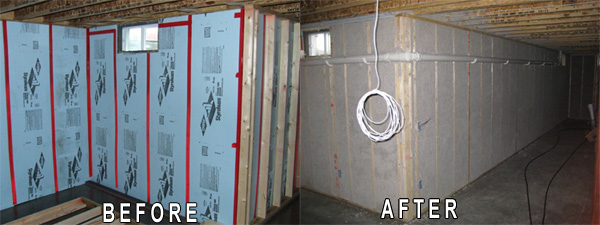
I get so many emails and questions about how to properly insulate a basement. For me there are really two options. Probably the best option out there is to use a closed cell spray foam insulation sprayed directly onto the concrete foundation walls and a framed stud wall. However, spray foam insulation is really expensive and depending on where you live it may be hard to find an installer. That’s why I like the approach I’ve outlined here using a combination of foam board insulation and cellulose.
How To Insulate Basement Walls
- First of all it’s very important to make sure your basement walls are structurally sound and any cracks that are present are properly sealed.
- Install a 1″ layer of polystyrene foam board insulation from the slab up to the top of concrete wall. Use an adhesive that’s rated for use with foam board. It’s also important to seal all the joints with a tape like Tyvek tape or similar.
- Frame a 2×4 wall in front of the foam board insulation. I like to install a piece of composite decking below the wood bottom plate. This ensure that if there ever is some water behind the wall that it won’t wick up into the framing and drywall.
- Hire a qualified NuWool cellulose insulation installer to use spray-in-place cellulose to fill the 2×4 framed wall.
You can see in the photo all the steps involved. The nice thing about the cellulose is it’s fire retardant and mold resistant. The foam board and taped joints help keep moisture from entering the basement from the damp cold concrete walls. Once the cellulose has dried a bit we’ll be installing a layer of gypsum board to ensure that the cellulose doesn’t fall out of the stud bays as it continues to dry.








Detailed and very helpful information. Thanks for sharing.
These info are very helpful!
But how about the ceiling insulation?
We live in 1940 house in Seattle, WA. We are building a bathroom in half-lit basement. Wondering what kind of insulation we should use for ceiling…
Since there will be water pipes, electrical cables, …etc. We prefer not to use spray-in insulation.
Thanks!
How about ceiling insulation?
We live in 1940 house, and building 2nd bathroom in half-lit basement. Wondering what kind of insulation we should install?
Since there are water pipes, electrical cables, …etc. in the area, we prefer not to use spray-form insulation…
Any advise will be appreciated!
@ Jacky – I would say fiberglass or cellulose. You can install a layer of Tyvek, cut small holes in it, blow in loose cellulose, then hang drywall.
For Jacky’s basement check out cellulose bats. They do exist, anything not to use fiberglass insulation! Nu-Wool has cellulose bats.
hope this helps,
cheers,
Todd,
I’m stumped on a few things, and I’m glad that I came across your site.
I want to frame the basement walls of my mid-1940s cape cod-style house, and so I’ve been reading books and gathering lots of information so that I can to make sure that I do it correctly. The last thing that I want going wrong is mold!
So far, I’ve painted my concrete block walls with two – three coats of waterproofing paint and a mold/mildew resistant sealer.
I’ve also installed a drycore subfloor, leaving a 1/4″ gap between the wall and the subfloor material.
The next part I’m not so sure about in regards to vapor/water barriers and insulation. In reading your posts, I have a few questions:
1) Can the polystyrene foam board be installed directly to the concrete wall?
2) Should the polystyrene foam board insulation be sealed somehow at the top and bottom?
3) After putting up the polystyrene foam board, should I still install a 6 mil plastic sheet between the foam board and studs or between the studs and drywall?
4) Should there still be a 1/2″ gap between the foam board and studs?
5) Would it be okay use a thermal guard insulation stapled to the studs instead of using a fiberglass insulation between the studs?
Any suggestions that you offer will be of great benefit, and will allow me to proceed with confidence!
(Ignore question #2 – In reading more of your posts, I found out that I should seal the tops and bottoms with “Great Stuff” or similar.)
David – Thanks for visiting the site. I hope you find it useful and bookmark it for future reference.
1. Yes – Great Stuff Pro works very well adhering it to concrete.
2. You figured this one out!
3. No – If you use a minimum of 1-1/2″ (2″ preferred) polystyrene insulation and seal it properly there’s no need for a vapor barrier.
4. Not mandatory – This is more of a concern when using 1-1/2″ foam plus fiberglass. If you go with 2″ of foam and skip the fiberglass then you can frame it tight.
5. Can you be more specific? Not sure what product you’re referring to.
Good luck!
Hi there
Thanks for a great site. I am about to start my basement insulation and finishing and your site keeps coming up in searches. I am planning to use the following method: Just want to run it past someone who knows what they are doing :-)
1. 2″ styrofoam board from Lowes using greatstuff, stick them on the walls from slab to top of the concrete wall,
2. 2″ polyiso board pieces cut and lodged in to seal rim joist, greatstuff to seal around it and at the top and bottom of the eps, eps boards joined along with a tape
3. a stud wall using 2×4 flush to the 2″ eps board on the wall.
4. vapor barrier on the floor, followed by pressure treated 1×4 to create a raised floor, osb on top, then underlayment and then laminates.
My questions are:
1. Does the bottom of the 2″ eps board need an opening or needs sealing using greatstuff?
2. Which is better – leaving an inch or two gap from the back of stud wall to the foamboard insulation or setting the stud wall flush to the foam – any advantages vs disadvantages to either?
3. Will r-10 be enough for midwest – or should I fill the stud wall bays with unfaced fiberglass or something else?
4. Any specific type of insulation to lay over the vapor barrier and below the 1×4 raised floor to help keep the feet warm?
I don’t expect a long answer. I understand you got to earn a living :-)
Great site and a lot of useful discussions here. Thanks a bunch
Thanks for visiting and finding the information here useful. Answers to your questions.
1. Typically we just “tight” fit the bottom unless there’s a large uneven gap.
2. In most situations we frame tight to the foam board, leaves more usable space in the room and helps keep the foam board in place. If the basement has a history of being wet then I’ll leave a gap.
3. This really depends on a couple things. First, in most areas the local building code now specifies a minimum insulation value, so you’ll need to check that. Secondly, heating costs are not likely to go down, only up. With that in mind, the more you insulate now, will likely pay off over time, unless you plan on moving in the near future.
4. In many situations we insulate the floor with foam as well. Check this out: http://www.homeconstructionimprovement.com/how-to-insulate-a-concrete-floor/
Good luck!
Thanks Todd.
I read differing advise on this matter. Do I set the 2×4 studwalls directly on the concrete slab or do they go on top of the false floor made of 1″ EPS+3/4″ OSB? I was under the impression you would put 2×4 stud walls on to the concrete slab and then create the false flooring on the inside space of the stud walls? However one of the articles suggested placing the studwalls on top of the flase floor. Am I missing the point somewhere?
I am sure I will come up with some bizarre questions as I proceed and thanks a bunch in advance.
I also had an idea about running pipes from several sections of the cavity between studwall and the foam board – to a utility and hacking up a dehumidifier to run constantly. I have a 1/3rd of basement already finished by previous owners and they have used studwall and faced fiberglass in the bays – done by a contractor apparently! That’s why the wacky idea above.
Thanks
You can do it either way with regard to the walls. It really doesn’t matter in my opinion. Good luck.
Thanks Todd.
one more question that forgot to ask – my basement walls are dry but you can never have dry enough basement walls right.
Is there any mileage in coating the entire basement walls and possibly floors with water sealant stuff you can get in lowes and HD?
Thanks again
Honestly, the cost compared to the benefit is small in my opinion. Having said that, if you’ve got the money and time, it can’t hurt.
If the benefit isn’t much I wouldn’t worry. I went to see the XPS [owens corning 2″ 250 board] in the HD/Lowes and I can see what you mean by the barrier. Thanks again
Hi Todd:
Thank you for all the great information you have been so kind to give. I now have completed my basement walls with 1.5 inches of Dow Board Rigid Insulation, have installed my stud walls with insulation leaving a space between the foam board and studs and am about to install my drywall. My question is: How far away do I cut the bottom sheets of drywall from the floor? I thought I read somewhere (perhaps on your site) that 2″ from the floor to the bottom of the drywall. It seems to me that I would require really wide bottom trim boards to do this. What’s your opinion? Thank you so very much and good luck with all your future indeavours.
Don – Thanks for the kind words.
It’s definitely a good idea to leave the drywall up off the floor. Typically I see it done three ways. Many take the easy route and sit the drywall on the slab (which I don’t think is a great detail in a basement), or they sit it on a board while installing it and then remove it. Some guys use a piece of 3/4″ wood and some will use a 2×4 (1-1/2″). In either situation, most standard baseboard details will easily cover it. This helps prevent any wicking of water/moisture that may be on the slab. good luck.
Todd
we have a brand new home. The basement has 2″ SM under the concrete, the walls have tar paper on the poured concrete walls, blu wood 2×4 frame stepped out with R20 fibreglass and then super 6 vapour barrier.
Would it be worth my while to rip out the install and put in foam behind the studs then replace the fibre glass? Should the vapour barrier go back?
Thanks
Jim – I’ll answer it the way I would for my own family and friends. What you have there will likely end with mold/mildew at some point. Will it happen this year? Maybe…maybe not. Unfortunately I see this detail so often and it’s so frustrating to see money spent on details that we know result in unhealthy environments.
If it were my home I’d replace it properly. Obviously it comes at a cost. Wish I had better advice for you. Good luck.
Todd neglected to mention that the poured foundation was sealed with tar then Delta MS installed with the top sealed against the foundation, would this be helpful with moisture control?
Not sure I understand the detail…possible to email me a picture? todd “at” frontstepsmedia “dot” com
Sorry again Todd, that was the exterior of the poured foundation that was tarred then Delta MS ( brown) dimpled foundation wrap plastic membrane sealed at the top full height from weepers to backfill height prior to backfill. Similar product as superseal dimpled membrane
Ok, that’s great for the outside to help keep “flowing” water from the foundation, and to help keep it down and directed to the foundation drains. But that does nothing to stop the water vapor issue on the inside. Still need to insulate the interior with a proper system.
Sorry Todd that was the foundation exterior, similar product to superseal system from weepers to above back fill
Todd, awesome info on this site, and you’re saving me from making some big mistakes! I have a couple questions. Just had interior drain tile installed. I really like the idea of doing the foam board to insulate, but how would you recommend doing the bottom? The drain tile is designed to capture any future wall seepage in channels. If I put the foam board to the floor, I’m afraid it negates that feature, but maybe I’m wrong. Thoughts?
Next question is I have some plumbing lines and a staircase running right along the walls. Could I leave that stuff in place, cut the board around it and then fill those areas in with spray foam (great stuff)?
Finally, my basement is English style, then a sill plate ties into a balloon frame home (built 1938). How should I frame up the walls after insulating the concrete? Can I run the studs floor to ceiling, flush against the foam board but a couple inches then away from the existing framed wall? Or is that an issue for moisture build-up?
Nick – The water can still run behind the foam and out the bottom to the drain. You should not foam the bottom edge.
Typically the foam will be butted up against pipes and sealed with spray foam unless you want to relocate all of them.
Run your foam up the foundation and back across the top tight to the sill plate. Then frame your wall tight to the foam and run up past the jog. This leaves an air space which is fine.
Good luck.
Insulating our walk out basement in Northwest Arkansas. Annual precipitation is under 46″. R-Value Climate Zone Chart for Wall, Attics, and Floors is 4. We have 15 inch thick concrete slab from 1962 (don’t ask me why) so there is never any dampness from the floor. There was pooling water thru the underground north walls. We put in a french drain in the front of the house and that didn’t work so we did it again and waterproofed the exterior where it was underground. After heavy rains and flooding in the area we live in, that resulted in a couple of 2’x 2′ areas of moisture at the bottom of our north walls, but no standing water. So that was a big improvement! We then patched up walls with concrete sealer and applied 2 coats Super Thoroseal to waterproof the inside northern underground walls. Since then, even with heavy extended rains, it is very dry. You can smell the difference! For cost reasons and toxicity reasons we decided to use cellulose for ceilings AND walls. We were going to use spray foam for walls, but $3300 expensive! And our framing is 2″x 2″ on walls, so to do 1″ spray foam and cellulose would not work I think. We also used Super Thoroseal on west exposed exterior wall as we found them damp after extended rain, but that will be covered up by Novabrik (stacking brick that ventilates) soon. Their website http://www.novabrik.com/html/en_stage/accueil/index.php3?flash=2. So we don’t foresee any problems. It is $1400 to do it all in cellulose. Oh, ANNND we are using Jetboard drywall on all the northern underground walls and bathroom too! http://www.jet-board.com/products/jetboard/ We feel pretty secure and safe with our choices but wanted your opinion. My concern is the exposed south wall in the summer with some humidity. It will be covered in Novabrik. We could also paint the exterior south wall with Super Thoroseal if you think that would be a good idea. I read that cellulose is good at managing moisture. Thank you much!
Without being there to really evaluate the entire system it’s hard to say. I’m not a huge fan of finishing a basement that has a history of water. Especially when the solution is using damp proofing coatings like Thoroseal. Coatings usually fail over time…and when that happens you’re back to a problem. Wish I could say more..but it’s too complicated from afar. Good luck.
Thank you for allowing you a few questions …. I insular ye read my basement that I get better installed directly to the wall first block polystyrene board and then make 2×4 framing and finally fill all that cellulose …. you recommend me … thank you … your advice is useful to solve moisture problems ……. NOTE —- DO yOU THINK THAT tHE BEST WOULD bE INSTALLED XPS POLYSTYRENE BOARD 2 “R- 10?
thahk MR. TODD
Can I use the blown in cellulose for my exterior basement walls or do I have to coat it with something?