


Laundry Room Sewer Smell Solved – Plumbing Trap

Sewer Smell – Washing Machine Plumbing Trap Problem
Recently a good friend of mine asked me what might be causing his laundry room to have a sewer smell. Obviously this was a serious problem that needed to be corrected immediately. Not only are sewer gasses an unpleasant experience but they can be a safety concern. If you smell sewer gasses in your home you should try and diagnose the problem sooner than later.
 I started quizzing my friend about any recent changes in their home that might have contributed to the sewer smell. He asked me if washing machine mold might be causing the smell or some type of dead rodent.
He wasn’t sure that anything had changed other than they had recently purchased a new washing machine. I knew there was likely something wrong with the plumbing trap (p-trap) which was accounting for the sewer gas smell.
The culprit ended up being the washing machine hose that was incorrectly installed by the appliance delivery guys. Read on to see what happened!
Plumbing P-Traps
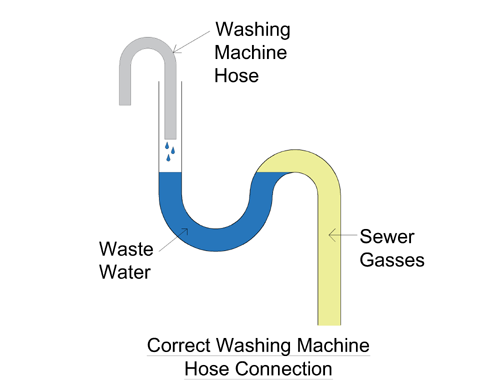
Plumbing traps (p-traps) create a trap in the drain pipes which retain a small amount of drain water which in turn creates a water seal to prevent sewer gasses from entering the living space of buildings. Traps come in several different configurations but they all work the same way by trapping water in the pipe to seal out the sewer gasses. Traps are present for all sinks, showers, toilets and drains (such as washing machine drains).
Typical Washing Machine Drain Connections
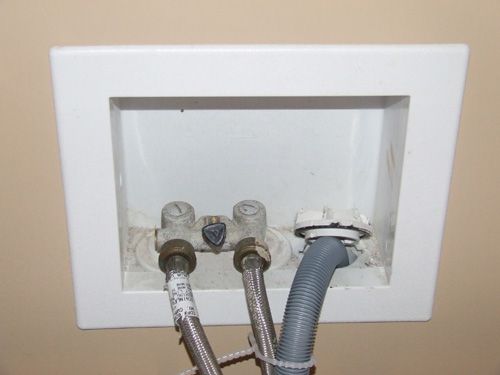 Today most washing machines come supplied with a flexible, corrugated plastic drain hose. The hose is easily inserted into a standard washing machine drain box (see photo). The washing machine drain box is hooked up to the houses waste piping that contains a P-Trap inside the wall (or exposed in older homes).
With this set-up waste water comes out of the plastic washing machine hose and empties into the drain box pipe. The waste water fills the trap below and creates a seal that prevents the sewer smell (gasses) from entering the home. See the next diagram for a typical washing machine drain set-up.
 In-Correct Washing Machine Drain Hose Set-Up
The following diagram shows what happened at my friends house. The delivery guys from the appliance company delivered the new washing machine and hooked it up. The ended up pushing the flexible plastic washing machine drain hose into the drain box and past the P-Trap.
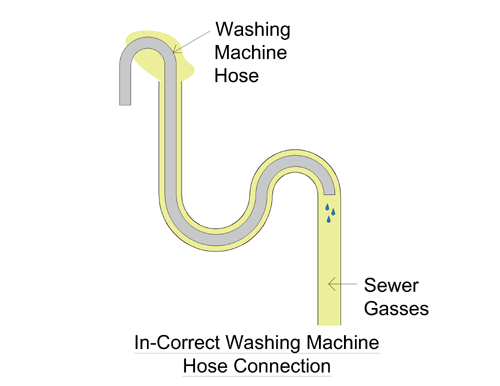 As you can see in this diagram the flexible washing machine drain hose prevented waste water from filling the trap. This allowed the sewer gasses to pass around the house and trap and into the house. To fix this problem all he had to do was pull the washing machine drain hose out of the drain box until it was only inside by about 8 inches or so.
Obviously this was a rare situation and one that I’m still scratching my head about. For the life of me I can’t figure out what the delivery guys were trying to do. However, this just shows you how important the plumbing trap is and how it works.










Did you have to pull it back to stop getting the smell? We have same issue for a while. The smell comes and goes. The cloths does npt smell but we get it often…specially early in the morning and when we come back home from out side.
Shohana – The hose should only be inside the drain tube a few inches as shown in the sketch. If the end of the hose is touching the trap water it’s too far.
Todd,
I need some advice.
I too have the sewer(septic tank in my case)odor.
My house is a view-out with the washer on the main floor.
I have a sump pump in my basement with a floor drain about a foot away from it for the a/c and water heater.
When we do laundry and the machine cycles it’s water out you can
see water rise in the floor drain and it spills over into the sump pump.
I had the septic tank cleaned out last month thinking that would take care of the odor, but it hasn’t.
What do you think?
P-trap?
clogged vent pipe?
sewer line clogged (under basement floor)?-the clean out just outside the house is not clogged.
Please help-the wife is getting upset.
Thanks,
Jim
Seems as though something isn’t vented properly or the hydraulic grade (height) of the floor drain is very close to the level of sewage in the tank. You really should get a licensed plumber (other than who built the place) to come look at it.
Thank you for posting about the drain trap/septic issue. I got a new washing machine a month ago and noticed the smell immediately after it had been installed. After reading your post, I checked the drain pipe. Sure enough. It had been shoved all of the way down the drain. Problem solved immediately and the smell miraculously disappeared. You saved me a visit from a plumber. Thank you!
Don’t forget the drain pan beneath your washer. The trap will dry up if you don’t pour water in the pan a couple times a year. Hopefully it never gets used but it often gets forgotten.
After checking everything, the smell still came and went. After 2 years and reading a lot of posts.
I poured water in the floor drain and have never had a problem since.
I have a similar problem, but my “drain smell” only seems to happen when I do a load of laundry after a few days. Then it goes away until I let it sit for a while again. As long as I use my washer a few times a day, no smell, otherwise the next time i have a horrid smell in my laundry area. Could this be something similar>
Absolutely. Do you have a drain hose on the back that goes into a washing drain in the wall? Did you check to see how far the hose goes into the wall drain?
I have the same problem except I can smell the sewer gas bad when I have the washer running and the a/c unit on. Coud this be something different?
It’s likely that they are related. I would certainly check the drain hose first. See if that is the problem. It might be that your A/C system is creating negative air pressure that’s sucking the sewer gas out of the trap.
We just bought a new house and we have an oder pretty bad from our washer drain. My washer hose is only in about an inch because it had a guard to keep it from going in too far. I have used rid-x, bleach and drano type cleaers with no luck. Our house was custom built by the original owner. How do we find out if there is even a p-trap hose installed? Is it even possible for a house to be built within the past 8 years to not have a p-trap?
Brandy – You can figure it out with an inspection camera. Most plumbers today have a very small camera that’s attached to a long snake like flexible rod. They should be able to put it in the drain and very quickly determine if a trap exists. Sure sounds like you don’t have one. You should get this looked at ASAP as it could be a serious health concern.
I have a hose leaving my washing machine that fits into an L shaped piece of Pvc pipe. The Pvc pipe then leads to a drain on the floor and sits loosely on top of the drain. We are having the same smell you describe here. So bad so I can’t sleep at the moment. Please help! I think I need a more airtight piping…I know very little plumbing but its the holidays and I can’t get my husband to do anything about it even if it weren’t
First of all if the pipes are loose and sewer gas is getting into your home it’s a serious health hazard. If you or your husband can’t fix it you really need to call a plumber. Washing machines MUST be drained into a trap and water tight plumbing.
Hi Todd,
I have a drainage problem, but no oder. My HE washing machine pumps up about 7 feet to the main house line going to septic. From the main line I have a p-trap and a vent, and they both seem to work fine. The problem I am having, is (grey) water is back-flushing into the machine when the spin cycle stops. This is the water that is still in the hose and doesn’t make it to the discharge drain. It makes sense that this would happen, however, the manufacturer says it can be as high as 10 feet (max). My question is why doesn’t it work? The manufacturer will not hold to their printed claim, and I have now tried everything to fix it. I have extended the flex hose to leave a large trap below the washer line; I have added in a check valve, and nothing has worked. Now I have removed everything and decided to drain into the shower. The problem I am having now is water is being suctioned back to the washing machine because there is no vent in the line to the shower. Please offer a solution or something to try. My next trail is to instal a PVC Y with the machine’s flex pipe going into it, the other end venting up, and then connecting to the 1″ flex pipe to the shower, which in theory should have a p-trap installed.
Thoughts???? Wife is about to pull her hair out and scalp me I think!!
Dave
Dave – While most manufactures say they can pump a certain amount of vertical head the reality is that never works well AT ALL. In fact, in some jurisdictions the code requires that you dump the water into a sump and pump it up to the sewer. Honestly, if you want to get it done right, create peace in your home, it’ time to get a licensed plumber out to look at it. Wish I had better advice but these type of situations really do require a professional. Good luck!
A drain box was installed in our new laundry room.
I just discovered there is not a trap in the drain
line. Instead of cutting the pipe and installing a
trap,is there a way to seal the washing machine hose
where it enters the drain box?
Thanks,
Jim
NO! The gases could still enter the washing machine. Did a licensed plumber install that? It needs to be corrected immediately as it’s a big health risk. Traps are one of the VERY most important features in all drain lines.
Thanks for the article. What you described is exactly the problem I had (down to the installers of our new washer being the guilty party).
I pulled those back….problem solved!
John – Glad you found the article helpful. I sure hope you’ll consider signing up for our Newsletter or sharing the article on social media. We sure could use the help and exposure.
Thank you so much! I could never pinpoint the location or cause of the mysterious smell that started the day our new washing machines arrived. I thought it might have been related to our water softener, which drains right into the same drain pipe. You just solved my household mystery.
Good evening Todd,
I’m installing a new tub and tub surround. I’m changing the hot n cold water pipes which are Copper to Pex tubing (shark bite fittings etc) my question is concerning grounding. I believe my pipes are grounded, so when taking a shower if lightening strikes it is redirected. When I change it to Pex then how can I ground it? Can I add a tracer wire, or is there something else I can do. Appreciate any advice. Safety is a number one concern to me.
Thanks,
Karen A-G
I’m not plumber, but I can tell you that I’ve never seen a ground wire installed in the new homes we build that use PEX piping. The only time we see one is a tub with a motor (hot tub, soaking tub, etc). You can certainly check with your local building code official or a local plumber to confirm this.
I have a problem with my washer drain. It seems to be a drain problem but I can’t really identify it. The drain pipe is allowing water to spill out at the beginning of the drain cycle through the holes in the rubber gasket at the top of the drain pipe (standpipe). We opened the clean-out to allow water to drain to the outside. Nothing comes out the clean-out. It doesn’t act like a blockage exactly but it certainly isn’t draining properly. My floor is going to be ruined if this continues. What else can I try?
Sounds like a venting issue.
We have three bathrooms with showers/tubs. When I use one of the showers in the upstairs bathroom, I notice the odor which was mentioned coming from the laundry room. I do not notice it as strong when we do any laundry. Any ideas on why the odor is so strong when this one bathroom shower is being used?
Most likely there is poor venting at the washer drain or the trap is being siphoned out. Sounds like a job for a plumber to evaluate. Good luck.
Thanks Todd… after reading more of the other questions/answers, we also noticed that we had the drain hose installed to far down into the pipe. We pulled it back and re-inserted it about 6″, and I didn’t notice the smell in the laundry room this morning after my shower. We will keep an eye on it. Thank You!
Hi Todd! I have the same sewer smell issue. Im not doing any home improvement but i did recently purchase a new he washer and dryer a few months ago. I started to notice a sewer smell when i would use my washer but not only that when it was not in use, the smell would be stronger. Now we could smell the sewer smell from our shower drains and most recently the kitchen sink! I have a septic system. We purchased our home 3 years ago and we were first time homebuyers. We don’t know anything about this. I understand you are not a plumber but any advice you can give, would be greatly appreciated! Thank you!
Did you at least check to see that the washer drain hose isn’t too far into the drain? It’s also possible that when the washer is draining, if the venting for that branch isn’t proper, that the drain water is siphoning the other traps dry, letting gas release from the other drains. You may need to get a plumber involved.Typically, this type of issue has nothing to do with the fact that you’re on a septic.
We moved our laundry room from first floor to basement. Was fine for a few years. Then we started noticing an egg/sulfur smell when doing laundry – but only where old laundry room used to be (now pantry). Nowhere else in house, not even new laundry room.
We now had new leech field installed with filter system(old system had no filter)
Now we are getting a septic smell in pantry. Again no where else but old laundry room.
It is only slight while using water for showers, dishwasher, sink, etc. but very stinky when doing laundry. Someone suggested old laundry room pipe was not capped or perhaps something with old drain.
Can you advise. Could this small be from old pipe left in wall in old laundry room that was not sealed off right
Thanks
Susan
Susan – That’s exactly what the problem is. If that laundry drain wasn’t capped, you’ll get sewer gases out of it because there’s no water going down it to fill the trap. This should be a very simple fix. It’s important that it be taken care of soon as sewer gases can be dangerous. Good luck.
Hi
We moved into a brand new house. We have a lower level laundry room floor pipe that has a horrible sewer gas smell. Our washer and dryer and on the upstairs level so nothing is connected here. In the laundry room, there is a closet that also has the sump pump and ejector pit. We had a guest stay with us and I noticed a foul smell. (Poop smell!) I looked down that drain and I swore I saw poop! What is it? Did the builder do something wrong?
I poured bleach and water down it. Also pine sol. All I smell is pine sol and it’s been 3 weeks. Any clue as to how we can elimate this could smell? Thanks!
Tricia – You need to call a plumber and have them inspect the situation. Couple of possibilities, could be just a dry drain, if you’re not using that drain, and there’s no water, the trap can’t “trap” sewer gases. But there’s also a possibility that there isn’t a trap installed. It’s really best to call a plumber.
need help myself if anyone can help washing machine drains with in seconds drain box over flows.One time could smell sewer.Even ran washer drain hoes into kichen sink but that to started to back its getting old watching machine so it doesnt back up
Sounds like a poor venting situation and not the issue we’ve pointed out in this article.
I have the weird odor that comes and goes in my laundry room too! We only bought our home about 2.5 years ago and it’s a newer home. When we moved in we purchased brand new HE front load washer and dryer. I never used to get a smell in there until about year ago. It’s not all the time, it comes and goes. We have a main floor laundry room, and I always keep the window in there a little bit open just incase. But we have checked the drain hose, and we have pulled it out and reinstalled it even. We can’t figure out why this keeps happening. Is there something else that it could be?
Many front loaders get mold build up inside the door gaskets, might just be odor from the machine.
On Saturday we started getting a sewer like smell, in our laundry room, and half bath upstairs. This smell cannot be smelled in our full bath which is on the main level with laundry room. Any Suggestions? I have checked the washing machine for the P trap which is there, and the washing machine hose is not too fare into in the pipe it drains into. I am stumped with the smelling coming from laundry and one bath but not the other. :/
It could be that one of the traps in each of those rooms is being sucked dry due to siphon action. I would make sure that each of the traps in each room is full of water (run water in sink, shower, tub, pour some down washer drain). Then systematically have one person stay in that room while you flush a toilet (most likely toilet causing this) in another location. Listen to the drains, you may here one of them being sucked out (water leaving the trap) due to the flush in another location. This would hint at a vent pipe that’s not working properly. At that point it may be time for a plumber. Good luck.
Hi Todd
We have a smell that comes and goes near the door frame of our main floor washroom’
We have checked that all drains drain properly and all p-pipes have water in them! We also checked the venting system and there are no cracks! what else could it be?? We have been in this house 3 years and this just started happening about a month ago! Please help!!
Cinzia
Not sure….sometimes dead rodents, things of that nature.
New construction and brand new appliances, so i am hopefully ruling out excessive lint, mold, rodents, etc. I have a similar sewer smell with the washing machine, but not everytime. We get the smell with the washing machine but also if someone is showering upstairs. I checked the drain hose like your example in this article and it was pushed in a full 24 inches into the drain hole on the wall. How far down the wall is the trap usually built? The tip of the drain hose was damp. Does that mean it was sitting in the P Trap? If the hose is sitting within the trap, will it displace the water that normally sits there?
Thank you for this website. It is very helpful for amateur do-it-yourself’ers
If the tip was wet it was most likely too far in. The trap is usually 12-18″ down, but could be less. The house should only be in a short distance.
Same basic issue of sewer gas smell around laudry and some sinks. Is it possible that a grinder/ejection pump could push too hard and cause sewerage to back up past a trap somewhere? The pump ejects up to the main line heading to septic, but just a few feet before the laudry drain tie-in.
Don’t want to be to premature butttttt. Followed this & discovered the drain hose was about 4 feet down drain & well past p-trap. Still doing laundry. No bad smells !!!!!!!! THANKS SO MUCH.
Joe – This is a fairly common problem…glad I could help.
Our sulfer smell only comes from the washer, no where else. Only when the cold water cycle is in use. someone told me to run the washer and see if I could see water inside my shower drains, if so that is normal. I did not see any water in my shower drains. both were dry. My washer drain hose is only installed 2-3 inches.
sulfur smell from the start of clothes washer, recently we installed a water softener and ran that drain into our sewer line. Could we have a vent issue? All traps have water, I’m at a loss here.
Certainly possible…how was the drain installed?
I am having a problem with the sewer smell occurring after a washing load is completed about 10 min into the dryer starting. Started happening after we upgraded to a large HE front loader washer and dryer. Some times a very faint smell and other times overpowering. I have tried to sniff out where the smell is coming from and can’t pinpoint it. I am suspecting the issue is with the dryer creating an air pressure issue and sucking sewer gas out. But how do I fix this?
Do I have to change my 1 1/8″ standpipe to a 2″ diameter pipe to connect a new washing machine with a 1″ drain hose? I am on a septic system
Have smell from washing machine
Drain goes directly into slop sink which has a trap
The wife is convinced that we need a pea trap installed
Please advise
It’s likely the “stink” of the water that’s coating the sink. I’d plumb that into a drain directly.
Not only a smell, but when i went to pull the hose out of the drain in the wall there was black muck all over it, I’m scared! Do you know what this could be??
It’s likely soap scum. How far down was the hose? if it was too far then it was bi-passing the trap.
My laundry room smells horrible in the summer. We have a drain on the wall and one on the floor. I can’t figure out where the smell is coming from. We’ve dumped water and bleach down both drains and the smell comes right back. There is no smell in the colder months. What could be wrong with it?
Certainly possible that even if traps were installed they are being “sucked” out by a bad plumbing design. Probably time to call a plumber so they can look at it.
We have a front load washer in the upstairs and a old school washer down in the basement. When we do laundry upstairs (in front load washer), sometimes the downstairs utility room smells. The washer is directly above this utility room where all our water heater, AC, furnace etc are. The other washer is also in this room. My husband says he has checked the hose and its fine.
Sounds like a bad vent installation, the lower one is likely “sucking” the trap dry in the one above. Likely time to call a plumber. Good luck.
So we suddenly have a smell coming from behind the washer as well. We did have a pipe that burst outside- lightning struck it and we had no running water for about 24 hours. Even after the pipe was replaced, the pipe line was then clogged from the dirt. We now have water but we still don’t have hot water because our water heater coil busted when the water stopped running. Any suggestions on if this is all related and what we need to do to get rid of the smell?
Unfortunately I do not. I’d HIGHLY recommend getting a plumber involved. Good luck.
Hello….same smell when doing laundry….washer drains into the utility tub which drains into a sump pump. What could the problem be in this case?
If it’s draining into a sump pump the question is do you have a trap between the utility sink and the sump pump? Is the sump pump sealed in a chamber?
Todd,
We are experiencing the same type odor around our washing machine. It shifts from faint to strong. In looking at my p-trap, the gray plastic hose is attached to the hot water hose with both electrical tape and a zip tie, so I don’t think the plastic hose has moved deeper into the trap. We have been in our home for two years, and the smell was first noticed a few days ago. Any ideas?
Not sure…i’d remove the drain hose and re-install it…maybe it has moved, maybe it was really close to the trap before and it settled lower.
Todd,
We recently moved our washing machine upstairs. The construction crew did not put in a p-trap and it smelled bad. They came back today and put in a p-trap and I have a photo of the work that I would like to get your input on to see if this is good work. How can I share the photo with you?
Thank you for the advice. Worked like a charm. Very helpful
Will a ptrap work without a vent … your diagram does not show a vent . I am actually going to run my discharge to a sealed sump pit 12 feet away and the standpipe is 5 feet higher than the sump so gravity will drain the hose the hose easily … do I still need a vent as there is nothing else hooked up to this drain
Need a vent or studervent
Make sure you check the seal on the lid to your grinder pump pit. I was driving my self crazy trying to figure out was causing the smell when I did laundry. Finally I checked the seal on the lid and could feel air coming from the edge of the lid.
We are getting a strong foul smell coming into the house when we turn the furnace on. The smell only comes when heat kicks on. I called local gas company thought there was a gas leak. The check everything out and no leak. We do have on going problem with Washer drain it gets clogged real bad or something else wrong this is a on going problem for over a year. We have call plumber every three to four months to unclog. So we just stop using the washer. By reading other comments could the smell be coming from the drain? If so why only when furnace kicks on we smell it? Then it goes away and then comes back when kick on again. I go in laundry room it real strong then goes away when furnace kick off.I pour a cup of bleach water down washer drain did not help.
wanted to add to my question we are not using washer the hose it not in drain pipe and laundry room off of garage and kitchen. Furnace is in garage.The smell comes when heat kick on and then goes away but like a mention is stronger in the laundry does comes in living room vents.
Tina – It’s hard to say. My gut feeling is the sewer gasses are venting somehow into the garage, when the furnace (I’m assuming forced air) comes on, it blows it into the house.
Hi Todd. We are having a cold snap here in Montana. Daytime temps in the minus teens. Started to get strong sewer odor from basement laundry room. Chased it down to complete ice capping on sewer stack vents (all 3 of them). They are all on the NW side of home (no direct winter sunlight). I’ve deiced them 3 times this past week. Currently trying copper tees (without much success). Local plumbers say there’s not much that can be done other than climb on roof and dump hot water down them. To add to the mystery, while drying clothes I went outside and noticed steam coming from one of the stacks as well as the dedicated dryer vent on side of the home. Climbed on icy roof again and it was laudry smell (downy dryer sheets) coming from that stack. Could the dryer hose somehow be tied to the sewer vent? I’m starting to think that I’m going to be removing a lot of drywall in my future. House is only 5 years old. Did not happen in the past.
Jeff – VERY interesting….I’ve never heard of this before…but that sure does seem strange! I’ve never heard of a vent stack icing before…simply not enough moisture in my opinion…now if a dryer was connected that’s entirely different story…someone has some explaining to do!!!
I have been trying to figure this out for weeks now. Thank you so much!!
i also just had a new washer installed. my problem is when the washer starts to drain the water doesn’t go down the waste water pipe!! it goes down in the very beginning (for 4 seconds) then just backs up and overflows out the pipe! i had no issue before with my old washer. i pulled back the washer hose but it still overflows! whats going on!!!?????
Either not sufficient venting or possibly a plugged drain.
Hi Todd, I am getting sewer gas through the bathroom sink whenever the washing machine is in the drain cycle. It will bubble up through. It seems like the sink trap has no water in it, but how would that happen
The sink in question is in the same room as laundry and the sink is the last drain on the way out. Waste water from the machine has to pass by it
Sounds like the washer drain is siphoning the sink trap….you’ll need a plumber to evaluate I believe. Good luck.
I have a problem with stinky laundry, drains and the smell outside when we take showers or do laundry. Even the neighbors can smell it. It is that bad.
Hello,
I had a bad odor in my downstairs laundry room. Now the odor moved into my kitchen, which I upstairs. I have a septic system and a dry well connected to the laundry.
I just had the spectic pumped out, as I do every year.
The smell will come back, I am convinced.
Any suggestions?
I just had a plumber visit my home for this very issue. After little to no observation, he deducted that the smell MUST be coming from my washer. His solution? Run a few empty loads of bleach water, clean the front-load rubber seals, etc. etc. Obviously, I had already tried ALL OF THAT or I wouldn’t have called a “professional.” He left after 5 minutes, having done NOTHING (because there wasn’t technically a stoppage). After much frustration, I took to the internet and ran across this article (praise sweet baby Jesus). I pulled the drain line out a bit. I could actually see discoloration on the plastic line where it had been inserted too far by the movers (I had noticed the smell since moving into our new home). THANK YOU for this article. It has solved the mystery!
I have a sewer gas problem coming from my washer machine.
I think maybe the washer in the spin and rinse cycle is causing the p-trap to become vacant of water and so the smell. if I leave the washer 1/2 full of water, the smell goes away.
could this be my only solution, after all those plumbers are very expensive.
Thanks for the tip. Followed your advise and it fixed BOTH the odor problem as well as the gurgling sound the pipe made when someone flushed the toilet. It seems that we had a long drain hose and the installer that it would look better if they shoved the excess hose down the hole. Thanks again..
I have the same smell problem when we run our washer. The hose is only sitting about 3-4 inches in the vent on the wall. We see no leaks under crawl space. The mud room/ laundry room smells and the michigan basement. Should we check the vent on the roof?
There is also a gurgle in the bathroom sink or tub or kitchen sink or laundry area. That is with the washer or dishwasher. Smell more with the washer.
Sounds like you may have a bad vent..or lack of proper venting.
Since the washer drain pipe is in the same exact shape as the PVC P-trap it fits into, why wouldn’t water be trapped in the washer drain pipe to contain the sewer gases further down the system, just like it would if the washer drain pipe did not extend into the existing P-trap? Water and gravity doesn’t care what it is in. If the washer drain pipe creates a P-trap profile inside the existing P-trap, the system will work just as well as if the washer drain pipe was too short to extend into the existing P-trap.
The sewer gases get around the outside of the washer drain hose. The PVC doesn’t have water in it when the hose drains past the trap. This is very common and easily fixed.
Recently, I’ve noticed a surfer odor coming from the pipe next to my washer and dryer hook ups. It seems to get worse at night. I don’t have a washer and dryer, just the hook ups. I had maintenance look at it and they said that the pipe is not connected to anything sewage related but they noted that it does connect to the drain line with the down stairs apartment. They noted that the neighbors just got a washer and dryer and noted that the washer and dryer hook ups haven’t been used in a while which might explain the odor but I really don’t think this explanation makes sense. Would you be able to add anything to this or clarify?
Most likely because you’re not using the hookups they p-trap is dry and therefore sewer gas is coming out of it. That should be fixed as it can be dangerous.
I had that awful sewage smell after we got a new front loader. I thought it was the machine and was smelling all around, it seemed to be coming from the drain pipe so I pulled out the drain hose and it was way down in there. I read this post pulled it out and poured some water down the drain and the smell went away in minutes. Thanks for the easy fix.
Todd,
We are having a sewer smell ever so often inside n sometimes outside been in same house going on 3 years n now the odors start during laundry n dishwasher guess we might need a plumber or does that septic need pumped
regardless of whether your septic needs to be pumped, you should never get sewer gas unless the venting isn’t working correctly. Time for a plumber if it’s not this simple hose issue.
Hi Todd. We have lived in this house for 15 years. The discharge hose from the washer is set up for the discharged water to go into the laundry tub. The original owners had it set up that way as well. It’s also been this way. Once we purchased an HE washer we now get this same strong sewer smell. The hose opening on the wall is empty. I was told I could put a screw-type ari-type cover over the opening or pour water down the hole and that would fix the problem. The repair man was concerned about putting the discharge hose down the hole thinking there could be a good reason the original homeowners did not set it up that way. Do you believe any of his suggestions will work? Thanks.
if I had to guess (I hate doing that) I have a feeling the drain in the wall wasn’t able to keep up with the volume of water during the spin cycle, so they put it in the wash basin to allow a slower drain and not leak all over the place. I’ve seen this in older homes that have undersized drains or poor venting.
Thanks Todd. So do you believe adding water to the open trap or fully sealing it up are good ideas?
adding water will work…but it will dry out….sealing it should work, unless it somehow makes the venting less effective
I have the same problem that is listed here but do you have any idea why I would only smell it when I come home and turn the air conditioner on? I have verified that the smell is not coming from the AC. It’s definitely coming from the laundry room and it very quickly permeates the entire house. Thank you!
Any chance the condensate line from the AC is plumbed into that drain?
OMG, this is exactly what we’ve been experiencing and it probably started after we got a new front loader a few years ago. We only noticed the smell when the washer was running and it was really only noticeable months ago. I found this article and just checked, sure enough, the installers has shoved the drain pipe way down there, and then zip-tied it to the water inlet hose just to make extra special sure it wasn’t going anywhere. I cut the zip tie and pulled the hose up and as I did, I could hear water draining out of the bottom of the pipe. Additionally, the end of the pipe was just caked with all kinds of unpleasantness. I had to pull out over a foot of hose to get to the caked-on part. Cut the end off and put it back in just a few inches and zip-tied it again just to be sure :)
THANKS for this post and guidance.
Why did the installers shove the line all the way in? Because the homeowners insisted that no extra line remain outside the drain. Some people are THAT obsessive.
Hi Todd, thanknyou for this helpful post. I live on a first floor of an apartment and have been getting sewer smell. When checking the drain pipe I hear water running down the drain. It sounds like it’scoming from the upstairs tenant? If so what can I do to fix it?
Sounds like the trap isn’t full, or one doesn’t exist, otherwise you wouldn’t hear that water running.
Todd – Here is situation. Last November septic collapsed and “dirty water” backed into washing machine until we could get new septic a week later. Now with new hookup the water is turning “dirty” still with the nasty sewer smell on almost every load. It finally hit me that maybe the drain pipe is too far in the stand pipe…sure enough – shoved all the way into water. Has our washer been siphoning the sewer water in or is it possible there is still sewage in the tub between outer and inside tub? I just did a load with drain pipe pulled up – water AND laundry were pristine! Thanks.
Quite possible water was backing up. Glad things are better now.
Thanks for sharing! Not only helped but I also learned something new :-)
I noticed sewer like smell from washer , but also after wash load was done you could smell it on towels just washed! Yuck! It’s not continuously doing this. But also recently installed new toilet in guest bathroom not far from laundry room that intermittently also has weak to strong sewer smell, is there any connection between the too having this smell, or coincidence?
I’d have a plumber come investigate
I have had the same foul odor for several years. Finally after trying everything I had read to do, I was ready to MOVE! My husband and I sat down and tried to remember exactly when this started. Long story short, it was when we bought our first High Efficiency washing machine. So we took the thing out and put an older machine in. NO MORE ODOR!!!!!!!!!! My advice to anyone with this wretched problem is to go back to the old fashion machine that ACTUALLY cleans your clothes with real water. The HE machine was not using enough water to keep the trap full. My clothes are now clean and NO ODOR!
We have the same problem with our HE Whirlpool Washer. We get the sewer smell after the clothes finish washing and the tub drains. I don’t know if replacing the washer is our plan but I would like to find a solution if anyone knows what we can do.
Sounds like the draining process is siphoning the trap empty, allowing sewer gas to escape. I’d discuss with a plumber.
Thanks for your post. This fixed my issue!
Same smell coming from washer drain. The hose has not been touched in months and all the sudden it is starting to smell. Is it normal for that to happen? Will try to pull hose out more to see if helps!
I have had a sewer smell in my laundry room for months. I had two plumbers come and they don’t know why it smells either. I have a breeze coming up through the hole wear you put the washer hole and I can smell that this is where the smell is coming from but my hose is only in a few inches. Should there be a breeze coming up that hole and why does it smell?
Sounds like you do NOT have a trap in that drain line would be my guess. Either that or the trap is being siphoned dry…either way plumbers should be able to scope that drain and know for sure. Time for a better plumber :)
The exact same thing happened when our brand new washer & dryer was installed, we couldn’t figure out why it smelled I checked the hose last night & it was shoved in too far, I put it back in only about 8 inches & the smell disappeared! Thank you!!!
we get an awful smell when doing laundry sometimes it happens when washer is almost done or done and sometimes It does this when we turn the dryer on. the laundry room is upstairs AND basically in the kitchen sometimes it is horrible and sometimes its not as bad. it seems the smell comes from the sink and the bath in the laundry room. I have no idea and we have been dealing with this for years. I have told my landlord and he does not seem to care, even told him that it is a health risk and he said only if its in large amounts of gas so I really don’t know what to do. I have done a lot of research trying to figure it out my self but nothing helps. do you have any ideas that I can try. Our washer hose was pretty far in the drain pipe so I did pull it out some but I just cant imagine that would make the sink and bath smell. Any advice would be much appreciated thank you.
ps we just bought brand new Samsung washer and dryer so its not due to old washer and dryer. we have had about 4 sets of old ones because of this problem but decided to buy new incase that was the problem. Obviously that has not helped
All I can say is it’s likely a bad venting situation, something a plumber needs to fix.
I have the same sewer smell problem, but my drain hose is definitely pulled out away from the p-trap. The washer is in the same room as the furnace, which you mentioned might be causing negative pressure to draw in gas, but the smell doesn’t seem to be very strong near the top of the drain pipe where the hose is inserted. I checked the drain pump filter and it’s clean. Could there be some compartment in the bottom of the washer that’s trapping gases or trapping old water? Any other ideas? Plumber was no help so might need to find another plumber.
If it’s sewer gas, then you’ve got a venting problem and it will likely take a plumber to solve. If it’s a musty smell, then that’s your washer.
My mother moved into an older mobile home that she hired someone to remodel for her. When I visit, I have noticed a sewer smell that comes and goes. At first I was worried that it was a gas leak, but that was tested and it’s not the case.
1. There do not seem to be any really pressing drainage problems, but I notice that sometimes if you flush the toilet twice in a row that you will hear a loud noise in the shower (but no water ever comes up into it).
2. Sometimes the toilet won’t flush if the washer (which is located in bathroom) is on the spin/drain cycle.
3.There actually was a half bath in the mobile home that was removed when the home was remodeled.
Any idea what we should look at first as the possible cause of the smell?
Sounds like there isn’t sufficient venting for the plumbing….maybe when they removed the old 1/2 bath they took out a required plumbing vent.
My laundry was built inside the bathroom on the main floor. It close up like a cloth cabinets. I found the smell come out after using the washer few days. I hired a licence plumber to check and he found the washer hose hooked in the vent pipe , the bad smell comes out around the hose. He glued all around the washer hose. The smell get improved but I found still a bit smelly.
SOunds like the venting isn’t working properly. You could drain in a vent, but it needs a trap, if it doesn’t then it’s never going to stop the smell.
My issue sounds a little different than what I’ve read so far. I replaced my washing machine thinking it was the front loader that was smelling but that isn’t it. The smell comes from the vertical drain in the wall behind the machine and only when I use real hot water. I’ve had a plumber out and he cleaned the “trap” and that helped for a couple weeks but now it’s back. Is there something I can do? I’ve tried pouring boiling water and bleach down the drain. It isn’t clogged.
Nothing in that trap should smell….does it smell like sewer gas? if so…the trap isn’t working properly.
Thanks for posting this! I have one minor quibble and that is about the “correct” picture. The picture features an S-trap which violates code AND allows water to be siphoned from the trap, allowing sewer gases to come up. If people are getting sewer gases and they have an S-trap, that may be the problem.
I’ve also since been told that in the past 5 years the code was changed to require a check valve on the water supply lines to prevent backflow. I wonder if any of the people here were having backflow issues.
Thanks for sharing Zach!
This has been very helpful thanks for positing. Like most, I didnt have any issues and then i had a new washer installed and i got this sewer smell when i use the washing machine. It happens “most” of the time, sometimes strong then others.
I checked the hose, its only in there a couple inches down, do i don’t believe that is the issue. driving me crazy because it worked fine before the new washer was installed.
Any thoughts?
Thank you so much! This is the first page that came up when I googled. This turned out to be my exact problem. My husband and a friend installed our washer and lately it has been smelling terrible. After reading your info we went to check and sure enough the tube was wayyy down there. We cut it down to have just a few inches in and ran an empty load through the washer and everything is perfect! It is rare to solve a problem so quickly, so I am very pleased.
And, the Peter Griffin image is perfect.
HI– we have the same rotten egg smell from our Samsung he washer discharge that most of the above posts mention. However, our drain line does not discharge into a house sewer line–it discharges into a utility sink and drains from there. The sink drain has no odor– and the washer discharge produces no odor except during the first load of our weekly washing routine. Since the problem cannot be migration of sewer gases up from a sewer line. what could be causing the problem? As info, there is no odor in or around the washer gasket, and the smell occurs despite the use of Clorox washer cleaner in the “tub clean” selection of washer settings. I am thinking that there must be somewhere inside the washer where residual wash water is stagnating between weekly wash routines, but do not know where to look, and am hoping others have found and solved a similar problem. Thanks
You are the only one that I could find on the internet that explained this simple trick. I pulled mine out about four inches, heard the water gurgling and no more smell after that. So thankful for this article.
Hey Todd!
I had a weird situation I started to notice awhile back similar to this one. I was getting a sewage smell from my toilet in my downstairs basement bathroom, but not from the shower or sink. It’s stronger sometimes than others, but it never fully goes away. I’ve noticed if I put Drain-O or cleaner down the drain it seems to go away for a bit but always comes back.
We had a plumber come and check it out and he found the toilet was not bolted down to the ground properly and was not sealed, so he put some new wax rings on the toilet and bolted it back to the ground to seal it up but that did not fix the problem. The plumber came back and seemed to think that the smell was coming from our washer/dryer room (they are in different rooms but the back of the washer faces the back of the toilet/shower) and somehow the smell was coming back through the toilet so we re-filled one of the traps in that room near the water heater.
I don’t notice any strong odors coming from that room, and pulled the washer hose up a bit to try and make sure the trap is being filled, but the odor still comes through the toilet only.
Could this be because the S-trap on my toilet itself is broken? Its an older toilet (2001), but I don’t notice any leaks from the toilet or anything. How would I check for this, and how could I check to see if its coming from my laundry room after all? I’m willing to try anything, just hoping to get this solved and crossing my fingers that its not a major issue!
Brendan
I would love advice!
A friend installed a new washer for us a couple of years ago, but the past year or so we’ve been getting that horrible septic smell in our basement (washer drains into slop sink). I was reading through your advice, so decided to try pulling the drain tube out a bit to see if it was put in too far, but I have a big question. I don’t see any kind of”box” like everyone is speaking of. Will try to attach a photo that shows what the tube leaving my washer looks like. Just the washer drain tube going into a heavier black rubber tube with two metal zip tie looking things securing it. Should I try pulling out the washer tube a bit, or do I have the wrong set up to begin with?
Hi there! Love this thread. I have an older ranch style home on the side of a hill. We have lived here for about 9 years. We have started noticing the sewer smell when we do laundry…only started in the last few months. We have just had our septic pumped and will need new lateral lines. However, having just done this…I started laundry today and as soon as I started the water the septic smell started. It was at the very beginning of the wash cycle. No new appliances and nothing has changed….ideas?
Probably has to do with the vent line, no trap. Time for a plumber unfortunately.
I’m having a sewage smell coming from my washing machine drain when it rains the drain is on the wall behind the washer please help
Sounds like bad venting, time to call a plumber if the tip in this article wasn’t the issue.
Every time I was clothes I notice water running down my driveway. So I started looking and the water is coming from the side of my house. I don’t see any drains or hoses or nothing. Now today I came home from work, my husband had washed a load of clothes, I noticed water all on the floor from the machine. What could it be?
Probably a plugged drain….so the water is coming over the top of the drain and running down the walls.
I started noticing the gas smell after I cut my drain hose shorter thinking that would solve my washer bad odor. Soon as I cut the drain hose shorter the gas smell started. Do I need to replace the drain hose to make it back long to resolve this gas smell?
yes
I had a new home built with a second floor laundry room. The builder was lazy and shoddy, many problems with the house. No drain pan installed.
A plumber wants to install and plumb a drain pan through a hole he’ll make in the floor. No drywall repair or little will be needed. He says they developed a product that coats the pipes, dries (inside the trap as a barrier?), and keeps the sewer smell out. He said I’d only smell sewer if there was an actual leak. The problem is I often splash water over the sides of my 30+ year old washing machine, pushing a large comforter into the washing machine, for example. I don’t want to be making emergency calls to the plumber every time I splash water onto the tray. He also wants to install an alarm which would put me in double panic.
Would I be better off just having a pan with a pipe out the side of my house. Note: the washing machine is heavy and, when off balance, wobbles during the spin cycle…so I don’t want to jar any seals loose with either option. I would never let my builder do this work but at least I could splash a little on the pan without worrying about sewer smell.
Thoughts?
New construction and appliances. Utility room one end of house bathroom opposite end septic tank just outside bathroom wall. I usually wash laundry at night and put them in the dryer the following morning. When the dryer runs I get a strong sewer oder in the bathroom coming from the sink and base of the toilet but not the shower drain. If I keep the utility door shut this doesn’t happen. my suggestions?
New construction and appliances. Utility room one end of house bathroom opposite end septic tank just outside bathroom wall. I usually wash laundry at night and put them in the dryer the following morning. When the dryer runs I get a strong sewer oder in the bathroom coming from the sink and base of the toilet but not the shower drain. If I keep the utility door shut this doesn’t happen. Any suggestions?
I have the same problem at the I copied this from didn’t see a reply so I’ll try again. we have the same rotten egg smell from our Samsung he washer discharge that most of the above posts mention. it discharges into a utility sink and drains from there. The sink drain has no odor– and the washer discharge produces no odor except during the first load of our weekly washing routine. Since the problem cannot be migration of sewer gases up from a sewer line. what could be causing the problem? As info, there is no odor in or around the washer gasket, and the smell occurs despite the use of Clorox washer cleaner in the “tub clean” selection of washer settings. I am thinking that there must be somewhere inside the washer where residual wash water is stagnating between weekly wash routines, but do not know where to look, and am hoping others have found and solved a similar problem. Should I just change the hose?
The problem is when the washer sits all week the water left in the machine (hoses) gets stank….then you run it and that nasty water dumps into the sink (versus directly into a drain like most washers) and you smell it. Only way to fix that is hard piping the drain.
Todd,
Can’t THANK YOU enough!! You are a hero! Pulled back the washing machine drain hose and waalaa!! You saved the day!! Really much more than that!?
We moved into our home last have talked to our builder multiple times about the sewage smell that comes and goes, permeating from the laundry room (first floor). It seems to occur after someone has used the first floor toilet. We have tried pulling the washer hose up from the drain, pouring bleach down the drains, but the only short term solution we have found is doing a load of laundry with hot water. Please let us know your thoughts. Plumber returns next week. Thank you for any help you may be able to provide.
Thank you so much for this!
We have a new mobile home and have been plagued by this from the start!!
Thank you so much for taking the time to share. ❤️❤️❤️
Last month I have this terrible smell coming out of the washbasin of my toilette which is near the laundry room, every time I use the washing machine. I used chemicals but it came back. What could possibly went wrong and that happened now?
Hi! I have checked the drain pipe and it is installed correctly. The smell seems to be coming from the tub and gets worse if I jostle the machine around. The machine is new and I run the cleaning cycle every month. It is not a mildew smell like our old front loader (never again). Any thoughts? Once I run a load it goes away…then returns.
Todd
I have lived in my house for 38 years a ranch style. It started last summer started getting sewer smell form drain in my laundry room. when fall and winter came did not have this smell at all. Now its hot weather again and the smell is back. I have the same washer top loader for 6 years, I had a new hot water tank install in 2018. Nothing else different in the laundry room I’ve pour water down the drain and bleach and it comes right back. I have called the city and plumber. It seems like nobody has a answer. I’ve never had to happen before.
If nothing has changed it may be the washer, if it’s a frontloader (if), they are famous for foul odors when water gets trapped in door seals. But it could also be a plugged plumbing vent as well. The laundry is one of the few sealed plumbing connections, it has a water trap, but if that trap goes dry, or gets siphoned dry it will let sewer gasses in.
Two years ago i purchased a mobile home and was told that the pipes had frozen up and broke and all had been repaired. I noticed at that time a faint egg smell. Being a first time home buyer, I figured it would go away. Well the smell is still with me and my trailer in fact it’s worse. It seems to be coming from my laundry/bathroom through the washer water outlet. I checked the hose and it’s fine. I put baking soda and then vinegar down the hose/pipe and it smells better for about 24 hours and then it’s back. The smell comes and goes. i had a so called plumber out and he said it was a small pipe that my gutters drain into. I don’t think so. Help… you have any ideas?
DJ
If you’re running it into a gutter pipe that’s a problem. Time for a better plumber.
Hi Todd! I have sewer smell coming through my laundry room sink. The previous owners have the laundry room in the basement and we moved upstairs where it was intended to be. The old pipe in the basement wasn’t cap, but I do pour Clorox and water down the line. Recently the smell is getting stronger from where the laundry tub is. Any other ideas? I smelled the basement pipe and it smells like Clorox. Not sure what el it could be. I had a plumber tell me that the drain vent pipe is probably not clogged in the roof because we don’t have a lot of trees around our house.
Sounds like where you installed the new sink, it’s not properly vented. Time for another plumber to look at it.
I also have started getting a sewer smell after doing a load of laundry. My washer drains into my laundry tub sink, so no dry p trap problem. I have lived here for 25 yrs and never had a problem before. I do have a floor drain in the laundry room, so I suppose the smell could be coming from there but I’ve never had this problem before.
Hi Todd,
We recently moved into home and shortly after moving in I noticed that every time we used the master shower we would have a strong sewer gas smell for days and we use the shower daily but if we didn’t use it for a couple of days it would subside. The shower is on the other side of the laundry room and I have had a licensed plumber come out twice and they ran a line through the shower drain and said that would do it and also asked that we use a drain cleaner regularly. The odor went away for about 2 months and it returned so I immediately used the drain cleaner and it subsided in the master shower but now it is very strong in the laundry room when first start using the washer. I have checked the drain hose behind the washer and it is only in about 6 inches but there is a loop in the extra length of drain hose behind the washer. Is that a problem? Also this could be related we have a built in spa that was here when we bought the home and someone at some point placed a drain next to the equipment for use when backwashing, this was a very poorly done drain that you normally use in a French drain in the yard type. It would overflow with minimal water when used so the pool service guys never used it and suggested we call a plumber and have its capped. The same plumber came out and tried to run camera to make sure that it was connected directly to the main drain before we got rid of it and had a concrete slab poured over it, he could never get far with the camera and told us it was safe to pour the concrete over it. He capped that drain so we did in fact pour concrete over it. This drain was only about 10 to 12 feet from the clean out behind our home and the clean out is also surrounded in concrete slab which is part of our driveway. Not sure if this is all connected to our sewer gas odor or not. I know how dangerous these smells can be to our health. I am frustrated and don’t know what to do now. We are praying we don’t have to tear out our concrete to get this resolved but fear we may have to do so. Your advise would be much appreciated.
We have a front loading washer and we leave the door open all the time when the washer is not in use. I also wipe the gasket often so I’m sure we don’t have a mold problem inside the machine. However, we do have a moldy smell coming from the machine every so often. I just removed the drain hose from the drain box and the inside of the hose is covered in mold. Why would this be?
Good Morning – we just had a new house built. Everything is great, but after it rains for a bit we smell sewage coming out of the laundry room. It doesn’t come out anywhere else except that room. Any thoughts?
Todd – great link! Thank you so much for the great advice.
Can you tell me is there any way to simply seal the connection between the tube and the pipe?
I have this sewer smell/fumes issue coming from both my laundry room and behind my dishwasher in the kitchen. The house is pretty new (about 6 months) and the same smell was coming from the pipes before the sinks were installed. It is just after starting coming from my laundry room and dishwasher in the past few weeks however… anyone have any idea?
Thanks for the great explanation. I was reading other articles , but none of them were as good as the one you did. Thanks again!!
Thank you so much for posting this helpful hint about sewer smells.. I take care of my mom who is in hospice. Not much money to go around for a plumber. I read your post and tried it on a new washer and it WORKED!! No smell of sewer in the house anymore!!! We really need a washer and I was afraid of so many other things that was causing that smell. I really appreciate your help, it was a life saver!!!
Hi Todd,
I have read most of the comments here and feel like I have a similar issue. My washer drain in the utility area goes into a circular hard plastic hose installed on the floor. Just moved into this house. The previous owners said the smell was only there if you did not run a wash cycle for days but not on a daily basis. Its bad right now even after running a wash cycle. I dont know if it has a P-trap installed underneath the floor. Anything you suggest I can do ? If I tape the opening with gas block tape, it reduces the smell but does not eliminate it.
The smell was coming out of garbage disposal in kitchen- cleaned with vinegar, baking soda and ice- cleared the smell. Now (immediately) the smell is coming from laundry room (washer and utility sink) is something going on from kitchen to laundry room ((appx 20’)?
Thanks for helping on this subject.
My utility sink is drained with a p-trap just above the washer with a trap into a single sewer pipe straight down. This seems wrong and I feel like it would create a siphon emptying the p-trap for the utility sink.
Should the sink and the washer be draining separately to a lateral?
Oh man, we have been living with this smell for months and have been sick on and off. If it is as simple as too much line down the drain, I will be extremely happy, embarrassed, and a bit angry as I put the washer and dryer in myself. Thank you for the illustrations and information!
Wow! This is amazing and it worked for me. I have searched everywhere and know one mentioned that drain hose causes an issue and I even paid a guy to look at it but not use.
Hi Todd! Just came upon this thread and hope you can assist 🙏 we just moved into a rental house with brand new LG washer and dryer. We have had the rotten eggs odor since day 1. Landlord has had the line snacked, raised the roof vent but yet the odor returned. The smell occurs shortly after starting laundry. The washer hose is just sitting down the drain by 2 inches. Plumbing is behind the wall. I can check for a ptrap by using the rope method but I’m baffled! Thank you for your help
More than likely the drain is sucking the trap dry. Has to be sewer gas. Time for a plumber.
Thank you!
I suspected it had to be the P-trap, because the smell would go away after running the washer AND if I simply poured water down the hole that the washer tube was inserted into.
I checked google for common issues and saw this page and, lo and behold the “professionals” who delivered my washer had stuffed the hose all the way into the sewer, apparently. Well not quite, but it was several feet into the drain hole.
My washer was delivered and installed by Nebraska Furniture Mart, and you can bet I’ll be contacting them about training their delivery personnel on this.