


Spray-In-Place Cellulose Insulation

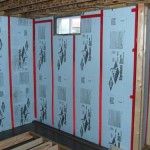
 Here are some more photos showing the spray-in-place cellulose wall insulation that’s being installed in the Energy Star home we’re building for a client. Installing cellulose spray-in-place insulation is a very effective way of insulating a home and almost completely stopping air infiltration.
As you can see in these photos the wall cavities between studs are completely packed tight with cellulose insulation. If you look closely you can see electrical outlet boxes that are covered with blue painters tape. The insulation is completely packed around each box to prevent any cold drafty spots.
The insulation crew finished up the house today. The house is 2350 sq ft on the main level, 800 sq ft for the garage and another 2350 sq ft in the basement. It took two crews only two days to air seal all the framing members and install the spray-in-place cellulose insulation.
It took the crew another day and a half to install the cellulose attic insulation. So in less than a week this house has been completely insulated including the garage and basement.
Overall spray-in-place cellulose insulation costs about 20% to 30% more than traditional fiberglass batt insulation. However, I’ve seen first hand how well the cellulose insulation performs especially when it comes to air infiltration and a blower door test. So it’s very likely that spray-in-place cellulose insulation will pay for itself in less than five years.
For this particular house it’s an important component of the Energy Star certification. I think it would be very difficult to meet the Energy Star guidelines by using traditional fiberglass insulation due to the poor air infiltration properties.
I just built a new home myself two years ago and I used fiberglass. If I had known about this product I certainly would have used it. But the real proof is in the performance. We’ve built four homes now with cellulose insulation and each of the owners are reporting significantly lower heating/cooling operating costs compared to similar homes built with fiberglass.









Is it possible to use the wet cellulose in existing walls by cutting a hole and blowing the insulation into the hole like traditional blown cellulose or must the walls be fully open?
@ Ian – Actually I was just talking to the superintendent for the insulation company yesterday about this. You can in fact inject wet cellulose into the cavity with fiberglass. The fiberglass get’s compressed so that there is room for the cellulose. Not sure how well it works but they say they’ve done it.
I have a house project with a concrete floor and a 2′ crawl space above it. steel frame and wood sub floor. can this product be sprayed in this situation? also can I diy or would a contractor have to apply this? its about 700 sq’. thank
@ Matt – Not exactly sure what your situation looks like….are you wanting to do the walls or floor? It’s not much of a DIY product.
Question about moisture. My brother had wet cellulose installed in at a home he is building. After it was up, drywall went up. When the drywall installer was done (mud and tape has not yet been installed) he noticed some wet spots on the drywall. He is concerned the cellulose was not given time to adequately dry, and moisture will affect the drywall and any mud and tape he will install, and possibly future paint.
My question is, do you know of a moisture meter that could be stuck through the drywall into the cellulose to see the moisture content? And if it is still wet, can the moisture pass through the drywall without hurting the drywall?
Thanks for any information.
Chris – Wet sprayed cellulose can be a very good insulation. However, it’s very important that the installers follow industry standards. There are some installers using as much as 5 gallons of water per 30 lbs of insulation which is much higher than the recommended 1.5 to 2.0 gallons per 30 lbs. Having said that it’s possible that either your situation was too wet (didn’t allow proper drying time) before drywall and/or the insulation had too much water to begin with.
Not really sure what moisture meter to use, I would remove a sheet of drywall and inspect the insulation, find out how wet it really is.
a contractor has recently built drywall with fiberglass insulation in the basement, the house was built in 1928 and is in New York City (standard detached single family). i decided to cut out some drywall and inspect the foundation wall after detecting some slight mold, the wall is cold and damp so i know this will surely lead to more mold! i also noticed that the wood studs are about 2 inches away from the foundation so i was thinking to try this.
1 – cut out some drywall at each framed section
2 – remove the fiberglass insulation
3 – have nu wool cellulose spray foam sprayed inside
will this work? will it stop the moisture from getting to the drywall and prevent mold? i am trying to figure out the best way to combat the old foundation wall made from cinder blocks without excavation all around the house or demolishing my finished basement.
(the current mold is more likely from a backflow from the toilet and not the foundation wall, the fiberglass and wood studs do not show any mold, YET!)
i also found this online which they say to never spray foam your underground foundation, do you agree with their statement below?
you never know who to trust online…
“The foundation of a below-grade crawlspace is almost always susceptible to water and moisture intrusion from groundwater. So what, you might ask? Well, Spray foam insulation traps water and moisture in the block wall or between the wall and the foam. This moisture has nowhere to go but UP, especially since a building’s air movement is upwards (Stack Effect). Up above the foundation is a sill plate, floor joist, bandboard, and subfloor. These are all wood components that are susceptible to wood rot and mold growth when the moisture content in the wood rises.
I don’t agree, especially if the top, exterior portion of the foundation is exposed. Please see the references in my previous comment.
The only method that I would promote is removing all the drywall, all the fiberglass and using a foam product. You REALLY need to create a vapor barrier to prevent moisture that’s in the foundation wall from entering the finished wall cavity. You should read these articles:
http://www.homeconstructionimprovement.com/how-to-insulate-basement-walls/
http://www.homeconstructionimprovement.com/vapor-barriers-for-basement-insulation/
Cutting a whole in the drywall won’t allow you to get a uniform application of any spray product.
I have just had the cellulose sprayed in my home. No drywall set up yet. It has been 3 days since contractors have installed the insulation. I am noticing wet spots in certain areas (some under windows and some in random areas). My question is would wet areas be normal in places? Building is 100’x48′ and I have noticed about four to five 3′ spots where the insulation is still wet. Thanks
Andy – Depending on the humidity level in there this is quite common. It’s important to get it as dry as possible..fans and dehumidifiers help.